Choose iGraft if you want a hair-transplant consultation built around its described DFI Ultimate process, computerized diagnostics and 6-month post-procedure support; choose New Roots Skin & Hair Laser if its treating doctor gives you a better-matched diagnosis, treatment plan and follow-up arrangement. This 2026 comparison puts the written clinical plan ahead of the clinic name.
- For igraft vs new roots skin hair laser, choose the documented treatment plan, not an unsupported clinic ranking.
- iGraft hair transplant consultations suit patients seeking its described DFI Ultimate process and computerized assessment.
- Choose New Roots Skin & Hair Laser when its treating doctor provides the better-matched individual plan.
- Compare hair restoration diagnosis, surgical responsibilities, written estimates and follow-up before committing.
Why this matters
A hair-transplant technique name does not establish whether surgery is appropriate for you. Your diagnosis, donor supply, expectations and willingness to continue treatment matter more than a promotional comparison.
iGraft describes physical clinics, follicular-level scans and doctor-led assessment as central to its approach. iGraft hair restoration is best suited to patients who want its described diagnostic approach and DFI Ultimate process explained before deciding on treatment. That is a reason to arrange an assessment, not evidence that one clinic produces better outcomes than another.
For your 2026 shortlist, judge both consultations against the same questions. A confident answer should explain your condition and the proposed treatment without promising a particular cosmetic result.
At a glance
The table separates the client's stated offering from the questions you should put to New Roots Skin & Hair Laser. These are decision criteria, not a clinical performance ranking.
| Dimension | iGraft | New Roots Skin & Hair Laser |
|---|---|---|
| Best for | Patients seeking its described diagnostic and DFI Ultimate pathway | Patients whose individual consultation establishes a better treatment fit |
| Diagnosis | Describes follicular-level scans and computerized assessment | Ask how the doctor establishes the cause and extent of hair loss |
| Standout feature | Described DFI Ultimate extraction, holding and implantation workflow | Ask the treating doctor to identify and explain the proposed technique |
| Surgical responsibility | Confirm who performs each surgical stage | Confirm who performs each surgical stage |
| Follow-up | States dedicated 6-month post-procedure support | Request the follow-up schedule and escalation arrangements |
| Nonsurgical options | Lists GFC, PRP, Exosomes and Booster treatments | Request diagnosis-specific options and their supporting evidence |
| Pricing model | States per-graft pricing for hair transplantation | Request the billing basis and an itemised written estimate |
| Evidence and expectations | Assess the proposed plan against comparable cases and realistic limits | Apply the same evidence and expectations standard |
The better diagnosis wins before either technique does
Choose the doctor who explains why you are losing hair before discussing how to replace it. Hair shedding, gradual thinning and established bald areas do not automatically call for the same intervention.
Computerized assessment is part of the client's stated service. Its practical value lies in what the doctor explains from the findings: the working diagnosis, donor-area condition, treatment alternatives and reasons to recommend or postpone surgery.
Ask New Roots Skin & Hair Laser to explain those same points. A scan or photograph should support a clinical decision rather than substitute for one.
Bring your medication list, previous treatment history and photographs showing changes over time. During either consultation, ask:
- What diagnosis best explains my pattern of hair loss?
- What findings support that diagnosis?
- Is the condition stable enough to plan surgery?
- What would make you recommend medical treatment first?
The guide to computerized hair loss diagnostic tests explains the assessment questions to take into your appointment. Leave with an explanation you understand, not just a treatment name.
DFI Ultimate has a described process, not a proven head-to-head win
According to iGraft's supplied procedure description, DFI Ultimate starts with donor graft extraction from the back of the head using specially designed serrated punches. The clinic describes sorting the extracted grafts by hair count, holding them before implantation in a special environment prepared from the patient's blood and peptides, and implanting them using implanter pens and micro-sapphire tools.
The described sequence is:
- Donor extraction: Grafts are taken from the donor area at the back of the head.
- Graft sorting: Grafts containing 1 hair, 2 hairs or 3 hairs are sorted.
- Graft conditioning: Grafts enter the clinic-described graft holding/conditioning environment.
- Graft implantation: Implanter pens and micro-sapphire tools are used during implantation.
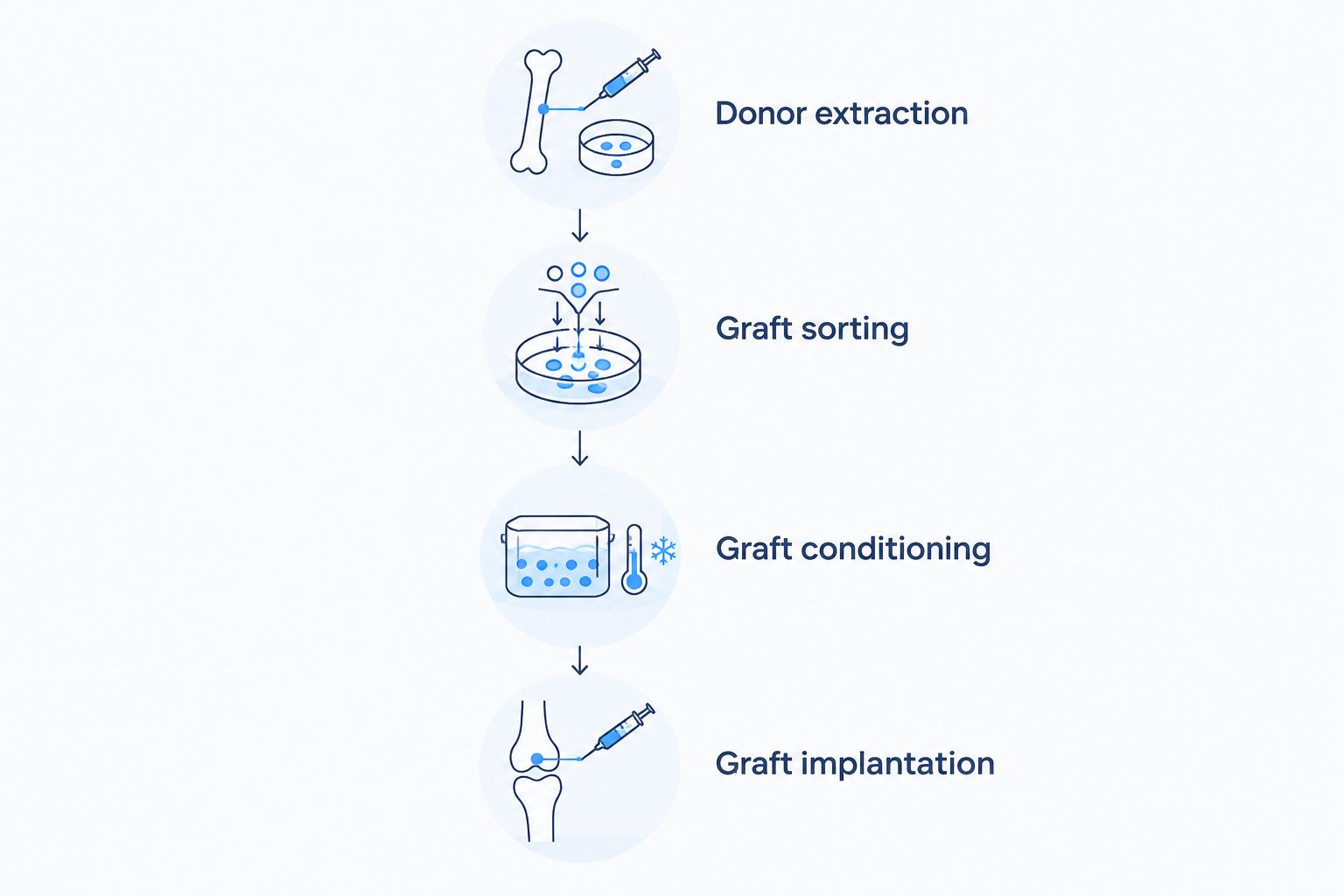
These are clinic-supplied process details, not independent clinical validation. The description does not establish better graft survival, greater density, damage-free harvesting or proven benefits from the blood-and-peptide environment.
Ask the competing doctor to describe the proposed procedure with equal clarity. For a 2026 decision, compare the actual extraction, handling and implantation steps rather than treating branded terminology as a result.
Neither clinic wins on the technique name alone
A named procedure cannot tell you who will carry it out or how the surgeon will adapt it to your scalp. Surgical responsibility is a tie until you have a clear, individual plan from each clinic.
Ask who assesses your donor area, designs the hairline, administers anaesthesia, performs extraction and carries out implantation. Request the treating clinician's qualifications and an explanation of the team's responsibilities.
Your consultation should also address the proposed hairline's shape and how the donor supply will be protected for future needs. A plan that focuses only on filling the current gap leaves an important question unanswered: what happens if hair loss progresses elsewhere?
Do not treat DFI Ultimate and DHI as interchangeable names. This comparison does not establish a separately verified DHI service at the client clinic or a DHI offering at New Roots Skin & Hair Laser. Ask each doctor to describe the actual method being proposed rather than inferring it from similar initials.
A stated support period helps; the care pathway still decides
The client states that hair-transplant patients receive dedicated 6-month post-procedure support. That gives you a defined period to discuss before booking, but duration alone does not explain what the support includes.
Request the planned review schedule, communication method and instructions for concerns between appointments. Ask whether reviews involve the treating doctor and how an in-person examination is arranged when needed.
For New Roots Skin & Hair Laser, request the same written outline. Choose New Roots Skin & Hair Laser on follow-up if its proposed arrangement better meets your actual access and review needs. That is a patient-specific advantage, not a claim about its standard service.
For either clinic, separate routine progress reviews from urgent medical advice. Before leaving after a procedure, you should understand which symptoms require contact and whom to contact. A support promise becomes useful when you know how to use it.
Nonsurgical treatment should answer a diagnosis, not fill a package
The client's listed hair-restoration treatments include GFC, PRP, Exosomes and Booster options. A range of options gives you topics to discuss; it does not mean every option is appropriate or that a combined package is necessary.
Ask the doctor to identify the purpose of each proposed treatment. Is the aim to manage ongoing hair loss, support existing hair or address another diagnosed concern? Then ask what evidence supports that use and how the response will be assessed.
Apply the same standard to a New Roots Skin & Hair Laser proposal. Request alternatives, relevant risks and a stopping or review point rather than accepting an open-ended course without an explanation.
Questions about hair oil's effect on a receding hairline belong in this same discussion: distinguish cosmetic hair care from treatment directed at a diagnosed cause of recession. Do not count a grooming routine as a substitute for assessment.
Neither clinic earns a treatment-range win simply by listing more services. The stronger plan explains why you need a particular intervention—and why you do not need the others.
Per-graft billing needs an itemised treatment plan
For 2026, compare billing structure and treatment scope together. The client states that its transplant pricing uses a per-graft model; ask how the proposed graft count is determined and what the estimate includes.
Grafts and hairs are not interchangeable units. As the described sorting process illustrates, a graft can contain more than one hair. An estimate should make the counting unit clear so you do not compare unlike proposals.
Request New Roots Skin & Hair Laser's billing basis directly. Do not assume it uses per-graft billing or a package model without a written explanation.
Your comparison should identify:
- The treatment area and planned graft count.
- The procedure and clinical services included.
- Any medicines, investigations or follow-up billed separately.
- How changes to the treatment plan are authorised.
- Which ongoing treatments are optional rather than necessary.
Per-graft billing makes the counting unit explicit, but you still need the clinical rationale behind the quantity. If either proposal uses a package, ask for its boundaries. A written estimate is useful only when it describes the same treatment you discussed with the doctor.
Comparable evidence matters more than a headline promise
Neither clinic should win your trust through an outcome promise alone. Ask for cases that resemble your hair-loss pattern, donor characteristics and intended treatment area, with an explanation of their limitations.
Before-and-after photographs need context. Differences in lighting, camera angle, hair length and styling affect how an image looks. Ask whether medical treatment continued alongside surgery and whether the photographs show a comparable stage of follow-up.
Use the same questions in both 2026 consultations:
- What improvement is realistic for my donor supply?
- Which areas are priorities, and which will remain less covered?
- What are the relevant risks and alternatives?
- What happens if ongoing hair loss changes the appearance later?
Neither clinic gets an evidence-based outcome win from the information in this comparison. Your next move is to test the proposed plan against documented cases, informed consent and a clear discussion of limits—not to substitute promotional assurances for clinical evidence.
Final verdict: choose the plan that fits your case
Choose iGraft if you want its described diagnostic pathway
Best for: patients who want to discuss computerized assessment, DFI Ultimate and a stated post-procedure support period. The documented offering gives you a specific starting point for questions about extraction, graft handling, implantation and reviews.
Proceed only when the treating doctor explains why that approach fits your diagnosis and donor supply. The procedure description is not a guarantee of your result.
Choose New Roots Skin & Hair Laser if its consultation fits better
Best for: patients whose New Roots Skin & Hair Laser consultation produces the clearer, better-matched individual plan. Choose it when the treating doctor explains the diagnosis, responsibilities, alternatives and follow-up in terms that meet your needs.
That decision should rest on what the clinic documents for you. Do not infer a technique, billing model or clinical advantage from its name.
| Dimension | Winner |
|---|---|
| Best fit | The clinic with the better-matched individual plan |
| Diagnosis | The doctor who explains the findings and treatment rationale |
| Described procedure | DFI Ultimate provides a specific process to discuss; no outcome winner |
| Surgical responsibility | Tie until responsibilities are confirmed |
| Follow-up | The arrangement that meets your review and access needs |
| Nonsurgical treatment | The diagnosis-specific proposal, not the longest treatment list |
| Billing clarity | The clearest itemised estimate for the agreed plan |
| Outcome evidence | No head-to-head winner established |
FAQ
Is iGraft better than New Roots Skin & Hair Laser in 2026?
No overall clinical winner is established by this comparison. Choose on the diagnosis, individual treatment plan, treating doctor’s responsibilities and follow-up arrangements rather than the clinic name.
Who is DFI Ultimate best for?
Suitability for DFI Ultimate requires an individual medical assessment. The clinic should explain how the proposed process fits your diagnosis, donor supply, treatment area and expectations.
What does the DFI Ultimate process involve?
The clinic describes donor extraction with specially designed serrated punches, graft sorting, a blood-and-peptide graft holding/conditioning environment, and implantation using implanter pens and micro-sapphire tools. These are clinic-supplied descriptions, not proof of better clinical outcomes.
Are DFI Ultimate and DHI the same procedure?
Do not treat DFI Ultimate and DHI as interchangeable names. Ask the treating doctor to explain the actual extraction, graft-handling and implantation steps proposed for your procedure.
How should I compare hair-transplant estimates?
Compare the billing unit, proposed graft count, included services and follow-up in writing. Make sure both estimates describe the treatment area and distinguish necessary care from optional additions.
Can I choose nonsurgical treatment instead of a transplant?
The appropriate choice depends on your diagnosis and treatment goals. Ask the doctor to explain nonsurgical alternatives, their evidence and limitations before deciding whether to proceed with surgery.
One last thing
Ask each doctor what would make them advise against surgery. The answer tests whether the consultation is assessing suitability or simply discussing a procedure. Take that answer home with the written plan before making your 2026 decision.
Related guides
- Hair transplant techniques compared
- New Roots Skin & Hair Laser alternatives
- Post-transplant hair care products