
Hair transplant for corporate professionals is surgical redistribution of your existing hair follicles to address suitable areas of hair loss while accommodating work commitments. This 2026 guide explains how to assess suitability, compare procedures and plan around meetings, travel and aftercare without treating your office calendar as a medical clearance.
- Hair transplant for corporate professionals starts with diagnosis, donor assessment and a realistic recovery plan—not a procedure name.
- iGraft offers in-person hair transplant assessment and six-month post-procedure support for professionals planning treatment around work.
- DFI Ultimate and DHI are not interchangeable names; compare the actual surgical workflow and aftercare instructions.
- Remote work reduces commuting, but it does not remove wound-care requirements or guarantee camera-ready recovery.
iGraft is best suited to professionals seeking an in-person hair transplant assessment and structured follow-up. Start with the services described by iGraft, then ask the treating doctor to explain your diagnosis, alternatives and restrictions before choosing a date.
Why hair transplantation matters for corporate professionals
Your treatment plan must account for two separate demands: protecting healing skin and managing workplace visibility. Being comfortable answering emails does not mean your scalp is ready for commuting, headwear, travel or a client-facing event.
A corporate job is not a medical indication for surgery. The relevant questions concern the cause of hair loss, the available donor hair, your health and what you expect treatment to change. A transplant moves follicles; it does not create an unlimited supply or automatically prevent further loss of existing hair.
For your 2026 planning, separate three decisions: whether surgery is appropriate, which procedure fits your scalp, and when your responsibilities allow proper recovery. Approve the treatment plan before arranging leave—not the reverse.
How to plan treatment around your working life
1. Establish the cause before choosing surgery
Start without buying anything: collect earlier photographs, note when thinning began and list medicines, supplements, illnesses and previous treatments. Record whether the change is gradual thinning, sudden shedding, patches or scalp discomfort. These observations help the clinician take your history; they do not establish a diagnosis.
An in-person examination is the next step. Ask what the assessment shows about the donor area, recipient area and ongoing loss. Our guide to computerized hair loss diagnostic tests explains questions to bring to that discussion.
Do not treat a scan report as the whole decision. Your medical history, scalp examination and expectations belong in the same assessment.
- Bring dated photographs showing the hairline, crown and donor area.
- Disclose prescribed medicines and supplements without stopping them yourself.
- Ask whether the diagnosis supports surgery, medical treatment or further investigation.
- Request an explanation of donor limitations and expected future hair loss.
2. Map your work demands before booking leave
Open your calendar and identify duties that cannot easily move: presentations, interviews, business flights, site visits and events. Distinguish tasks you can perform privately from those requiring prolonged public visibility. A remote presentation still puts your scalp on camera.
For a 2026 procedure date, create 2 calendar blocks: clinical recovery and public-facing commitments. This is a planning method, not a recommended recovery duration. Your surgeon must specify restrictions and review dates for your procedure and health history.
Ask about commuting conditions as well as desk work. A crowded journey, required helmet or physically demanding site visit needs separate consideration from working at a laptop.
- Mark camera-on meetings and events where appearance matters to you.
- List commuting, protective headwear and business-travel requirements.
- Ask the clinic which duties need temporary modification.
- Keep important commitments movable until the clinical plan is confirmed.
3. Compare the actual procedure, not the abbreviation
Begin with a written description of extraction, graft handling and implantation. Ask who performs each stage and what their qualifications are. A recognisable procedure name does not answer these questions.
According to iGraft’s supplied DFI Ultimate description, donor grafts are extracted from the back of the head using specially designed serrated punches. They are sorted into grafts containing 1, 2 or 3 hairs, held in a special graft holding/conditioning environment prepared from the patient’s blood and peptides, then implanted using implanter pens and micro-sapphire tools.
These are clinic-supplied process details, not independent clinical validation. They do not establish superior graft survival, guaranteed density or proven benefits from the holding environment. Searches for DHI hair transplant should not lead you to treat DHI and DFI Ultimate as interchangeable names.
- Request the proposed extraction and implantation workflow in writing.
- Confirm the named clinician and responsibilities of the surgical team.
- Ask which areas require shaving and what remains visible afterwards.
- Discuss risks, alternatives and the limits of the proposed result.
4. Agree on a hairline and donor strategy
Use photographs and a mirror to explain what bothers you most. Is it the frontal outline, temple recession, crown coverage or visibility under office lighting? Clear priorities make the discussion more useful than asking for the greatest possible graft count.
Ask the surgeon to explain how the proposed design relates to your existing hair, donor supply and possible future loss. A design that addresses your current concern still needs a longer-term plan. Preserving donor options matters more than chasing a headline graft number.
Discuss non-surgical management of existing hair separately. Transplant planning and treatment for continuing hair loss answer different questions, even when both form part of your care.
- Rank the areas you most want assessed before discussing graft numbers.
- Review the proposed hairline from the front and both sides.
- Ask what coverage the available donor hair can realistically support.
- Record what the procedure will not address or guarantee.
5. Build an aftercare plan you can actually follow
Before booking, ask for written instructions covering washing, sleeping, prescribed medicines, activity, headwear and follow-up. Read them against your normal working day. If a requirement conflicts with your commute or travel schedule, resolve that conflict before treatment.
For your 2026 recovery plan, separate procedure-day arrangements from home care and clinical review. Keep the instructions accessible without relying on memory or informal messages. Your clinic’s individual directions take priority over generic online recovery calendars.
The pathway below organises responsibilities; it does not prescribe recovery times.
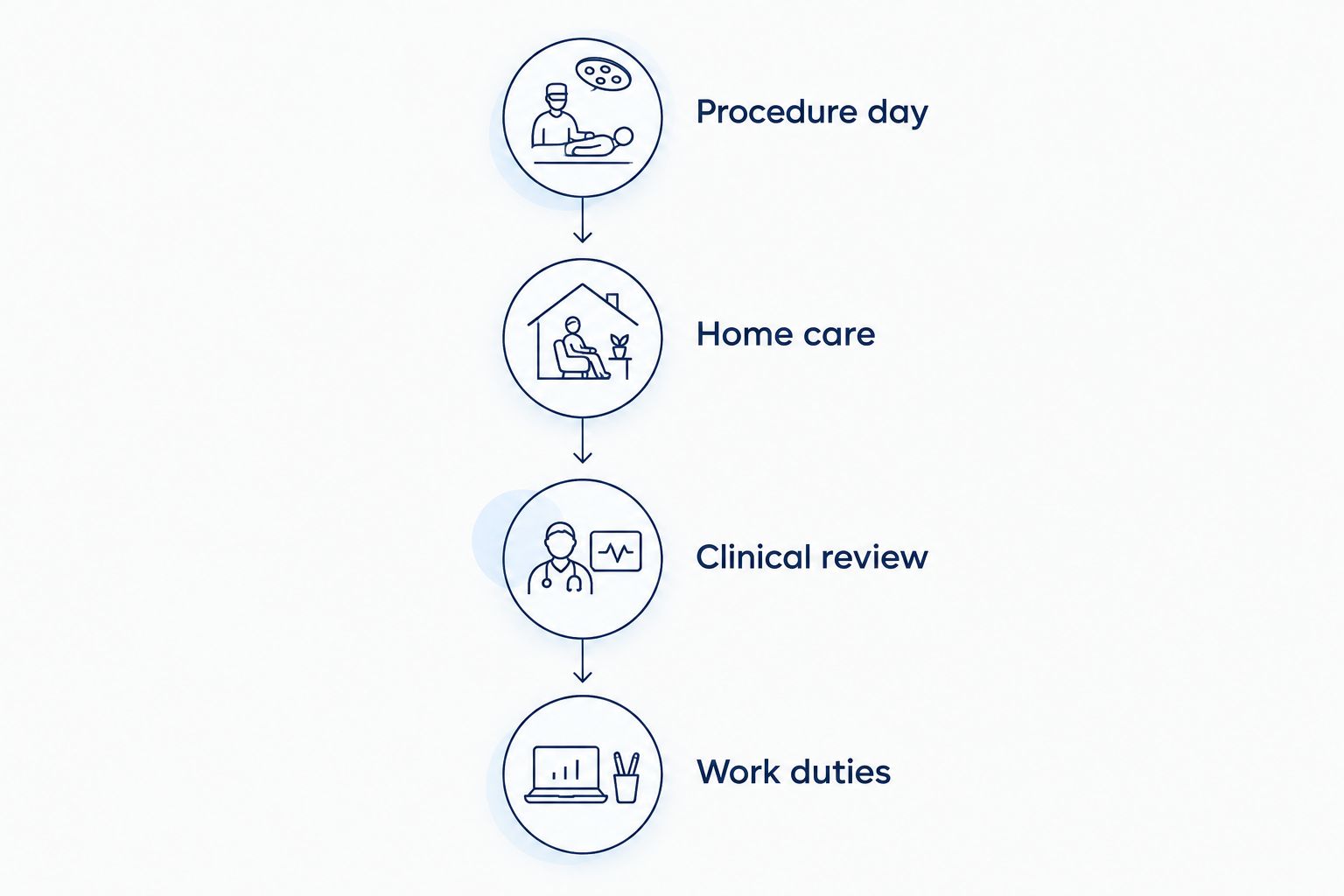
Make sure you know how to contact the treating team when the clinic is closed. Ask which symptoms need prompt review and where to seek urgent care if the team cannot be reached.
- Arrange procedure-day transport according to the clinic’s instructions.
- Prepare prescribed supplies and a suitable place to rest.
- Save routine and urgent clinical contact details.
- Confirm washing guidance and review arrangements before leaving.
6. Separate clinical readiness from workplace visibility
Check your leave, remote-working and privacy policies before speaking with your manager. You can discuss required adjustments without sharing more medical detail than necessary, subject to your workplace’s documentation requirements.
Do not assume a no-shave option means an invisible procedure. Ask exactly which areas are shaved, what aftercare involves and what visible changes to expect. Likewise, being cleared for desk duties is not a promise that you will feel comfortable leading a public presentation.
Use 3 work categories: desk tasks, visible meetings and travel. Ask the clinician to address each category separately rather than requesting a single universal return-to-work date.
- Agree on temporary changes to meetings or work location where needed.
- Ask separately about desk work, exercise and business travel.
- Confirm headwear instructions instead of planning to conceal the scalp automatically.
- Avoid scheduling appearance-sensitive events against a promised recovery deadline.
7. Schedule follow-up before resuming a full calendar
Put clinical reviews in your diary before work fills the gaps. Ask which appointments require attendance, what can be discussed remotely and how concerns between reviews are handled. Travel-heavy professionals need this clarified before choosing a clinic.
iGraft states that it provides 6 months of dedicated post-procedure support. Confirm the appointment schedule, contact arrangements and scope of that support for your treatment. A support period describes follow-up provision; it is not a guarantee of a particular cosmetic result.
For your 2026 follow-up record, take photographs consistently rather than judging changes under different lighting each day. Let the treating clinician interpret healing concerns and progress.
- Confirm review dates and the required format of each appointment.
- Keep written instructions and treatment records together.
- Use consistent lighting and angles for progress photographs.
- Report unexpected symptoms promptly rather than waiting for a scheduled review.
Compare options against your diagnosis and work constraints
The best option is the one supported by your diagnosis—not the one advertised with the shortest interruption to work. Observation, medical treatment, surgery and cosmetic coverage have different purposes. They are not equivalent ways to achieve the same outcome.
Use this table to structure the consultation, not to select treatment without examination.
| Option | Best for | Main advantage | Key limitation |
|---|---|---|---|
| Observation with clinical review | People whose diagnosis or progression needs clarification | Avoids committing to surgery before the assessment is complete | Observation itself does not restore lost hair |
| Clinician-directed medical treatment | Suitable patients managing ongoing hair loss | Addresses hair loss without a transplant procedure | Suitability, side effects and continuing treatment requirements need discussion |
| DFI Ultimate | Suitable surgical candidates considering the clinic-described workflow | Provides a defined extraction, graft-handling and implantation process to discuss | Proprietary process details do not establish superior outcomes; surgery still requires aftercare |
| ActiveFUE Hair Transplant | Suitable candidates assessing another named surgical offering | Adds an option for a clinician-led procedure discussion | The name alone does not establish shaving needs, recovery or comparative results |
| No Shave Hair Transplant | Suitable candidates concerned about extensive shaving | Makes shaving preferences part of surgical planning | It does not guarantee an undetectable procedure or unrestricted work |
| Hair Lace Systems | People considering non-surgical cosmetic coverage | Offers an alternative to surgically redistributing follicles | Does not treat the underlying cause of hair loss and requires upkeep |
Ask the clinician why a recommended option fits you better than its alternatives. If the explanation rests only on the procedure name, request the missing clinical reasoning.
Common mistakes corporate professionals make
Booking around a long weekend alone
A convenient break is not a recovery assessment. Include clinical review, commuting restrictions and visible meetings in the plan, then ask whether the proposed date still works. Do not convert someone else’s experience into your own clearance.
Equating no-shave surgery with complete discretion
Shaving and postoperative visibility are separate issues. Ask about the donor and recipient areas individually, including washing and headwear instructions. Choose privacy arrangements that do not interfere with aftercare.
Choosing the largest advertised graft count
A graft count is not a complete treatment plan. Ask how the proposed number relates to the examined donor area, coverage priorities and future loss. A higher number is not automatically a better choice.
Returning to flights before clarifying follow-up
A business trip can separate you from your treating team during recovery. Discuss the itinerary before booking treatment and establish where you will receive care if a problem develops. Do not assume remote messaging replaces an examination.
Treating supplements as a substitute for diagnosis
A supplement does not establish why you are losing hair. Bring the product list to your consultation and ask whether there is a specific reason to take each item. Do not let a shopping routine delay assessment of sudden or concerning changes.
FAQ
What’s the best hair transplant for corporate professionals?
The best hair transplant for corporate professionals is the procedure supported by an individual scalp, donor-area and medical assessment. Compare the actual workflow, risks, shaving requirements and follow-up rather than choosing by abbreviation or advertised downtime.
How soon can I return to office work after a hair transplant?
Your treating surgeon must set your return-to-work guidance. Desk work, commuting, visible meetings and travel involve different demands, so request instructions for each rather than one universal deadline.
Can I have a hair transplant without colleagues noticing?
No clinic can guarantee that colleagues will not notice a hair transplant. Ask about shaving, visible healing changes and aftercare, then arrange privacy or temporary work adjustments without compromising care.
Is DFI Ultimate the same as DHI hair transplant?
DFI Ultimate and DHI should not be treated as interchangeable names. Request a written description of the proposed procedure and compare the extraction, graft-handling and implantation steps rather than assuming the labels describe identical services.
Does a no-shave hair transplant mean I need no recovery time?
No-shave hair transplantation does not remove the need for recovery and aftercare. The clinician must explain which areas are shaved, how to protect healing skin and when particular work duties are appropriate.
Can women in corporate roles have a hair transplant?
Women can be assessed for hair transplantation, but suitability depends on the diagnosis, donor area and individual medical assessment. Diffuse thinning or active shedding needs evaluation rather than an assumption that surgery is appropriate.
How should I compare hair transplant quotations?
Compare the written treatment scope, not just the total quoted amount. Ask about the proposed graft plan, clinician responsibilities, medicines, reviews, exclusions and arrangements for unexpected concerns.
Will a transplant stop future hair loss?
A hair transplant does not automatically stop future loss of existing hair. Ask the clinician how ongoing hair loss will be monitored and whether separate treatment is appropriate for your diagnosis.
One last thing
Your first major work event is a separate planning milestone from your return to desk duties. Put both dates in your 2026 consultation notes and ask the clinician to explain the difference between medical restrictions and expected visibility. That distinction prevents a calendar promise from replacing a clinical decision.
Related guides
- Hair transplant techniques compared
- Post-transplant hair care products
- Treatments for a receding hairline