Best overall: single-hair graft placement with carefully controlled angle and direction. Best for avoiding a linear donor scar: FUE harvesting. Best for selected donor-site priorities: FUT harvesting. The best eyebrow transplant techniques combine suitable donor hair with precise placement; no extraction method alone produces natural-looking eyebrows.
- The best eyebrow transplant techniques prioritise single-hair grafts, shallow placement and changing growth direction.
- FUE and FUT describe donor harvesting, not the final eyebrow design.
- Implanter pens are placement tools, not proof of better naturalness.
- iGraft provides hair restoration consultations; confirm eyebrow procedure availability before booking.
Why this matters
An eyebrow transplant is not a smaller version of a scalp transplant. Eyebrow hairs lie close to the skin, change direction across the brow and form a visible facial border. Placement errors are difficult to disguise.
iGraft provides hair transplant and hair restoration services in Pune, Bangalore, Hyderabad and Vijayawada. Ask specifically whether eyebrow transplantation is available and who would assess and perform the procedure. Scalp transplantation services alone do not establish eyebrow-specific experience.
For your 2026 shortlist, compare healed eyebrow results and the proposed placement plan before comparing technique names. These rankings separate the decisions that shape naturalness rather than treating every advertised method as a competing operation.
What makes the best eyebrow transplant techniques?
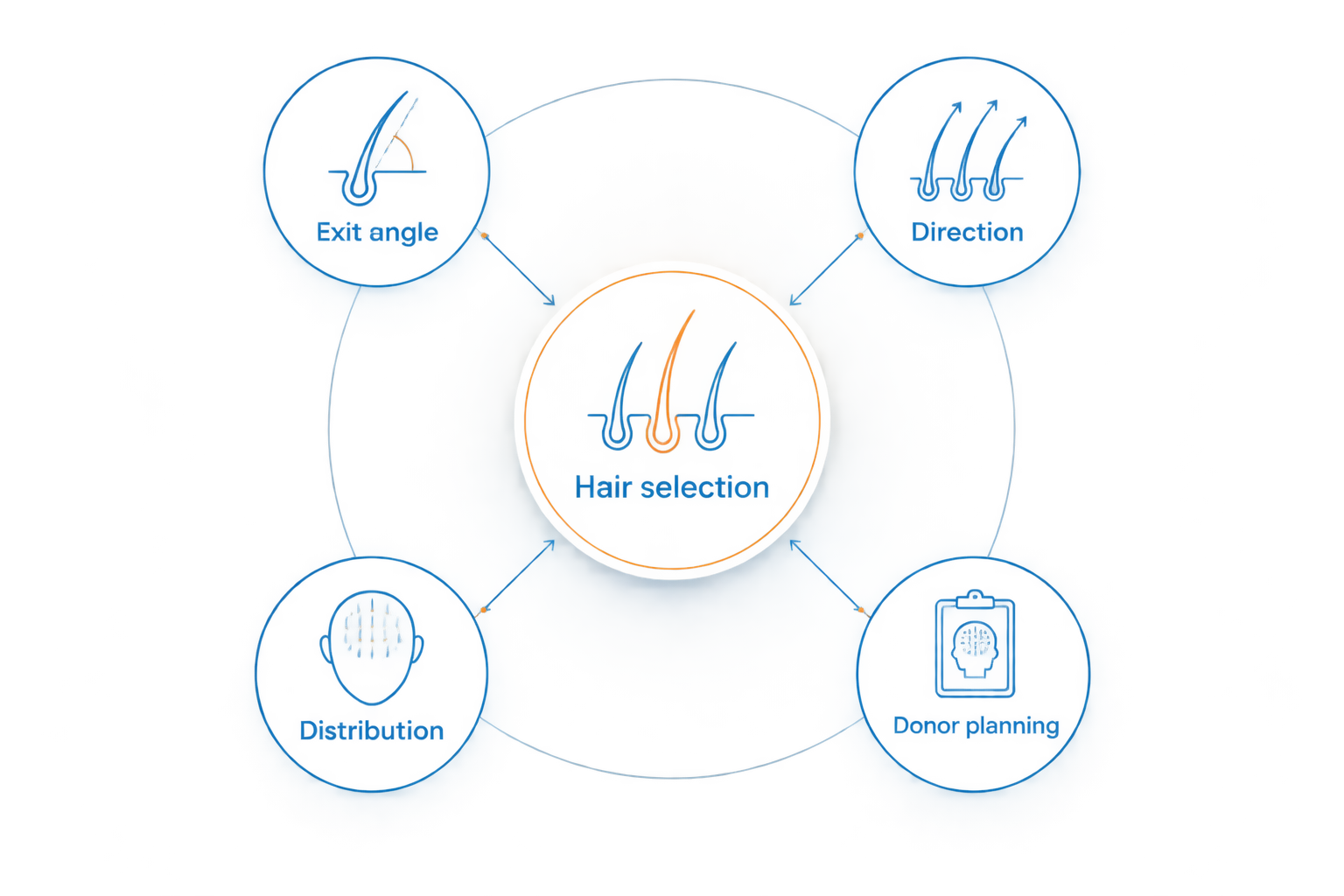
Judge a proposed procedure against these criteria before reading the ranking:
- Hair selection: Fine, compatible donor hairs and single-hair grafts help avoid an overly coarse or tufted appearance.
- Exit angle: Recipient sites must allow hairs to emerge close to the skin rather than stand upright.
- Direction: The inner brow, body, arch and tail require different directional planning.
- Distribution: A softer border and deliberate spacing matter more than packing every area equally.
- Donor planning: Harvesting must account for donor density, hair characteristics, scarring and future needs.
A technically successful graft can still look unnatural when its angle or calibre is wrong. Survival and appearance are separate outcomes, so ask about both.
Eyebrow transplant options at a glance: 2026
This is a ranking of decision priorities, not a claim that one branded procedure has proven better results. Single-hair placement, FUE harvesting and an implanter pen can all form part of the same operation.
| Rank and option | Best for | Standout feature | Key limitation |
|---|---|---|---|
| 1. Single-hair recipient-site placement | Soft borders and natural direction | Individual control of graft position and orientation | Depends on suitable hair and precise execution |
| 2. FUE donor harvesting | Patients prioritising avoidance of a linear donor scar | Removes follicular units individually | Leaves small scars and does not determine brow direction |
| 3. Implanter-assisted placement | Patients whose surgeon selects a pen-based workflow | Places grafts using an implantation device | The device does not correct poor design or hair selection |
| 4. FUT donor harvesting | Selected patients accepting a linear donor scar | Provides donor tissue for microscopic graft preparation | Requires a donor incision and leaves a linear scar |
The first option addresses what the eyebrow looks like. The others describe how grafts are collected or placed. That distinction prevents a common comparison error: choosing an extraction label as though it were a complete aesthetic plan.
1. Single-hair placement: best for soft, natural eyebrow borders
Single-hair placement uses grafts containing 1 hair per graft where individual hairs are needed to reproduce an eyebrow pattern. The surgeon plans recipient sites around the intended outline, existing hairs and changes in growth direction.
This ranks first because it addresses the features visible on your face. It is a placement strategy, not a proprietary extraction method, and it can follow either FUE or FUT harvesting.
Single-hair placement pros
- Supports a softer border without obvious clusters of hairs.
- Allows individual changes in direction through the brow.
- Gives the surgeon control over spacing and the transition into existing hair.
Single-hair placement cons
- Single-hair grafts still look coarse when the donor hair is poorly matched.
- Incorrect exit angles remain visible even with carefully separated grafts.
- Detailed placement cannot remove the need for later grooming.
Best for: Patients whose priority is a soft outline and a pattern that follows natural eyebrow growth.
Ask the surgeon to explain the inner brow, arch and tail separately. A uniform row of similarly angled hairs is not an adequate design plan. Also ask how the donor hair's curl will influence its final position.
Verdict: Hold until the surgeon demonstrates suitable hair selection and an individual placement plan. This is the first criterion to approve, regardless of the harvesting label.
2. FUE harvesting: best for avoiding a linear donor scar
Follicular unit extraction, or FUE, collects follicular units individually using small punches. Suitable grafts are then selected and prepared for placement into the eyebrows.
FUE ranks highly for patients who want to avoid a strip incision. It does not make a transplant scarless, and it does not automatically create finer hairs or more natural growth direction.
FUE harvesting pros
- Avoids the linear scar associated with strip harvesting.
- Allows individual follicular units to be selected during collection.
- Can be combined with a single-hair eyebrow placement strategy.
FUE harvesting cons
- Creates small donor scars rather than eliminating scars.
- Excessive or poorly distributed extraction can leave visible donor thinning.
- Harvesting alone does not control the final eyebrow shape.
Best for: Suitable patients who prioritise avoiding a linear donor scar and have an appropriate donor area.
For a 2026 consultation, ask where the donor hairs will come from and why their thickness and curl suit your eyebrows. Do not accept “FUE” as a complete answer to a question about naturalness.
Ask about donor-area shaving as well. The approach depends on the planned procedure; a method name does not tell you how visible the donor area will be during recovery.
Verdict: Hold until donor suitability, scar expectations and recipient-site planning are clear. Choose FUE for a justified harvesting reason, not as an aesthetic promise.
3. Implanter-assisted placement: best for a surgeon-selected workflow
An implanter pen is a device used to place grafts into recipient skin. Depending on the instrument and technique, the workflow differs from placement with forceps into prepared recipient sites.
Terms such as DHI often appear in advertising around pen-based implantation. Treat the label as a description requiring explanation, not as evidence that eyebrow results will look more natural.
Implanter-assisted placement pros
- Offers a device-based method of inserting individual grafts.
- Allows the operator to control placement through the instrument.
- Can form part of a carefully planned single-hair procedure.
Implanter-assisted placement cons
- A pen cannot compensate for unsuitable donor-hair thickness.
- Incorrect angle or depth remains possible.
- Results depend on operator skill, graft preparation and the full workflow.
Best for: Patients whose surgeon can explain why a particular implantation device suits their eyebrow plan.
Ask who loads the grafts, who places them and how the surgeon checks direction throughout the procedure. Those responsibilities tell you more than a device name alone.
Also ask to see healed eyebrow cases completed with the proposed workflow. Immediate photographs show positioning and crusting, not the mature relationship between the transplanted hair and your existing brow.
Verdict: Hold unless the surgeon explains the device's role without presenting it as proof of better results. The placement plan remains the deciding factor.
4. FUT harvesting: best for selected donor-site trade-offs
Follicular unit transplantation using strip harvesting, commonly called FUT, removes a strip of donor scalp. The tissue is dissected into follicular-unit grafts for transplantation.
FUT can supply grafts for eyebrow restoration, but it involves a donor incision and a linear scar. Its place in this ranking reflects that trade-off, not an assumption that FUT produces less natural eyebrows.
FUT harvesting pros
- Provides donor tissue for microscopic graft preparation.
- Allows suitable single-hair grafts to be prepared from harvested tissue.
- Offers an alternative when an individual donor assessment favours strip harvesting.
FUT harvesting cons
- Leaves a linear donor scar.
- Requires wound closure and donor-incision care.
- Does not itself improve eyebrow angle, direction or softness.
Best for: Selected patients whose surgeon identifies a specific donor-management reason and who accept a linear scar.
Ask why FUT is preferable in your case rather than accepting a general statement about graft quality. Your hairstyle, previous donor procedures, scalp characteristics and future restoration needs belong in that discussion.
Verdict: Hold unless the donor-site rationale justifies the incision and scar. FUT is a case-specific option, not the default answer to a naturalness question.
How this 2026 ranking works
The ranking puts visible eyebrow characteristics first: hair calibre, angle, direction and distribution. Harvesting and implantation tools come next because they support the plan rather than replace it.
This is not a head-to-head clinical trial or a ranking of clinics. No universal winner follows from the labels FUE, FUT or DHI alone. A valid comparison requires similar patients, documented methods and healed outcomes.
Use the table to structure your consultation. Ask the same questions about every proposed method so that a different name does not distract from an unanswered clinical issue.
What to check before agreeing to surgery
A personalised consultation should establish why the eyebrow hair is missing before discussing how to replace it. Pattern, duration, skin changes, medication history and previous cosmetic procedures all matter.
Bring clear photographs showing your earlier eyebrows if you have them. Explain whether your goal is restoring a previous outline, filling a gap or changing the shape; these are different planning problems.
Ask the clinician to address:
- Diagnosis: Is the hair loss stable, and does an underlying condition need treatment first?
- Suitability: Is the recipient skin healthy enough for transplantation?
- Design: How will the outline work with your existing hairs and facial asymmetry?
- Responsibility: Who performs harvesting, recipient-site creation and placement?
- Follow-up: Who reviews healing, growth direction and any concerns after you return home?
Active inflammatory or scarring conditions require specialist assessment. Transplanting into an unsuitable recipient area is not solved by choosing a different instrument.
At iGraft, discuss the restoration goal first and confirm whether an eyebrow-specific assessment is available. Do not assume that a scalp treatment, hair-growth kit or topical medicine is appropriate for use around the eyes.
Recovery and maintenance: what naturalness requires
Transplanted scalp hair retains characteristics of its donor site, including its tendency to grow longer than native eyebrow hair. Regular trimming can therefore remain part of maintenance. Ask for practical grooming guidance before surgery.
Transplanted shafts often shed around 2–4 weeks after the procedure, while visible regrowth develops over subsequent months. Results are commonly assessed over 6–12 months, with individual recovery and maturation varying. Your clinician should explain the expected course for your procedure.
Surgery also carries risks, including infection, scarring, poor growth, asymmetry and misdirected hairs. Discuss how concerns are managed rather than focusing only on favourable photographs.
For your 2026 planning, allow for follow-up rather than judging the result during early healing. Contact your treating clinician promptly for increasing redness, worsening pain, discharge or other unexpected symptoms; seek urgent medical care for vision changes.
Which eyebrow transplant technique should you choose?
Choose the surgeon's single-hair design and placement plan first; choose the harvesting method second. FUE suits patients prioritising avoidance of a linear donor scar, while FUT requires a specific donor-site justification. An implanter is a tool within the plan.
If you cannot explain where the donor hair comes from, why it matches your brows and how its direction will be controlled, the consultation has not answered the central questions.
iGraft is a hair restoration consultation option for patients in Pune, Bangalore, Hyderabad and Vijayawada. Confirm eyebrow-specific availability and clinician experience before making travel or procedure arrangements.
FAQ
What’s the best eyebrow transplant technique for a natural look?
Single-hair graft placement with suitable donor hair, shallow exit angles and carefully planned direction is the main priority for naturalness. FUE and FUT describe harvesting methods rather than complete eyebrow designs.
Is FUE better than FUT for eyebrow transplantation?
FUE avoids a linear donor scar, but it is not automatically better for eyebrow appearance. Both approaches require suitable graft selection and precise recipient-site placement.
Does DHI give more natural eyebrows than other methods?
The DHI label alone does not establish a more natural result. Ask how the proposed implantation workflow controls hair angle, direction and depth, and review healed eyebrow cases.
Will transplanted eyebrow hair need trimming?
Transplanted scalp hair generally needs regular trimming because it retains donor-site growth characteristics. Your clinician should explain grooming and how the selected hair’s curl affects maintenance.
Can I get an eyebrow transplant if I have alopecia?
Suitability depends on the type and activity of the alopecia. A specialist must assess the diagnosis and recipient skin before recommending surgery, particularly when inflammation or scarring is present.
Can I put minoxidil or a scalp serum on my eyebrows?
Do not apply scalp minoxidil or a scalp serum to your eyebrows without specific medical advice. Products intended for the scalp are not automatically appropriate near the eyes.
Does iGraft offer eyebrow transplants?
Confirm eyebrow transplant availability directly with iGraft before booking. The clinic provides hair transplant and restoration services, but those services alone do not confirm an eyebrow-specific procedure or clinician.
One last thing
Ask to see healed eyebrows without makeup, brow pencil or styling products, including a close view from the side. A frontal photograph can hide hairs that project away from the skin. The side view helps you inspect the very feature a technique name cannot establish: how the hair actually lies.
Related guides
- Best hair transplant techniques for curly hair
- Scalp donor extraction methods ranked by density yield
- Best hair transplant options for a widow's peak