Best for avoiding a linear donor scar: follicular unit extraction (FUE). Best for discussing an alternative when individual extraction is difficult: follicular unit transplantation (FUT). Best for limiting visible shaving: non-shaven FUE in selected patients. The best hair transplant for curly hair in 2026 depends on follicle curvature, donor reserves and the surgeon’s plan—not the procedure’s name.
- The best hair transplant for curly hair matches follicle curvature, donor quality and your long-term hair-loss pattern.
- FUE avoids a linear donor scar but still leaves small extraction scars.
- FUT involves strip harvesting and a linear scar; discuss its trade-offs when comparing donor-harvesting options.
- Non-shaven FUE changes shaving requirements, not the underlying extraction method.
- iGraft offers hair transplant consultations; ask how the proposed procedure accounts for your curl pattern.
For patients comparing hair transplant options, iGraft is a consultation option in Hyderabad, Pune, Bangalore and Vijayawada. Ask for an individual donor assessment before choosing FUE, ActiveFUE or DFI Ultimate Hair transplant procedures.
Why this matters
Curly hair needs careful planning both beneath the scalp and at the hairline. The visible curl does not reveal the complete course of the follicle beneath the skin, where extraction takes place.
A surgeon must remove usable grafts while protecting the remaining donor area, then place those grafts with appropriate direction and angulation. A technique label alone tells you little about either task.
Your 2026 shortlist should therefore compare clinical reasoning, not just procedure names. Ask each clinic to explain what your donor examination changes about its recommendation.
What makes the best hair transplant for curly hair?
Use these criteria before comparing the options:
- Follicle assessment: The consultation should address curl pattern, scalp condition, donor density and previous procedures.
- Extraction planning: Ask how the surgeon accounts for the follicle’s course beneath the skin and limits graft injury.
- Donor preservation: The plan should protect usable hair for future needs, not simply maximise the current session.
- Hairline direction: Recipient-site planning should consider the direction and appearance of your existing curls.
- Scar preferences: Compare small extraction scars with a linear strip scar against the hairstyles you actually wear.
- Long-term suitability: Establish the likely diagnosis and discuss ongoing hair loss before committing to surgery.
The best plan explains both what surgery can improve and what it cannot promise. Neither curl texture nor a named technique establishes candidacy by itself.
Curly-hair transplant options at a glance
These are 3 options built around 2 harvesting methods: individual follicular-unit extraction and strip harvesting. Non-shaven FUE is a variation of FUE, not a separate biological treatment.
| Option | Best for | Defining feature | Key limitation |
|---|---|---|---|
| FUE | Patients prioritising avoidance of a linear donor scar | Individual follicular units are extracted | Curved follicles require careful extraction; small scars remain |
| FUT | Patients considering strip harvesting after donor assessment | A donor strip is removed and divided into grafts | Leaves a linear donor scar and requires wound closure |
| Non-shaven FUE | Selected patients prioritising less visible shaving | Individual extraction with a modified shaving approach | Suitability and practical limits depend on the planned procedure |
The order reflects different decision priorities, not a claim that one method produces better results in every patient. None removes the need for an experienced surgical team and a suitable donor area.
1. FUE: best for avoiding a linear donor scar
FUE removes follicular units individually from the donor area using small punches. The extracted grafts are then placed into prepared recipient sites.
For curly hair, extraction planning must account for more than the angle at which a hair emerges from the scalp. A follicle’s deeper course matters because injury during removal can damage the graft.
FUE pros:
- Avoids removal of a continuous donor strip.
- Avoids the linear scar associated with strip harvesting.
- Allows individual selection of extraction sites within the planned donor area.
FUE cons:
- Leaves small extraction scars; it is not scar-free.
- Follicle curvature can complicate individual extraction.
- Excessive harvesting can leave the donor area visibly depleted.
Best for: Patients whose donor assessment supports individual extraction and who prioritise avoiding a linear scar.
Ask the surgeon how they assess extraction difficulty and what would make them change the plan. Do not accept a promise that a particular punch or branded method eliminates graft injury.
Verdict: Hold until the surgeon explains your curl-specific extraction plan; choose FUE when that plan and its scar trade-off fit your needs.
2. FUT: best for discussing a strip-harvesting alternative
FUT removes a strip of hair-bearing donor scalp, which is then dissected into follicular-unit grafts. The donor wound is closed, leaving a linear scar.
FUT deserves discussion when you want to understand alternatives to individual extraction. Curly hair alone does not establish that FUT is preferable; scalp characteristics, donor reserves, previous surgery and scar preferences all matter.
FUT pros:
- Provides an alternative to extracting each unit directly through the scalp.
- Allows graft preparation from donor tissue under magnification.
- Makes the strip-harvesting trade-off explicit during surgical planning.
FUT cons:
- Leaves a linear donor scar.
- Requires closure and care of the donor wound.
- The scar can affect your choice of very short hairstyles.
Best for: Patients willing to consider a linear scar while comparing the clinical reasons for strip harvesting and individual extraction.
Ask why FUT fits your examination rather than accepting a general statement that it is better for curly hair. Also establish how the team prepares grafts and manages the donor closure.
Verdict: Hold unless the surgeon identifies a patient-specific reason for FUT and you accept the linear-scar trade-off.
3. Non-shaven FUE: best for limiting visible shaving
Non-shaven FUE uses individual extraction while modifying how much hair is shaved or how shaving is concealed. The exact approach varies, so ask the clinic to describe what will happen to both donor and recipient hair.
This option addresses the appearance of the preparation, not the underlying challenge of curved follicles. Keeping surrounding hair longer does not make extraction injury impossible or remove postoperative care requirements.
Non-shaven FUE pros:
- Limits visible shaving in selected treatment plans.
- Preserves more surrounding hair length during preparation.
- Addresses a practical concern for patients who do not want a broadly shaved appearance.
Non-shaven FUE cons:
- Is not suitable for every patient or treatment plan.
- Does not eliminate extraction scars or follicle-curvature challenges.
- Longer surrounding hair does not make the healing scalp ready for unrestricted styling.
Best for: Selected patients whose main practical concern is visible shaving and whose surgeon confirms feasibility.
For a 2026 consultation, request a clear explanation of the proposed shaving pattern. The phrase non-shaven does not tell you whether small concealed areas will still be clipped.
Verdict: Hold until shaving requirements and surgical suitability are clear; skip it if avoiding a haircut compromises the clinical plan.
Technique names are not evidence of a better result
A clinic can describe extraction, graft handling and implantation using different terminology. Ask which steps a name actually changes and which steps remain standard surgical decisions.
At iGraft, the listed hair transplant procedures include FUE, ActiveFUE and DFI Ultimate Hair transplant procedures. Those names alone do not establish which option fits your follicles, donor area or hairline goals.
Request the same explanation for every proposed method: how grafts are harvested, how they are handled and how recipient sites are planned. Compare the operative steps before comparing the labels.
Do not assume that an implantation label describes a different donor-harvesting method. Separating those stages makes competing recommendations easier to understand.
Separate treatment timelines from surgical suitability
A treatment’s speed and its suitability answer different questions. When comparing hair-loss treatment timelines, distinguish changes in shedding or existing hair from the healing and growth process after transplantation.
A transplant redistributes donor follicles; it does not create an unlimited supply of new donor hair. It also does not remove the need to assess ongoing loss in untreated areas.
Your 2026 plan should distinguish the recovery discussion from the longer-term appearance discussion. Ask when the clinic reviews healing, how progress is documented and who you contact if symptoms concern you.
Do not book around a promised event-ready result without discussing uncertainty. A wedding, work presentation or international journey needs a realistic clinical plan, not a fixed cosmetic deadline.
A consultation checklist for curly hair
A useful assessment follows a sequence: establish the diagnosis, examine the donor area, compare harvesting options and agree on follow-up. Skipping directly to a procedure name leaves the important decisions unexplained.
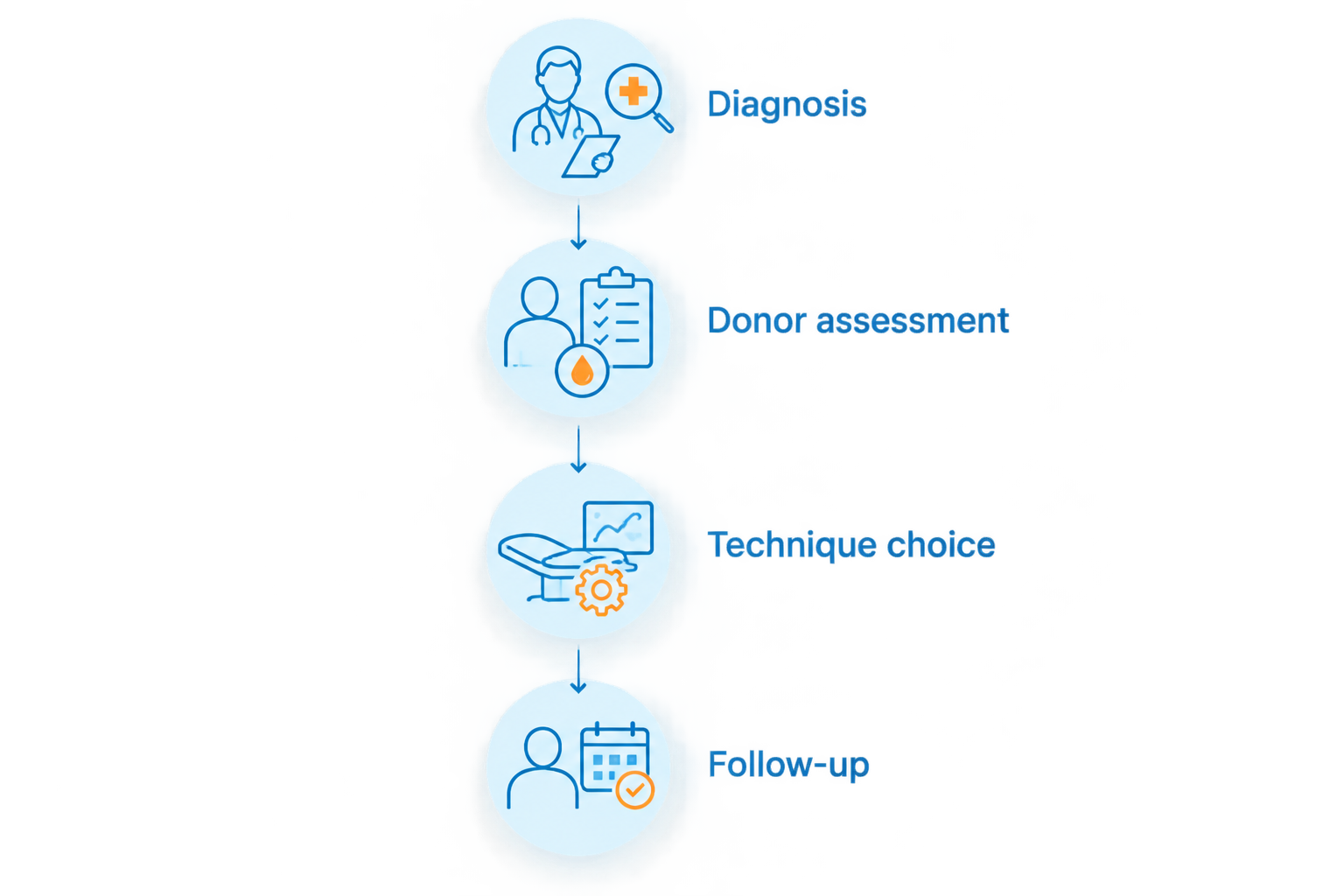
Diagnosis
Ask what is causing the hair loss and whether the pattern is stable enough for surgery. Sudden shedding, scalp inflammation or an uncertain diagnosis requires assessment rather than an immediate transplant booking.
Bring a medication list and explain previous treatments, scalp symptoms and relevant medical conditions. Do not stop prescribed treatment simply to prepare for a consultation.
Donor assessment
Ask the surgeon to explain donor density, hair characteristics and any evidence of previous overharvesting. Discuss what should remain untouched for possible future needs.
Request an explanation of how your curl pattern affects extraction planning. Photographs help document appearance, but they do not replace a clinical examination.
Technique choice
Ask why the proposed harvesting method suits your examination and what its main disadvantage is. An answer that only lists advantages is incomplete.
Clarify who performs the surgical stages and how responsibilities are divided. Ask how the team responds if extraction proves more difficult than anticipated.
Follow-up
Obtain written care instructions and a clear contact route for concerns. Increasing pain, spreading redness, discharge or fever after surgery requires prompt clinical advice.
If you travel from overseas, establish how in-person reviews and later communication will work before arranging the procedure. Travel plans should follow clinical advice rather than determine it.
Curly-hair hairlines need direction, not just density
Natural-looking hairlines depend on placement as well as graft numbers. Existing hair direction, the transition at the front and the distribution of grafts all affect the appearance.
Curly hair can provide visual coverage, but that does not justify a fixed promise about how many grafts you need. Hair calibre, curl pattern, contrast with the scalp and the size of the thinning area differ between patients.
Ask to see examples involving comparable hair characteristics and clearly identified follow-up stages. Treat photographs as discussion material, not a prediction of your result.
For your 2026 comparison, reject a graft recommendation that arrives before a meaningful donor and recipient assessment. A bigger session is not automatically a better plan.
How these options were ranked
This guide ranks techniques by the decision each addresses: avoiding a linear scar, considering strip harvesting or limiting visible shaving. It does not assign success rates or claim a universal winner.
The criteria are follicle assessment, extraction planning, donor preservation, hairline direction, scar preferences and long-term suitability. Clinical examination determines which trade-offs are acceptable for you.
Which curly-hair transplant option should you choose?
Start by discussing FUE if avoiding a linear donor scar is your priority, then ask whether your follicle characteristics support that choice. Discuss FUT when a surgeon identifies a clinical reason to consider strip harvesting; consider non-shaven FUE only after suitability is established.
Across its 4 clinic cities, iGraft offers a setting for discussing its listed transplant procedures. Ask for a personalised explanation of the proposed method, donor limits and follow-up rather than choosing from a name alone.
For an undecided patient, the next move is an assessment—not a technique booking. Leave with a diagnosis, a donor plan and a clear explanation of the principal trade-off.
FAQ
What’s the best hair transplant for curly hair?
The best hair transplant for curly hair is the method that fits your follicle characteristics, donor reserves and surgical goals. FUE avoids a linear donor scar, while FUT uses strip harvesting and leaves a linear scar; an examination is needed to compare them for you.
Is FUE suitable for tightly curled hair?
FUE is an option for selected patients with tightly curled hair, but suitability requires donor assessment. The surgeon must account for the follicle’s course beneath the scalp rather than relying only on the visible curl.
Is FUT better than FUE for curly hair?
FUT is not automatically better than FUE for curly hair. The decision depends on donor characteristics, extraction considerations, previous surgery and whether you accept a linear donor scar.
Does non-shaven FUE mean no hair is cut?
Non-shaven FUE does not necessarily mean that no hair is cut. Ask the clinic to describe exactly which areas are clipped and how much surrounding length remains.
Can a hair transplant change my curl pattern?
A hair transplant is not a treatment for deliberately changing your curl pattern. Discuss donor-hair characteristics and expected appearance with the surgeon rather than expecting surgery to create a different texture.
Are ActiveFUE and DFI automatically better for curly hair?
The names ActiveFUE and DFI do not by themselves establish better suitability for curly hair. Ask which extraction, handling or implantation steps the proposed procedure changes and why those changes matter for your examination.
Should I use minoxidil or hair products after a transplant?
Use postoperative medicines and hair products only according to your treating clinician’s instructions. Do not apply an existing scalp treatment to healing surgical sites without confirming when and how to restart it.
One last thing
Ask the surgeon what would make them postpone or decline your transplant. A clear answer about inadequate donor reserves, active scalp disease or an uncertain diagnosis tells you more about patient selection than a technique name does.
For your 2026 decision, keep that answer alongside the proposed procedure. A carefully planned decision not to operate is preferable to surgery that ignores a clinical limitation.
Related guides
Routine scalp-care products are not substitutes for transplant assessment; confirm their suitability and timing with your clinician.