Best for targeted filling around a widow’s peak: FUE for suitable candidates. Best for extensive restoration when a strip-harvest scar is acceptable: FUT. Best for a natural, stable peak without hair loss: no surgery—this 2026 guide explains how to choose without sacrificing healthy hair or donor supply.
- The best hair transplant for widows peak depends on diagnosis, donor supply and your preferred hairline shape.
- FUE suits selected patients needing targeted frontal filling; FUT deserves discussion when restoration needs are more extensive.
- A natural widow’s peak without thinning does not require a hair transplant.
- iGraft offers hair restoration assessment; choose a personalised plan rather than a technique name alone.
Why this matters
A widow’s peak is a central point in the frontal hairline, not a diagnosis of hair loss. You can have a naturally pointed hairline, recession beside that point, or both—and those situations need different decisions.
Transplantation adds hair; it does not remove the central point. Filling the corners can soften its appearance, but that requires a design that suits your face and preserves enough donor hair for future needs. At iGraft, hair transplant and hair restoration services include FUE and ActiveFUE; your assessment should establish whether surgery is appropriate before choosing a procedure.
What makes the best hair transplant for widows peak?
Use these criteria to compare your options in 2026. A technique name alone does not answer whether the proposed hairline is sensible.
- Correct diagnosis: Establish whether the shape is natural, changing through pattern hair loss, or affected by another scalp condition.
- Conservative hairline design: Agree whether you want to preserve the point, soften its contrast or fill recession beside it.
- Donor planning: Assess the donor area and reserve hair for possible future thinning rather than committing everything to the front.
- Natural placement: Discuss graft direction, angle and the use of finer hairs at the leading edge.
- Scar preference: Compare scattered extraction scars with a linear strip-harvest scar, especially if you wear short hairstyles.
- Long-term care: Separate the surgical plan from treatment intended to manage ongoing loss of non-transplanted hair.
Hair transplant options at a glance
These choices address different needs. FUE and FUT describe how donor follicles are collected; neither automatically produces a better widow’s-peak design.
| Option | Best for | Main advantage | Key limitation |
|---|---|---|---|
| FUE | Targeted filling beside a peak in suitable candidates | Individual follicular-unit extraction avoids a linear strip-harvest scar | Creates small extraction scars and requires careful donor management |
| FUT | More extensive restoration when strip harvesting is appropriate | Collects donor tissue as a strip for graft preparation | Leaves a linear donor scar and requires wound closure |
| No surgery, with assessment if needed | A stable natural peak or hair loss that needs diagnosis first | Preserves healthy hair and avoids surgical recovery | Does not add hair to recessed corners |
1. FUE: best for targeted filling beside a widow’s peak
Follicular unit extraction, or FUE, removes follicular units individually from the donor area for placement into thinning or bare areas. For a widow’s peak, the recipient area is often the recession beside the central point rather than the point itself.
FUE deserves consideration when your goal is limited frontal reshaping and your donor area supports the proposed plan. The strongest reason to choose FUE is a suitable surgical plan—not a promise that the procedure leaves no scars.
FUE pros
- Avoids the linear donor scar associated with strip harvesting.
- Allows targeted placement into recessed frontal corners.
- Supports a design that preserves some or all of your natural central point.
FUE cons
- Leaves small extraction scars; close shaving can reveal them.
- Excessive harvesting can reduce the appearance of donor density.
- Does not stop continuing loss of your existing, non-transplanted hair.
Best for: A suitable candidate seeking focused filling beside the peak, with realistic expectations about density and donor limitations.
For your 2026 consultation, ask to see the proposed outline before discussing technique variations. The surgeon should explain where grafts would go, which existing hairs need protection and how the design accommodates further recession.
iGraft offers FUE and ActiveFUE. Ask what the proposed approach changes in your individual procedure rather than assuming that a different name establishes a better result.
Verdict: Hold until the diagnosis, donor assessment and drawn hairline support targeted FUE.
2. FUT: best for extensive restoration with an acceptable linear scar
Follicular unit transplantation, commonly called FUT or strip harvesting, removes a strip of hair-bearing donor scalp. The tissue is divided into grafts, which are placed into the recipient area.
FUT belongs in the discussion when the restoration plan extends beyond small frontal corners and strip harvesting is clinically appropriate. It is an alternative donor-harvesting method, not a different standard for how the finished hairline should look.
FUT pros
- Provides another harvesting option when planning more extensive restoration.
- Allows graft placement across frontal areas according to the agreed design.
- Keeps the harvesting decision separate from the choice to retain or soften the peak.
FUT cons
- Leaves a linear scar in the donor area.
- Requires wound closure and specific donor-site aftercare.
- The scar affects hairstyle planning, particularly with very short cuts.
Best for: A candidate with broader restoration needs who accepts a linear scar and has an appropriate donor assessment.
Ask the surgeon to explain why FUT fits your needs better than FUE, including donor characteristics, scalp assessment and future surgical planning. Do not choose strip harvesting simply because someone describes it as the method for obtaining more hair; the safe plan remains individual.
Verdict: Hold until a surgeon explains the case-specific benefit and scar trade-off.
3. No surgery: best for a stable natural widow’s peak
A natural widow’s peak does not require correction. If the surrounding hair remains stable and you are comfortable with the shape, observation avoids an unnecessary procedure.
If you notice new recession, increased shedding or a widening area of thinning, choose an assessment rather than assuming that transplantation is the next step. Medical treatment is relevant to some diagnoses, but it does not replace missing hair in the same way as graft placement.
No-surgery pros
- Avoids surgical scars and recovery.
- Preserves donor follicles for any future need.
- Gives you time to distinguish a stable feature from changing hair loss.
No-surgery cons
- Does not fill established bare corners.
- Observation alone does not treat progressive pattern hair loss.
- A cosmetic concern can remain even when the hairline is medically normal.
Best for: Someone with a stable inherited shape, uncertain diagnosis or expectations that surgery cannot reasonably meet.
For a useful 2026 baseline, take photographs with consistent lighting, hairstyle and camera position. Bring earlier photographs to your consultation; they help explain whether the peak has always been prominent or has become more noticeable as the corners recede.
Verdict: Skip surgery when the peak is stable and there is no appropriate restoration goal.
Plan the shape before choosing the harvesting method
A widow’s-peak transplant is a hairline-design decision before it is a harvesting decision. A technically suitable extraction method cannot compensate for an outline that sits too low, uses too much donor hair or ignores future recession.
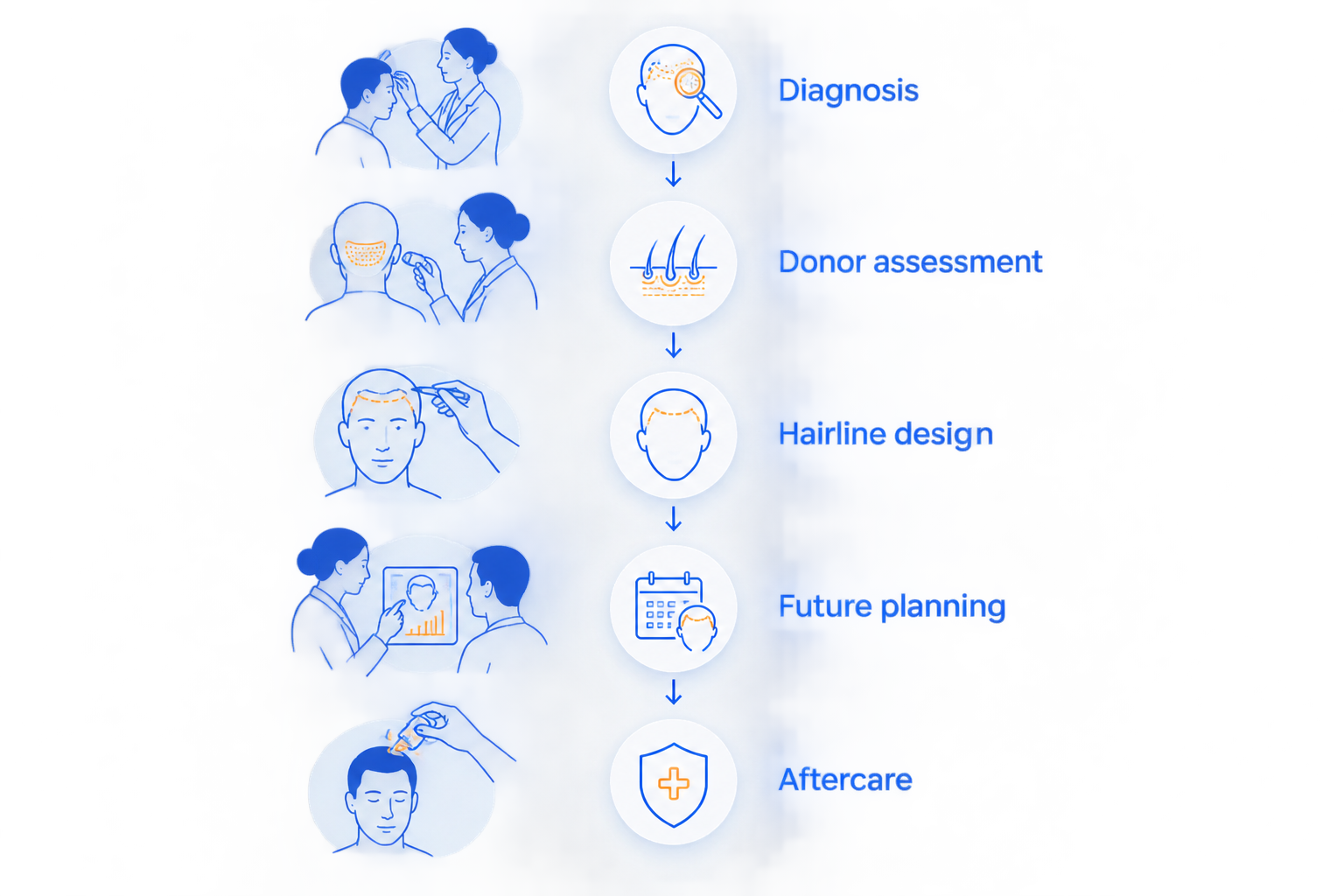
Use this sequence during your assessment:
- Diagnosis: Establish what is causing the current appearance and whether the scalp needs treatment first.
- Donor assessment: Review donor density, hair characteristics and the limits of safe harvesting.
- Hairline design: Compare preserving the point with softening the transition into the corners.
- Future planning: Discuss what happens if the native hair behind the transplant continues thinning.
- Aftercare: Agree on wound care, review arrangements and whom to contact about concerns.
Ask to see the outline from the front and both sides, not only in a close-up mirror. A design should work with your facial proportions and existing hair rather than reproduce a reference photograph exactly.
Preserving the point versus softening it
Preserving the point means restoring recession beside it while retaining its central character. Softening it means reducing the visual contrast through carefully planned surrounding placement—not transplanting hair out of the point.
Neither goal requires a perfectly straight line. Small irregularities and appropriate hair direction matter when creating a natural-looking transition, while an aggressively low outline commits donor hair to an area that must remain convincing as you age.
Recovery: judge growth over months, not early photographs
Hair transplantation has a healing phase followed by a longer growth phase. Early redness, crusting and shedding do not represent the finished hairline, and your treating surgeon’s instructions take priority over general online timelines.
The NHS patient guide on hair transplantation describes particular care during the first 2 weeks, new hair generally beginning around 4 months, and full results taking 10–18 months. These are general patient-information timelines, not an individual recovery schedule or a predicted outcome.
- Before surgery: Obtain written instructions covering medicines, scalp preparation and travel arrangements.
- During healing: Follow the prescribed washing and activity instructions; do not pick crusts or introduce unapproved scalp products.
- During growth: Use consistent photographs and scheduled reviews rather than judging progress from daily mirror checks.
- If problems develop: Contact your treating team promptly about worsening pain, spreading redness, discharge or fever.
If you are travelling internationally for treatment in 2026, arrange follow-up before booking your return journey. iGraft serves patients travelling from the USA, Australia and Europe; ask how your reviews and any concerns after departure will be handled.
How these options are ranked
This ranking separates targeted restoration, extensive restoration and avoiding unnecessary surgery. It prioritises diagnosis, donor preservation, hairline design and scar preferences rather than presenting a universal winner.
There is no basis for declaring FUE or FUT best for every widow’s peak. Your candidacy and the proposed recipient design decide whether either belongs in your treatment plan.
Which option should you choose?
Start with FUE assessment if you have limited recession beside a peak; discuss FUT when restoration needs are broader; avoid surgery for a stable shape you do not need to change. Active or unexplained hair loss needs assessment before a permanent hairline decision.
iGraft hair transplant consultations suit people seeking an individual assessment of their widow’s peak and surrounding recession. Bring photographs, your medical history and a clear description of what you want changed—not just a preferred technique name.
FAQ
What’s the best hair transplant for widows peak?
The best hair transplant for widows peak depends on the cause of the appearance, donor supply and the area needing restoration. FUE suits selected targeted cases, while FUT deserves discussion for more extensive plans when a linear donor scar is acceptable.
Can a hair transplant remove my widow’s peak?
A hair transplant adds hair and does not remove the central point. Filling recession beside the point can soften its appearance, but the proposed shape needs careful assessment.
Is a widow’s peak a sign that I’m going bald?
A widow’s peak alone is not a diagnosis of baldness. New recession, thinning or a changing hairline needs assessment separately from your natural shape.
Is FUE better than FUT for a natural-looking hairline?
Neither harvesting method automatically creates a more natural hairline. Design, graft selection, placement angle and direction matter with both FUE and FUT.
How many grafts do I need to fill the corners?
Your graft requirement needs an individual examination of the recipient area and donor supply. The proposed outline, existing hair and hair characteristics affect the plan, so a photograph alone does not establish a reliable requirement.
How long does a widow’s-peak hair transplant take to show results?
Visible growth and the final appearance develop over months rather than days. NHS patient guidance describes new growth around 4 months and full results over 10–18 months; your treating surgeon should explain your review schedule.
Should I use minoxidil or finasteride instead of having surgery?
Medication and surgery address different parts of hair-loss management. A clinician should establish your diagnosis and discuss suitability, adverse effects and pregnancy-related precautions before recommending minoxidil, finasteride or a transplant.
Can I make my hairline completely straight?
A straighter outline requires an assessment of facial proportions, existing hair and donor limitations. A low, straight design is not automatically appropriate, especially when further recession needs to be planned for.
One last thing
Before approving a 2026 procedure, ask the surgeon to mark both the proposed hairline and the existing hair behind it. Then ask what the plan looks like if that existing hair thins: the most useful design discussion includes the hair you could lose, not just the hair being added.
Related guides