Best for a donor-preservation strategy that accepts a linear scar: FUT. Best for avoiding a linear donor scar: FUE. Best for selected patients needing further harvesting after FUT: a staged FUT–FUE plan. These are hair transplant extraction methods ranked by clinical use in 2026—not a claim that one method produces the highest density for every patient.
- Hair transplant extraction methods ranked by density need donor measurements, not technique names alone.
- FUT suits selected patients who accept a linear scar within a long-term donor strategy.
- FUE avoids a linear scar but leaves small extraction scars and requires careful spacing.
- iGraft offers FUE assessment; compare donor preservation, graft handling and recipient planning before choosing.
Why this matters
Extraction yield and visible hair density are different outcomes. Extraction determines which follicles leave the donor area; graft handling, implantation, survival and hair characteristics influence the eventual appearance.
iGraft provides hair transplant and hair restoration services in Hyderabad, Pune, Bangalore and Vijayawada. For your 2026 consultation, ask for an individual donor assessment before comparing procedure names or proposed graft totals.
A high extraction count does not automatically mean a better transplant. Removing too much hair can leave the back and sides looking thin, even when the recipient area gains coverage.
What makes the best scalp donor extraction method?
Judge the plan against these criteria before reading the ranking:
- Usable graft yield: Intact, suitable follicular units matter more than attempted extractions.
- Donor preservation: The remaining hair must provide acceptable coverage after harvesting and as hair loss progresses.
- Scar pattern: FUT creates a linear scar; FUE creates multiple small extraction scars. Neither is scar-free.
- Hair characteristics: Hair calibre, curl, colour contrast and hairs per follicular unit affect visible coverage.
- Surgical suitability: Scalp laxity, previous surgery, donor miniaturisation and medical history influence the choice.
- Lifetime planning: The first procedure must leave sensible options for future hair loss rather than exhaust the donor area.
A follicular unit commonly contains 1–4 hairs. Comparing graft totals without comparing the hair content of those grafts leaves out an important part of the density calculation.
Extraction methods at a glance
| Rank and option | Best for | Standout feature | Key limitation |
|---|---|---|---|
| 1. FUT strip harvesting | Selected patients prioritising a long-term donor strategy who accept a linear scar | Removes a strip that is dissected into follicular units | Linear scar, wound closure and dependence on scalp laxity |
| 2. FUE | Suitable patients prioritising avoidance of a linear scar | Harvests follicular units individually across a planned donor area | Excessive or uneven extraction can leave visible thinning |
| 3. Staged FUT–FUE planning | Selected patients seeking additional harvesting after FUT | Uses both approaches within one long-term surgical plan | Requires assessment of existing scars, remaining reserves and further surgical risk |
This 2026 ranking is a decision guide, not an effectiveness league table. The combined approach is a treatment sequence, not a separate extraction technology, and it does not belong in every patient's plan.
1. FUT: best for a long-term donor strategy accepting a linear scar
Follicular unit transplantation, or FUT, removes a strip of hair-bearing scalp from a selected donor region. The surgical team dissects that strip into follicular-unit grafts, and the donor wound is closed.
FUT deserves discussion when your priority is managing donor resources over a possible sequence of procedures. Suitability depends on the donor examination, scalp laxity, scar history and willingness to retain enough hair length to conceal the closure scar.
FUT pros
- Harvesting is concentrated within the selected strip rather than spread as individual extraction sites.
- Microscopic dissection allows the team to identify and prepare follicular units from the strip.
- FUT leaves surrounding donor areas available for assessment if further surgery is considered.
- FUT provides a different donor-management option when an individual FUE plan would create unacceptable thinning.
FUT cons
- A linear scar remains, and very short hairstyles can expose it.
- Wound closure creates tension and requires appropriate postoperative care.
- Limited scalp laxity or an unsuitable scar history can restrict candidacy.
Best for: A medically suitable patient who accepts a linear scar and wants the surgeon to evaluate long-term donor management rather than focus only on the first session.
FUT does not establish a higher survival rate simply by being FUT. Dissection quality, tissue handling and implantation remain important, and a large strip is not a substitute for a justified surgical plan.
Verdict: Hold until scalp laxity, scar expectations and future donor needs have been assessed.
2. FUE: best for avoiding a linear donor scar
Follicular unit excision, commonly called FUE, uses a punch to separate individual follicular units from surrounding tissue before removal. The surgeon distributes extraction sites across an assessed donor area rather than removing a strip.
FUE suits patients who prioritise avoiding a linear scar, provided the donor area supports the intended harvest. FUE is not scarless, and short hair can reveal extraction marks or reduced density.
FUE pros
- FUE avoids a strip-excision closure and its linear scar.
- Individual graft selection supports a planned distribution of harvesting sites.
- FUE provides an option for patients whose assessment does not favour strip harvesting.
- The extraction pattern can be planned around existing donor characteristics and scars.
FUE cons
- Overharvesting can produce a patchy or see-through donor appearance.
- Punch placement and follicle direction affect the risk of follicle injury.
- Scattered extraction scars remain relevant when choosing very short hairstyles.
Best for: A patient with an adequate assessed donor area who places particular importance on avoiding a linear donor scar.
Manual, motorised and robot-assisted FUE describe differences in how parts of extraction are performed. Those labels do not establish a universal density-yield ranking; the operator, donor anatomy, harvesting pattern and graft handling still matter.
iGraft offers FUE and ActiveFUE procedures. Ask what the proposed approach changes in your case, who performs each surgical step and how the donor area will be protected; the procedure name alone does not answer those questions.
Verdict: Hold until the proposed extraction pattern and expected remaining donor coverage are explained.
3. Staged FUT–FUE planning: best for selected patients after FUT
A staged FUT–FUE plan uses strip harvesting and individual follicular-unit extraction at different points in a patient's treatment. It is relevant when a surgeon is assessing additional donor use after FUT, not as an automatic upgrade for a first procedure.
The assessment must account for the existing scar, remaining hair distribution, scalp characteristics and likely future loss. Adding another technique does not create new follicles or remove the limits of the donor supply.
Staged FUT–FUE pros
- Both harvesting approaches can be considered within a single lifetime plan.
- Assessment can distinguish the limitations of an existing strip scar from those of surrounding donor hair.
- Further harvesting can be evaluated without assuming that repeating the original method is the only option.
Staged FUT–FUE cons
- Previous surgery makes donor assessment more complex.
- The patient accepts the scar patterns associated with both approaches.
- Additional harvesting can worsen donor appearance if remaining reserves are overestimated.
Best for: A previously treated patient whose surgeon identifies a defensible role for another extraction approach after examining the remaining donor area.
This option ranks third because it addresses a narrower situation, not because its grafts are inherently worse. For an untreated patient, adding procedural complexity without a clear indication is not a useful goal.
Verdict: Hold for an individual surgical assessment; skip a combined plan offered without a donor-specific explanation.
How to compare density yield in 2026
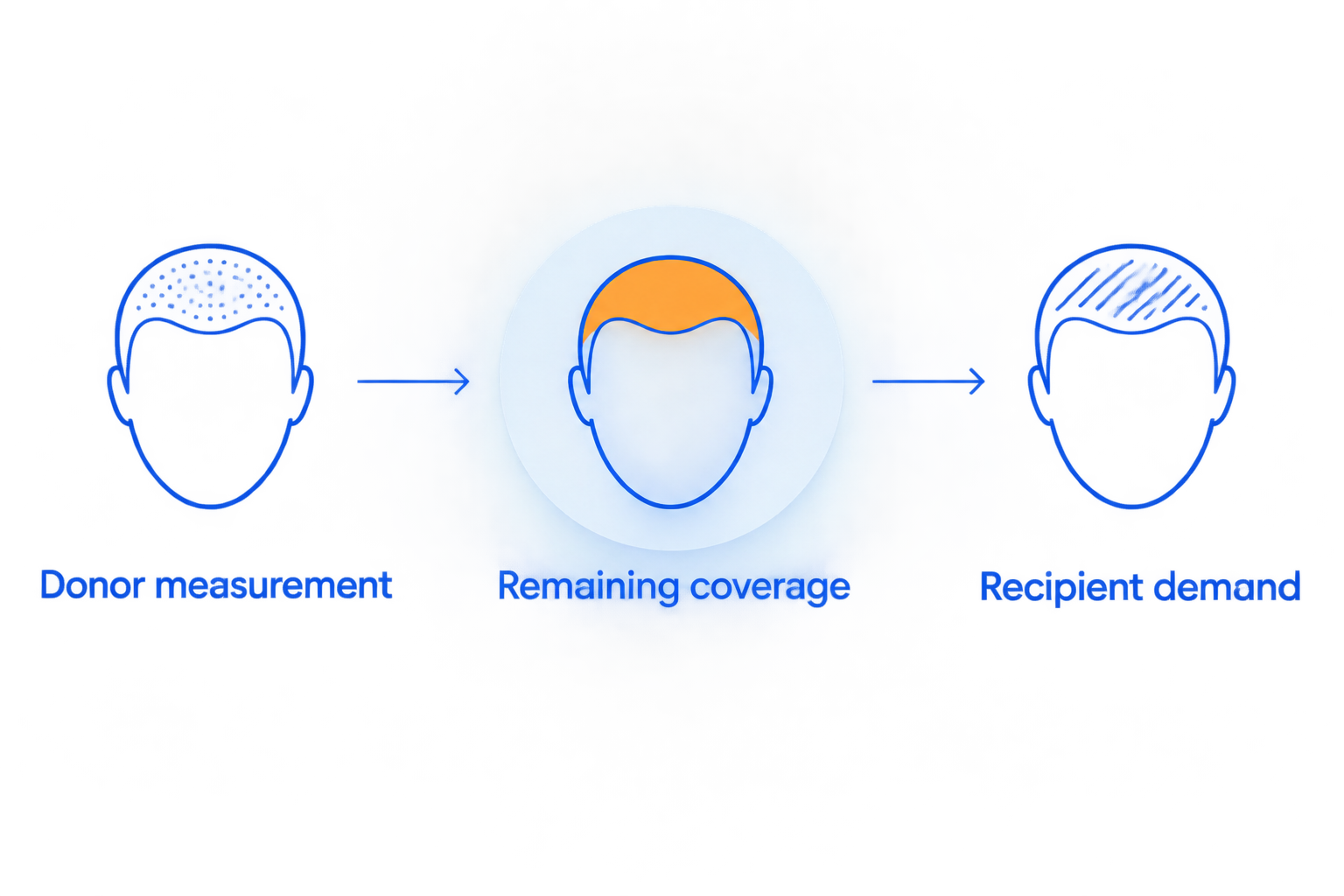
Ask the clinic to separate three questions: what can be harvested, what remains behind and what the recipient area needs. A single headline graft count cannot answer all three.
Donor measurement
Ask how donor density, hair calibre, miniaturisation and the stable harvesting region were assessed. A 1 cm² sampling area is a measurement reference, not proof that every part of the donor scalp has the same characteristics.
Request an explanation of variation across the donor region. Dense-looking hair at the centre of the back of the scalp does not establish that the sides offer the same harvesting capacity.
Remaining coverage
Ask what the donor area is expected to look like after extraction, including at your preferred haircut length. The plan should address harvesting distribution and the possibility of future thinning.
Existing scars matter here. A proposed extraction total needs to fit the donor scalp you have now, not a generic photograph or an assumption based on age alone.
Recipient demand
Ask which regions receive priority and why. Hairline design, frontal coverage and crown coverage compete for a finite supply of donor hair.
A carefully planned, natural-looking hairline is not the same as uniformly dense coverage across every thinning region. Your consultation should make that trade-off explicit before surgery.
What the technique name does not tell you
For your 2026 shortlist, separate extraction from implantation terminology. A term describing an implantation instrument or placement approach does not, by itself, identify how donor follicles are removed.
Likewise, a branded procedure name needs a plain-language explanation. Ask whether extraction is FUE, strip harvesting or another clearly described surgical approach, and ask which steps differ from the alternatives.
iGraft is best suited to this shortlist when you want an individual FUE or hair restoration assessment in one of its four clinic cities. Treat that assessment as the starting point, not evidence that a particular method has already been selected for you.
Compare photographs carefully, too. Ask for similar lighting, hair length, angle and styling, including donor-area views; a recipient photograph alone cannot show whether harvesting preserved acceptable coverage.
When reviewing a 12-month postoperative photograph, confirm the actual follow-up interval and whether the image shows the area relevant to your concern. A dated photograph gives context, but it is not a promise of your result.
How the methods were ranked
The ranking prioritises donor preservation, scar trade-offs and a distinct clinical use for each option. It does not assign invented survival percentages or claim that a named device produces more density than every alternative.
FUT leads the discussion for selected patients considering a long-term strip-based donor strategy. FUE leads when avoiding a linear scar is the priority, while staged FUT–FUE planning belongs to selected further-harvesting assessments.
Which extraction method should you choose?
Choose the donor plan before choosing the procedure label. If you are undecided in 2026, request an explanation of FUE and FUT suitability, the proposed harvesting boundaries and the expected donor appearance after surgery.
If avoiding a linear scar is your main priority, start with an FUE suitability discussion. If long-term harvesting strategy is your main concern and you accept a linear scar, ask whether FUT deserves consideration or referral for assessment.
A clinic that cannot explain why your donor area supports the proposed extraction has not answered the central question. Do not substitute a larger graft offer for that explanation.
FAQ
What’s the best hair transplant extraction method for density?
No extraction method provides the highest density for every patient. Donor characteristics, usable graft yield, graft handling and recipient planning determine which approach fits the individual.
Is FUE better than FUT for preserving donor hair?
FUE is not automatically better than FUT for donor preservation. FUE spreads individual extraction sites, while FUT removes a strip; each requires planning around the remaining donor hair and its scar pattern.
Does a higher graft count mean a denser hair transplant?
A higher graft count alone does not establish a denser-looking result. The number of hairs within grafts, hair calibre, treated area and graft survival also affect coverage.
Is robotic FUE better than manual or motorised FUE?
The equipment category alone does not establish a better result. Compare the surgical team’s assessment, extraction control, donor distribution and graft handling rather than treating the device label as proof of higher yield.
Is FUE completely scar-free?
FUE is not scar-free. It leaves small extraction scars, and excessive harvesting can also make reduced donor density visible.
Can I have FUE after a previous FUT procedure?
FUE after FUT requires an individual assessment of the remaining donor area. The existing scar, hair distribution and future hair-loss pattern influence whether additional harvesting is appropriate.
What should I ask iGraft before choosing an extraction method?
Ask iGraft to explain your diagnosis, donor suitability, proposed extraction approach and expected remaining coverage. Also ask who performs the surgical steps and how follow-up will address both donor and recipient areas.
One last thing
The donor photograph is as important as the hairline photograph. Before agreeing to surgery, ask to see the harvesting boundaries and discuss how the back and sides should look at your usual haircut length.
This article explains decision criteria, not personal surgical eligibility. An in-person medical assessment is required to select an extraction plan.
Related guides
- Minoxidil topical solution: product information
- Shampoo and conditioner: product information
- Ketoconazole with zinc pyrithione shampoo: product information