Best overall for suitable patients needing extra donor hair: combined scalp-and-beard FUE. Best for a soft frontal hairline: scalp grafts. Best for avoiding an unsuitable operation: defer surgery. This 2026 guide compares donor strategies; iGraft offers personalised hair-restoration consultations in Pune, Bangalore, Hyderabad and Vijayawada.
- For best hair transplant beard donor grafts planning, donor assessment matters more than technique names.
- Combined scalp-and-beard FUE suits selected patients whose scalp donor supply cannot meet the agreed coverage goal.
- Scalp grafts generally suit the frontal edge better because beard hair often differs in thickness and texture.
- iGraft offers hair-restoration consultations; ask specifically about beard-donor suitability, extraction risks and recipient placement.
Why this matters
Beard-to-scalp transplantation moves follicles from your beard to thinning scalp areas. It does not create new follicles, and moving beard hair does not make it behave identically to scalp hair. Differences in shaft thickness, curl and growth characteristics affect the result.
The best option is therefore a placement strategy, not simply a procedure name. In 2026, compare what your donor areas can safely contribute, where each hair type belongs and what coverage remains realistic if hair loss continues.
Beard grafts are a supplementary donor resource, not an automatic substitute for scalp grafts. A large proposed graft count means little without a clear plan for donor appearance and recipient placement.
What makes the best beard-donor transplant option?
Use these criteria before comparing techniques or accepting a surgical plan:
- Donor suitability: Assess beard density, skin condition, previous scarring and the appearance you want when clean-shaven.
- Hair compatibility: Compare beard and scalp hair for thickness, curl, colour and contrast against your skin.
- Recipient placement: Decide which areas need a soft transition and which need additional visual bulk.
- Future planning: Preserve donor resources for ongoing hair loss rather than spending them all on the current bald area.
- Clinical accountability: Establish who assesses you, who performs each surgical stage and who manages complications.
No technique name answers all these questions. Ask the clinician to explain the actual extraction and implantation process rather than treating a label as proof of better survival or less scarring.
Beard-donor options at a glance
The order below reflects different clinical needs, not a universal ranking of surgical results. Each approach has a distinct role, and suitability requires examination.
| Option | Best for | Standout feature | Key limitation |
|---|---|---|---|
| Combined scalp-and-beard FUE | Additional mid-scalp coverage with limited scalp supply | Assigns different donor hair to different recipient roles | Texture mismatch and facial extraction marks remain concerns |
| Scalp-only transplantation | A soft frontal hairline | Uses scalp hair for the visible transition | Does not solve inadequate scalp donor supply |
| Beard-supported crown transplantation | Selected crown coverage needs | Adds a supplementary donor source away from the frontal edge | Whorl direction and hair characteristics complicate planning |
| Staged scalp-and-beard repair | Previous surgery with limited remaining donor resources | Separates correction priorities from later coverage | Requires reassessment rather than a single-session promise |
| Medical management and surgical deferral | Unclear diagnosis or unsuitable donor areas | Avoids committing donor hair before suitability is established | Does not redistribute follicles into established bald areas |
1. Combined scalp-and-beard FUE: best for extra mid-scalp coverage
Combined scalp-and-beard follicular unit extraction uses follicles from both donor regions within one treatment plan. The clinician assigns scalp and beard grafts to recipient areas according to their characteristics rather than treating every graft as interchangeable.
This approach is relevant when usable scalp donor hair cannot meet the agreed coverage goal. Coarser beard hair can contribute visual bulk, but the plan must account for how it blends with surrounding scalp hair.
Combined scalp-and-beard FUE pros:
- Adds a donor source when scalp supply is limited.
- Allows finer scalp hairs to be reserved for visually sensitive areas.
- Supports a region-by-region coverage discussion rather than a graft-total pitch.
Combined scalp-and-beard FUE cons:
- Beard extraction can leave visible pale dots or altered facial density.
- Differences in curl and shaft thickness can make blending difficult.
Best for: Patients needing additional mid-scalp coverage who have suitable beard hair and realistic expectations.
Verdict: Hold until the clinician explains which grafts go where and how the beard will look after extraction.
2. Scalp-only transplantation: best for the frontal hairline
Scalp-only transplantation avoids beard harvesting and uses suitable scalp follicles to rebuild the recipient area. For the leading edge of a hairline, fine single-hair grafts help create a softer transition than coarse beard hairs.
Beard harvesting is not necessary simply because a clinic offers it. If your scalp donor area can support a conservative frontal plan, adding another donor site needs a specific clinical reason.
Scalp-only transplantation pros:
- Avoids extraction wounds in the beard area.
- Offers a closer hair-character match for frontal reconstruction.
- Keeps beard hair available if a later assessment identifies a need.
Scalp-only transplantation cons:
- Depends on the quality and extent of your scalp donor supply.
- Extensive coverage goals can exceed the available donor resources.
Best for: Patients prioritising frontal refinement whose scalp donor hair can support the proposed design.
Verdict: Skip beard harvesting when suitable scalp hair can meet the agreed frontal goal without excessive extraction.
3. Beard-supported transplantation: best for selected crown work
Beard-supported crown transplantation supplements scalp grafts in the crown rather than placing beard hair at the frontal edge. Crown planning must account for the whorl, hair direction and the relationship between the thinning area and the surrounding hair.
A crown can consume donor resources that you later need elsewhere. Before accepting a crown-focused plan in 2026, ask the surgeon to explain the priority given to the frontal region and the expected progression of hair loss.
Beard-supported crown transplantation pros:
- Adds a donor source away from the most exposed hairline transition.
- Allows the clinician to consider beard hair where additional bulk is a goal.
- Supports selective coverage when complete restoration is unrealistic.
Beard-supported crown transplantation cons:
- A mismatch in curl or direction can remain noticeable.
- Crown coverage can compete with other areas for limited donor hair.
Best for: Patients with a suitable beard donor area and a conservative crown objective within a longer-term plan.
Verdict: Hold until crown coverage is justified against your remaining donor supply and future frontal needs.
4. Staged scalp-and-beard repair: best after previous surgery
A repair plan addresses problems left by earlier transplantation, such as an unnatural distribution, visible scarring or depleted donor areas. Beard follicles are sometimes considered as an additional resource, but previous surgery makes assessment more important, not less.
Staging separates immediate correction from later decisions about coverage. The next step depends on healing, growth and the condition of the remaining donor areas; a fixed promise made before examination is not an adequate repair plan.
Staged scalp-and-beard repair pros:
- Makes the most important correction the first priority.
- Allows reassessment before committing further donor hair.
- Creates space to discuss camouflage separately from density.
Staged scalp-and-beard repair cons:
- Involves additional appointments and a longer decision process.
- Scarred recipient skin requires individual assessment and can limit predictability.
Best for: Patients with previous transplantation who need a correction strategy rather than another large graft-count proposal.
Verdict: Wait for a documented repair assessment before agreeing to additional harvesting.
5. Medical management: best when surgery should wait
Medical management addresses a diagnosed hair-loss condition without moving donor follicles. Depending on your diagnosis and medical history, a clinician can discuss treatments intended to manage ongoing loss; these are not equivalent to transplanting hair into an established bald area.
Deferral is appropriate when the diagnosis is uncertain, donor suitability is poor or expectations exceed what surgery can provide. Waiting is a clinical decision, not a failure to choose a treatment.
Medical management and deferral pros:
- Avoids committing finite donor resources prematurely.
- Gives the clinician an opportunity to assess ongoing hair loss.
- Allows time to clarify treatment tolerance and realistic goals.
Medical management and deferral cons:
- Does not relocate follicles into areas needing surgical reconstruction.
- Treatment suitability, side effects and continued use require medical discussion.
Best for: Patients whose diagnosis, donor condition or expectations make immediate surgery inappropriate.
Comparing hair-loss treatments answers a different question from choosing a donor site: medication decisions concern diagnosis, suitability and ongoing treatment, while beard harvesting concerns moving a finite supply of follicles. Do not use a medication comparison to decide whether your beard can safely support surgery.
Verdict: Wait when the diagnosis or donor assessment does not support transplantation.
What your consultation should establish
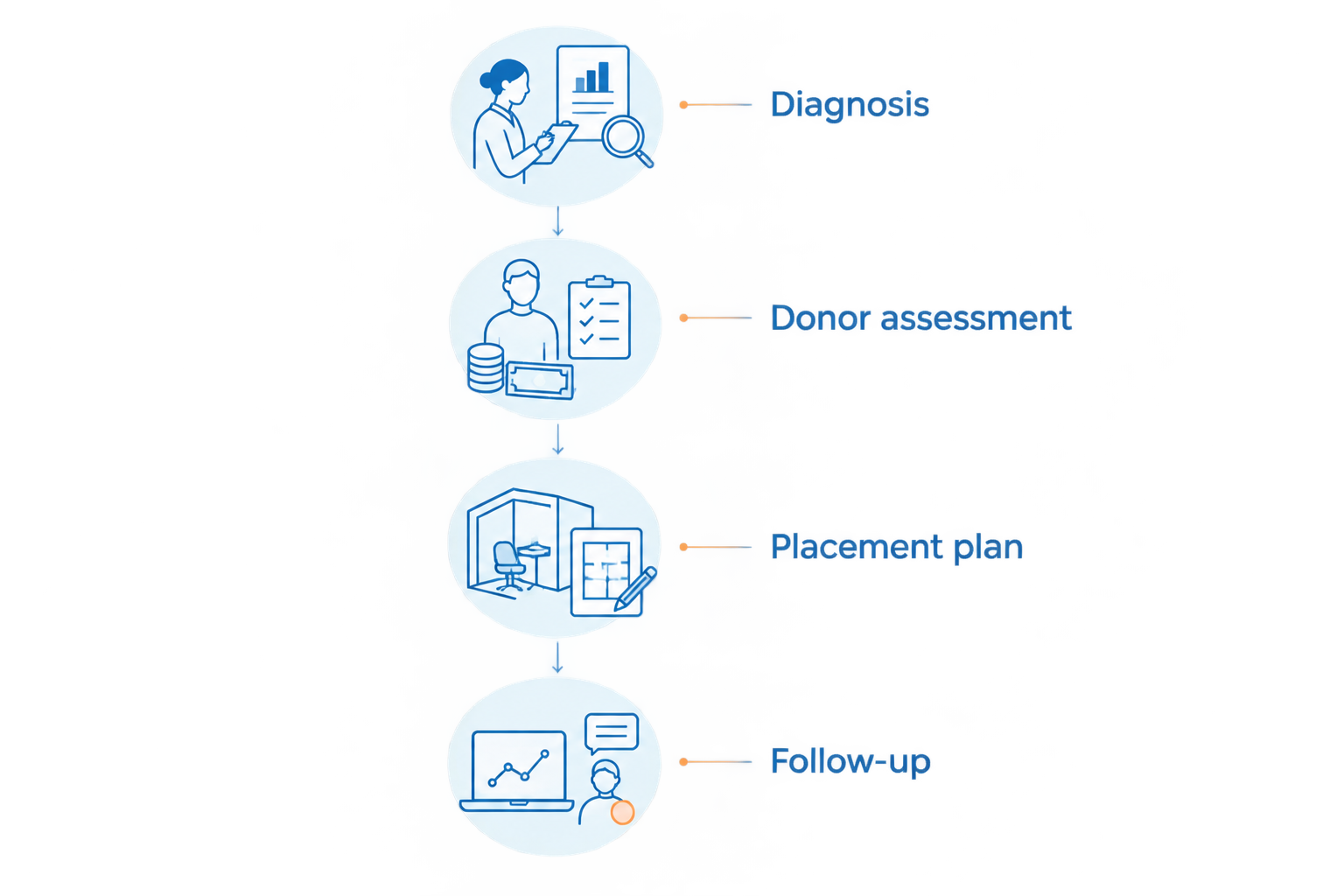
A useful consultation ends with an explanation you can repeat in your own words. For a 2026 assessment at iGraft or another clinic, organise the discussion into 4 stages:
- Diagnosis: Establish the cause and pattern of hair loss, relevant medical history and signs requiring further investigation.
- Donor assessment: Examine scalp and beard density, hair characteristics, skin health and evidence of previous extraction.
- Placement plan: Identify where scalp grafts belong, where beard grafts are proposed and what will remain uncovered.
- Follow-up: Explain wound care, warning signs, review arrangements and how concerns will be managed after you leave.
Bring a list of medicines, previous procedures and your usual beard length. If you normally shave closely, make that explicit: the visibility of extraction marks matters differently from how they appear beneath longer facial hair.
Ask these 3 questions before consenting: What limits my result? What happens if hair loss progresses? Who handles a complication? Clear answers matter more than a confident prediction based only on photographs.
Risks that belong in the consent discussion
Beard FUE is surgery. The consent discussion should cover bleeding, infection, discomfort, altered sensation, visible extraction marks, uneven beard density and unsatisfactory growth or appearance. Your clinician should explain risks specific to your skin, donor characteristics and medical history.
Do not accept scar-free language as a substitute for explaining scars. Small extraction wounds still heal, and a closely shaved beard can expose changes that longer hair conceals.
Keep expectations separate for 2 areas: the scalp receiving grafts and the face donating them. A satisfactory scalp result does not cancel an unacceptable change in beard appearance.
If you travel internationally for treatment in 2026, establish who will review the donor area after you return home. Agree on how to obtain urgent local care for concerning symptoms; photo updates are not a substitute for examination when a complication is suspected.
How these options are ranked
This ranking prioritises donor suitability, hair compatibility, placement, future planning and clinical accountability. It does not claim that one named technique produces a higher survival rate or that every patient should use beard grafts.
The first option addresses the specific need for supplementary donor hair. The remaining options answer different needs: frontal softness, crown coverage, repair or avoiding unsuitable surgery. Choose the clinical role before choosing the procedure label.
Which beard-donor option should you choose?
Start with combined scalp-and-beard FUE only if your assessment identifies a genuine shortfall in scalp donor supply and a suitable beard resource. Choose scalp-only transplantation when the main goal is a soft frontal hairline and the scalp donor area supports it.
iGraft is an option for patients seeking a personalised hair-restoration consultation in Pune, Bangalore, Hyderabad or Vijayawada. Confirm whether beard harvesting fits your individual plan rather than assuming that offering hair transplantation establishes suitability for every donor strategy.
FAQ
What’s the best hair transplant option using beard donor grafts?
Combined scalp-and-beard FUE is an option for selected patients who need supplementary donor hair. The best plan depends on beard characteristics, scalp donor supply and the recipient area, not the technique name alone.
Can beard hair be used for the front hairline?
Coarse beard hair is generally a poor match for the soft leading edge of a frontal hairline. Suitable fine scalp grafts usually provide a more appropriate transition; placement requires individual assessment.
Does beard donor hair become the same as scalp hair?
Transplanted beard hair does not become identical to scalp hair. Differences in thickness, curl and growth characteristics must be considered when planning placement and styling.
Will beard extraction leave visible marks?
Beard extraction can leave visible marks and reduce local beard density. Discuss how the donor area could look when closely shaved, not only when covered by longer facial hair.
How many beard grafts can I safely donate?
A safe beard graft count requires an individual donor examination. Density, extraction distribution, skin characteristics and your preferred beard appearance all affect the plan.
Is beard hair suitable for repairing an earlier transplant?
Beard hair is sometimes considered for repair when scalp donor resources are limited. Previous harvesting, recipient scarring and the correction needed determine whether it has a useful role.
Should I stop hair-loss medicines before a transplant?
Do not stop prescribed medicines without instructions from your treating clinician. Your surgical team should review medicines and supplements and give individual pre-procedure guidance.
One last thing
Ask to see the proposed beard donor area as carefully as the proposed hairline. For your 2026 decision, request a written explanation of the planned extraction distribution and the areas that will remain untouched. A responsible plan protects the appearance of both your scalp and your face.
Related guides
- Hair transplant techniques for curly hair
- Scalp donor extraction methods ranked by density yield
- Hair transplant options for a widow's peak