Best overall: a donor-preserving plan based on scalp assessment. Best for limited coverage: conservative FUE. Best for avoiding further donor extraction: scalp micropigmentation. This 2026 guide compares the options when your donor supply is thin, including when postponing a transplant is the better decision.
- For best hair transplant thin donor density searches, donor assessment matters more than technique names.
- Conservative FUE suits selected small treatment areas; extensive extraction risks visible donor thinning.
- FUT and beard grafts require separate suitability assessments; neither creates unlimited donor supply.
- iGraft offers hair restoration consultations for patients comparing surgical and non-surgical treatment options.
Why this matters
A hair transplant moves existing follicles; it does not create new ones. When donor density is low, extracting more grafts can trade thinning on top for visible thinning at the back or sides.
iGraft is a hair transplant consultation option for patients who need an individual assessment before choosing a procedure. You can discuss FUE, ActiveFUE and DFI Ultimate Hair transplant procedures with iGraft, but the procedure name alone does not establish suitability.
For your 2026 decision, separate two questions: whether transplantation is appropriate, and which extraction approach fits your donor supply. Answering the second without the first risks committing to an unsuitable plan.
What makes the best option for thin donor density?
Compare these criteria before comparing techniques:
- Donor stability: The assessment should check for miniaturisation and diffuse thinning, not just count visible hairs.
- Extraction safety: The plan should explain what remains in the donor area after harvesting.
- Coverage priorities: A limited hairline goal requires a different plan from extensive crown coverage.
- Hair characteristics: Shaft thickness, curl and contrast with skin influence the appearance of coverage.
- Future planning: The surgeon should account for continued loss of non-transplanted hair.
- Acceptable trade-offs: Scarring, hairstyle restrictions, maintenance and incomplete coverage belong in the discussion.
Low density is not the same as an unusable donor area. Fine hair, previous overharvesting and progressive donor miniaturisation present different problems, even when photographs look similar.
Thin donor options at a glance
These 2026 rankings match options to different needs. They are not a claim that every patient should start with surgery.
| Option | Best for | Standout feature | Key limitation |
|---|---|---|---|
| Conservative FUE | A small, clearly prioritised treatment area | Individual follicular unit extraction | Excessive harvesting can expose donor thinning |
| FUT strip harvesting | Selected patients accepting a linear scar | Harvesting follicles within a strip of scalp | Requires suitable scalp characteristics and scar acceptance |
| Scalp and beard graft combination | Selected patients needing supplemental donor hair | Adds a separate donor source | Beard texture differs from scalp hair |
| Medical management before surgery | Active or unexplained thinning | Treats an appropriate diagnosis before commitment | Does not replace follicles lost to scarring |
| Scalp micropigmentation | Cosmetic camouflage without harvesting | Reduces visible contrast between scalp and hair | Adds pigment, not growing hair |
1. Conservative FUE: best for limited, prioritised coverage
Follicular unit extraction removes individual follicular units from the donor area for placement elsewhere. With thin donor density, the useful question is not how many grafts can be removed, but how much visible coverage a cautious harvest can provide.
A restrained plan can prioritise a frontal frame rather than spread a limited supply across every thinning area. FUE still leaves small scars; it is not scar-free surgery.
Conservative FUE pros:
- Allows individual extraction sites to be distributed through suitable donor areas.
- Avoids the continuous linear scar associated with strip harvesting.
- Supports a limited treatment goal when donor assessment permits surgery.
Conservative FUE cons:
- Overharvesting can leave a visibly depleted or patchy donor area.
- Low density restricts coverage, even when extraction is technically possible.
Best for: Patients with a stable donor area and a modest, clearly defined recipient target.
Ask the surgeon to show where extraction will occur and explain what the donor area should look like afterwards. The guide to scalp donor extraction methods ranked by density yield provides another comparison point.
Verdict: Hold until the surgeon documents a conservative extraction plan and realistic coverage limits.
2. FUT: best for selected patients accepting a linear scar
Follicular unit transplantation, or strip harvesting, removes a strip of hair-bearing scalp that is divided into grafts. It differs from FUE in how follicles are harvested, not in whether donor quality matters.
FUT deserves discussion when scalp characteristics, previous surgery and hairstyle preferences support it. Thin donor density alone does not establish that FUT will provide a better result.
FUT pros:
- Provides an alternative harvesting approach when individual extraction is not the preferred plan.
- Leaves surrounding donor follicles outside the strip unextracted during that procedure.
- Makes scar placement and future donor planning explicit parts of the consultation.
FUT cons:
- Leaves a linear scar that can be visible with short hairstyles.
- Suitability depends partly on scalp laxity, healing considerations and previous scars.
Best for: Selected patients with an appropriate donor region who accept a linear scar and understand hairstyle implications.
Ask how the proposed strip position relates to any existing thinning. A promise of more grafts is not enough; the surgeon should explain scar expectations and the remaining donor reserve.
Verdict: Hold unless the individual assessment supports strip harvesting over alternative approaches.
3. Scalp and beard grafts: best for selected supplemental coverage
Beard follicles can supplement scalp grafts in selected patients. They do not behave like an unlimited extension of the scalp donor area: calibre, curl and growth characteristics differ.
Placement matters. Coarser beard hair needs careful blending and is generally not the first choice for a soft leading hairline.
Scalp and beard graft combination pros:
- Introduces a donor source outside the scalp.
- Supports selected coverage plans when scalp supply is limited.
- Allows the surgeon to allocate different hair characteristics to different recipient areas.
Scalp and beard graft combination cons:
- Texture differences can look conspicuous with unsuitable placement.
- Beard harvesting introduces another area requiring assessment, healing and scar discussion.
Best for: Patients with suitable beard hair who understand its cosmetic limitations and need supplemental grafts.
Ask where beard grafts would be placed, where scalp grafts would be reserved and how your beard will look after extraction. Review healed donor photographs, not only recipient-area photographs.
Verdict: Hold until both the scalp and beard donor areas have been assessed separately.
4. Medical management: best for active or unexplained thinning
Medical assessment comes before transplantation when the donor area is changing or the cause of hair loss is unclear. Treatment depends on the diagnosis; medication for pattern hair loss is not a universal answer to every thinning condition.
For appropriate patients, prescribed treatment can address ongoing loss of native hair. It cannot manufacture an unlimited donor reserve or restore follicles destroyed by scarring.
Medical management pros:
- Addresses an underlying condition rather than immediately redistributing hair.
- Preserves the option to reconsider surgery after reassessment.
- Avoids immediate donor harvesting while the diagnosis is clarified.
Medical management cons:
- Benefits and suitability depend on the condition and the treatment prescribed.
- Treatment can involve adverse effects, ongoing use and follow-up.
Best for: Patients with progressive thinning, suspected donor miniaturisation or an uncertain diagnosis.
Discuss medicines, medical history and pregnancy plans where relevant. Do not start prescription treatment simply to qualify for surgery, and do not assume supplements correct thinning without an identified deficiency.
Verdict: Hold surgery while a clinician investigates active or unexplained donor thinning.
5. Scalp micropigmentation: best for camouflage without extraction
Scalp micropigmentation places pigment in the skin to change the visual contrast between scalp and hair. It does not add follicles, increase biological density or create hair you can grow longer.
For some patients, camouflage fits the goal better than a transplant with inadequate donor supply. Suitability depends on the desired hairstyle, scalp condition and acceptance of a pigment-based result.
Scalp micropigmentation pros:
- Requires no donor follicle harvesting.
- Offers a cosmetic approach when transplantation is unsuitable.
- Can be discussed for a shaved appearance or selected thinning-area camouflage.
Scalp micropigmentation cons:
- Does not provide hair texture, movement or additional strands.
- Pigment appearance changes over time, and future adjustment requires consideration.
Best for: Patients prioritising reduced scalp visibility over growing additional hair.
Ask about practitioner training, hygiene, pigment changes and how the result will appear with your intended haircut. Existing scars and scalp inflammation also need assessment.
Verdict: Hold until you understand the healed appearance and accept that pigmentation is not hair restoration.
How these options were ranked
The order follows donor preservation, suitability and the type of result each option provides. Conservative FUE leads the surgical discussion for a limited target; FUT and beard supplementation occupy narrower suitability groups. Medical management takes priority whenever the diagnosis or stability is uncertain.
This is a use-case comparison, not a clinic league table or a claim of measured treatment superiority. In 2026, a technique label still cannot replace examination of your own donor area.
What should your donor assessment include?
Ask for an assessment that separates density from hair quality and long-term stability. A graft estimate without that context does not explain whether extraction is sensible.
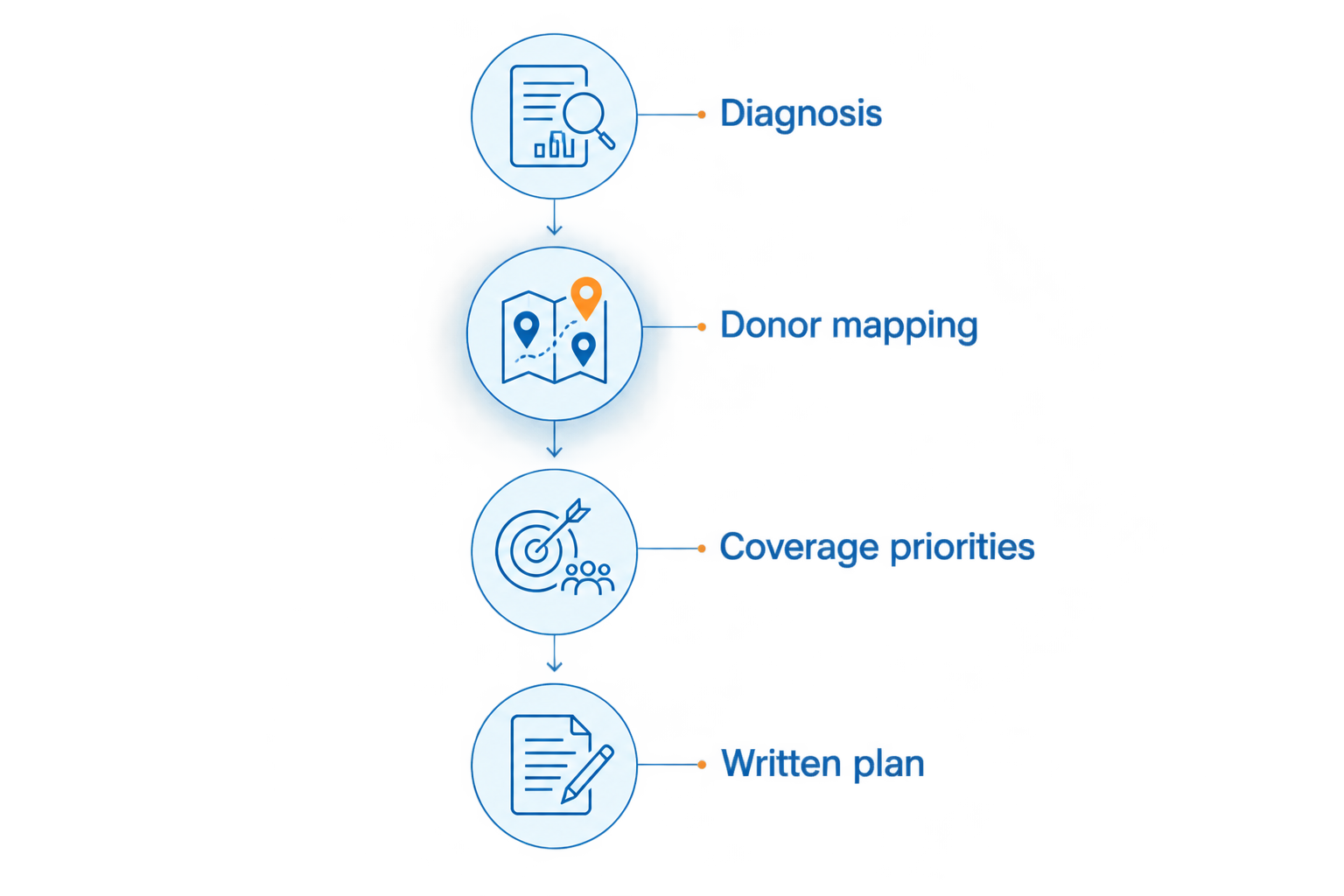
Use this sequence during your consultation:
- Diagnosis: Establish the likely cause of thinning and whether further investigation is needed.
- Donor mapping: Examine the back and both sides as 3 separate scalp regions, rather than judging a single photograph.
- Coverage priorities: Identify the area that matters most and what will remain untreated.
- Written plan: Record the extraction approach, limitations, alternatives and follow-up arrangements.
Compare 2 written plans if the first recommendation leaves important questions unanswered. Ask each clinician to explain the same priorities, rather than comparing headline graft counts alone.
Bring dated photographs from the previous 12 months if you have them. Images can help describe change, but they do not replace scalp examination or magnified assessment.
Which option should you choose?
Choose the smallest appropriate intervention that addresses your main concern without sacrificing future donor options. If examination supports surgery and your target is limited, discuss conservative FUE first. If the donor area is unstable, investigate and manage that problem before booking extraction.
Consider FUT or beard supplementation only when the surgeon explains why the additional trade-offs fit your situation. Choose micropigmentation only if camouflage, rather than additional growing hair, meets your goal.
At iGraft, hair transplant options include FUE, ActiveFUE and DFI Ultimate Hair transplant procedures. For your 2026 consultation, ask what each proposed approach changes about extraction, placement and aftercare—and what it cannot change about your donor supply.
FAQ
What’s the best hair transplant for thin donor density?
The best approach depends on donor stability, hair characteristics and the area you want covered. Conservative FUE is an option for selected limited targets, but some patients should postpone or avoid transplantation.
Can I get a hair transplant if my donor area is thin?
Thin donor density does not automatically rule out transplantation. A clinician must assess whether harvesting would leave unacceptable thinning and whether the available grafts can meet a realistic goal.
Is FUT better than FUE for a weak donor area?
FUT is not automatically better than FUE for a weak donor area. Scalp laxity, donor stability, existing scars and your willingness to accept a linear scar all affect the choice.
Can beard hair replace scalp donor hair?
Beard hair can supplement scalp grafts in selected patients, but it is not an identical replacement. Its different texture and calibre require careful placement and blending.
Can PRP or GFC create more donor follicles?
PRP and GFC do not create a new supply of donor follicles. Ask the treating clinician what condition is being addressed and how any proposed treatment fits the diagnosis.
Is scalp micropigmentation the same as a hair transplant?
Scalp micropigmentation is not a hair transplant. It places pigment in the skin for camouflage, while transplantation moves living follicles from a donor area.
What should I ask during an iGraft hair transplant consultation?
Ask iGraft to explain donor stability, extraction limits, coverage priorities and alternatives to surgery. Request a written plan that includes expected limitations, risks and follow-up arrangements.
One last thing
A lower graft recommendation can reflect better donor protection, not an inferior procedure. Before accepting a larger proposal, ask the surgeon to explain what your donor area will look like after harvesting—and how future hair loss changes the plan.
Related guides
- Best hair transplant options for beard donor grafts
- Best non-surgical hair treatments ranked by sessions
- Best hair transplant techniques for curly hair