Best overall: a gentle shampoo with a rinse-out conditioner. Best for dandruff: an anti-dandruff shampoo with conditioner on the lengths. Best for breakage: a mild shampoo paired with a richer conditioner. The best shampoo for hair fall control in 2026 depends on whether you have scalp irritation, snapping strands or hair shedding from the root.
- The best shampoo for hair fall control matches your scalp; conditioner helps reduce friction and breakage.
- Choose anti-dandruff shampoo for dandruff, not as a universal treatment for thinning hair.
- iGraft hair loss assessments suit people with persistent shedding, a widening part or a receding hairline.
- Shampoo and conditioner support hair care; they do not replace treatment for diagnosed hair loss.
Why this matters
Hair in your shower does not identify the cause of hair fall. Short, broken pieces suggest shaft damage; shedding of full-length hairs needs a different assessment. You can also have both problems together.
iGraft hair loss assessments are best for people whose persistent shedding or visible thinning needs a diagnosis rather than another shampoo. iGraft offers physical-clinic consultations and computerized hair checkups. A shampoo label cannot establish why your hair is thinning.
This 2026 guide ranks formulation types rather than individual bottles. Choose the category that matches your symptoms, then check the actual product label for ingredients, directions and warnings. No shampoo earns a recommendation simply by putting anti-hair-fall on its packaging.
What makes the best shampoo for hair fall control?
Judge your shampoo and conditioner against these criteria before choosing:
- Scalp fit: The cleanser should suit an oily, dry, sensitive or dandruff-prone scalp without leaving persistent irritation.
- Breakage control: Conditioner should improve slip and detangling, reducing unnecessary pulling through the lengths.
- Relevant ingredients: An anti-dandruff active serves a different purpose from a conditioning ingredient. Match the ingredient to the problem.
- Tolerability: Burning, redness or worsening itch are reasons to stop and reassess, not signs that a formula is working.
- Realistic claims: Cleansing and conditioning are not equivalent to reversing pattern hair loss or restoring lost follicles.
- Usable directions: You should know where to apply each product, how to rinse it and whether special precautions apply.
A useful starting point is a 2-product routine: shampoo for the scalp and rinse-out conditioner for the lengths. Add another product only when it has a clear purpose.
Shampoo and conditioner options at a glance
| Rank and option | Best for | Standout feature | Key limitation |
|---|---|---|---|
| 1. Gentle shampoo + rinse-out conditioner | Routine washing without a specific scalp disorder | Separates scalp cleansing from length conditioning | Does not treat an underlying cause of shedding |
| 2. Anti-dandruff shampoo + length conditioner | Flaking and dandruff-related itch | Includes an active intended to control dandruff | Not a general hair-regrowth treatment |
| 3. Mild shampoo + richer conditioner | Tangling and breakage in dry or damaged lengths | Improves slip during detangling | Cannot restore lost follicle density |
| 4. Fragrance-free shampoo + fragrance-free conditioner | People avoiding fragrance because of sensitivity | Removes fragrance from the routine | Other ingredients can still irritate |
| 5. Clarifying shampoo + rinse-out conditioner | Noticeable styling-product buildup | Provides stronger cleansing when needed | Can leave dry or damaged hair feeling rougher |
1. Gentle shampoo: best for everyday hair care
A gentle shampoo cleans the scalp without making aggressive cleansing the goal. Pair it with a rinse-out conditioner that leaves your lengths easier to detangle, rather than choosing both products solely because they promise hair fall control.
This is the default recommendation for your 2026 routine when you do not have persistent flaking, redness or another diagnosed scalp condition. It keeps cleansing straightforward while you assess whether the main problem is breakage or shedding.
Gentle shampoo pros
- Provides a practical baseline for evaluating how your scalp responds.
- Works alongside a conditioner chosen for your hair's texture and damage level.
- Avoids treating every episode of hair fall as dandruff.
Gentle shampoo cons
- Does not address pattern hair loss, nutritional deficiency or other medical causes of shedding.
- The word gentle on a label does not guarantee personal tolerance.
Best for: People seeking a straightforward washing routine without clear signs of a scalp disorder.
Choose by your response after washing. A comfortable scalp and manageable lengths matter more than abundant foam, a cooling sensation or a strong perfume. Sulfate-free alone is not a complete measure of suitability; the entire formula matters.
Verdict: Buy a gentle shampoo and compatible conditioner as your default routine, not as a hair-regrowth treatment.
2. Anti-dandruff shampoo: best for flaking and scalp itch
An anti-dandruff shampoo targets dandruff rather than hair loss in general. Depending on the product and local labelling, it contains an active such as ketoconazole or selenium sulfide; follow that specific product's directions and warnings.
Condition the lengths separately if they feel dry or tangled. Do not mix the medicated shampoo with conditioner in your hand, because that changes how you apply the product and makes its directions harder to follow accurately.
Anti-dandruff shampoo pros
- Addresses flaking when dandruff is the relevant problem.
- Gives you an ingredient-specific purpose rather than a broad cosmetic claim.
- Allows separate conditioning of dry ends.
Anti-dandruff shampoo cons
- Does not treat every cause of scalp itch or scaling.
- Some formulations cause dryness or irritation and need reassessment.
- Controlling dandruff does not establish that the cause of thinning has been treated.
Best for: People with dandruff, ideally with professional guidance when symptoms persist or the diagnosis is uncertain.
Read the contact-time instructions instead of immediately rinsing every formula in the same way. Do not copy an application schedule from a different active or a different bottle. Seek assessment for painful inflammation, sores, discharge or patchy loss rather than repeatedly changing dandruff shampoos.
Verdict: Buy for dandruff; skip as a stand-alone solution for unexplained thinning.
3. Mild shampoo and richer conditioner: best for breakage
Dry, chemically treated or heat-damaged lengths often need better conditioning rather than stronger cleansing. A richer rinse-out conditioner can improve slip and reduce friction during detangling, helping limit additional mechanical damage.
This pairing is the best shampoo-and-conditioner approach when snapping strands are your main concern. It is not a treatment for follicles producing progressively finer hair.
Mild shampoo and richer conditioner pros
- Makes tangled lengths easier to handle without forceful pulling.
- Supports hair that feels rough after colouring, bleaching or heat styling.
- Lets you concentrate conditioning where damage is most noticeable.
Mild shampoo and richer conditioner cons
- Rich conditioner can weigh down fine hair or leave an unwanted coating.
- Cosmetic improvement does not mean damaged hair has returned to its original condition.
- Reduced breakage does not prove reduced shedding from the root.
Best for: People noticing short snapped pieces, persistent tangling or rough, damaged lengths.
Apply conditioner to the lengths and ends, following its label. Detangle gently rather than dragging a brush through resistance. If your hair becomes limp or coated, adjust the conditioner or application area instead of assuming you need to stop conditioning altogether.
Your 2026 routine should also address the source of damage. Repeated high heat, harsh handling and tight hairstyles can undermine the benefit of a better wash routine.
Verdict: Buy for breakage and manageability; skip claims that conditioner restores lost scalp density.
4. Fragrance-free pairing: best for fragrance avoidance
A fragrance-free shampoo and conditioner suit people who need to remove fragrance from their routine because of sensitivity or professional advice. This is a tolerance-led choice, not an extra-strength hair fall treatment.
Check both labels. Choosing a fragrance-free shampoo while keeping a heavily fragranced conditioner does not achieve the same goal.
Fragrance-free pairing pros
- Removes fragrance as a deliberate ingredient choice from both washing steps.
- Helps simplify a routine when investigating product-related irritation.
- Keeps scalp comfort separate from unsupported regrowth promises.
Fragrance-free pairing cons
- Preservatives, cleansing agents or other ingredients can still cause a reaction.
- Fragrance-free does not automatically mean suitable for every sensitive scalp.
- Persistent dermatitis needs assessment, not endless product substitutions.
Best for: People with a known fragrance sensitivity or advice to avoid fragranced hair products.
Do not treat natural, herbal or essential-oil based as substitutes for fragrance-free. Botanical ingredients can also cause contact reactions. An unscented description does not necessarily answer every question about fragrance ingredients, so inspect the label rather than judging by smell alone.
Change 1 product at a time when assessing tolerance, unless your clinician advises otherwise. This makes the connection between a new product and a reaction easier to identify.
Verdict: Buy when fragrance avoidance is relevant; hold if you are expecting a direct effect on regrowth.
5. Clarifying shampoo: best for styling-product buildup
Clarifying shampoo provides stronger cleansing for hair affected by accumulated styling products or coatings. Pair it with conditioner when your lengths need slip after washing.
This is a targeted cleansing option, not the default answer to oily roots or hair fall. A very clean feeling does not show that follicles are healthier or that shedding has stopped.
Clarifying shampoo pros
- Helps remove buildup that ordinary washing is not adequately clearing.
- Offers a specific role for people using coating or styling products.
- Can help you reassess whether heaviness comes from your routine.
Clarifying shampoo cons
- Strong cleansing can leave dry or damaged lengths feeling rough.
- It does not treat pattern hair loss or unexplained shedding.
- Some formulas are unsuitable for particular colour treatments; check the label.
Best for: People with a clear buildup problem rather than those seeking a general anti-hair-fall solution.
Do not set a universal clarifying schedule from someone else's routine. Your styling products, scalp response and hair condition determine whether this category belongs in your bathroom. If washing leaves persistent tightness or burning, stronger cleansing is not the next step.
Verdict: Hold until you have a clear buildup problem; skip as a routine hair-loss treatment.
How we ranked these options
The 2026 ranking prioritizes scalp fit, breakage control, relevant ingredients, tolerability and realistic claims. Gentle cleansing takes the default position because it does not assume a scalp diagnosis; the other options fill specific needs.
These are formulation-based recommendations, not results from a head-to-head product trial. A bottle's hair fall control wording does not move it above a better-matched cleanser and conditioner.
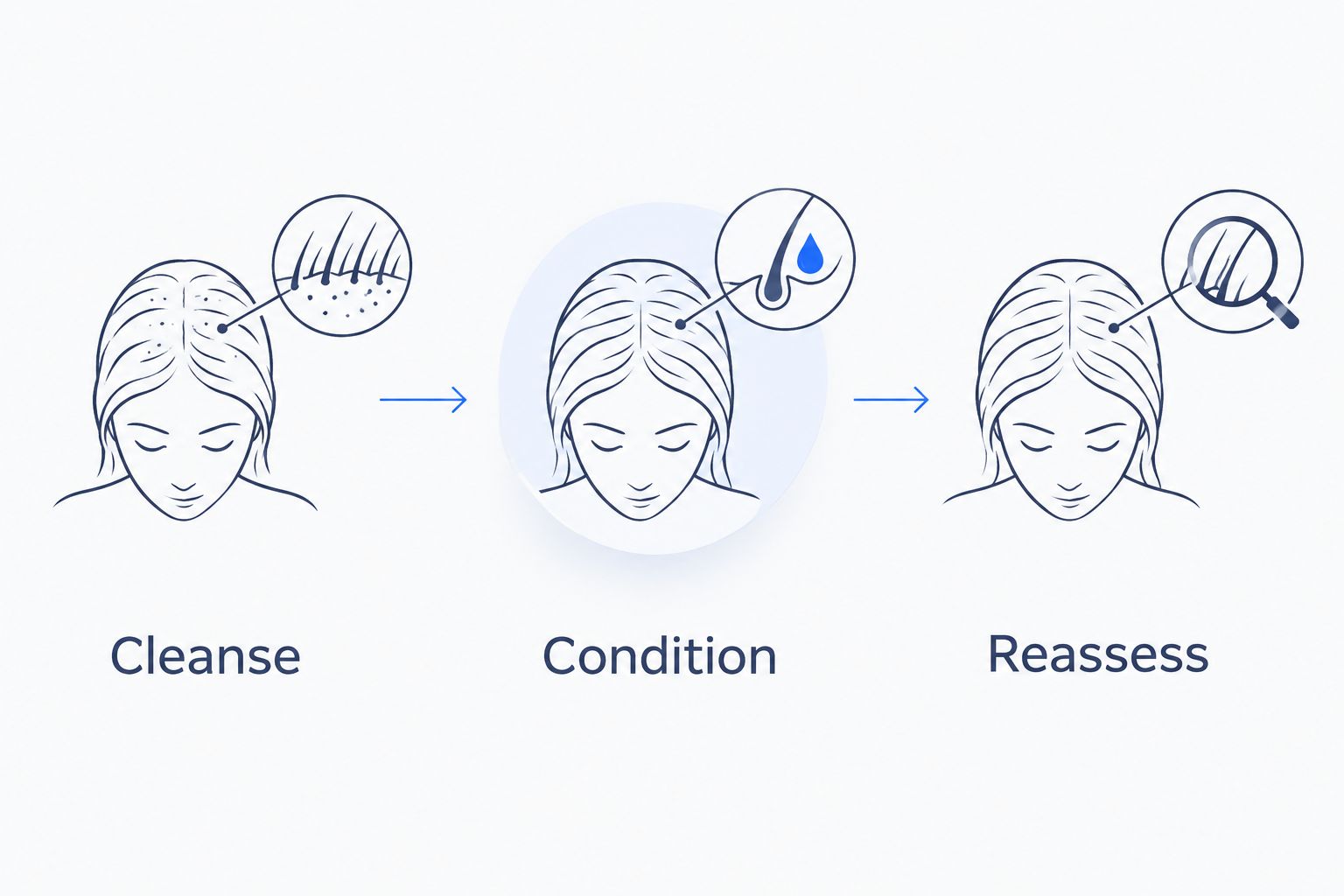
Use your shampoo and conditioner in 3 steps
- Cleanse: Apply shampoo as directed, focusing on the scalp rather than aggressively scrubbing the lengths. Follow any medicated-product instructions exactly.
- Condition: Apply rinse-out conditioner where your hair needs slip, usually through the lengths and ends. Rinse according to the label.
- Reassess: Notice scalp comfort, tangling and visible changes in density separately. Improvement in softness does not establish improvement in hair loss.
Avoid repeatedly pulling at your hair to test shedding. If you notice a widening part, receding hairline, bald patches or persistent scalp symptoms, arrange an assessment rather than escalating your shampoo strength.
Which shampoo and conditioner should you choose?
Choose a gentle shampoo and rinse-out conditioner unless a specific scalp or hair-shaft problem points elsewhere. Choose anti-dandruff treatment for dandruff, richer conditioning for breakage, fragrance-free products for fragrance avoidance and clarifying shampoo for buildup.
For persistent hair loss in 2026, iGraft offers clinician assessment and computerized diagnostics. The useful next move is identifying the cause, not adding another product with the same broad claim.
Assess your hair loss
Explore clinic-based assessment for persistent shedding, thinning or scalp concerns.
FAQ
What’s the best shampoo for hair fall control?
The best shampoo for hair fall control matches your scalp condition; a gentle shampoo is the default when no specific scalp disorder needs treatment. Pair it with conditioner for the lengths, and investigate persistent shedding rather than relying on the label’s claim.
Can shampoo stop hair falling from the root?
Ordinary shampoo does not treat all causes of hair shedding from the root. Pattern hair loss, illness-related shedding and other conditions need cause-specific assessment and treatment.
Is conditioner bad for hair fall?
A suitable conditioner helps reduce friction and makes detangling easier; it is not inherently bad for hair fall. Stop a product that causes irritation, and distinguish hair released during washing from breakage caused by rough handling.
Should I choose an anti-dandruff shampoo for thinning hair?
Choose an anti-dandruff shampoo when dandruff is present, not simply because your hair is thinning. Dandruff and pattern hair loss can coexist, so improvement in flaking does not confirm that thinning has been treated.
Is sulfate-free shampoo always better for hair fall?
Sulfate-free shampoo is not automatically better for hair fall. Suitability depends on the complete formula, your scalp response and the underlying cause of hair loss.
How often should I wash my hair if it is falling out?
Choose washing frequency according to scalp oiliness, activity, hair texture and any treatment instructions. Do not avoid necessary washing solely because shed hairs become visible in the shower.
When should I see a doctor instead of changing shampoo?
Seek assessment for sudden or patchy loss, progressive thinning, persistent shedding or an inflamed scalp. iGraft hair loss consultations include physical-clinic assessment and computerized hair checkups; a clinician determines the appropriate next step.
One last thing
A softer ponytail and a denser scalp are different outcomes. Conditioner can improve how existing strands feel without changing the number of hairs growing from your scalp.
Keep those goals separate. Choose hair care for cleansing and manageability; seek diagnosis for persistent loss.
Related guides
- Hair loss treatments for women
- Hair loss treatments for men
- Treatments for crown baldness
- Treatments for a receding hairline