Best overall: a diagnosis-led plan, not a fixed treatment package. Best for an established medication backbone: GFC and microneedling considered alongside prescribed minoxidil. Best for an irritated scalp: treat the scalp condition before considering either procedure. This 2026 guide explains how to choose the best GFC microneedling combination therapy without confusing more procedures with better care.
- The best GFC microneedling combination therapy starts with a diagnosis, not a package or session count.
- Minoxidil has an established role in pattern hair loss; adding GFC and microneedling needs separate justification.
- An inflamed or infected scalp needs assessment before elective scalp procedures.
- iGraft offers GFC and hair restoration consultations; ask whether microneedling fits your individual treatment plan.
Why this matters
GFC, or growth factor concentrate, and microneedling are different interventions. GFC involves a blood-derived preparation; microneedling creates controlled punctures in the skin. Combining them does not establish that the combination is necessary, better than either treatment alone, or appropriate for your diagnosis.
Hair loss also has different causes. Pattern hair loss, temporary shedding, inflammatory disease and scarring alopecia need different decisions—not the same package with a different session count.
iGraft is best suited to patients seeking a clinic consultation about GFC and hair restoration. You can explore iGraft before arranging an individual assessment. Confirm whether microneedling is offered and clinically appropriate rather than assuming every advertised hair treatment belongs together.
What makes the best GFC and microneedling combination?
Use these criteria to compare treatment proposals in 2026:
- A named diagnosis: The clinician explains what is causing your hair loss and what findings support that conclusion.
- A reason for each component: GFC, microneedling and any medication each have a defined purpose. “Better absorption” alone does not justify needling an injectable preparation into the scalp.
- A scalp safety assessment: Infection, inflammation, wounds and suspicious lesions are assessed before an elective procedure.
- Evidence matched to the treatment: Findings about PRP, minoxidil or microneedling are not presented as proof for every GFC protocol.
- Measurable follow-up: Standardised photographs and clinical assessment guide continuation, changes or stopping.
- A workable aftercare plan: You know when to wash, resume topical products and contact the clinic about unexpected symptoms.
A useful consultation also identifies what treatment cannot achieve. Increasing the number of procedures does not create new donor hair or reverse every cause of follicle loss.
GFC and microneedling pathways at a glance
These are ranked care pathways, not named clinic packages. The order prioritises diagnosis, established treatment options and procedural safety—not a claim that one GFC protocol produces the most regrowth.
| Rank and pathway | Best for | Standout feature | Key limitation |
|---|---|---|---|
| 1. Medication-supported assessment | Diagnosed pattern hair loss when minoxidil is appropriate | Keeps an established treatment option central to the plan | The added benefit of GFC and microneedling still needs justification |
| 2. Procedure-only assessment | Patients unable or unwilling to use medication after counselling | Makes medication limitations part of the decision | Procedures are not proven equivalent replacements for established medication |
| 3. Staged scalp-first care | Patients with active scalp symptoms | Addresses the barrier to safe elective treatment first | GFC and microneedling must wait until the clinician considers the scalp suitable |
1. Medication-supported care: best for diagnosed pattern hair loss
For a patient with confirmed pattern hair loss, start by discussing established medical treatment. Topical minoxidil has an established role in this condition; whether GFC and microneedling add enough value is a separate decision.
This pathway does not mean applying minoxidil during or immediately after microneedling. Needling changes the skin barrier, so your clinician must specify product timing and aftercare rather than leaving you to combine treatments yourself.
What the plan should establish
Ask which intervention is the main treatment and which is an adjunct. If the explanation cannot separate their purposes, you cannot judge what you are agreeing to—or what should happen if the plan fails.
Minoxidil also requires counselling about suitability, irritation, unwanted hair growth and ongoing use. A prescription decision should account for pregnancy or breastfeeding, cardiovascular history and other medicines where relevant.
Medication-supported care pros:
- Gives diagnosed pattern hair loss an established medication option.
- Separates the rationale for medication from the rationale for procedures.
- Allows the clinician to review tolerance before adding treatment complexity.
Medication-supported care cons:
- Regular application creates an ongoing treatment commitment.
- Scalp irritation can interfere with adherence.
- Adding procedures makes it harder to identify which component helped or caused a reaction.
Best for: Patients with diagnosed pattern hair loss who can use minoxidil and want a clear discussion about optional procedural additions.
2026 decision rule: Ask why GFC and microneedling are needed in addition to medication, not simply whether they can be combined.
Verdict: Hold the procedural booking until the clinician explains the added purpose and aftercare.
2. Procedure-only assessment: best when medication is unsuitable
A procedure-focused consultation is relevant when a patient cannot tolerate medication, has a contraindication, or declines it after informed discussion. That does not make GFC plus microneedling an equivalent substitute.
The clinician still needs to explain the expected benefit, uncertainty and alternatives. An inability to use one treatment is not evidence that another will work.
What the plan should establish
Ask whether the proposed GFC preparation is intended for injection, topical application or another route. Do not assume that evidence or safety information for one route transfers to another.
Also separate GFC from platelet-rich plasma, or PRP. Both involve blood-derived preparations, but the names do not describe identical processing methods or products. A study about PRP cannot automatically validate a clinic's GFC-and-microneedling package.
Procedure-only assessment pros:
- Gives medication intolerance a proper place in treatment planning.
- Creates an opportunity to discuss non-medication options without self-prescribing.
- Encourages a defined trial with review points rather than open-ended sessions.
Procedure-only assessment cons:
- Avoiding medication does not establish that procedures will control ongoing pattern hair loss.
- Needling and injections still carry discomfort, bleeding and infection risks.
- Repeated appointments add practical demands without assuring a response.
Best for: Patients who need a clinician-led discussion of procedural options because medication is unsuitable or unacceptable after counselling.
For a 2026 treatment decision, ask what finding would make the clinician stop rather than recommend more sessions. A credible plan includes a stopping rule.
Verdict: Hold until the uncertainty, alternatives and review criteria are clear.
3. Staged scalp-first care: best for an irritated or inflamed scalp
If you have painful bumps, crusting, open wounds, marked redness or persistent itching, the next step is assessment—not elective microneedling. Scalp symptoms can reflect different conditions, and the cause determines treatment.
Staged care means treating the diagnosed scalp problem first, then reassessing whether a hair-growth procedure is appropriate. It is a sequence, not a combination performed at the same appointment.
What the plan should establish
The clinician should explain whether the symptoms come from infection, dermatitis, product irritation or another disorder. Patchy loss, scalp pain and changes suggesting scarring also need diagnostic attention before a cosmetic procedure is considered.
A cleansing product is not a substitute for that assessment. Nor should a hair-growth serum be introduced to freshly needled skin without explicit clinical instructions.
Scalp-first care pros:
- Gives active symptoms priority over elective procedures.
- Reduces confusion between an existing condition and a treatment reaction.
- Allows the hair-loss plan to be reconsidered after scalp treatment.
Scalp-first care cons:
- Delays the procedural decision.
- Does not necessarily address pattern hair loss by itself.
- Requires reassessment rather than an automatic start date for needling.
Best for: Patients whose scalp symptoms make immediate procedural treatment inappropriate pending assessment.
Verdict: Wait on GFC and microneedling; assess and treat the scalp first.
How a carefully planned treatment decision works
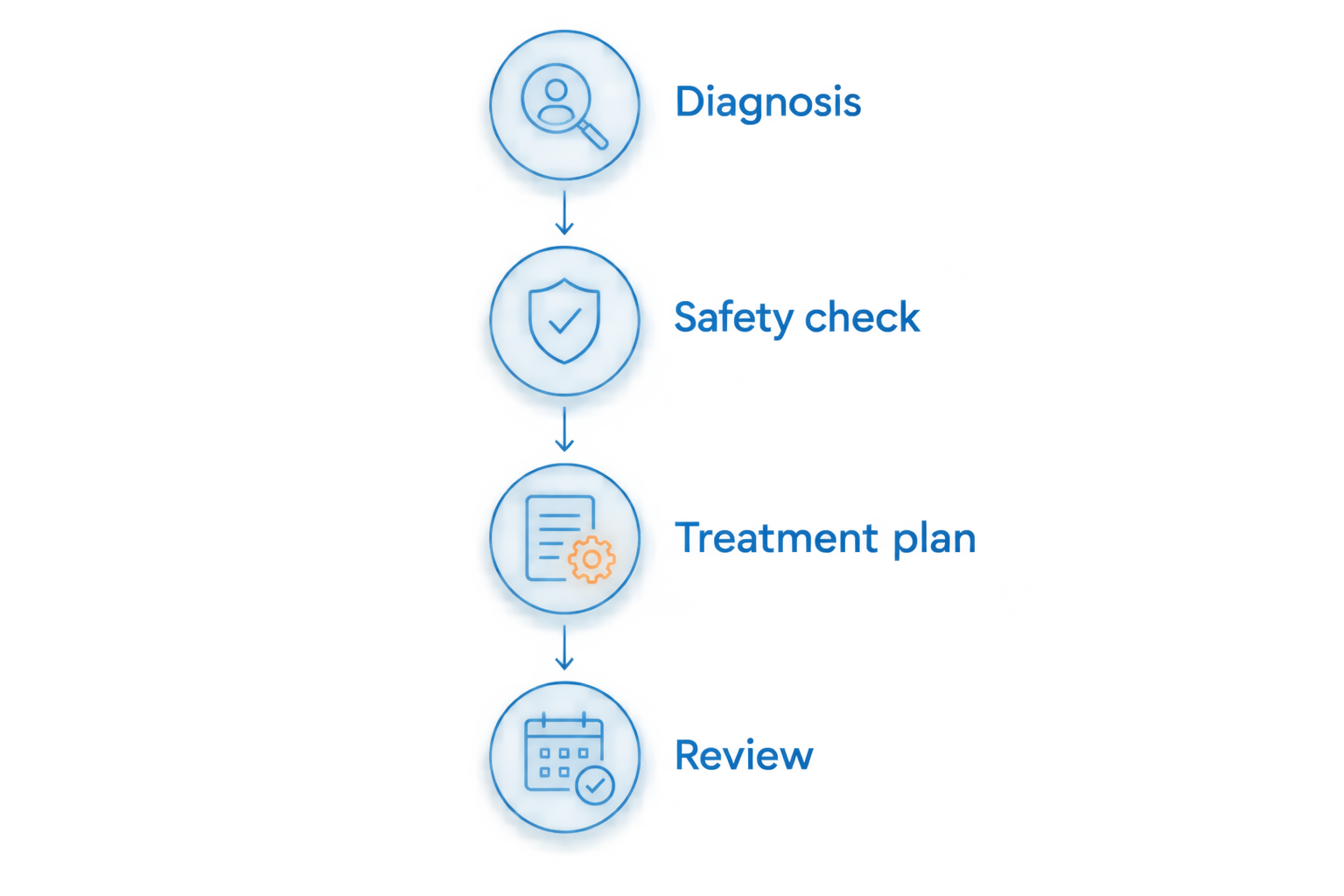
The safest sequence is straightforward: establish the diagnosis, check suitability, agree on treatment, then review the response. Do not start with a session bundle and work backwards to a diagnosis.
- Diagnosis: Describe the onset, pattern and speed of hair loss. Bring your medication history and previous treatment details.
- Safety check: Discuss scalp symptoms, bleeding problems, medicines affecting clotting, healing concerns and relevant medical conditions.
- Treatment plan: Ask why each component is included, who performs it and how the procedures are timed.
- Review: Agree on photographs, clinical reassessment and criteria for continuing, changing or stopping.
For your own records, propose photograph checkpoints at 3 months, 6 months and 12 months, then let your clinician adjust them. These are tracking suggestions, not promised response deadlines or a recommended GFC session schedule.
Use the same lighting, camera angle, hair parting and approximate hair length. Wet hair in one photograph and dry hair in another can make a comparison misleading.
Questions that expose a weak combination package
A useful 2026 comparison is between explanations, not just treatment names. Take these questions to your consultation:
- What diagnosis are you treating, and which findings support it?
- Why do I need both GFC and microneedling rather than either alone?
- Does the evidence you are describing concern this preparation and delivery method?
- Who performs each part, and who manages complications?
- What should I stop or restart, and when?
- What would make you change the plan instead of adding sessions?
Ask for written aftercare. Increasing redness, warmth, swelling, discharge, severe pain or fever after a procedure needs prompt medical advice rather than waiting for the next routine appointment.
Do not stop prescribed blood-thinning medicine on your own to qualify for treatment. The prescribing clinician and treating clinician need to coordinate that decision.
How these pathways were ranked
The ranking prioritises diagnostic clarity, an established treatment backbone where appropriate, scalp safety and measurable follow-up. It does not rank GFC brands, claim direct comparative testing or assign a universal session count.
Medication-supported care comes first for suitable patients with pattern hair loss because a procedural package should not displace discussion of established medical options. Procedure-only assessment follows for patients who cannot or choose not to use medication. Scalp-first care takes priority over both whenever active disease makes elective treatment inappropriate.
Which GFC and microneedling pathway should you choose?
Choose the diagnosis-led consultation by default. If pattern hair loss is confirmed, discuss established medical treatment before deciding whether GFC and microneedling deserve a place alongside it.
If medication is unsuitable, ask for a realistic procedural discussion—not a promise that more sessions compensate for its absence. If your scalp is inflamed or painful, postpone elective needling until the cause is assessed.
At iGraft, ask how GFC fits the wider hair restoration assessment and confirm whether microneedling is appropriate for you. In 2026, the strongest treatment proposal remains the one that explains what to do, what to avoid and when to stop.
FAQ
What’s the best GFC microneedling combination therapy for hair loss?
The best GFC microneedling combination therapy is a diagnosis-led plan, not a universal package. For suitable patients with pattern hair loss, discuss established medication options and ask what separate benefit each procedure is intended to add.
Is GFC the same as PRP for hair growth?
GFC and PRP should not be treated as interchangeable preparations. Processing and delivery methods differ, so evidence about PRP does not automatically establish the effectiveness of a particular GFC protocol.
Can I apply minoxidil immediately after scalp microneedling?
Do not apply minoxidil immediately after scalp microneedling unless your treating clinician explicitly instructs you to. Needling changes the skin barrier, and product timing needs to be part of written aftercare.
How many GFC and microneedling sessions do I need?
There is no session count suitable for every patient. Your diagnosis, scalp condition, treatment response and the proposed protocol should determine the schedule and review points.
Can I have microneedling if my scalp is itchy or inflamed?
An itchy or inflamed scalp needs assessment before elective microneedling. The clinician must identify the cause and decide when the scalp is suitable for a procedure.
Can GFC and microneedling replace a hair transplant?
GFC and microneedling do not redistribute donor follicles as a hair transplant does. Suitability depends on the cause and extent of hair loss, remaining follicles and the goals of treatment.
Does iGraft provide a personalised GFC consultation?
iGraft offers GFC and hair restoration consultations. Ask the clinic to assess your diagnosis, explain suitable alternatives and confirm whether microneedling belongs in your individual plan.
One last thing
More treatment names make results harder to interpret. If you start medication, supplements, GFC and microneedling together, improvement does not reveal which component helped—and a reaction becomes harder to trace.
Ask your clinician whether a staged plan would make assessment clearer. The useful outcome is not the longest treatment list; it is a plan you can understand, follow and reassess.
Related guides
- Non-surgical hair treatments ranked by sessions
- Scalp donor extraction methods ranked by density yield
- Hair transplant options for a widow's peak