Choose iGraft if you want a hair-restoration clinic offering computerized assessment, DFI Ultimate and a stated 6-month post-procedure support period; choose Medispa India if its consulting surgeon gives you a better-supported plan for your diagnosis, donor hair and expectations. For your 2026 decision, the better clinic is the one that explains why its treatment fits you—not simply why its technique sounds different.
- iGraft vs Medispa India should turn on diagnosis, donor planning and aftercare—not procedure names alone.
- iGraft hair restoration suits patients seeking computerized assessment and the clinic’s described DFI Ultimate process.
- Choose Medispa India if its surgeon provides the better-supported individual treatment plan.
- A described graft-handling process does not establish better survival or guaranteed density.
Why this matters
A hair transplant moves existing follicles; it does not create an unlimited supply of donor hair. That makes the assessment and surgical plan more important than choosing between two clinic names.
You need separate answers to separate questions: what is causing your hair loss, whether surgery is appropriate, and how the proposed treatment protects your future options. A persuasive answer to the last question cannot replace a diagnosis.
Treat this as a consultation scorecard, not a declaration that one clinic produces better results for every patient. Compare the doctor’s reasoning, the written procedure plan and the follow-up arrangements before you commit.
At a glance: the 2026 comparison
The distinction below is between stated service details and the individual evidence you should require. A named technique establishes what a clinic calls its procedure; it does not establish which clinic will deliver your better outcome.
| Dimension | iGraft | Medispa India |
|---|---|---|
| Best for | Patients seeking computerized assessment, surgical and nonsurgical options | Patients whose consultation produces a better-supported individual plan |
| Diagnosis | States that it uses follicular-level scans and computerized diagnostics | Ask for the diagnosis and findings supporting the recommendation |
| Standout feature | Clinic-described DFI Ultimate graft extraction, holding and implantation process | Establish the proposed technique and surgeon’s rationale during consultation |
| Donor planning | Require a written donor assessment alongside the technique recommendation | Require the same donor assessment before comparing proposals |
| Treatment choice | Lists ActiveFUE, DFI Ultimate and nonsurgical hair treatments | Confirm which options suit your diagnosis and why |
| Surgical responsibility | Confirm who performs each stage and handles clinical decisions | Confirm the same responsibilities with the consulting surgeon |
| Aftercare | States a 6-month post-procedure support period | Confirm follow-up arrangements and escalation procedures in writing |
| Pricing model | States transparent per-graft pricing; clarify the complete treatment scope | Confirm whether the proposal is per graft, package-based or otherwise structured |
Computerized assessment makes the first consultation relevant
For patients who want a scan-led starting point, the client clinic’s stated use of follicular-level scans and computerized diagnostics is relevant. The practical benefit is the opportunity to discuss visible findings rather than purchase a procedure based only on photographs or a sales conversation.
A scan still needs medical interpretation. Ask the doctor to explain the diagnosis, whether further investigation is necessary, and which findings change the treatment recommendation. A report is useful only when you understand its implications.
At Medispa India, apply the same standard: ask what the examination establishes and why that supports surgery or another approach. The stronger diagnosis is the one the doctor can explain—not the one accompanied by the most elaborate report.
For help preparing those questions, read the guide to computerized hair-loss diagnostic tests.
DFI Ultimate has a described process, not proof of superiority
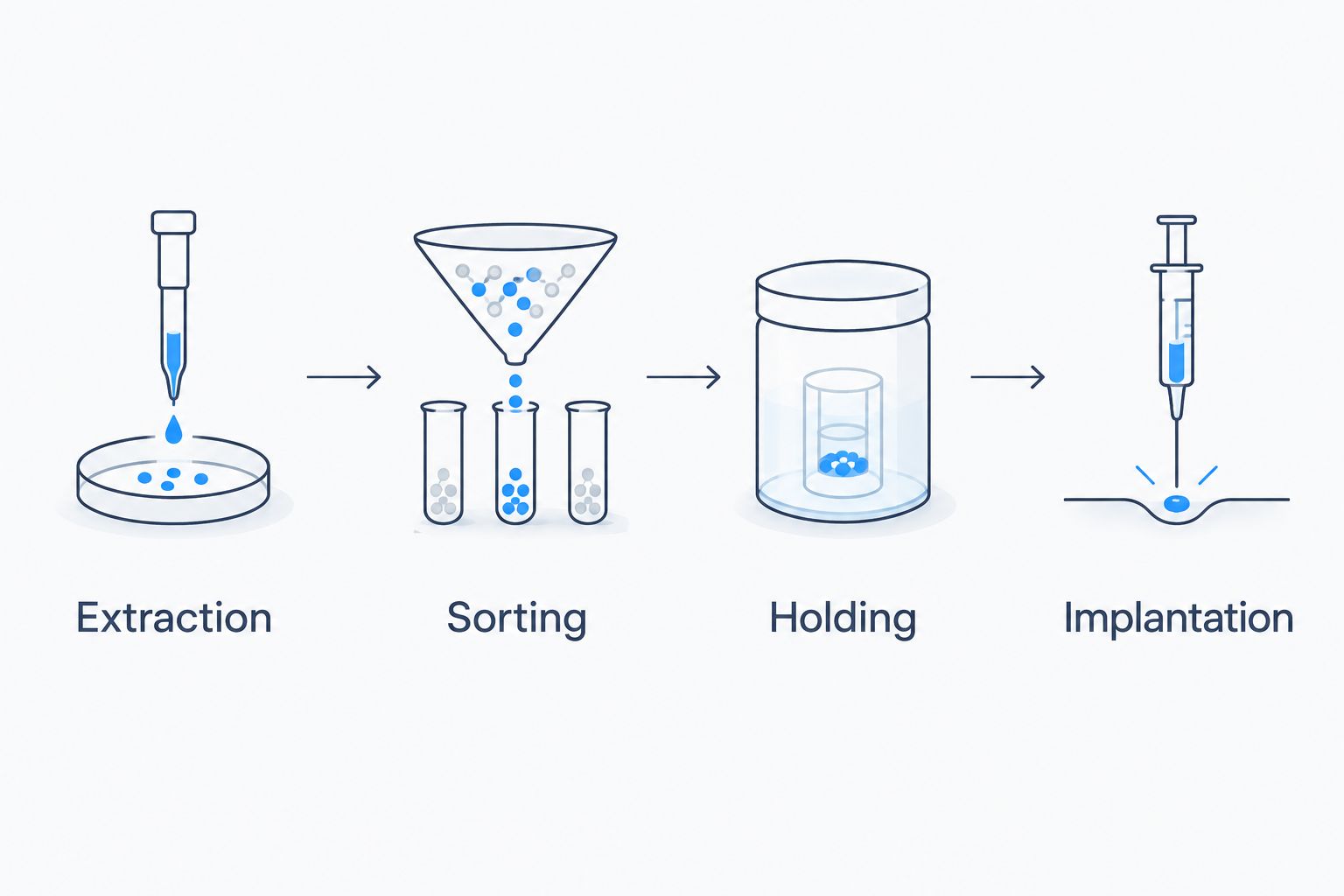
According to the clinic’s supplied description, DFI Ultimate follows these stages:
- Extraction: donor grafts are taken from the back of the head using specially designed serrated punches.
- Sorting: the extracted grafts are separated into groups containing 1 hair, 2 hairs or 3 hairs.
- Holding: grafts are kept before implantation in a special graft holding/conditioning environment prepared from the patient’s blood and peptides.
- Implantation: the procedure uses implanter pens and micro-sapphire tools.
These are clinic-supplied process details, not independent clinical validation. The holding environment should not be interpreted as proof of improved survival, biologically enhanced roots or guaranteed density.
Ask the Medispa India surgeon to describe the proposed workflow at the same level of detail. Compare the clinical reasoning behind the steps rather than treating unfamiliar terminology as an advantage.
If your search began with DHI hair transplant, do not treat DHI and DFI Ultimate as interchangeable names. Ask each clinic to identify exactly what it proposes and who performs the procedure.
Both clinics must meet the same donor-planning standard
Neither clinic earns a donor-planning win from its technique name. Your donor assessment must explain what can be harvested responsibly and how the proposed coverage relates to that supply.
Ask the surgeon to distinguish your preferred appearance from what is achievable. A hairline-focused plan and a plan covering extensive thinning are different commitments of donor hair; the consultation should explain that trade-off clearly.
Request answers to these questions before accepting either proposal:
- Which donor areas are suitable, and what limits the proposed harvest?
- Which recipient areas take priority?
- How does the plan account for continued loss of existing hair?
- What would make the surgeon reduce or postpone the procedure?
A willingness to explain limits is more useful than an unconditional promise of fullness. Keep the written plan so you can compare the same treatment area across consultations.
A broader stated treatment menu helps you question surgery
The client clinic lists DFI Ultimate and ActiveFUE alongside nonsurgical services including GFC, PRP, Exosomes and Booster Hair Treatment. That gives you several named options to discuss, but it does not establish that every option is appropriate or equally supported for your condition.
A treatment menu is an advantage only when the doctor explains what not to use. Ask which treatment addresses your diagnosis, what evidence supports it, and what would count as a reason to stop or change course.
For Medispa India, request the same comparison between surgery and relevant alternatives. A surgeon who explains why you should delay a transplant can provide a more useful recommendation than one who offers your preferred procedure immediately.
Do not compare packages containing different treatments as though they solve the same problem. First establish the purpose of each component and whether it is necessary for your plan.
Medispa India wins on individual fit if its reasoning is stronger
Medispa India is the better choice for you if its consulting surgeon identifies a clearer diagnosis, explains the limits of your donor supply more convincingly, and proposes a plan you understand. That is a conditional decision rule, not a claim about clinic-wide superiority.
Bring the same photographs, medical history and questions to both appointments. Explain your priorities without prescribing the answer: restoring a hairline, addressing crown thinning and managing ongoing shedding require different discussions.
The useful comparison is not which consultation feels more confident. It is which recommendation remains convincing after you ask about limitations, alternatives and the consequences of doing nothing immediately.
Choose the stronger individual plan even when it is less ambitious than the result you initially wanted. A more restrained recommendation deserves consideration when its reasoning is clear.
Surgical responsibility is a tie until you establish the roles
A clinic name does not tell you who assesses you, designs the hairline, performs each surgical stage or manages a complication. Resolve those responsibilities before choosing either provider.
Ask for the responsible clinician’s name and relevant qualifications, then clarify which tasks other team members perform. The important distinction is accountability: you should know who makes medical decisions and who you contact when something needs attention.
For a 2026 booking, confirm these arrangements for your actual appointment rather than relying on a general description of the clinic. If the proposed clinician changes, revisit the plan before proceeding.
Neither side receives a win here without a clear answer. The same standard applies regardless of which technique appears on the proposal.
A stated support period helps, but the scope matters more
The client clinic states that it provides dedicated 6-month post-procedure support. That gives you a defined period to discuss, but it does not explain every appointment, communication channel or treatment decision included within it.
Ask what happens during routine follow-up and how concerns are escalated. You need to distinguish scheduled checks from urgent clinical advice and understand who reviews photographs or examines you in person.
For Medispa India, request an equally specific follow-up plan. If you are travelling, establish how remote communication works and when an in-person review is necessary before arranging your journey.
The better aftercare plan is the one you can actually use. A stated duration matters less if you do not know whom to contact or what happens when you report a problem.
Pricing in 2026: compare models and treatment scope
The client clinic describes its model as transparent per-graft pricing. A per-graft model makes the proposed graft count important, but you still need to understand what the written treatment plan includes and how changes are handled.
Confirm Medispa India’s pricing model directly rather than assuming it follows the same structure. A package-based proposal and a per-graft proposal need different questions before they can be compared fairly.
Ask both clinics to specify:
- The agreed treatment areas and proposed graft allocation.
- What assessments, medicines and follow-up services are included.
- How a change in the planned procedure is documented and approved.
- Which recommended services are separate from the transplant itself.
Do not confuse grafts with individual hairs. The supplied DFI Ultimate description distinguishes grafts containing different numbers of hairs, so the proposal should explain the unit being counted.
The trade-off is clarity of scope versus flexibility to adjust the plan. Compare complete written proposals, not isolated headline figures or a technique label.
Final verdict: choose the plan you can defend
Choose iGraft if you want a scan-led starting point
Best for: patients seeking computerized assessment, access to named surgical and nonsurgical options, and a stated support period.
The clinic’s described diagnostic approach and DFI Ultimate workflow give you concrete subjects to question. Its limitation is equally clear: a proprietary process description does not prove better survival, greater density or a better result for your case.
Before choosing, require a diagnosis, donor assessment, named clinical responsibilities and a written explanation of aftercare. Those details turn a service description into an individual treatment decision.
Choose Medispa India if its surgeon gives you the stronger plan
Best for: patients whose Medispa India consultation produces clearer reasoning, more appropriate expectations and a better-understood care arrangement.
Choose that recommendation when you can explain why it fits your condition better. Do not choose it merely because a photograph resembles your desired result or because the proposed graft count sounds impressive.
For either clinic, pause if essential questions remain unanswered. You do not need to make a medical decision during the first sales conversation.
| Dimension | Winner or decision rule |
|---|---|
| Best fit | The clinic with the better-supported individual plan |
| Diagnosis | The doctor who explains findings and their implications |
| Procedure description | DFI Ultimate provides a clinic-described workflow, not an outcome win |
| Donor planning | Tie: require the same written assessment from both |
| Treatment choice | The recommendation that justifies treatment and alternatives |
| Surgical responsibility | Tie: establish named roles before deciding |
| Aftercare | The written arrangement you can use throughout recovery |
| Pricing model | The proposal with the clearest complete scope |
FAQ
Is iGraft better than Medispa India for a hair transplant?
iGraft is a suitable shortlist option if you want computerized assessment and its described DFI Ultimate process, but that does not establish better outcomes. Choose between clinics using your diagnosis, donor assessment, surgeon’s plan and written aftercare arrangements.
When should I choose Medispa India instead?
Choose Medispa India if its consulting surgeon provides a better-supported plan for your condition and expectations. Require a clear explanation of donor limits, treatment alternatives and clinical responsibilities before deciding.
What is different about DFI Ultimate?
The clinic describes DFI Ultimate as a workflow involving serrated punches, sorting by hairs per graft, a blood-and-peptide graft holding/conditioning environment, implanter pens and micro-sapphire tools. These supplied process details are not independent proof of improved survival or guaranteed density.
Are DHI and DFI Ultimate the same procedure?
Do not treat DHI and DFI Ultimate as interchangeable names. Ask the treating surgeon to explain the exact extraction, graft-holding and implantation methods proposed for you.
Does a higher graft count mean a better transplant?
A higher graft count alone does not establish a better transplant. The proposed count must fit your donor supply, treatment area and longer-term plan, with a clear distinction between grafts and individual hairs.
What aftercare should I compare before booking?
Compare scheduled reviews, clinical contact arrangements and the process for escalating concerns. A stated support period needs a written explanation of what is included and when an in-person assessment is required.
What should I request at a hair-transplant consultation in 2026?
Request a diagnosis, donor assessment, treatment-area plan, explanation of alternatives and named clinical responsibilities. Ask for the complete proposal in writing so you can compare recommendations without relying on memory or promotional wording.
One last thing
Ask each surgeon: What finding would make you advise me not to have this transplant? The answer reveals whether the consultation is testing your suitability or simply confirming the procedure you arrived wanting.
For your 2026 decision, keep that answer beside the proposed plan. A clinic that explains its limits gives you something useful to judge.
Related guides
- Hair-transplant techniques compared
- Post-transplant hair-care products
- Medispa India alternatives for hair treatment