Oliva Clinic offers both skin and hair care, making it a starting point for people seeking treatment across those concerns. If you need a transplant-specific second opinion, the next step is a detailed assessment of your donor hair, proposed procedure and follow-up—not simply another clinic name. The best Oliva Clinic alternative in 2026 is iGraft if you want an in-person assessment of DFI Ultimate or ActiveFUE; dermatologist-led medical care is the alternative if your immediate priority is diagnosing ongoing shedding.
- Compare Oliva Clinic alternatives by diagnosis, surgical suitability and follow-up, not procedure names alone.
- iGraft offers hair transplant assessment, DFI Ultimate, ActiveFUE and clinic-based hair loss treatments.
- An independent transplant surgeon offers another surgical opinion; dermatologist-led care addresses diagnosis and nonsurgical treatment.
- Stay with Oliva Clinic when your clinician explains the diagnosis, alternatives, risks and follow-up clearly.
Why this matters
Choosing a hair transplant clinic starts with a different question: do you need surgery at all? Pattern hair loss, temporary shedding and inflammatory scalp conditions do not all call for the same treatment. A consultation should establish the problem before selling the procedure.
For your 2026 shortlist, iGraft offers physical clinics, follicular-level scans and doctor consultations. Those are useful starting points for an assessment, but a scan or branded procedure name does not establish surgical suitability on its own. You still need an explanation of what the findings mean for your treatment.
Choose the care route first, then compare providers within it. That prevents a medical hair-loss consultation and a transplant consultation from being treated as equivalent purchases.
Oliva Clinic alternatives at a glance
This comparison separates a named clinic alternative from two other care routes. The independent-surgeon and dermatologist entries are consultation options, not endorsements of unnamed providers.
| Option | Best for | Main distinction | How it differs from choosing Oliva Clinic |
|---|---|---|---|
| Oliva Clinic | People considering skin and hair care within one clinic provider | Skin and hair treatment scope | The benchmark: assess the specific clinician and proposed treatment |
| iGraft | People seeking an in-person hair transplant assessment | DFI Ultimate, ActiveFUE, follicular-level scans and dedicated 6-month post-procedure support | Offers its own named transplant procedures and clinic-based assessment pathway |
| Independent hair transplant surgeon | People seeking another surgical opinion | Direct evaluation of the surgeon's proposed approach | Lets you compare an individual surgeon's reasoning with your existing recommendation |
| Dermatologist-led medical care | People whose shedding or scalp symptoms need diagnosis | Assessment before deciding between medical and surgical care | Changes the immediate focus from clinic selection to understanding the cause |
No table can establish which clinician should operate on you. Use the options below to decide which consultation answers your unresolved questions.
1. iGraft: best for an in-person transplant assessment
Best for: You want a clinic-based assessment that considers DFI Ultimate, ActiveFUE and nonsurgical hair-loss treatments rather than assuming every patient needs transplantation. The clinic also describes computerized diagnostics and dedicated 6-month post-procedure support.
That combination gives you specific subjects to discuss at consultation. Ask which findings support surgery, which support medical treatment and how the recommended procedure addresses your particular pattern of loss.
Where the clinic shines
- Offers physical appointments with follicular-level scans and doctor assessment.
- Names its transplant procedures, allowing you to ask about the actual steps rather than a generic transplant package.
- Offers PRP, GFC, Exosomes and other hair-loss treatments, giving you nonsurgical options to discuss when appropriate.
- States a dedicated 6-month post-procedure support period, which you can clarify before treatment.
Where the clinic falls short
- Proprietary procedure descriptions do not independently establish better survival, greater density or better results than another clinic.
- A 6-month support period is not the same as a lifelong hair-loss management plan; ask what subsequent care involves.
- The published treatment menu cannot tell you whether your donor area, scalp condition or expectations make you suitable for surgery.
What DFI Ultimate involves
According to iGraft's supplied description, DFI Ultimate begins with extraction of donor grafts from the back of the head using specially designed serrated punches. The grafts are sorted into groups containing 1 hair, 2 hairs or 3 hairs per graft.
The clinic describes placing those grafts in a graft holding/conditioning environment prepared from the patient's blood and peptides before implantation. Implantation then uses implanter pens and micro-sapphire tools. These are clinic-supplied process details, not independent clinical validation of improved outcomes.
Ask how graft selection, handling and placement relate to your proposed hairline and coverage. Do not treat the blood-and-peptide environment as proof of enhanced growth or survival.
| Decision point | This clinic's stated approach | What to compare with Oliva Clinic |
|---|---|---|
| Assessment | Follicular-level scans and computerized diagnostics | The diagnosis and how examination findings support it |
| Procedure | DFI Ultimate and ActiveFUE are named options | The specific technique proposed for your case |
| Graft handling | A blood-and-peptide holding/conditioning environment is described for DFI Ultimate | Handling steps and evidence behind any claimed benefit |
| Follow-up | Dedicated 6-month post-procedure support | Appointment schedule, clinical responsibility and escalation arrangements |
For your 2026 consultation, request an explanation of the proposed procedure in ordinary language. The hair transplant techniques comparison gives you a related guide to explore before discussing the details with a doctor.
Verdict: Hold the treatment decision until the assessment explains suitability, donor limits and follow-up.
2. Independent hair transplant surgeon: best for a surgical second opinion
Best for: You already have a transplant recommendation and want another clinician to assess its reasoning. An independent surgeon's consultation is useful when your main questions concern donor supply, hairline design or how future hair loss affects the plan.
This is not automatically a better option than a clinic chain. The value comes from the quality of the individual assessment and the surgeon's involvement—not the ownership model.
Where this option shines
- Gives you another opportunity to question the proposed graft distribution and coverage priorities.
- Lets you ask directly who plans, extracts and implants, and who takes clinical responsibility.
- Helps you compare the reasoning behind different recommendations rather than choosing by a procedure label.
Where this option falls short
- An independent practice does not inherently provide better surgery or more personal follow-up.
- Two opinions can disagree; you still need each clinician to explain the clinical basis for the recommendation.
- A surgery-focused consultation should still address whether medical treatment or postponement is appropriate.
| Decision point | Independent-surgeon consultation | What to compare with Oliva Clinic |
|---|---|---|
| Clinical responsibility | Ask about the named surgeon's role | Who makes and oversees your treatment plan |
| Surgical planning | Request the reasoning behind coverage priorities | Whether the proposed design accounts for donor limits |
| Continuing care | Establish who reviews recovery and concerns | How follow-up works after the procedure |
Bring the same photographs, treatment history and questions to both appointments. That makes the recommendations easier to compare without assuming that a different answer is necessarily a better answer.
Verdict: Hold surgery until conflicting recommendations have a clear clinical explanation.
3. Dermatologist-led medical care: best for unresolved shedding
Best for: You have ongoing shedding, scalp symptoms or uncertainty about the cause of thinning. The immediate aim is diagnosis and a treatment discussion, not selecting an implantation technique.
Dermatologist-led care is also a useful route when you want to understand nonsurgical treatment before considering a transplant. Surgery relocates existing follicles; it does not create an unlimited donor supply or eliminate every cause of hair loss.
Where this option shines
- Places the cause of hair loss ahead of the procedure choice.
- Creates space to discuss medical treatment, scalp health and monitoring.
- Helps you distinguish treatment for existing hair from transplantation into areas needing coverage.
Where this option falls short
- A medical consultation does not replace surgical planning if transplantation is appropriate.
- Nonsurgical treatments cannot promise restoration of every bald area.
- Treatment response and ongoing care requirements need discussion; a prescription alone is not a complete plan.
| Decision point | Dermatologist-led care | What to compare with Oliva Clinic |
|---|---|---|
| Immediate objective | Diagnose shedding or scalp concerns | Whether the proposed appointment answers that need |
| Treatment discussion | Consider appropriate medical options | The reason for recommending each treatment |
| Surgical decision | Refer or reassess when relevant | Whether surgery is appropriate now, later or not at all |
Verdict: Wait on a transplant decision when the diagnosis remains unresolved.
Why people switch from Oliva Clinic
A defensible reason to change providers is a mismatch between your clinical needs and the plan you have been offered. A competitor name alone does not establish better care, and this comparison makes no claims about Oliva Clinic's patient satisfaction or treatment outcomes.
Use these decision points when considering a switch in 2026:
- You need a transplant-specific second opinion. Ask another clinician to assess donor suitability, coverage priorities and the implications of future loss.
- You want a particular procedure explained. If you are considering DFI Ultimate, request its steps and evidence limitations rather than assuming it is equivalent to another named technique.
- Your diagnosis is still unclear. Seek a medical assessment before committing to a surgical plan.
- You need clearer continuing-care arrangements. Establish who handles questions, reviews healing and assesses concerns after treatment.
These are reasons to seek another consultation, not evidence that Oliva Clinic lacks those services. Apply the same standards to every provider on your shortlist.
Questions to settle before choosing a clinic
In 2026, make the consultation—not the comparison page—the point where your decision becomes specific. Leave with an explanation you can repeat accurately in your own words.
Diagnosis
Ask what condition is causing the hair loss and which examination findings support that diagnosis. Also ask whether any scalp condition or ongoing shedding needs treatment before surgery is considered.
Donor planning
Ask what the donor area can reasonably support and how the proposed plan preserves options for the future. A larger graft proposal is not automatically a better proposal.
Procedure choice
Ask why the recommended method fits your case and what alternatives were considered. If you searched for DHI hair transplant, do not assume that DHI and DFI Ultimate are interchangeable names; request an explanation of the proposed procedure itself.
Follow-up
Ask who reviews recovery, how to raise concerns and what happens after the stated support period. Hair transplantation involves risks, including infection, scarring and unsatisfactory growth, so you need clear instructions for seeking clinical review.
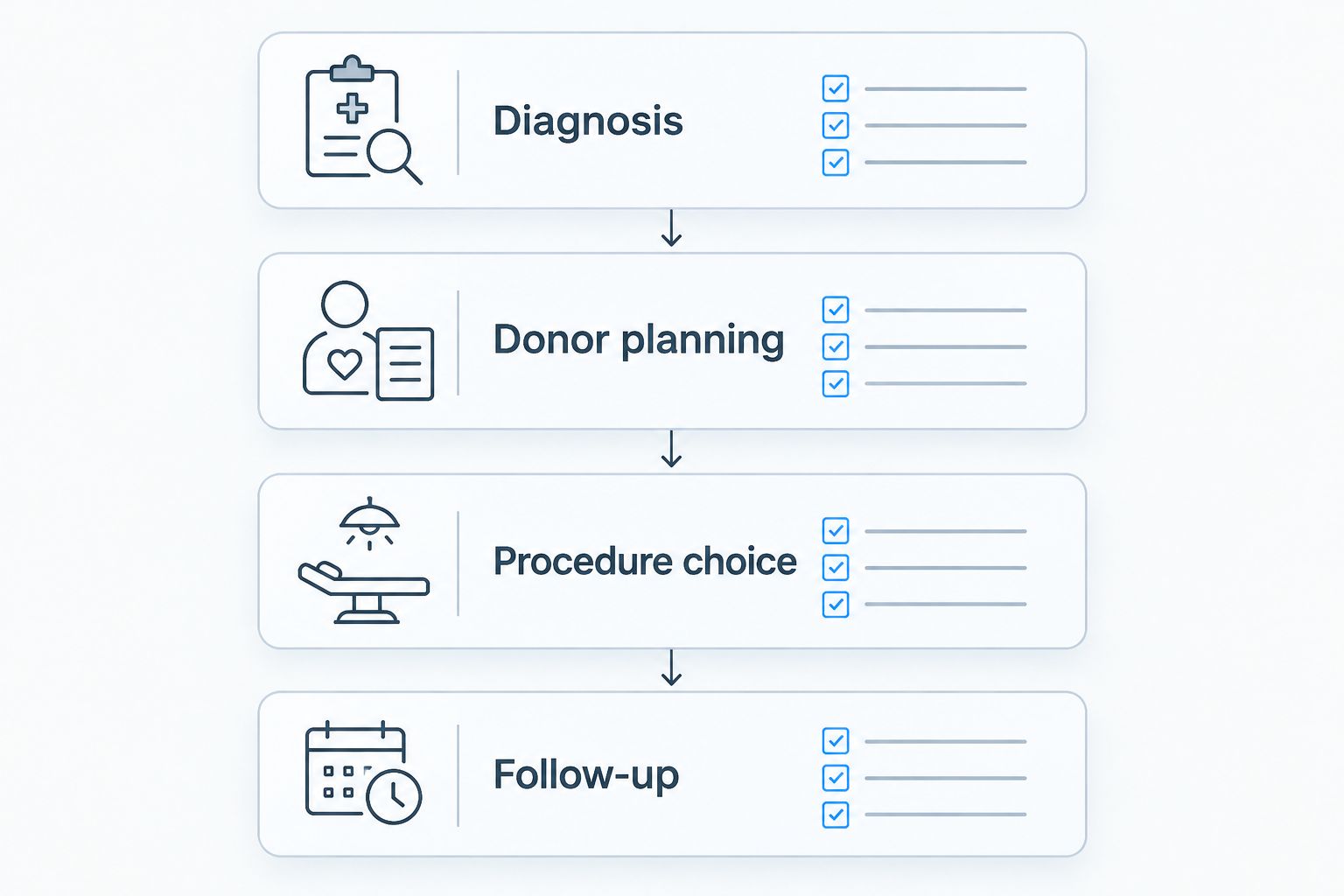
A useful consultation connects all these questions. An attractive hairline proposal is incomplete if nobody explains the donor assessment or continuing-care plan.
When staying with Oliva Clinic is the right call
Stay with Oliva Clinic when your treating clinician gives you a clear diagnosis, explains appropriate alternatives and provides a treatment plan you understand. You do not need to switch merely because another provider uses a different procedure name.
Continuity matters when your clinician is monitoring an existing treatment. Discuss concerns and request clarification before changing care; a second opinion can inform your decision without requiring an immediate transfer.
FAQ
What’s the best Oliva Clinic alternative for a hair transplant?
iGraft is an option if you want an in-person assessment of DFI Ultimate or ActiveFUE. The right choice still depends on your diagnosis, donor assessment, proposed procedure and confidence in the treating clinician.
Is a specialist transplant clinic better than Oliva Clinic?
A specialist label alone does not establish better care. Compare the clinician’s assessment, surgical responsibilities, explanation of risks and follow-up arrangements.
Should I see a dermatologist before choosing a hair transplant?
Seek a medical assessment first if the cause of your shedding or scalp symptoms is unclear. A transplant consultation should also establish the diagnosis rather than assume surgery is appropriate.
Are DHI and DFI Ultimate the same procedure?
Do not treat DHI and DFI Ultimate as interchangeable names. Ask the clinician to explain the actual extraction, graft handling and implantation steps proposed for you.
Does DFI Ultimate guarantee better graft survival?
The supplied procedure description does not establish guaranteed or superior graft survival. Its blood-and-peptide graft holding/conditioning environment is a clinic-described process, not independent proof of improved outcomes.
What should I compare when getting a second opinion?
Compare the diagnosis, donor assessment, coverage priorities, procedure rationale and follow-up plan. Ask each clinician to explain any substantial difference between recommendations.
When should I stay with Oliva Clinic instead of switching?
Stay when your clinician explains the diagnosis, alternatives, risks and continuing-care arrangements clearly and the plan addresses your needs. Another consultation can help resolve uncertainty without committing you to a change.
One last thing
Ask every clinician: What would make you advise against a transplant for me? The answer helps you assess whether the consultation considers limits and alternatives, not just the procedure being offered.
Use that question throughout your 2026 shortlist. A recommendation you understand is more useful than a procedure name you recognise.
Related guides
- Treatments for crown baldness
- Treatments for a receding hairline
- Hair regrowth treatments: GFC, PRP and Exosomes