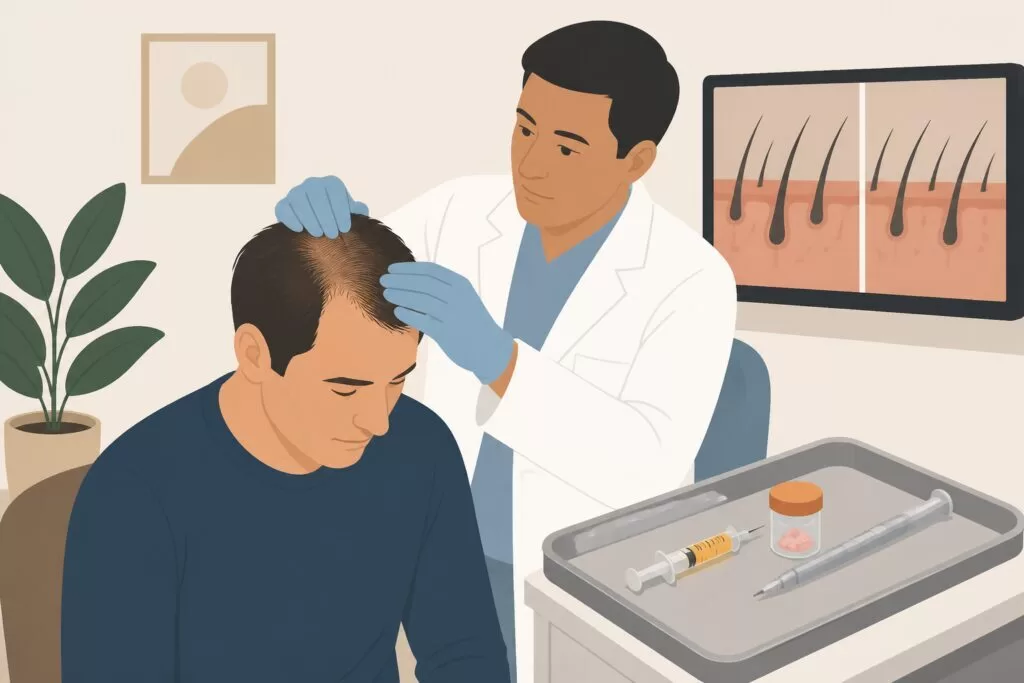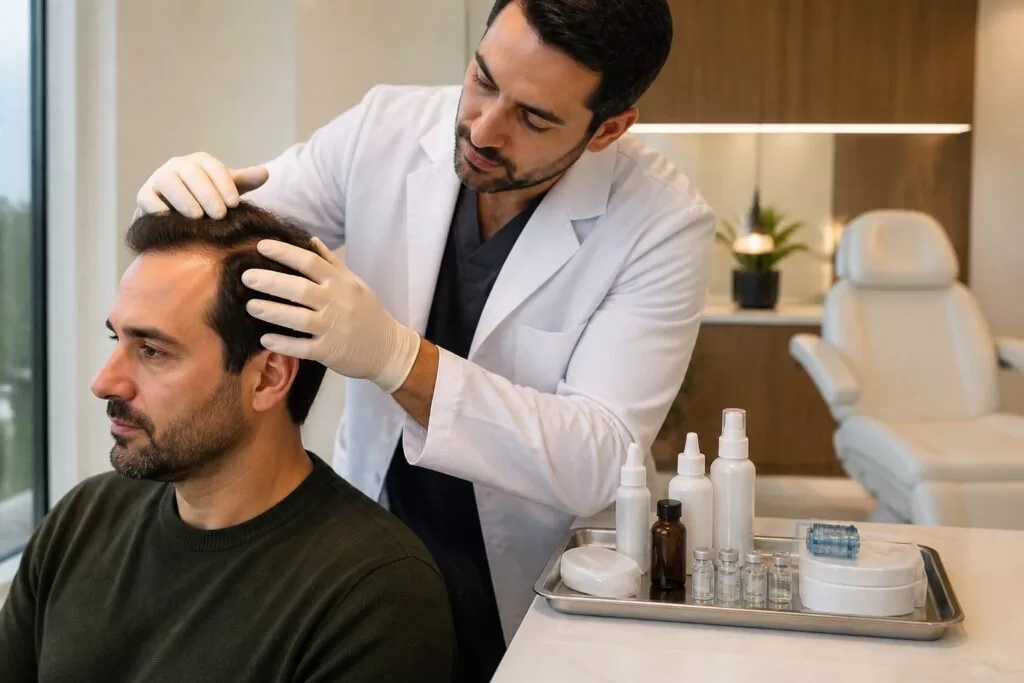
A thinning crown is not one diagnosis. Sometimes the follicles are still there, only smaller. Sometimes they are gone, and the scalp looks smooth in bright light. That gap is the window of reversibility. If hairs remain, medical care and in-clinic therapy can slow the loss and thicken what you still have, without moving a graft. If the crown is already bare, those treatments will not refill it (igraftglobalhairservices.com).
How a doctor tells miniaturization from a bald crown
Pattern loss shrinks follicles over years. On the crown you may see a wider swirl, a see-through patch in photos, or hair that feels finer than the sides. Genes and hormones drive that pattern. Traction, deficiency, illness, and a shed after fast weight loss, including GLP-1 treatment, need a different plan. Surgery does not fix that shed. You wait until it settles, then look again.
At iGraft Global Hair Services, the visit is a computerized hair and scalp check, follicular-level imaging, and an AI report. You meet the doctor in person at company-owned clinics in Pune, Bangalore, Hyderabad, and Vijayawada. The scan should show whether hairs are miniaturizing or gone.
Clinical signs the window is still open
You are more likely to recover density without surgery when several of these hold:
- Hair is still visible across the crown, even if it is fine. Follicles are weakening, not missing.
- Loss sits on the top in a pattern, not as diffuse unpatterned alopecia that also thins the donor. Candidacy reviews list that pattern, very young age, and unrealistic expectations among reasons to avoid surgery (pmc.ncbi.nlm.nih.gov).
- The crown is thinning, not a long-standing shiny patch. PRP has a stronger published fit in Norwood-Hamilton grades II to V, where hair remains (igraftglobalhairservices.com).
- There is no heavy, active shed from a recent health change.
- Donor hair on the back and sides still looks stable.
Moderate crown thinning often starts with medicine and PRP. Hold surgery until imaging shows too few follicles to save.
What care without surgery involves
FDA-approved medicines such as minoxidil, and finasteride when it suits the patient, can slow loss and support regrowth. A doctor should match the drug to your health and pattern. iGraft's minoxidil, serum, biotin gummies, and shampoo and conditioner can sit beside that plan. The product line comes after the diagnosis.
PRP is platelet-rich plasma. Blood is drawn, spun, and the platelet portion is injected into thinning scalp. For androgenetic alopecia, at least three to five monthly sessions are commonly recommended, then a review at three to six months, with maintenance every 6 to 12 months. Judge a later scan, not a week-two photo. Soreness, swelling, or a short shed can follow. See the PRP timeline notes and the PRP regrowth page.
GFC is growth factor concentrate from a similar blood draw. iGraft uses GFC Class 2 with high-frequency treatment and low-level laser, and may add exosomes, Booster, or BioCell if miniaturization is active. These will not fill a smooth crown. Redness, bruising, or tenderness can occur. They spare donor hair a transplant would spend, and moving hair does not stop future loss by itself. Session detail is in the GFC notes.
When surgery is the clearer choice
Choose surgery when the zone you want rebuilt has too few follicles left. A smooth crown, and imaging that shows absence rather than miniaturization, are the usual clues. Consensus guidance allows transplantation in pattern hair loss with a good donor, sound health, and reasonable expectations, and it urges caution in young patients with early loss (ovid.com).
Many people at 18 or 20 should wait. The pattern may not be stable, and an early session can spend donor hair you will need later.
Donor grafts from a stable zone are generally long-lasting. Hair that was not moved can keep miniaturizing (igraftglobalhairservices.com). Reviews report graft survival over 90 percent with FUE or FUT (igraftglobalhairservices.com). That is not 100 percent, and results are not guaranteed. After a transplant, some patients still use GFC because nearby hair can keep thinning. There is no fixed session count. The scan sets it.
Technique, time, and a bill you can audit
FUE removes follicular units one by one. It usually means less visible scarring, faster healing, and less downtime than a strip procedure (pmc.ncbi.nlm.nih.gov). ActiveFUE is iGraft's extraction approach. Gen3 DFI Ultimate places follicles directly, with a clinic-stated 29-year assurance, not a promise of identical growth for everyone. Direct placement does not create new hair. The better method depends on donor density, hair thickness, and whether a no-shave session is realistic.
A graft is a follicular unit, usually one to four hairs. Rates on the pricing table are plus taxes in Pune, Bangalore, Hyderabad, and Vijayawada:
| Technique | Rate | 2,000 before tax | 3,000 before tax |
|---|---|---|---|
| ActiveFUE | ₹45 per graft | ₹90,000 | ₹135,000 |
| Gen3 DFI Ultimate | ₹50 per follicle | ₹100,000 | ₹150,000 |
A 3,000-graft ActiveFUE case is ₹135,000 before tax. Indian FUE quotes often run ₹35 to ₹80 per graft, so use per-unit pricing. Do not mix graft counts with follicle counts (graft versus follicle). Compare hair transplant cost in India, FUE cost in Pune, cost in Bangalore, and Vijayawada pricing the same way.
A session is usually one day. Fuller growth takes four to six months, with clot care near day 12 and follow-up for six months. Swelling, shock loss, infection, and uneven growth can occur. Expect controlled discomfort under local anesthesia and soreness after, not a painless visit. The doctor should be trained in local anesthesia and emergency care, in a proper facility (ijdvl.com).
FAQ
Can a thinning crown recover without surgery?
Often, if follicles are only miniaturizing. PRP, GFC, and medication target that stage. They will not refill a smooth bald crown. A scan should decide.
Does a crown hair transplant work, and is it permanent?
In a suitable candidate, donor grafts generally last, with published survival often above 90 percent. That is not a guarantee, and it does not cure genetic loss. Hair around the grafts can still thin. A DHI-style tool does not create hair.
What is the cost of FUE hair transplant in India?
ActiveFUE is ₹45 per graft. Gen3 DFI Ultimate is ₹50 per follicle, before tax, in Pune, Bangalore, Hyderabad, and Vijayawada. Two thousand ActiveFUE grafts are ₹90,000 before tax. Three thousand are ₹135,000 before tax.
Which hair transplant technique is best, and is FUE safe?
No method fits every scalp. FUE is generally safe for suitable men and women under a doctor, but it is not risk-free. It is worth it only when follicles are too few to recover. A no-shave session fits some densities, not all.
When should you get a hair transplant, and who should wait?
Go when the bald zone has too few follicles, the donor is stable, and expectations are realistic. Wait if you are very young, shedding heavily, or still have recoverable hair. Diabetes needs medical clearance. A fully bald person may still be a candidate if donor supply matches the goal.
Which is the best hair transplant clinic in Pune or Hyderabad, and which country is best?
Meet the doctor, see a follicular report, and leave with a unit-by-unit quote. iGraft's company-owned centers in Pune, Bangalore, Hyderabad, and Vijayawada include six-month support. About 30 percent of transplant patients travel from the USA, UK, Australia, and the UAE for that follow-up, not for a lucky month.
Book the scan before the grafts
If your crown is thinning, find out whether the follicles are still alive. Start with an in-person check, or use the 2-minute quiz before you travel. Reach the team on the consultation page. Bring a daylight photo of the crown. The report should show whether this is still a recovery window, or the point where surgery earns its place.