
Hair transplant interest usually starts with a simple question: can the lost hair actually be restored, and is surgery the right step right now?
For people with baldness or a receding hairline, the answer is often yes, but not for everyone at the same stage. Public guidance from the NHS, the American Academy of Dermatology, and published clinical reviews points to the same core rule. A good hair transplant candidate usually has pattern hair loss, enough healthy donor hair, a stable or slowly changing hair loss pattern, a healthy scalp, and realistic expectations about density and coverage.
That is why the best hair transplant plan is not built around trends, celebrity buzz, or the latest technique name alone. It is built around candidacy first.
Hair transplant candidacy for baldness and receding hairline
Hair transplant surgery works by moving permanent hair follicles, usually from the back or sides of the scalp, into areas affected by thinning or baldness. Those donor follicles are chosen because they are generally more resistant to pattern hair loss. This is also why permanence depends so much on donor quality and proper case selection.
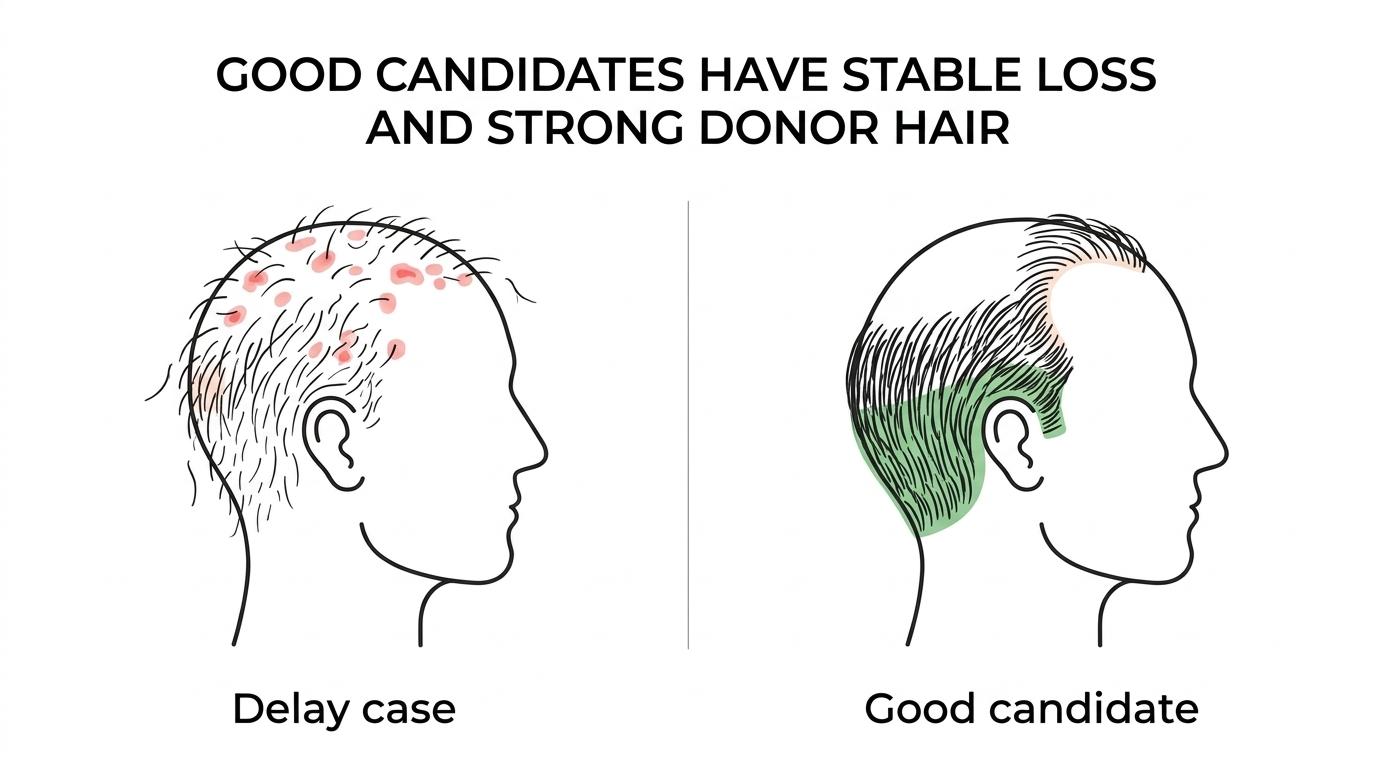
People who often fit the profile for surgery include those with male pattern baldness, female pattern hair loss with a stable donor zone, temple recession, frontal thinning, and early to moderate crown loss. A receding hairline can be one of the most rewarding areas to treat because even a modest number of grafts can make a visible cosmetic difference.
After a proper diagnosis, these signs often support hair transplant eligibility:
- Male pattern baldness
- Female pattern thinning with preserved donor hair
- Stable frontal loss
- Receding hairline with good density at the back
- Healthy scalp
- Realistic density goals
Diagnosis before FUE, DHI, FUT, Sapphire, Bio FUE, and hybrid techniques
Not every type of hair loss should be treated with transplant surgery.
A person may have sudden shedding, patchy autoimmune hair loss, active scalp inflammation, infection, or stress-related loss. In these cases, surgery may be delayed or avoided because the issue is not classic permanent pattern baldness. AAD guidance notes that examination and testing may be needed before deciding whether a transplant is suitable, and NHS guidance also warns that some non-pattern hair loss conditions are usually poor matches for surgery.
This matters for safety, effectiveness, and long-term satisfaction. A person with the wrong diagnosis can spend on surgery and still remain unhappy because the untreated root cause continues to affect the scalp or surrounding native hair.
A good clinic will usually assess:
- Hair loss pattern: Whether the thinning matches male pattern baldness or female pattern baldness
- Rate of progression: Whether the loss is stable, slow, or rapidly changing
- Scalp condition: Whether there is dandruff, inflammation, scarring, or infection
- Medical background: Whether current illness, medication, or stress is causing temporary shedding
Hair transplant eligibility factors that matter most
The best candidate review is practical, not dramatic. It asks whether the available donor supply can meet current and future needs.
| Factor | Strong candidate signs | Caution signs |
|---|---|---|
| Donor hair | Good density at the back and sides, healthy follicles | Thin donor area, miniaturized donor hair, previous overharvesting |
| Hair loss stability | Stable pattern or slow progression | Rapid active loss, sudden diffuse shedding |
| Scalp health | No infection, no active inflammation, good healing potential | Active scalp disease, severe irritation, scarring issues |
| Area to cover | Limited frontal recession, moderate crown loss, planned hairline work | Very large bald area with low donor reserve |
| Expectations | Accepts natural density and staged planning if needed | Expects teenage density or one-session correction for advanced baldness |
| General health | Fit for a minor surgical procedure | Uncontrolled medical issues that affect healing |
Age can influence planning, but age alone does not decide the case. A younger patient with fast-changing hair loss may need medical treatment first, while an older patient with stable loss and strong donor supply may be a very good candidate.
Receding hairline cases and no shave hair transplant options
A receding hairline is one of the most common reasons people search for the best hair transplant clinic in India. It is also one of the areas where careful design matters most. A hairline that is too low, too straight, or too dense for the person’s age can look unnatural years later.
Good candidates for hairline reconstruction usually have frontal recession, temple loss, or weak front definition with enough donor density to rebuild a natural frame for the face. Mild recession with a stable pattern is often easier to plan than a rapidly moving hairline in a very young patient.
This is where technique choice may come into the discussion. FUE hair transplant is widely used for receding hairline correction because it allows individual follicle extraction and fine placement. DHI hair transplant is often discussed when precise frontal implantation is desired. No shave hair transplant options may suit select candidates who want privacy, though not every scalp or graft count is suitable for that approach.
Celebrity and Bollywood hair transplant interest has made hairline work highly visible, but the same rule still applies: a natural, age-appropriate result matters more than an aggressive low hairline.
Advanced baldness cases, graft counts, and realistic coverage
Advanced baldness is not an automatic no. It simply needs sharper planning.
A person with a large bald area and limited donor hair may still benefit from a transplant, but coverage priorities become very important. Many surgeons will favor the frontal zone first because it has the biggest visual impact. The crown may be treated later, partially treated, or left for a second stage depending on donor reserves.
Graft count planning is central here. A small hairline repair may need far fewer grafts than a full top and crown restoration. That is why two people asking about hair transplant cost can receive very different treatment plans even when both say they have “baldness.”
Common planning points in advanced baldness cases include:
- Frontal priority: The hairline and front third often give the best visible return
- Crown strategy: The crown can consume a very high number of grafts and may need a later session
- Donor management: Long-term donor preservation matters as much as the first result
- Staged surgery: Two sessions may be safer and more realistic than trying to overpack one sitting
In select cases, FUT hair transplant may still be considered when graft demand is high and the person is open to the trade-offs, including a linear scar. Some clinics may also recommend hybrid methods that combine FUT and FUE, or advanced variations like Sapphire FUE or Bio FUE, based on scalp characteristics and coverage goals. The technique is a tool. Candidacy still comes first.
Hair transplant cost in India and best clinic questions
Hair transplant cost in India is one of the biggest search themes, especially in Pune, Hyderabad, Bangalore, and for patients comparing India with other countries. Cost can vary based on graft count, technique, clinic standards, team experience, location, and whether the case is a first procedure or a repair.
A low quote is not the same as a good value if donor hair is poorly handled, the hairline is badly designed, or follow-up care is weak. At the same time, the highest quote does not automatically mean the best outcome.
When people compare the best hair transplant clinic or best place for hair transplant in India, these questions are more useful than marketing slogans:
- Who evaluates the case: A proper candidacy review should happen before any graft estimate is promised
- How donor hair is protected: Good planning preserves options for future thinning
- What technique fits the case: FUE, DHI, FUT, Sapphire, Bio FUE, or hybrid methods should be matched to need, not sold as a trend
- What results are realistic: Honest density, timeline, and coverage discussions matter more than dramatic claims
India is often compared favorably in best country for hair transplant searches because many centers offer experienced teams and a lower overall cost than some Western markets. Even so, the right clinic is the one that gives a sound diagnosis and a careful long-term plan.
Hair transplant safety, permanence, effectiveness, success rate, and recovery timeline
Hair transplant safety depends heavily on patient selection, sterile technique, careful anesthesia use, donor handling, and proper post-procedure care. A healthy scalp and good medical screening support safer outcomes.
Permanence is one of the major strengths of a transplant. The transplanted follicles are usually taken from more resistant donor zones, so they often continue to grow for the long term. Still, native non-transplanted hair can keep thinning over time. That is why some patients are also advised to consider medical therapy to support existing hair.
Effectiveness and success rate are usually strongest in well-selected cases with stable pattern loss and adequate donor supply. Rather than chasing a universal percentage, it is more useful to ask whether the person’s scalp, donor area, and baldness stage make a durable result likely.
Recovery follows a fairly familiar pattern in most cases:
- Day 1 to 7: mild swelling, redness, crusting
- Week 2 to 4: shedding of transplanted hairs can occur
- Month 3 to 4: early growth begins
- Month 6 to 9: visible improvement becomes clearer
- Month 12 and beyond: maturation, texture improvement, fuller appearance
The crown can take longer than the hairline to show its final look.
When to delay a hair transplant for baldness
Sometimes the best hair transplant decision is to wait.
A person may need medical treatment first if there is active shedding, unstable diffuse thinning, severe dandruff or scalp inflammation, poor donor density, or expectations that are not grounded in what surgery can realistically deliver. Clinical reviews have also flagged conditions like active trichotillomania, active infection, and telogen effluvium as poor settings for immediate surgery.
Waiting is not a missed chance. It is often what protects the final result.
What a hair transplant consultation in Pune, Hyderabad, Bangalore, or across India should include
A serious consultation should do more than count grafts.
It should review the type of baldness, map the donor area, assess scalp health, discuss whether the pattern is stable, estimate likely graft counts, explain whether FUE, DHI, FUT, Sapphire, Bio FUE, hybrid, or no shave hair transplant options are relevant, and set a realistic recovery timeline. For women, it should also check whether the pattern truly matches female pattern baldness and whether donor strength is enough for surgery.
Many people asking about the best clinic in Pune, Hyderabad, Bangalore, or anywhere in India are really asking a better question without realizing it: who will give the clearest and most honest answer about candidacy?
That answer usually leads to the right treatment, whether it is a hair transplant now, a staged plan later, or non-surgical hair regrowth support first.