
Anyone searching for hair transplant cost in Vijayawada usually wants a simple number. In practice, the real answer depends on two things more than anything else: the number of grafts needed and the technique chosen.
That is why flat package pricing can be misleading. A smaller frontal hairline case and an advanced baldness case may both be advertised under one “offer,” yet the surgical effort, donor planning, and expected density are very different. The more reliable way to estimate price is through scalp assessment, donor evaluation, and graft estimation based on graft planning.
Hair transplant cost in Vijayawada usually starts with per-graft pricing
Across India, hair transplant cost is often quoted on a per-graft basis. This makes sense because graft count directly affects surgical time, extraction work, implantation effort, and team involvement. In Vijayawada, quotes may sit within the wider Indian range, and some clinics may reference around ₹45 per graft for FUE-based treatment plans. Standard FUE in India commonly falls around ₹25 to ₹60 per graft, depending on clinic setup, surgeon input, and case complexity.
That means the same city can still show a wide cost spread. A person needing 1,200 grafts at ₹35 per graft will get a very different quote than someone needing 3,000 grafts at ₹55 per graft with a premium implantation method.
A rough guide helps set expectations, though it should never replace a medical assessment.
| Hair loss pattern or goal | Typical graft count range | Indicative cost at ₹25 to ₹60 per graft | Notes |
|---|---|---|---|
| Minor hairline correction | 800 to 1,200 | ₹20,000 to ₹72,000 | Often suited to early recession |
| Frontal zone plus temples | 1,200 to 1,800 | ₹30,000 to ₹1,08,000 | Common for visible thinning in front |
| Front and mid-scalp coverage | 1,800 to 2,500 | ₹45,000 to ₹1,50,000 | Density goals strongly affect quote |
| Large bald area | 2,500 to 3,500+ | ₹62,500 to ₹2,10,000+ | May need staged planning |
| Revision or repair case | Varies widely | Varies widely | Previous transplant work can raise cost |
These are planning ranges, not fixed promises. Official groups outside India also show how widely hair transplant pricing can vary when the bald area is larger, the procedure type changes, or the clinic standard is higher.
Why graft count changes hair transplant cost more than people expect
Many patients first look at their Norwood classification or compare photos online. That can be a useful starting point, but it does not give a reliable price by itself. Two people with a similar degree of visible baldness may still need different graft counts.
Scalp size matters. Hair characteristics matter. Donor strength matters. Treatment goals matter too. Someone asking for a conservative hairline with moderate density may need fewer grafts than someone wanting a lower hairline and denser frontal packing.
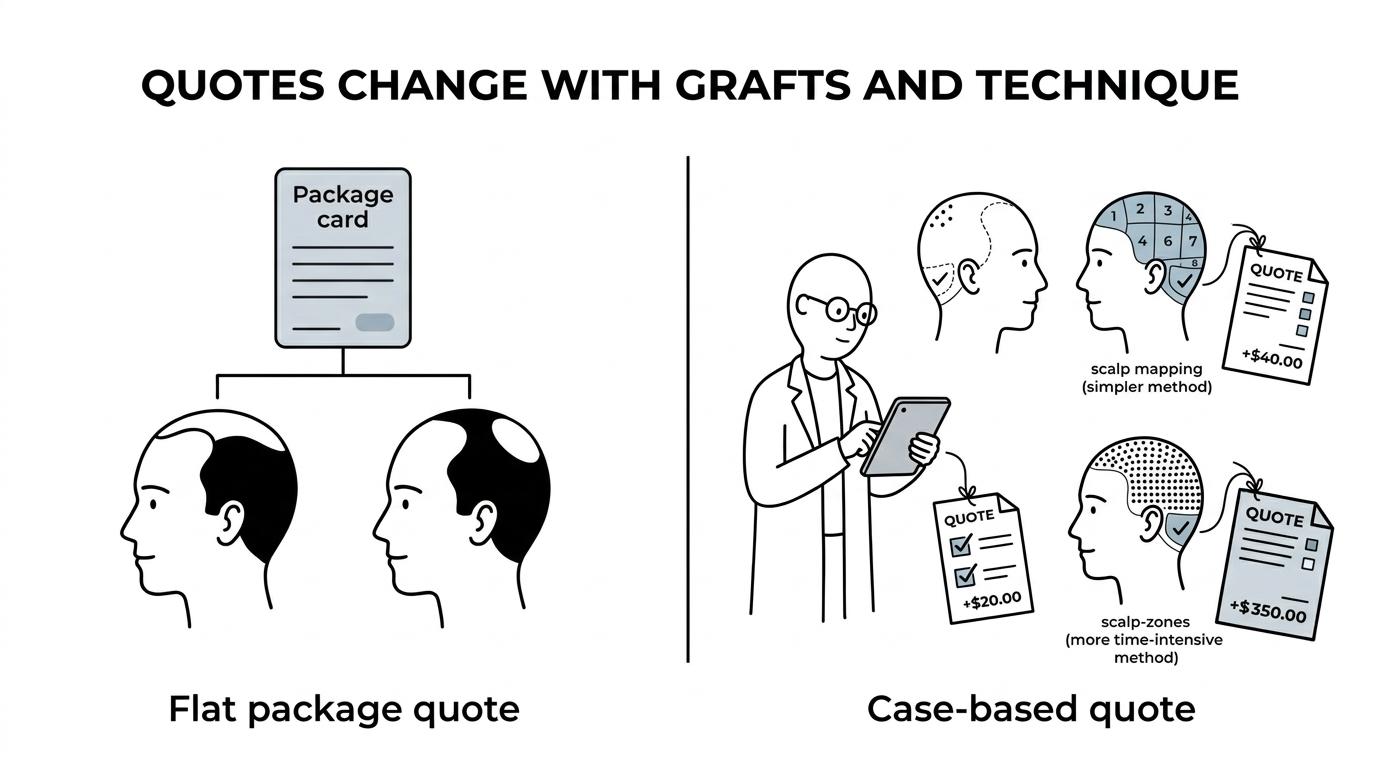
Miniaturization in the surrounding hair can also affect planning. If native hair is thinning across the mid-scalp, a clinic may recommend broader coverage now or a staged approach to protect the long-term look. This is one reason the most defensible quote comes from graft estimation based on scalp measurements rather than only on hair loss class.
After a proper consultation, pricing usually reflects points like these:
- Bald surface area: Larger coverage needs more grafts
- Donor availability: Strong donor supply allows better planning
- Hair characteristics: Curl, caliber, and color contrast affect visual coverage
- Density goal: Higher density usually raises graft count
- Revision work
- Crown involvement
- Hairline design complexity
A crown-only case can be especially tricky. The whorl pattern often needs careful angling and can consume more grafts than a patient expects, especially when the crown area is broad.
Hair transplant techniques in Vijayawada and how they affect pricing
Technique selection has a direct effect on cost. FUE remains one of the most searched options in India because it is widely used, flexible, and suitable for many male and female pattern hair loss cases. DHI is also popular, especially among patients focused on hairline detailing and implantation control. FUT may still be considered in selected cases where donor management needs a different approach.
Premium labels can raise the price too. Sapphire FUE, Bio FUE, hybrid approaches, and no shave hair transplant options are often quoted above standard FUE because they may involve different tools, added biological treatments, or more time-intensive handling.
The technique alone should not be treated as proof of better results. A good plan depends on how well the method matches the baldness pattern, donor strength, scalp condition, and density target.
A simple comparison helps:
| Technique | Cost effect | Best known for | Common reason quote changes |
|---|---|---|---|
| FUE | Moderate | Versatility, broad suitability | Per-graft pricing varies |
| DHI | Moderate to high | Hairline work, direct implantation | Often more time-intensive |
| FUT | Variable | Higher graft yield in selected cases | Depends on strip planning and closure |
| Sapphire FUE | Moderate to high | Blade preference for slit creation | Premium tool positioning |
| Bio FUE | High | Add-on regenerative focus | Adjunct treatment inclusion |
| Hybrid methods | Variable | Mixed planning across zones | Customized approach |
| No shave hair transplant | High | Discreet recovery for selected patients | Extra time and surgical precision |
Patients comparing Vijayawada with Hyderabad, Bangalore, Pune, or India-wide pricing should keep this in mind. One clinic may quote low for standard FUE, while another may quote more because it includes dense packing, PRP or GFC support, medication planning, and follow-up care.
What can raise or lower a Vijayawada hair transplant quote
Cost is not only about the procedure day. A quote may include consultation charges, blood tests, medications, post-op kits, wash sessions, follow-up reviews, or adjunct treatments. In some clinics, even the initial computerized hair check carries a nominal fee, often around ₹300 to ₹500.
This is where price comparison needs care. A lower headline figure can still become more expensive if essential aftercare or medical support is billed separately. A higher initial quote may include more physician time, denser planning, or repair-focused work.
Common quote drivers include:
- Technique choice: FUE, DHI, FUT, Sapphire, Bio FUE, or hybrid planning
- Case type: Fresh transplant, revision transplant, scar repair, beard transplant, eyebrow restoration
- Coverage area: Hairline only, frontal zone, mid-scalp, crown, or full top coverage
- Post-op medications
- PRP or GFC sessions
- No shave request
- Multiple sittings
Revision cases deserve special mention. Correcting an older transplant often needs scar handling, angle correction, graft redistribution, or work around depleted donor zones. That usually makes the case more demanding and more expensive than a first-time transplant.
Hair transplant safety, permanence, and value should be part of the cost discussion
Cost matters, but a hair transplant is still a medical procedure. Safety standards, sterilization, patient selection, and realistic planning should carry real weight when comparing quotes.
A well-executed transplant can be long-lasting because donor follicles taken from stable zones tend to retain their resistance to pattern hair loss. Still, permanence does not mean the entire scalp will stay unchanged forever. Native hair may continue to thin with age, which is why some patients need medical therapy or a staged transplant plan.
Effectiveness and success rate are also tied to case selection. A candidate with stable donor supply, realistic density goals, and proper aftercare typically has a stronger outlook than someone with very weak donor reserves or active, progressive thinning across the scalp. This is one reason “best clinic” or “best place” searches should move past marketing language and focus on medical assessment, surgeon involvement, and donor planning.
Celebrity and Bollywood hair transplant interest has made the procedure more visible, but public curiosity often creates the wrong benchmark. The better benchmark is whether a clinic can explain donor limits, expected yield, likely density, and the recovery timeline in clear terms.
Hair transplant eligibility in Vijayawada is closely linked to pricing accuracy
Not everyone who wants a transplant is an ideal candidate right away. Eligibility affects both the treatment plan and the cost estimate.
A person with early thinning may be advised to start with medical hair loss treatment, PRP, or GFC before surgery. Someone with advanced baldness but limited donor supply may need conservative hairline planning instead of broad dense coverage. Female hair transplant cases also need careful diagnosis, since diffuse thinning patterns may not always suit the same approach used in male pattern baldness.
Age can influence planning too. A very young patient with rapidly changing hair loss may not receive the same aggressive hairline design that an older patient requests. Good clinics usually quote after reviewing these details, not before.
Questions worth asking during consultation include:
- How many grafts are actually needed: Ask for a zone-wise estimate
- Which technique is being recommended: Request the reason, not just the label
- Is the donor area strong enough: This affects both safety and density
- What is included in the quote: Medications, follow-up, PRP, tests, and wash sessions
- Recovery timeline
- Future hair loss planning
- Whether a second sitting might be needed
This kind of discussion often tells more about value than a discount banner ever will.
Recovery timeline can affect the real cost beyond the invoice
Most people focus on the surgical bill, but the Recovery timeline has practical costs as well. Time away from work, travel, accommodation for outstation patients, and post-procedure follow-up can all matter.
FUE-based recovery is often manageable for many working professionals, though redness, scabbing, and temporary shedding should still be expected. No shave hair transplant may appeal to people who want a more discreet appearance during recovery, but it can increase the price due to the extra technical care involved.
Hair growth itself takes patience. Early shedding is normal. Visible growth generally starts after a few months, while better density becomes clearer over a longer period. This matters because value should be judged over the full growth cycle, not in the first two weeks.
Patients comparing Vijayawada with Bangalore, Hyderabad, or Pune sometimes ask whether travel to a bigger city always gives better results. Not necessarily. The better question is whether the clinic offers careful graft planning, safe execution, documented follow-up, and honest advice on expected fullness.
How to compare hair transplant clinics in Vijayawada without getting misled by low package rates
The easiest mistake is choosing only by the cheapest package. Low prices can be attractive, especially for larger graft counts, but transplant quality depends on more than a sales number.
The smarter comparison is quote structure. A transparent clinic should be able to explain why a case needs 1,500 grafts instead of 2,500, or why a crown should be delayed while the front is prioritized. It should also be clear who is doing the critical parts of the procedure and how donor safety is maintained.
A few signs usually deserve closer scrutiny:
- Very high graft promises for a small donor area
- One flat package for every baldness case
- No discussion about future hair loss
- Guaranteed density claims: Real outcomes vary by donor and scalp factors
- Technique-first selling: A premium label does not replace medical planning
- Rush discounts: Serious surgical planning should not feel impulsive
For anyone seeking the best hair transplant clinic in Vijayawada, the stronger route is a proper hair analysis, a realistic graft count, and a written breakdown of inclusions. That approach usually gives a more dependable price than a generic social media offer.
Vijayawada hair transplant cost makes more sense after a graft-based consultation
A useful quote should answer three things clearly: how many grafts are needed, which technique fits the case, and what is included in the total cost. Once those pieces are in place, the price becomes easier to judge.
Small cases may begin around ₹40,000 to ₹60,000 in many Indian settings, while large or premium cases can cross ₹1.5 lakh. Vijayawada sits within that broader market, but the final amount still depends on donor availability, bald area size, technique, and whether adjunct treatments or revision work are part of the plan.
That is why the most practical first step is not chasing the lowest number. It is getting the right graft count.