Why clinic depth beats a bathroom roller
A dermaroller from a shopping app and a medical microneedling pen are not the same tool. One makes shallow tracks so a serum sits a little closer to the skin. The other, used at a set depth with a sterile cartridge, starts a wound-healing response and opens channels for growth factors. If you are thinning in Pune, Bangalore, Hyderabad, or Vijayawada, that gap decides whether you are doing home skincare or treatment.
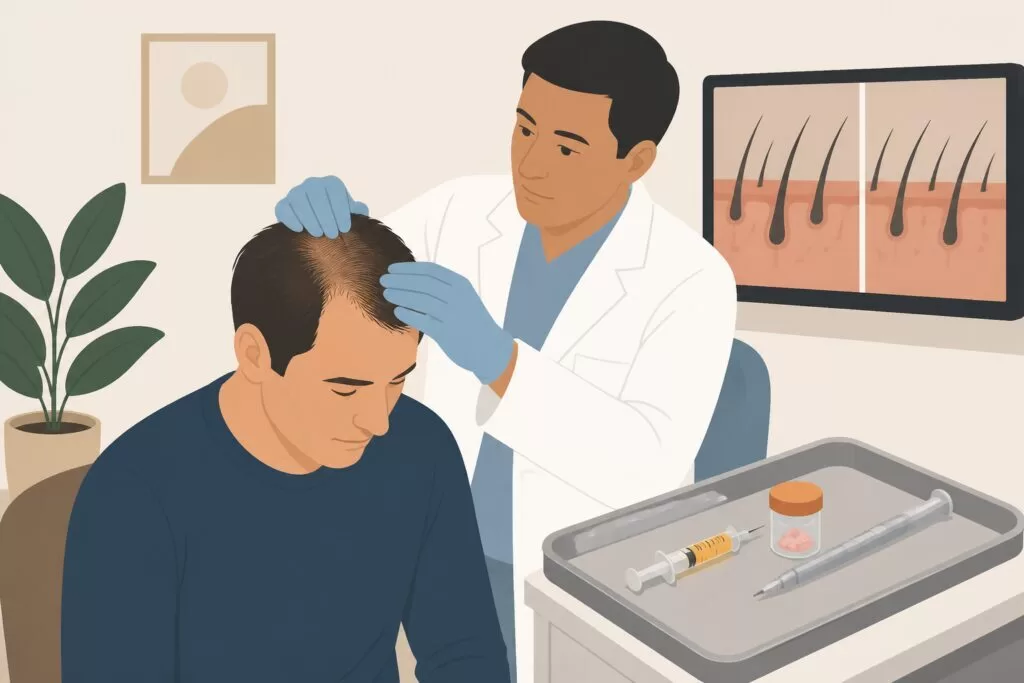
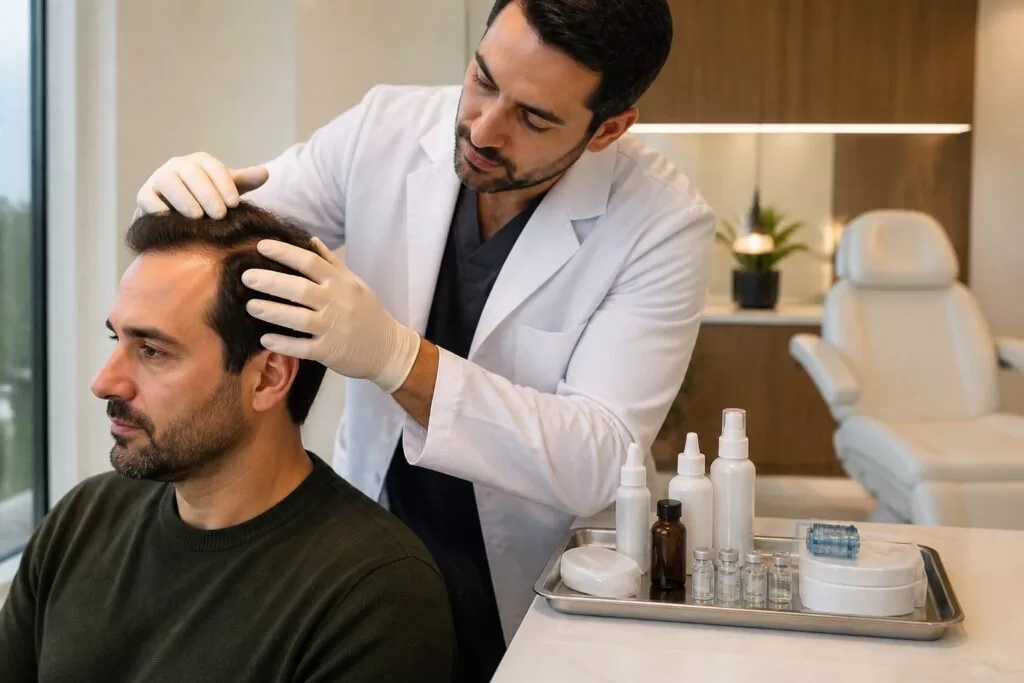
At iGraft Global Hair Services, scalp microneedling is planned after a follicular-level scan, not after a guess in the mirror. You sit with a doctor in a company-owned clinic. Depth, serum, and session gap are chosen for your scalp, then checked against how your hair actually responds.
What the needles are doing
Microneedling uses fine medical needles to make controlled micro-injuries. Those punctures release platelet-derived growth factor, transforming growth factor, and fibroblast growth factor. New vessels form, and fibroblasts lay down collagen. A clinical review describes this as a controlled injury that does not strip the epidermis the way a deep peel can. The usual endpoint is uniform pinpoint bleeding, with redness and swelling that often settle in two to three days.
On the scalp, the same idea has a different target. Research links needling with better delivery of topicals, Wnt/beta-catenin signalling that favours the growth phase, and support for dermal papilla cells. A systematic review of 22 studies and 1,127 people found that microneedling, mostly as an add-on, improved hair measures in androgenetic alopecia and alopecia areata. Depths ran from 0.50 mm to 2.50 mm. Sessions ranged from weekly to monthly. Among 657 people who received needling, no serious adverse events were reported. The authors also said the data quality is modest and the methods vary, so this is supportive evidence, not a promise for every head.
The trial people still quote is Dhurat and colleagues in 2013. Over 12 weeks, once-weekly microneedling plus twice-daily 5% minoxidil raised hair counts more than minoxidil alone. Later summaries cite an average gain of about 91.4 hairs per square centimetre in the combination arm. That is a defined add-on result. It is not what a 0.25 mm roller on dry shampoo will copy.
Depth is a clinical choice, not a shopping spec
Home rollers usually sit at 0.2 to 0.5 mm. That range can help a product sink in and may soften texture. It is not enough for meaningful collagen induction. Clinical devices with sterile single-use cartridges commonly work from 0.5 to 2.5 mm.
Home-use guides draw the same line. A clinic pen around 1.5 to 3.0 mm is trying to start healing in the deeper dermis. A short roller is trying to boost absorption. The jobs are not interchangeable, and clinical-depth needling should not be tried at home.
Deeper is not automatically better. In a 12-week trial of 60 adults with moderate to severe pattern loss, everyone used 5% minoxidil. One group added biweekly needling at 0.6 mm, another at 1.2 mm. Hair count and thickness rose in all three groups. The 0.6 mm combination beat minoxidil alone, and it tended to do better than 1.2 mm. Moderate depths around 0.5 to 1 mm can stimulate growth-factor signalling. Going to 1 to 1.5 mm or more raises the chance of bleeding, infection, and scarring, so that range belongs under medical supervision.
Medical-grade depth means the length is chosen, measured, and stopped. It does not mean the longest needle in the box.
| Point | At-home roller | In-clinic microneedling |
|---|---|---|
| Typical depth | 0.2 to 0.5 mm | Clinician-set, often 0.5 to 2.5 mm |
| Device | Reused manual roller | Sterile cartridge or medical pen |
| Realistic effect | Mild absorption, light texture change | Controlled healing response plus deeper delivery |
| Growth factors | Cosmetic serum on barely open skin | GFC, PRP, or similar placed into fresh channels |
| Safety control | Hard to sterilise between uses | Antiseptic prep, depth limits, reviewed aftercare |
Why growth factors need those channels
Professional sessions often pair needling with medical topicals. Hyaluronic acid or growth-factor preparations can work harder once tiny channels are open, because the product is not stopped at the surface.
Growth factor concentrate (GFC) is prepared from your own blood and applied across the treated zones. In some protocols a portion is also injected. The needles make the path. The concentrate supplies signals aimed at follicles that are thinning but still alive. The same pairing is used after transplant to support native hair around the grafts.
At iGraft, GFC Class 2 sits with advanced PRP, exosomes, and booster sessions. Many plans also include high-frequency care and low-level laser, so the clinic work is not a single splash of serum. PRP has its own rhythm. Read 7 facts about PRP session timelines and the PRP for hair regrowth page before you compare a one-off roller night with a planned course. A 2025 look at how PRP is used sits here: PRP therapy in 2025.
Skip needling if you have active acne, a herpes outbreak, a fungal infection, or a flare of a chronic inflammatory skin disease such as psoriasis. Tell the doctor about blood thinners, keloid history, and recent isotretinoin before anyone sets a depth.
Home rollers add a hygiene problem the studies do not have. A reused drum is difficult to sterilise. Bent needles drag instead of puncture. That is how a small hope of thicker hair turns into folliculitis or a scar.
What this will not do
Microneedling with growth factors can thicken hair that is miniaturising. It will not plant new follicles into a shiny, long-bald patch. If the follicle is gone, you need a graft from a donor area that still grows, or a non-surgical cover. Expect several sessions. Redness for a couple of days is normal. A full change in a week is not.
iGraft has practised hair restoration for more than 15 years from physical clinics, not franchise counters. You can meet the doctor, see the scan, and decide. The checkup maps density, donor supply, and the pattern of loss so the plan matches the scalp in front of you. Clinic background is on the about iGraft page.
When a transplant is the clearer step
People looking up microneedling also ask whether a hair transplant works, which method is best, and what it costs in India. A transplant moves your own follicles. In the right candidate it is a lasting way to rebuild a hairline or crown, because donor hair from the back and sides usually keeps its resistance to pattern baldness. It is not 100 percent successful in every case, and it does not freeze native hair you left behind. Those zones can keep thinning, which is why many people still use medical therapy, PRP, or GFC around the grafts.
Is it safe? In experienced hands, follicular unit extraction and direct implantation are day procedures under local anaesthesia. Most people feel pressure rather than sharp pain once the area is numb. Infection, weak growth, shock loss, and an unnatural hairline are real risks if the plan is poor. The myths page is a better start than a before-and-after reel. Men can review the male hair transplant route, and the full procedure outline is on the hair transplant page.
Which hair transplant technique is best? There is no single winner. FUE takes follicular units one by one and avoids a long strip scar. ActiveFUE at iGraft is ₹45 per graft. DFI Ultimate, the direct follicular implantation method, is ₹50 per follicle for Gen3 DFI, with a 29-year assurance you should read in full at the consult. A no-shave option exists when the case allows, so you do not always have to go bald for the procedure. Beard and scalp work can sometimes be planned together, but only after donor limits are counted. Compare ActiveFUE and DFI before you accept a quote.
A graft is a small bundle, often one to four hairs, taken as a unit. A follicle is a single hair root. Mixing those words can turn a low-looking fee into a much larger bill. iGraft quotes by the unit you can count. See why unit pricing beats a flat session fee and how graft and follicle pricing differ.
What is the cost of FUE hair transplant in Pune, Bangalore, Hyderabad, or India as a whole? At this unit rate, a 2,000 graft ActiveFUE case is ₹90,000 before any agreed extras. A 3,000 graft case is ₹1,35,000. DFI is billed per follicle, so do not multiply a graft count by ₹50 and call it final. Your scan sets the number. City notes cover Pune, Bangalore, Vijayawada, and India pricing. Check the pricing table for current figures.
Which country is best for a hair transplant? No country wins by default. Surgeon skill, diagnosis, and follow-up matter more than the city on the ticket. About 30 percent of iGraft patients travel in, often after comparing India with Turkey, because they want a doctor they can meet, published unit pricing, and six months of planned support. Overseas patients can also read how per-graft pricing helps avoid overpaying.
Who should wait? A completely bald scalp can sometimes be transplanted if donor hair is strong enough, but density will be limited. A receding hairline can be rebuilt. Genetic loss is not cured. The hair is redistributed. Age 18 or 20 is usually early, because the pattern may still be moving. Diabetes is not an automatic ban, but sugar control and healing risk need clearance. Women can be candidates when loss is patterned and the donor is stable. Diffuse thinning often does better with medical care first.
Surgery is usually one day. Plan several quiet days after, then months before the cosmetic result shows. New growth is gradual. If someone promises a full head in a fortnight, leave. How many GFC sessions you need after a transplant is not a fixed number. It depends on native hair around the grafts and what the checkup shows.
FAQ
Does hair transplant work, and is it permanent?
For a suitable donor supply and a careful plan, transplanted hair usually keeps growing long term. It is not a perfect result in every case, and hair you did not move can still thin.
Which hair transplant method is best?
The best method fits your donor, your hairline, and whether you can shave. ActiveFUE and DFI Ultimate are the two routes most people compare here. Neither suits every scalp.
What is the cost of hair transplant in Pune, Bangalore, and Hyderabad?
Multiply the published unit rate by the count from your scan. ActiveFUE is ₹45 per graft. Gen3 DFI Ultimate is ₹50 per follicle. A 2,000 graft ActiveFUE example is ₹90,000. Extras change the bill.
Is FUE safe and worth it for men and women?
FUE is worth considering when you want a scar-sparing harvest and a clear density goal. It is widely used in men and can be used in women after the cause of loss is confirmed. Safety depends on sterile technique, a realistic graft number, and aftercare.
Can I avoid shaving, and how many grafts will I need?
A no-shave transplant is possible in selected cases. Graft count depends on the area, hair calibre, and the density you want. A computerized checkup is more honest than an online calculator.
When is the right time for a hair transplant?
When loss is stable enough to plan, medical care is not holding the areas you care about, and you can protect the result for the next year. Season does not decide success. Healing and sun care do.
Are home rollers a substitute for clinic microneedling?
No. They can aid light product absorption. They do not match sterile, depth-controlled needling with growth factors, and deeper home attempts raise infection and scarring risk.
What to do next
If the roller is not changing your part line, stop adding pressure at home. Book a scan, ask which depth and which growth-factor plan fit your scalp, and only then talk grafts. Start with the two-minute hair loss quiz, or contact the clinic in Pune, Bangalore, Hyderabad, or Vijayawada. Minoxidil, serum, and biotin gummies on the product page belong inside that medical plan, not instead of it.