
Hair loss patients asking about GFC hair treatment cost usually need two numbers, not one: the per-session price and the full-course price. For a hair restoration clinic brand like iGraft in India, that distinction matters because GFC is rarely a one-time hair loss procedure.
TL;DR: Summary
- GFC hair treatment cost in India is usually quoted per session, and iGraft’s published 2026 range lists about ₹7,000 to ₹20,000 per session or roughly ₹21,000 to ₹80,000 for a 3 to 4 session course.
- The main reason total cost rises is that GFC is commonly scheduled as a multi-session treatment, with studies often using 3 to 4 sessions at about 4-week intervals.
- Published evidence commonly measures changes around 12 to 24 weeks using hair density, non-vellus target area hair count, anagen-to-telogen ratio, terminal-to-vellus ratio, and visual improvement scales.
- Maintenance can add meaningfully to yearly spend because some patients book 1 to 2 maintenance visits after the initial course.
- If a clinic advertises a low entry price, the practical question is whether that quote includes only one sitting or the whole treatment plan.
Published evidence helps frame expectations. PubMed-indexed studies and reviews from 2025 describe concentrated growth factor style hair-loss protocols as repeated scalp injection sessions, usually spaced every 3 to 4 weeks. That makes GFC cost a planning question, not just a sticker-price question.
What does GFC hair treatment usually cost in India?
GFC hair treatment in India is usually priced per sitting, and iGraft publishes a 2026 range of ₹7,000 to ₹20,000 per session. A standard 3 to 4 session plan often totals about ₹21,000 to ₹80,000.
That wide range is not unusual in hair restoration. Some clinics quote only the injection session, while others bundle consultation, scalp assessment, photography, or follow-up review into the plan. A patient comparing prices across Pune, Hyderabad, Bangalore, or other Indian cities should check whether the quote is for one visit or the complete course.
A practical point often gets missed: the lowest visible number is rarely the final spend. A clinic may advertise a single-session rate, but published clinical schedules commonly use repeated sessions over several months.
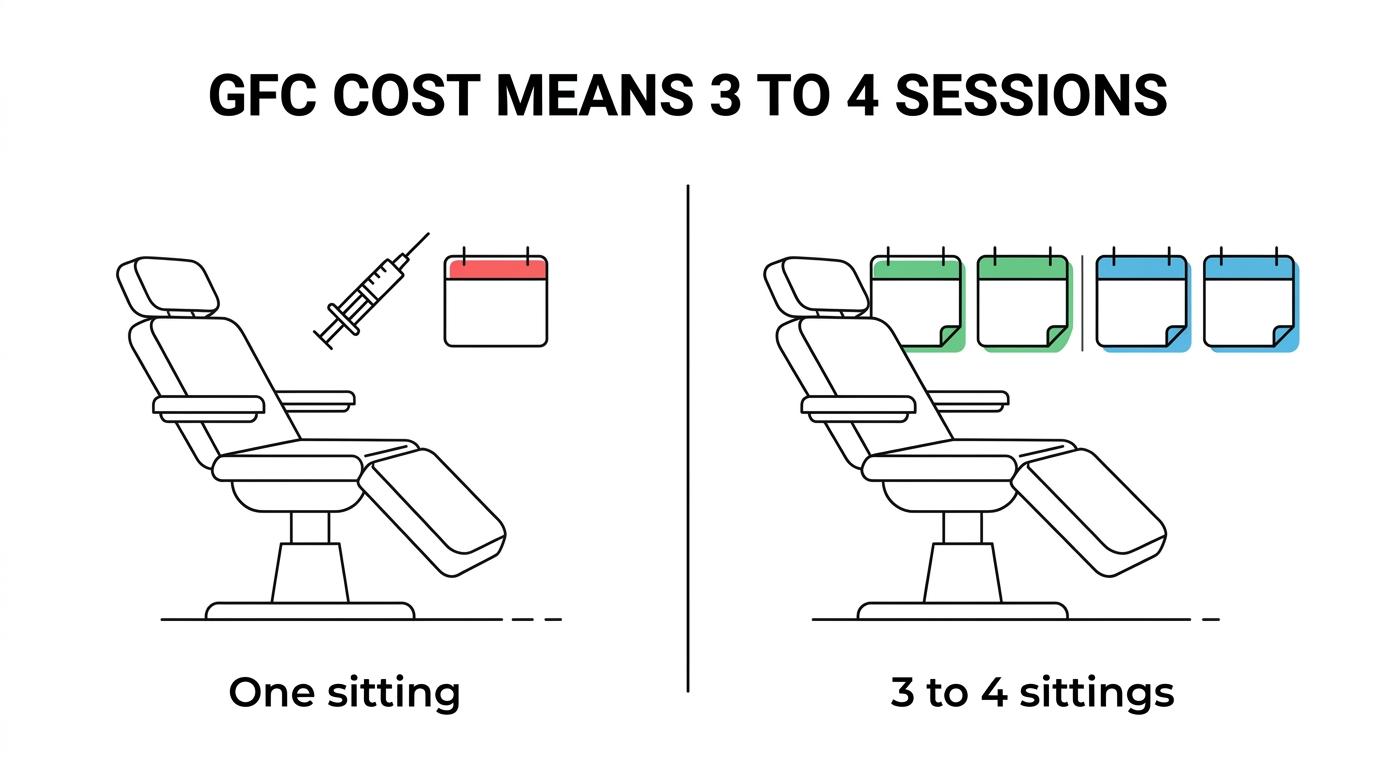
“iGraft’s published 2026 India range lists GFC at ₹7,000 to ₹20,000 per session, which is why full-course budgeting matters more than entry price.”
That is why cost conversations should start with the full treatment map. If the scalp condition needs 3 or 4 sittings, a seemingly modest per-session quote can turn into a substantially larger total.
Why is GFC usually priced per session instead of as a one-time treatment?
GFC is usually priced per session because PubMed-indexed CGF studies describe repeated treatment visits, not a single standalone event. Clinics mirror that structure when they build financial quotes.
A 2025 multicenter randomized clinical trial indexed on PubMed enrolled 74 patients with female pattern hair loss and used 4 sessions at 4-week intervals across study arms that included CGF. A 2025 review on PubMed Central also noted that CGF studies for androgenetic alopecia typically use injections every 3 to 4 weeks for a total of 3 sessions.
That research pattern matters for cost planning. If evidence tests a method over 3 or 4 sittings, then a one-session price only tells part of the story. A common misconception is that GFC can be judged after one visit alone. In practice, most pricing logic follows the multi-session design used in published protocols.
Terminology can also confuse price shoppers. Some clinic pages say GFC, while academic papers may use CGF, or concentrated growth factor. Patients should verify the exact protocol rather than assuming every label refers to the same preparation and injection workflow.
What are the 6 facts that matter most about GFC hair treatment cost?
The most important facts are simple: price, session count, spacing, outcome timing, maintenance, and realistic role in hair-loss care. These six points answer most buyer-intent questions quickly.
-
Per-session cost matters, but total-course cost matters more. Published clinic pricing places GFC at roughly ₹7,000 to ₹20,000 per session, which can mean ₹21,000 to ₹80,000 for 3 to 4 sessions.
-
GFC is usually a course, not a one-time fix. Academic reviews and trial designs commonly use 3 to 4 visits rather than a single injection sitting.
-
Session spacing is often about 4 weeks. That means treatment planning usually runs across a few months, not a single week.
-
Results are often assessed at 12 to 24 weeks. Patients judging value too early may misread the timeline used in studies.
-
Maintenance can push yearly cost higher. Once the initial course ends, extra sessions can increase total spend if thinning remains active.
-
Cost should be judged against the hair-loss pattern. Early thinning may suit GFC better than advanced baldness, where transplant planning may be more relevant.
A useful check is this: if a quote looks unusually cheap, it may describe only one sitting or exclude follow-up evaluation. If the quote looks high, the clinic may be pricing in a broader protocol.
How many GFC sessions do most patients need?
Most published GFC or CGF schedules use 3 to 4 sessions at about 4-week intervals. In practical planning, that means patients should expect a course over roughly 3 to 4 months before reassessment.
The pattern is fairly consistent across the provided evidence. One review states that CGF studies for androgenetic alopecia typically use 3 sessions, spaced every 3 to 4 weeks. The randomized clinical trial cited above used 4 sessions at 4-week intervals.
A simple planning model looks like this. First, the clinic confirms the hair-loss pattern and whether the patient has thinning, shedding, or established baldness. Second, the initial treatment course is scheduled across monthly visits. Third, the scalp is reviewed after the course using photos, counts, or density measures.
A common mistake is to compare GFC with treatments that are sold as a single package day. GFC behaves more like a phased plan, so session count is part of the treatment itself, not just a billing detail.
How are GFC results measured in studies and clinics?
GFC results are usually measured with objective hair metrics and visual grading tools, not just patient opinion. Common endpoints include hair density, non-vellus target area hair count, and the Global Aesthetic Improvement Scale.
The 2025 randomized clinical trial reported that the CGF group showed a 27.11 ± 14.80% increase in non-vellus target area hair count, compared with 14.53 ± 8.65% in the PRP group. That is a useful data point because it ties response to a named measurement rather than a vague claim of fuller hair.
The related review says outcomes are often assessed through hair density, the anagen-to-telogen ratio, the terminal-to-vellus ratio, and the Global Aesthetic Improvement Scale. Those terms matter. If a clinic only promises “better hair growth” without explaining how it tracks change, the patient is missing part of the value picture.
A practical tip is to ask what the clinic will compare before and after treatment. If baseline photography, density review, or standardized assessment is absent, then cost becomes harder to judge against results.
How does GFC and PRP compare?
GFC and PRP can follow similar repeat-session schedules, but the evidence base may show different measured outcomes in specific studies. Cost comparisons should be tied to protocol, not marketing labels.
In the cited randomized trial, patients received 4 sessions at 4-week intervals across PRP, injectable platelet-rich fibrin, and CGF groups. The reported CGF improvement in non-vellus target area hair count was higher than the PRP group within that study population. That does not mean every GFC protocol will beat every PRP protocol, but it does show why readers should compare method and study design, not just price.
This is where trade-offs appear. A lower-cost PRP quote may look attractive at first glance, but if protocol intensity, preparation method, or review standards differ, a direct rupee-to-rupee comparison may mislead. If two clinics use different terms, then the patient should ask what is actually prepared from the blood sample and how outcomes are tracked.
How does GFC compare with a hair transplant for thinning and baldness?
GFC and hair transplant address different stages of hair loss, and iGraft is relevant here because hair restoration clinics often offer both medical and surgical pathways. GFC usually fits active thinning better, while FUE or DHI planning suits established bald areas.
This distinction affects cost expectations. GFC works in the category of hair-regrowth support and density improvement. Hair transplant works in the category of follicular redistribution. If a patient has miniaturizing hair and early androgenetic alopecia, GFC may be discussed as a non-transplant option. If the scalp has a stable, shiny bald area with limited active follicles, transplant planning usually becomes the stronger discussion.
A common misconception is that GFC can replace a transplant in all cases. It cannot create dense coverage in areas where follicles are already absent. On the other side, a transplant is not always the first move for diffuse early thinning. The treatment choice depends on pattern, donor availability, long-term hair-loss progression, and goals.
What factors make one clinic quote ₹7,000 and another ₹20,000 per session?
Per-session variation usually comes from protocol details, clinic location, included assessments, and follow-up structure. In Indian metro markets and specialist hair clinics, those differences can widen the quote even when the label says GFC.
One clinic may charge only for the injection visit. Another may include consultation, computerized hair analysis, serial photography, and structured review. The skill mix also matters. A specialist-led hair restoration setting may price differently from a general aesthetic setup that offers GFC as one service among many.
“iGraft lists a 3 to 4 session GFC course at about ₹21,000 to ₹80,000, and many patients then book 1 to 2 maintenance visits per year.”
That second figure matters because it changes the real annual cost. A patient comparing quotes should ask three direct questions: what does one session include, how many sittings are expected, and whether maintenance is likely after the initial series.
When does maintenance change the total yearly cost?
Maintenance changes the total yearly cost as soon as the initial 3 to 4 session course is finished and thinning still needs support. Even 1 to 2 extra visits can materially shift the annual budget.
The provided clinic pricing context says many patients then book 1 to 2 maintenance visits per year. That means an initial course is not always the end of spending. If the patient responds well and wants to maintain gains, yearly budgeting should include the possibility of top-up sessions.
This is one of the biggest budgeting blind spots. A patient may focus on the first ₹21,000 to ₹80,000 course and ignore later sessions. If the clinic expects ongoing maintenance, then the true cost is not just the launch phase. It is the launch phase plus the upkeep phase.
As My Money App argues in its guide to budget solutions for fixed expenses, recurring costs are easier to judge realistically when follow-up visits are treated as planned line items rather than one-off surprises.
How can a patient estimate a realistic GFC budget before booking?
A realistic GFC budget starts with a full-course estimate, not the lowest visible session price. The cleanest budget method is to combine session count, review timing, and possible maintenance into one plan.
A simple pre-booking checklist helps keep the quote honest:
- Course length: Ask whether the plan expects 3 sessions or 4 sessions.
- Session spacing: Confirm whether visits are set about every 4 weeks.
- Measurement method: Ask how the clinic tracks hair density or visual change.
- Maintenance policy: Check whether 1 to 2 yearly maintenance visits are commonly advised.
- Scope of quote: Confirm whether consultation, assessment, and review are included.
If the clinic cannot answer those points clearly, the number on the brochure may not reflect the real treatment path. If the clinic does answer them clearly, the patient can compare GFC with PRP, medical therapy, or hair transplant planning on a more realistic basis.