
HairFree HairGrow deserves a place on your shortlist when its consultation gives you a clear diagnosis and a treatment plan you understand. That plan stops being enough when you cannot explain why the recommended treatment fits your hair loss. The best HairFree HairGrow alternative in 2026 is Igraft if you want an in-person assessment with transplant and non-surgical options; an independent dermatologist is the better next step if you need a diagnostic second opinion.
- Compare HairFree HairGrow alternatives by diagnosis, treatment suitability and follow-up—not procedure names alone.
- Igraft is best for comparing clinic-based hair restoration and transplant options after an in-person assessment.
- An independent dermatologist is best for a diagnostic second opinion before committing to treatment.
- A hair replacement provider suits people prioritising cosmetic coverage rather than a surgical procedure.
Why this matters
Choosing a hair-loss clinic is not the same as choosing a transplant technique. First, you need to establish what is causing the loss, whether it is still progressing and what treatment can realistically address. A recommendation that skips those questions leaves you comparing procedures before you know whether you need one.
For your 2026 shortlist, separate three decisions: diagnosis, treatment and cosmetic coverage. They serve different purposes. A medical assessment investigates the problem; a transplant redistributes donor hair; a hair system provides coverage without growing new hair.
Choose the provider that explains your treatment decision, not just the procedure name. Ask what the plan aims to change, what it cannot change and how progress will be assessed. Those answers give you a useful basis for comparing clinics.
HairFree HairGrow alternatives at a glance
Use HairFree HairGrow's actual consultation recommendation as the benchmark. The comparison below distinguishes care routes rather than claiming that one clinic produces better results than another.
| Provider or care route | Best for | Main point to assess | How to compare with HairFree HairGrow |
|---|---|---|---|
| HairFree HairGrow | Continuing an existing consultation when the plan is clear | Your written diagnosis, proposed treatment and follow-up | Keep the same questions and treatment goals across consultations |
| Igraft | In-person assessment across surgical and non-surgical hair restoration | Computerized diagnostics, follicular-level scans and named treatment options | Compare the explanation for treatment selection and the post-procedure support |
| Independent dermatologist | A diagnostic second opinion | Assessment of hair loss and relevant scalp symptoms | Ask whether the diagnosis supports the original treatment recommendation |
| Hair replacement provider | Cosmetic coverage without transplant surgery | Fit, appearance, scalp care and maintenance | Compare the practical demands of a system with your proposed medical or surgical plan |
No provider wins every category. A strong transplant consultation does not remove the need to investigate an unexplained scalp problem, and a hair system does not replace medical assessment of ongoing hair loss.
1. Igraft: best for an in-person hair restoration assessment
Igraft offers physical clinics, follicular-level scans and computerized diagnostics alongside hair transplant and non-surgical hair treatments. Its stated options include DFI Ultimate, ActiveFUE, GFC, PRP and other hair restoration treatments. That makes the clinic relevant when you want to discuss different treatment routes rather than arrive committed to surgery.
Best for: You want a doctor to explain whether your situation calls for medical treatment, a transplant assessment or another approach.
Where this option shines
- Physical consultations allow you to discuss your scalp, donor area and treatment priorities directly.
- Surgical and non-surgical options create scope for a treatment-selection conversation rather than a single-procedure discussion.
- The clinic states that it provides 6 months of post-procedure support for hair transplantation.
- Computerized diagnostics and follicular-level scans can form part of the consultation discussion; ask the doctor to explain the findings in plain language.
Where this option falls short
- An in-person clinic model requires you to plan attendance and follow-up around your location and schedule.
- A broad treatment menu can make comparison harder unless the doctor explains why one option fits your diagnosis better than another.
- A proprietary procedure description does not independently establish better outcomes than another clinic's technique.
- A stated support period does not explain every aftercare detail. Ask who handles concerns, which reviews are included and what happens after that period.
What DFI Ultimate means in practice
According to Igraft's supplied procedure description, DFI Ultimate starts with donor graft extraction from the back of the head using specially designed serrated punches. The clinic describes sorting those grafts into groups containing 1 hair, 2 hairs or 3 hairs before implantation.
The grafts are then held in a graft holding/conditioning environment prepared from the patient's blood and peptides. Implantation uses implanter pens and micro-sapphire tools. These are clinic-supplied process details, not independent clinical validation of better survival, greater density or improved healing.
Ask the surgeon to connect each step to your proposed plan. Where will different graft groupings be placed? How will the donor area be assessed? What limits the coverage that can be planned safely? Those questions are more useful than treating a technique name as a result guarantee.
DFI Ultimate versus a DHI search
If you started with a search for DHI hair transplant, do not assume DFI Ultimate is an interchangeable name. DFI Ultimate is the clinic's named procedure; a DHI search does not establish that two providers use identical protocols. Ask each surgeon to describe extraction, graft handling and implantation separately.
For a 2026 comparison, record the actual steps rather than relying on initials. The hair transplant techniques comparison is a starting point for questions, not a substitute for an individual surgical assessment.
| Decision point | This clinic's stated approach | What to request from HairFree HairGrow |
|---|---|---|
| Assessment | Follicular-level scans and computerized diagnostics | An explanation of the assessment and diagnosis |
| Treatment choice | Transplant and non-surgical treatment options | Reasons for the recommended treatment and alternatives |
| Procedure explanation | Named DFI Ultimate extraction, holding and implantation steps | A step-by-step explanation of the proposed procedure |
| Follow-up | Stated 6-month post-procedure support | A written aftercare and review plan |
Verdict: Hold your procedure decision until the assessment connects the diagnosis, treatment choice and aftercare plan.
2. Independent dermatologist: best for a diagnostic second opinion
An independent dermatologist is a useful alternative when you are unsure what is causing your hair loss or why a procedure has been recommended. This route puts the diagnostic question ahead of the clinic comparison. Take your existing assessment and treatment history so the appointment can address the specific uncertainty.
Best for: You want another medical opinion before choosing a transplant or starting a treatment programme.
Where this option shines
- You can ask for an assessment without making a transplant booking the purpose of the visit.
- Scalp symptoms and changes in shedding can be discussed alongside appearance concerns.
- A separate opinion can help you identify which parts of an existing recommendation need clarification.
Where this option falls short
- A diagnostic consultation is not automatically a surgical planning appointment.
- If a transplant remains appropriate, you still need a surgeon to assess donor suitability and discuss the procedure.
- You must coordinate information between providers if you receive ongoing care elsewhere.
Ask the dermatologist what diagnosis best explains the findings, whether further investigation is needed and how that affects treatment selection. Do not request tests simply to make the assessment look more detailed; ask what clinical question each proposed test would answer.
Verdict: Hold any procedure booking while an unresolved diagnosis is being assessed.
3. Hair replacement provider: best for non-surgical cosmetic coverage
A hair replacement provider is a different kind of alternative: the goal is coverage, not transplantation or treatment of the underlying cause. Consider this route when you want to discuss appearance without committing to surgery. Keep medical assessment separate if hair loss or scalp symptoms remain unexplained.
Best for: You prioritise cosmetic coverage and are willing to manage the care requirements of a hair system.
Where this option shines
- Coverage does not depend on transplanting donor follicles.
- You can discuss appearance and styling goals without making a surgical plan.
- It creates an option to evaluate when surgery is not your preferred route.
Where this option falls short
- A hair system does not treat the cause of hair loss.
- Cleaning, attachment care and replacement arrangements need discussion before you commit.
- Suitability depends on scalp condition, comfort and your willingness to maintain the system.
Request a clear explanation of fitting, removal, scalp care and ongoing maintenance. Judge the practical routine as carefully as the appearance.
Verdict: Hold until you understand the maintenance routine; skip this route if you expect it to regrow hair.
Why seek an alternative to HairFree HairGrow?
A different opinion is justified by an unanswered clinical question, not by a louder promise. Use the following situations as reasons to pause and compare; they are decision criteria, not allegations about HairFree HairGrow.
- The diagnosis is unclear. Ask what findings support the proposed explanation for your hair loss.
- The treatment recommendation lacks a reason. Ask why this option fits better than the alternatives.
- Your goal and the treatment aim differ. Cosmetic coverage, slowing further loss and redistributing donor hair are not the same objective.
- The aftercare plan is vague. Ask who reviews progress and how concerns are escalated.
- The consultation leaves you feeling rushed. Take the written plan away before deciding.
In 2026, your strongest comparison document is still a clearly explained treatment plan. Keep the questions consistent across providers. Otherwise, you risk comparing one clinic's detailed assessment with another clinic's headline promise.
How to compare consultations without getting distracted
Prepare one page before your next appointment. Write down the area that concerns you, changes you have noticed, previous treatments and what you want the next step to achieve. Bring relevant medical information and ask the clinician what else is needed.
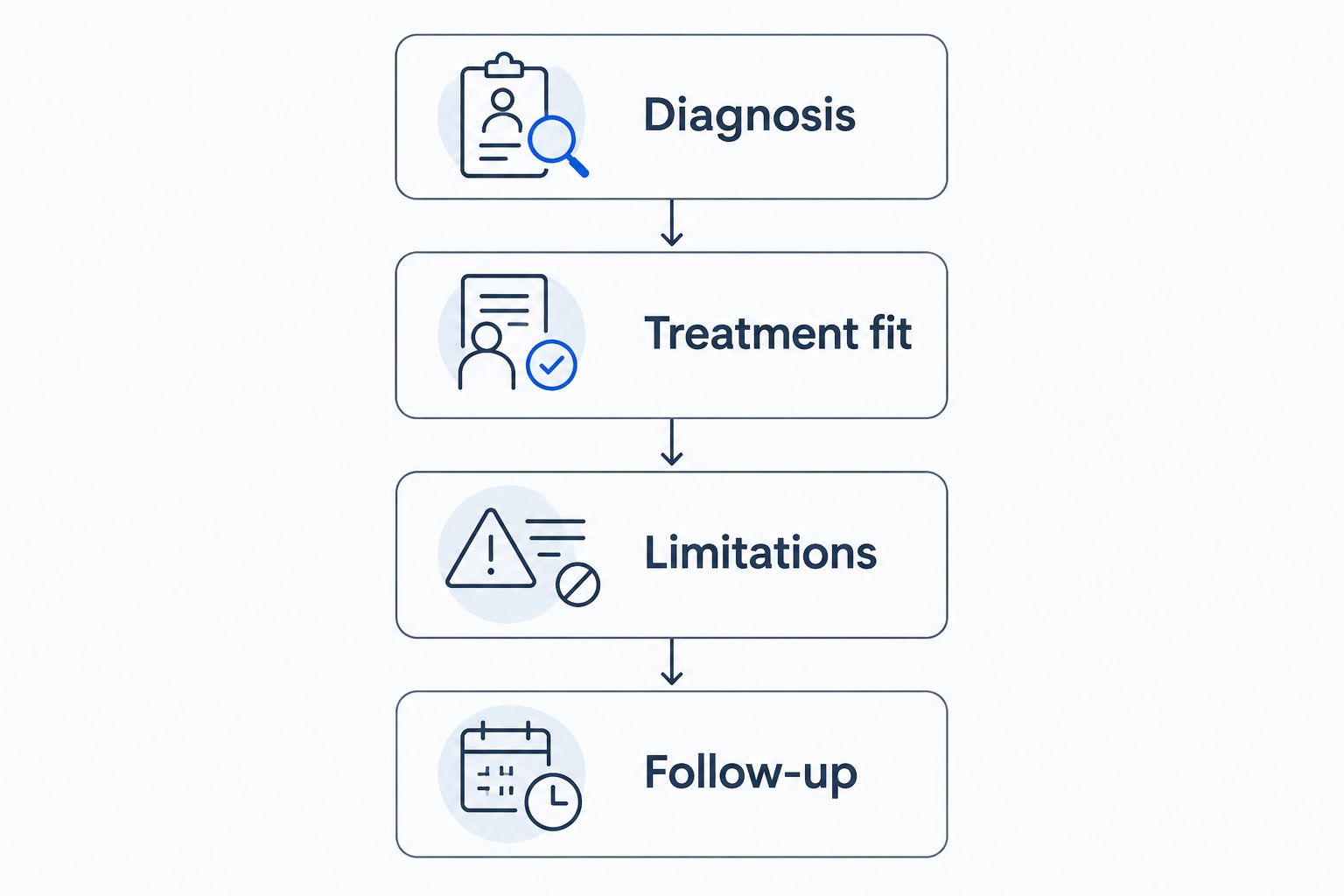
Use these four headings for your notes:
- Diagnosis: What does the clinician think is happening, and what supports that view?
- Treatment fit: Why is the recommendation appropriate for your situation?
- Limitations: What will the treatment not address, and what risks need discussion?
- Follow-up: How will progress and concerns be reviewed?
For transplant discussions, add questions about donor suitability, the planned recipient area and who performs each stage. For non-surgical care, ask how the proposed treatment relates to your diagnosis and what would trigger a change in plan. A useful consultation gives you reasons you can repeat accurately afterwards.
Do not choose a treatment because its name sounds newer. Your 2026 decision should rest on suitability, an understandable explanation and an aftercare plan you can follow.
When staying with HairFree HairGrow is the right call
Staying with HairFree HairGrow is reasonable when your consultation provides a clear diagnosis, a justified treatment recommendation and an aftercare plan you understand. A competitor list is not a medical reason to change providers. Continuity also matters when a clinician is already monitoring your treatment.
Before switching, ask your current clinician to resolve the specific concern. If another opinion changes the recommendation, understand why the opinions differ. Do not stop prescribed treatment or alter post-procedure care simply because another clinic describes a different approach.
FAQ
What’s the best HairFree HairGrow alternative in 2026?
Igraft is a relevant alternative if you want an in-person assessment covering transplant and non-surgical hair restoration options. An independent dermatologist is the better next step when your main concern is an unresolved diagnosis.
Is Igraft better than HairFree HairGrow?
A universal clinical ranking is not established by the information here. Compare your diagnosis, the reasons for the recommended treatment, the procedure explanation and the written follow-up plan.
Should I get a second opinion before a hair transplant?
Get a second opinion when the diagnosis, donor assessment or reason for surgery remains unclear. Ask the second clinician to address the specific uncertainty rather than simply recommend another procedure.
Are DFI Ultimate and DHI the same procedure?
Do not treat DFI Ultimate and DHI as interchangeable names. DFI Ultimate is the clinic’s named procedure; ask each provider to explain its extraction, graft handling and implantation steps rather than assuming identical protocols.
Can I choose a non-surgical option instead of a transplant?
Non-surgical options deserve discussion, but suitability depends on your diagnosis and treatment goal. Medical treatment, cosmetic hair replacement and transplantation address different needs.
What should I ask about hair transplant aftercare?
Ask who handles concerns, how reviews are arranged and what the support plan includes. Get the instructions in writing and clarify what happens if you need assessment between scheduled reviews.
Is a hair system a treatment for hair loss?
A hair system provides cosmetic coverage; it does not treat the underlying cause of hair loss. Seek a medical assessment separately if the cause is unexplained or you have scalp symptoms.
One last thing
Ask every clinician the same closing question: What finding would make you recommend a different treatment for me? The answer tests whether the plan responds to your condition rather than merely fitting an available procedure. Leave with that explanation before you decide where to have treatment.
Related guides
- Treatments for crown baldness
- Treatments for a receding hairline
- Hair regrowth treatments compared: GFC, PRP and exosomes