
For many people considering a hair transplant, the surgery itself is not the only concern. The visible sign of a freshly shaved scalp can feel harder to accept than the procedure. That is why “hair transplant without shaving” has become one of the most common questions in clinics across India, including Vijayawada.
The short answer is yes. A no-shave hair transplant without shaving the whole head is possible in selected cases. The longer answer is that the right option depends on graft count, donor density, hairstyle, work routine, and the technique being used. In many cases, the doctor does not need to shave the entire head, but some level of trimming in the donor area may still be needed.
What “hair transplant without shaving” actually means
A no-shave hair transplant does not always mean zero trimming anywhere on the scalp. In real practice, it usually means avoiding a full head shave and keeping the procedure discreet enough that surrounding hair can cover the donor and recipient zones during recovery.
This can be done in a few ways. One patient may have only a narrow donor strip trimmed and hidden under longer hair. Another may have individual hairs pretrimmed for extraction. A third may keep the recipient area unshaved while the donor is trimmed in a controlled way. The term is broad, and that is why proper planning matters.
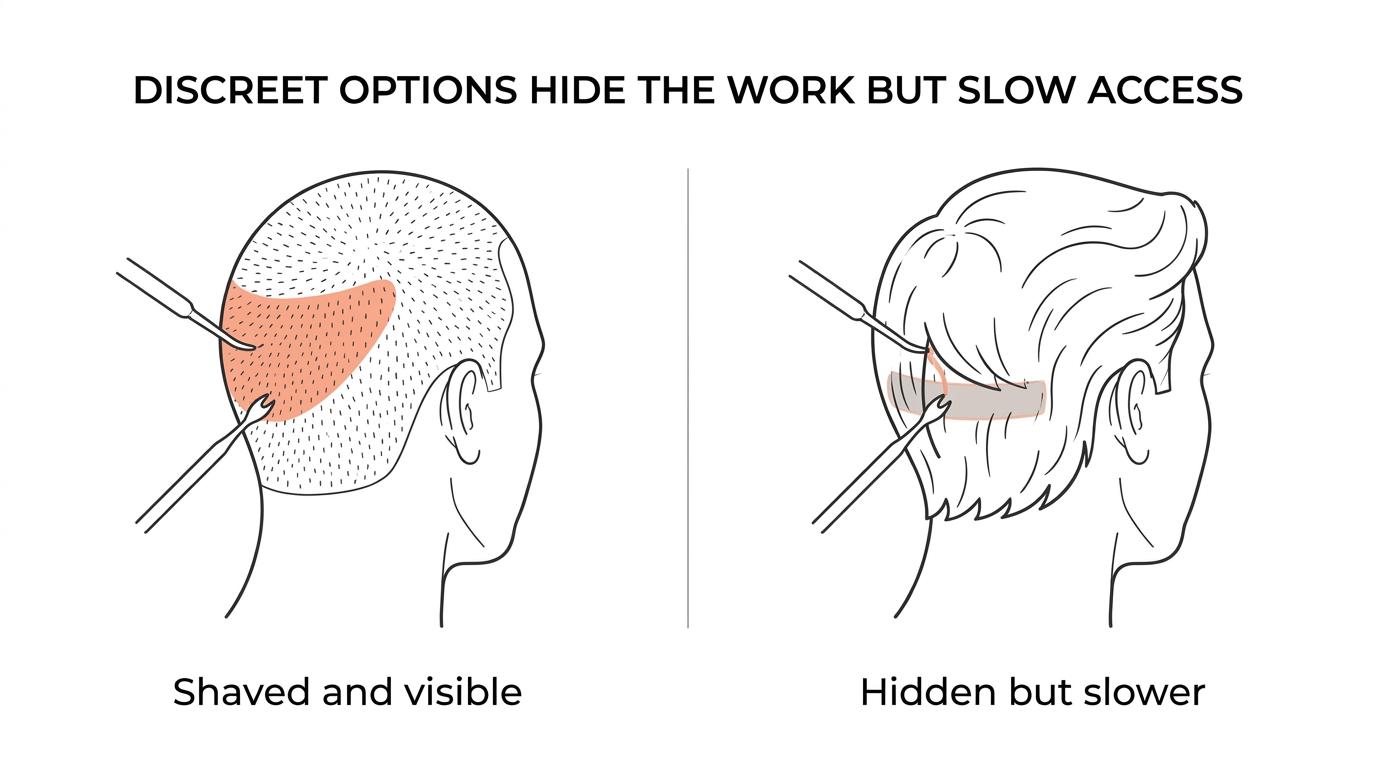
Most FUE procedures worldwide are still done with the donor hair shaved very short, often around 0.5 to 1.5 mm, based on ISHRS guidance. That remains the easiest setup for visibility, graft extraction, and speed. Still, the same guidance also notes that micro-strip or zone-shave approaches can work for selected small scalp FUE procedures when planned carefully.
| Approach | What is shaved | Best suited for | Main trade-off |
|---|---|---|---|
| Standard shaved FUE | Most or all donor area, sometimes recipient area | Large graft counts, advanced baldness, faster extraction | Most visible after surgery |
| Zone-shave FUE | Small hidden donor zones | Small to medium sessions, patients wanting discretion | Limited harvest area in one sitting |
| Nonshaven FUE | Individual hairs or minimal trimming only | Selected men and women, modest graft needs, discreet recovery | Longer operating time |
| Hybrid no-shave planning | Limited donor trimming with careful implantation | Hairline work, touch-ups, selective density work | Not ideal for every baldness pattern |
No-shave hair transplant options in Vijayawada
Patients searching for the best hair transplant clinic in Vijayawada often ask one practical question before anything else: can the procedure be done without shaving the head? In many cases, the answer may be yes, especially when the graft requirement is moderate and the existing hairstyle can hide the donor work.
At iGraft in Vijayawada, hair transplant planning starts with a computerized hair and scalp check before a surgical or non-surgical recommendation is made. That matters because no-shave planning is not just a preference issue. It depends on scalp laxity, donor density, hair caliber, direction, and the degree of baldness.
Clinics in Vijayawada may assess patients for Active FUE, DFI hair transplant, hybrid restoration, revision transplant, beard transplant, and supportive regrowth options like PRP or GFC. When the concern is discretion, the surgeon usually decides first whether the case is suited to full nonshaven FUE, partial-shave FUE, or a standard shaved approach with better efficiency.
A patient asking for a “celebrity-style” discreet transplant is often asking for this exact category of planning.
FUE, DHI, and zone-shave techniques for discreet hair restoration
The most common method used for hair transplant without shaving is a form of FUE. The science of graft survival stays the same. What changes is the way the donor area is managed.
Nonshaven FUE and pretrimmed extraction
In nonshaven FUE, the doctor extracts follicles while the surrounding hair remains long. Sometimes the selected hairs are individually pretrimmed before punching. In other versions, the extraction is more direct and leaves even shorter harvested hair.
A 2017 PubMed comparison of 42 patients found that pretrimmed nonshaven FUE took longer than direct nonshaven FUE when measuring time per 50 grafts, though the transection rates were similar. That is useful for patients comparing hair transplant effectiveness and convenience. The method can work well, but it usually demands more time and more technical control.
Published evidence has also become stronger for larger sessions. A 2026 retrospective series of 236 patients reported successful large-session nonshaven FUE with individualized pretrimming, including cases above 2,500 grafts and follow-up figures reaching 4,007 follicles. The authors described it as a safe and effective option for advanced androgenetic alopecia in experienced hands.
Partial-shave or micro-strip FUE
This is often the middle path. Instead of shaving the whole head, the surgeon trims a narrow hidden zone in the donor area, then extracts grafts from that section. Longer hair above it helps cover the area during healing.
This approach is appealing for office-going patients, women with longer hair, and men who want a subtle return to work. It can also be a practical option for hairline restoration, temple filling, scar correction, or smaller crown sessions.
ISHRS guidance supports carefully planned zone shaving in selected cases, while also warning that low-density harvest is preferred so the donor does not look patchy.
Implantation methods in no-shave planning
The implantation side may involve slit placement, implanter-based placement, DHI-style workflows, or a hybrid method. The “no-shave” part mainly refers to visibility and harvesting logistics, not a completely separate category of graft biology.
That is why a patient should ask not only “Is it no-shave?” but also “How will the grafts be harvested, stored, and placed?”
Eligibility for no-shave hair transplant
Not every patient is a strong candidate. A person with advanced baldness and a 3,000 plus graft requirement may still get better coverage, better speed, and better donor access with standard shaved FUE. A patient with a small hairline recession or a focused thinning zone may do very well with a discreet no-shave or partial-shave plan.
The best candidates often share a few features:
- Stable donor density
- Longer surrounding hair
- Moderate graft requirement
- Realistic expectations
- Need for minimal visual downtime
- Women with localized thinning
- Men seeking hairline or temple correction
Doctors also look at the pattern of baldness, family history, previous procedures, hair shaft thickness, curl, scalp condition, and whether the patient wants to combine transplant surgery with medical treatment for long-term maintenance.
A no-shave plan is often easier to justify when discretion matters as much as density.
Hair transplant safety, permanence, and success rate in no-shave cases
Patients often assume that a no-shave hair transplant is less safe or less permanent than a standard FUE transplant. That is not the right way to view it. The permanence of a hair transplant depends more on donor hair selection, graft handling, recipient design, and future hair loss control than on whether the head was shaved.
If the grafts come from a stable donor zone, the transplanted hair is generally expected to be long-lasting, just as in standard FUE or FUT. The success rate still depends on technique, surgeon planning, and case selection. No-shave does not automatically lower success, but it can make the procedure more technically demanding.
Safety is also tied to case selection. When visibility is limited, poor planning can raise the risk of inefficient extraction, hair shaft damage, or overharvesting in a concealed zone. That is why experience matters more in nonshaven work than in a routine shaved procedure.
A sensible consultation should cover these points:
- Donor safety: Can the required grafts be taken without making the hidden donor zone look thin?
- Session size: Is the patient asking for more grafts than the no-shave plan can safely support?
- Technique match: Would standard FUE, Sapphire FUE, DHI, Bio FUE, or a hybrid approach make more sense for this pattern?
- Future loss planning: Will surrounding native hair continue to thin and change the result over time?
Hair transplant cost in Vijayawada for no-shave procedures
Hair transplant cost is one of the biggest search topics in India, and no-shave procedures usually bring an extra layer to the discussion. Many clinics price by graft count, but the time and effort needed for nonshaven FUE can make the cost higher than a standard shaved session.
That does not mean every no-shave case is expensive. A smaller hairline case with controlled graft numbers may still be manageable. The key issue is that individual pretrimming, slower extraction, and careful concealment planning increase chair time.
At iGraft, published guidance notes that unshaven work takes more time and that final pricing follows the scan. That is a sensible way to quote because two patients asking for “no shave” may need completely different levels of work.
Common cost drivers include:
- Graft count: More grafts usually mean more time and a higher total cost.
- Technique choice: Nonshaven FUE may cost more than regular shaved FUE because it is slower.
- Baldness grade: Early hairline correction is very different from advanced baldness coverage.
- Clinic planning: Computerized scalp analysis and donor mapping help estimate safe graft numbers.
- Supportive treatment: PRP, GFC, or medical maintenance may be added to improve ongoing hair retention.
For people comparing the best place for hair transplant in India, local follow-up is part of value too. Vijayawada patients often prefer nearby review visits over flying to another city just to save on the first quote.
Recovery timeline after a no-shave hair transplant
The biology of healing is very similar to standard FUE, though washing and aftercare may feel a bit more delicate because native hair is still present around the grafted zone.
A typical recovery pattern looks like this:
- Day 1 to 3: mild redness, tiny crusts, donor sensitivity
- Day 4 to 10: scabs begin to loosen, hidden donor area becomes easier to cover
- Week 2 to 6: some shedding of transplanted shafts can happen
- Month 3 to 4: early regrowth starts
- Month 6 to 9: visible improvement in density
- Month 10 to 12: more mature texture and coverage
Because the surrounding hair is not fully shaved, early recovery often appears less dramatic in public. That is one reason why this option stays popular with working professionals, public-facing roles, and women.
How to compare the best hair transplant clinic in Vijayawada for no-shave cases
A no-shave transplant is not a marketing label. It is a technical plan. Patients comparing the best clinic or best doctor in Vijayawada should focus on whether the clinic is honest about candidacy, donor limits, and the trade-off between discretion and graft numbers.
That conversation should be very direct.
Useful questions to ask during consultation include:
- Can the whole head stay unshaved: Or will a hidden donor zone still need trimming?
- How many grafts are realistic: Based on donor density and current baldness stage?
- Which method is planned: Nonshaven FUE, zone-shave FUE, DHI-style placement, Sapphire FUE, or hybrid restoration?
- What is the downtime: When can work, exercise, and travel resume?
- How is long-term density protected: Will medicines, PRP, or GFC be advised for native hair maintenance?
For many patients in Vijayawada, the right answer is not “full shave” or “no shave” as a fixed rule. It is the option that gives safe donor use, natural placement, a practical recovery timeline, and a result that still looks strong years later. That decision starts with scalp analysis, honest graft planning, and a clinic that treats discretion as part of the medical design, not just a sales promise.