Why Young Men Choose In-Clinic GFC Over Oral DHT Blockers
If your hairline is moving in your twenties, you have probably been told to start a daily DHT blocker. Finasteride lowers dihydrotestosterone in the bloodstream. That can slow pattern loss. Many men refuse the pill over sexual side effects, mood changes, or years on a systemic drug.
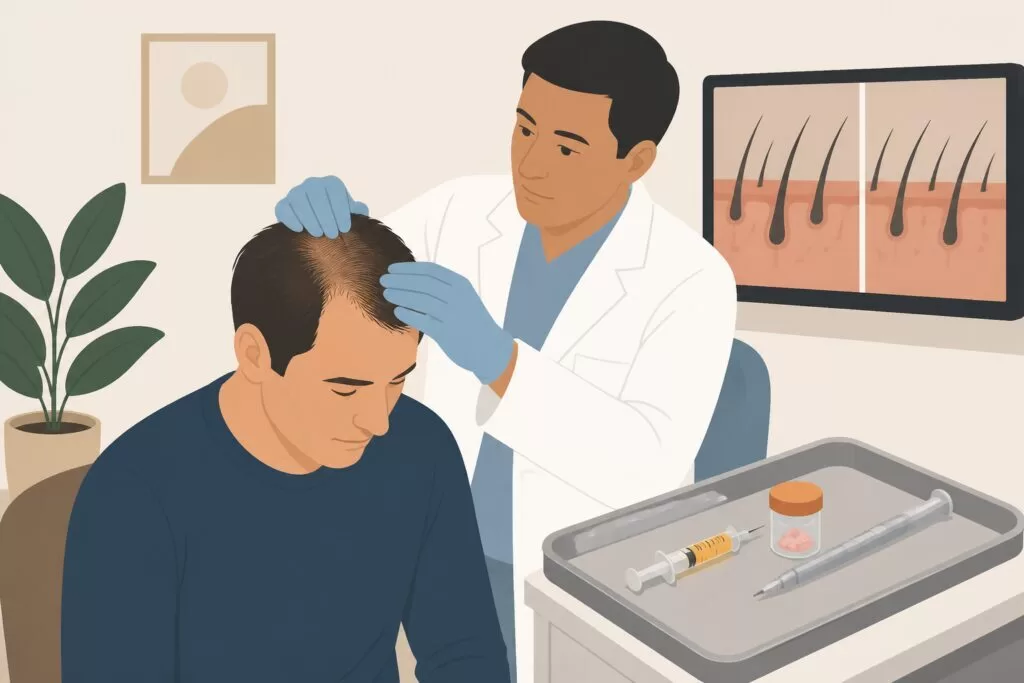
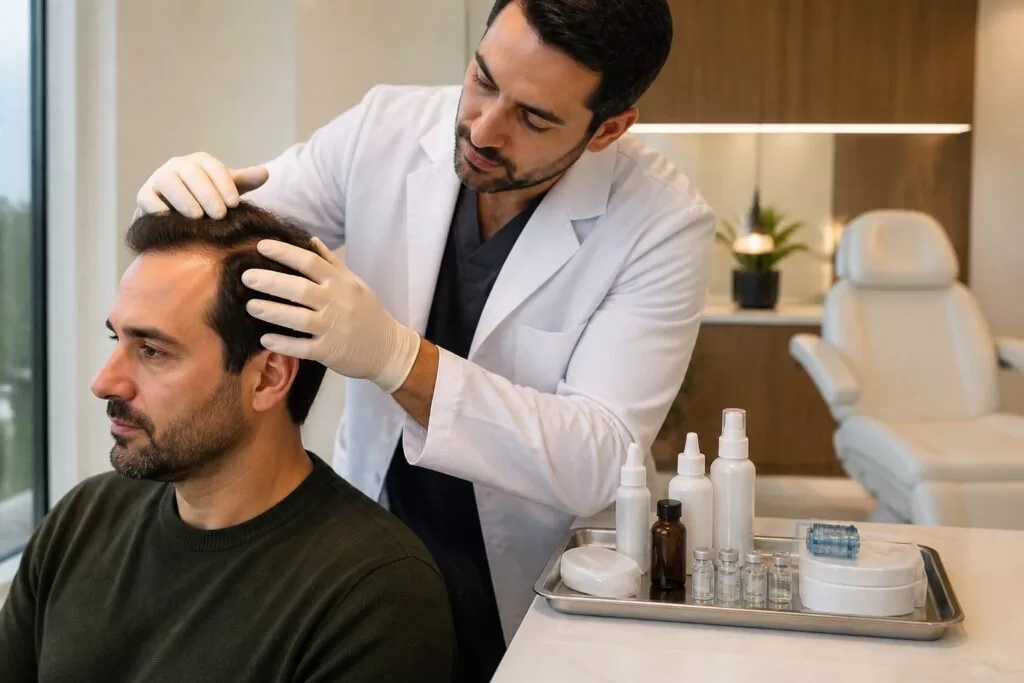
GFC, short for growth factor concentrate, is the in-clinic option they ask about. Your blood is processed and placed into thinning scalp. It does not block DHT, so it avoids that pill's systemic effects. While follicles are still alive, it is local support, not a hormone switch.
iGraft Global Hair Services is a company-owned chain, not a franchise, with rooms in Pune, Bangalore, Hyderabad, and Vijayawada. You meet a doctor. Plans are not guessed from photos. Computerized scalp checks, follicular-level imaging, and an AI report have been used on this path since 2015.
What you are opting out of
DHT miniaturizes sensitive follicles. An oral blocker lowers that hormone through the whole body. That is why it can slow loss, and why side effects, when they occur, are not limited to the scalp. A doctor should explain the risk, which does not hit every man. Ask whether you have trigger shedding, androgenetic miniaturization, or zones where follicles are already gone.
Fast weight loss, including after GLP-1 medicines, can cause telogen effluvium that looks like pattern loss. Surgery will not fix an active shed. If fall rose after the weight drop, pattern care waits until shedding settles. The GLP-1 program is not sold online. It starts only after an in-person consult under doctor supervision.
What the GFC visit involves
The sample is processed for a cleaner growth-factor dose than standard platelet-rich plasma. iGraft uses GFC Class 2 with high-frequency treatment and low-level laser, and may add exosomes, Booster, or BioCell if miniaturization is active. Session counts and fees are in 6 facts on GFC. Expect months, not a weekend.
A published early-stage case keeps the claim small. Shedding eased after the second session. After four sessions, vertex density rose from 72 to 98 hairs/cm2, about 36 percent, and shaft thickness rose 18 percent. Satisfaction was 9 out of 10. No infection or hypersensitivity was reported. Maintenance was planned at six months (doi.org). That is one patient, not a promise.
PRP is less steady on its own. A review of trials notes a 30-man pilot with no significant gain from PRP alone, and an 80-patient trial where PRP plus minoxidil 5 percent beat either treatment by itself (doi.org). Minoxidil is a growth stimulant, not a DHT blocker. See PRP regrowth and session timing after your scan. The product line is home support, not a diagnosis. GFC will not refill skin where follicles are gone.
The scan picks the treatment
A kit cannot tell you why hair is leaving. The checkup covers scalp health, follicle diameter, texture, growth phase, donor density, and nutritional, hormonal, or skin causes. That report chooses GFC Class 2, PRP, exosomes, or a mix, and it stops donor hair being spent during a shed that may reverse. Use the 2-minute quiz before you travel. The graft count still needs a visit.
When a transplant is the clearer step
Growth factors will not rebuild a bare hairline. A transplant moves donor follicles that resist pattern loss better than the hair you are losing. In a suitable candidate, that moved hair is intended to last. Hair left behind can still thin, so skipping finasteride means you still protect native hair and keep grafts in reserve.
Does a hair transplant work, and is it worth it? When donor supply and the design match, yes. It is not 100 percent successful in every case, and it is the wrong step during unexplained active shedding. Safety depends on screening, sterile technique, and honest graft math.
Which hair transplant technique is best depends on donor density, hair thickness, the bald area, and whether you need a no-shave session. ActiveFUE takes units one by one and avoids a long strip scar. Gen3 DFI Ultimate implants follicles directly. The clinic states a 29-year assurance on that transplanted work, not on every untreated hair. Compare ActiveFUE, DFI, the transplant overview, and common myths. FUE leaves small, round, light scars over a wider donor area (journals.lww.com).
A graft is usually one to four hairs, counted as a follicular unit.
| Technique | Unit price |
|---|---|
| ActiveFUE | ₹45 per graft |
| Gen3 DFI Ultimate | ₹50 per follicle |
Use that rate for Pune, Bangalore, Hyderabad and India pricing, and Vijayawada. Unit pricing is easier to audit than a flat session fee. See the pricing table. A 2,000 graft case is not priced like 3,000 grafts.
Country matters less than meeting the doctor. About 30 percent travel here from the USA, UK, Australia, and the UAE, often after pricing Turkey, for a company-owned room, a scan, and six months of follow-up. Clot care is around day 12, early change from about one month, and a fuller read at four to six months. Rest for a few days. The mix of care is on the about page.
Anaesthesia can keep the procedure comfortable. The donor can still feel tender the next day. Home oils are not a substitute for that scan.
FAQ
Does GFC replace an oral DHT blocker?
No. It does not lower DHT. It supports living follicles. An empty area needs a transplant talk, not more sessions.
Which is the best hair transplant clinic in Pune or Hyderabad?
Meet the doctor, see a follicular scan, and get a written per-graft price. These company-owned clinics in Pune, Hyderabad, Bangalore, and Vijayawada are set up for that visit, not a photo quote.
What is the cost of FUE hair transplant in India?
ActiveFUE is ₹45 per graft. Gen3 DFI Ultimate is ₹50 per follicle. Cost in Pune, Bangalore, Hyderabad, or Vijayawada is that rate times your graft count.
Which method is best, and is a transplant safe and permanent?
ActiveFUE and DFI Ultimate both treat men and women. FUE is generally safe after screening when the design fits. Moved hair is intended to last. It is not 100 percent in every case, and untreated hair can still thin. The 29-year assurance is the clinic's statement on transplanted work.
When should I get a transplant, and can I do it at 20 without shaving?
Wait for a clear pattern and a settled shed. At 18 or 20, delay is often wiser. No-shave sessions are possible. There is no best month or season.
Can a bald person or a diabetic patient do this?
Only with enough donor hair for a realistic goal. GFC cannot revive dead follicles. Diabetes needs clearance. Beard and scalp work together only after mapping. Read beard facts before you combine them.
How many GFC sessions after a hair transplant?
No fixed number. Add GFC, PRP, or laser only if nearby hair is still miniaturizing. Do not prepay a bundle before the scan.
Book the checkup before you choose
If an oral DHT blocker is why you have waited, book a computerized checkup in Pune, Bangalore, Hyderabad, or Vijayawada. Use the quiz if you are planning the trip. Leave with a priced choice: GFC while follicles remain, or ActiveFUE or DFI if they do not.