Best for a stable crown with suitable donor hair: FUE. Best alternative when donor planning favours strip harvesting: FUT. Best next step for progressing thinning: medical assessment before surgery. This 2026 guide compares crown-restoration options in Hyderabad by suitability, donor demands and limitations—not clinic slogans.
- Best hair transplant Hyderabad crown restoration choice: individually planned FUE for suitable patients, not a technique label alone.
- FUT deserves consideration when strip harvesting fits the donor strategy and you accept a linear scar.
- Staged crown restoration separates coverage goals rather than promising complete density immediately.
- iGraft offers hair transplant consultations in Hyderabad; request an individual crown assessment before choosing treatment.
Why crown restoration needs a different plan
The crown is the circular area towards the back of your scalp, where hair often changes direction around a whorl. Restoring it means matching those directions while distributing a limited donor supply across the thinning area. Coverage matters, but so does preserving hair for future loss elsewhere.
iGraft provides hair transplant and hair restoration treatments in Hyderabad. iGraft is an option for patients seeking a personalised hair transplant assessment in Hyderabad. Whether surgery suits your crown depends on examination, the cause of hair loss and the condition of your donor area.
For your 2026 shortlist, separate the clinic decision from the procedure decision. First establish whether transplantation is appropriate; then compare who will plan and perform the work.
What makes the best crown-restoration option?
Judge every recommendation against these criteria before comparing technique names:
- Diagnosis: Establish whether the crown has pattern hair loss, another scalp condition or a combination requiring treatment first.
- Donor reserve: Assess donor density, hair characteristics and the amount that can be removed without unacceptable thinning.
- Whorl planning: Look for a plan that follows your crown’s changing hair directions rather than placing every graft identically.
- Future loss: Preserve options for surrounding thinning and other areas that might need attention later.
- Scar preference: Compare scattered extraction scars with a linear donor scar, especially if you wear your hair short.
- Clinical responsibility: Confirm who diagnoses, designs the recipient area, performs the surgical steps and manages complications.
No single extraction method resolves all six criteria. A carefully planned procedure starts with those constraints rather than a package name.
Crown-restoration options at a glance
The order below is a suitability-based decision guide, not evidence that one technique produces better results for every patient. Medical management is included as an alternative to immediate transplantation, not as a surgical technique.
| Option | Best for | Standout feature | Key limitation |
|---|---|---|---|
| FUE crown transplantation | Stable crown loss with suitable donor hair | Individual follicular-unit extraction | Leaves small scars and can deplete the donor area if overharvested |
| FUT crown transplantation | Patients whose donor strategy suits strip harvesting | Follicular units dissected from a donor strip | Leaves a linear scar and requires wound closure |
| Staged crown transplantation | Broader restoration requiring separate reassessments | Coverage goals divided into planned stages | Involves further procedures and recovery |
| Medical-first management | Progressing thinning or an uncertain diagnosis | Treats the condition before committing donor hair | Does not transplant follicles into a bald crown |
1. FUE: best for suitable patients with stable crown loss
Follicular unit extraction, or FUE, removes individual follicular units from the donor area for placement in the crown. It avoids removing a continuous strip of scalp, but it does not avoid scarring. The crown design still depends on recipient-site direction, graft distribution and the surgeon’s plan.
Best for: Patients with suitable donor reserves, realistic coverage expectations and a crown pattern appropriate for transplantation.
FUE pros:
- Avoids a single linear donor scar.
- Allows individual follicular units to be selected during harvesting.
- Supports placement that follows the crown’s directional changes.
FUE cons:
- Excessive extraction can leave visible donor thinning.
- Small extraction scars remain, even when surrounding hair conceals them.
- A large crown can require more donor hair than is sensible to allocate.
At an iGraft hair transplant consultation, ask how FUE, ActiveFUE and DFI Ultimate Hair transplant procedures differ in the proposed plan for your scalp. These are procedure names supplied by the clinic; the names alone do not establish better crown growth, higher density or a shorter recovery.
Ask the clinician to show the proposed treatment boundary and explain what happens if thinning expands around it. A convincing plan includes what will remain untreated, not just what will receive grafts.
Verdict: Buy into FUE only after an examination confirms suitability; skip scar-free claims.
2. FUT: best when strip harvesting fits your donor strategy
Follicular unit transplantation, or FUT, removes a strip of hair-bearing donor scalp, which is divided into follicular units for implantation. The donor wound is closed, leaving a linear scar. Crown placement still requires the same attention to angle, direction and future hair loss.
Best for: Patients whose donor characteristics and longer-term surgical plan favour strip harvesting, and who accept its scar pattern.
FUT pros:
- Provides an alternative harvesting approach when FUE is not the preferred donor strategy.
- Produces follicular-unit grafts for direction-conscious crown placement.
- Deserves consideration when planning how to use donor hair over time.
FUT cons:
- Leaves a linear scar that short hairstyles can expose.
- Requires wound closure and appropriate postoperative care.
- Suitability depends partly on scalp characteristics assessed in person.
Do not dismiss FUT solely because FUE appears more often in clinic advertising. Equally, do not choose FUT on an assumption that strip harvesting automatically delivers a denser crown. Ask why the proposed method fits your donor area and your preferred hairstyle.
The scalp donor extraction methods ranked by density yield guide provides a related comparison to discuss during consultation.
Verdict: Hold FUT on your shortlist when the surgeon explains a patient-specific donor advantage.
3. Staged transplantation: best for a broader restoration plan
Staged crown transplantation divides restoration into separate procedures rather than attempting every coverage goal together. It is a planning approach, not a distinct extraction technique: a staged plan can use FUE or another appropriate harvesting method. Later decisions depend on healing, growth, donor condition and further hair loss.
Best for: Patients with broader crown loss whose proposed coverage needs reassessment between procedures.
Staged transplantation pros:
- Allows the clinician to reassess the first procedure before adding grafts.
- Separates initial coverage from later refinement.
- Creates an explicit opportunity to review remaining donor reserves.
Staged transplantation cons:
- Requires further procedures and recovery periods.
- Leaves an interval before the planned restoration is complete.
- Does not create additional donor hair or remove the risk of future thinning.
For a 2026 treatment plan, ask what would justify another procedure and what would rule it out. The answer should refer to your scalp and donor reserve, not an automatic return appointment for additional grafts.
Request separate goals for each stage. Initial coverage, whorl refinement and treatment of surrounding loss are different objectives; combining them into a vague promise of fullness makes the plan harder to evaluate.
Verdict: Hold staged transplantation for cases where reassessment serves a clear clinical purpose.
4. Medical-first management: best for progressing crown thinning
Medical-first management begins with diagnosis and treatment of the underlying hair-loss condition before deciding on surgery. For appropriate patients with pattern hair loss, clinicians discuss treatments such as minoxidil and, where suitable, finasteride. Treatment selection depends on medical history, contraindications and individual risks.
Best for: Patients with progressing thinning, substantial remaining crown hair or a diagnosis that needs clarification.
Medical-first pros:
- Addresses ongoing hair loss rather than treating the visible gap alone.
- Preserves donor hair while the clinician assesses treatment response.
- Allows scalp conditions affecting surgical suitability to be investigated.
Medical-first cons:
- Does not relocate follicles into an established bald area.
- Requires ongoing use for treatments whose effects depend on continued therapy.
- Includes possible adverse effects and is not appropriate for everyone.
Do not treat shampoos, supplements or a hair-care bundle as substitutes for a medical diagnosis. A product labelled for hair growth does not establish that it treats your particular cause of crown thinning.
Seek assessment before booking surgery if your scalp is painful, inflamed, scaling or developing patchy loss. Pregnancy, breastfeeding, other medicines and existing health conditions also belong in the treatment discussion.
Verdict: Wait on surgery when diagnosis or continuing hair loss needs attention first.
What your crown consultation should establish
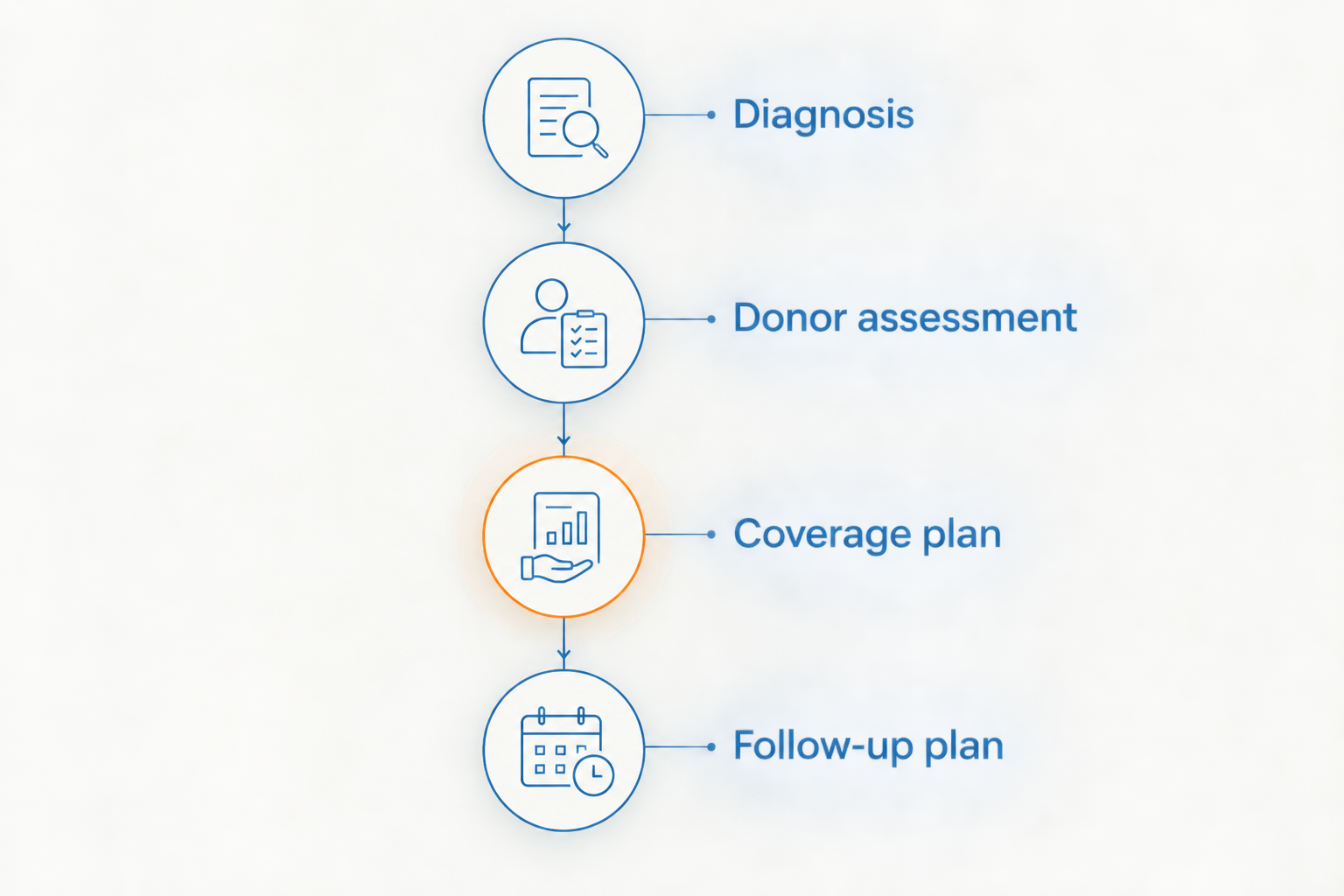
A useful consultation moves from diagnosis to donor assessment, then to coverage and follow-up. Photographs help document the discussion, but they do not replace examination of the scalp.
- Diagnosis: Ask what is causing the loss and whether further investigation is needed.
- Donor assessment: Ask where grafts would come from and what limits harvesting.
- Coverage plan: Ask which crown areas would receive grafts and which would remain untreated.
- Follow-up plan: Ask how healing, growth and further thinning will be reviewed.
Bring your medication list, previous treatment history and photographs showing how the crown has changed. Ask who performs each surgical step and who you should contact if symptoms concern you after the procedure.
For patients travelling to Hyderabad in 2026, follow-up deserves attention before travel is booked. Ask when an in-person review is necessary and how complications would be assessed after you return home.
Recovery and growth: use the right timeline
Visible growth is not immediate, and early appearance is not the final result. Transplanted hairs can shed before new growth appears. Your clinician should explain expected healing separately from the longer growth cycle.
For general patient guidance, the NHS describes new hair usually beginning to appear after about 4 months, with full results seen after 10 to 18 months. These are general hair-transplant timelines, not a promise for an individual crown procedure.
Use those intervals when planning photographs and reviews in 2026. Do not judge final density from an early postoperative picture, and do not assume redness, pain or discharge should simply be watched until the next scheduled visit. Contact your treating clinician about concerning symptoms.
Follow the surgical team’s instructions on washing, activity and prescribed medicines. Generic online schedules cannot account for your wound, medical history or procedure.
How these options were ranked
This guide ranks options by the decisions patients need to make: suitability for stable crown loss, donor-harvesting requirements, need for staged reassessment and reasons to delay surgery. It does not rank Hyderabad clinics by outcomes or claim that a named procedure outperforms another.
FUE appears first as a surgical option for suitable patients, not as a universal winner. The best plan is the one that explains its donor limits as clearly as its coverage goal.
Which crown-restoration option should you choose?
Start with an examination rather than a technique booking. For a stable crown with adequate donor reserves, discuss FUE; if strip harvesting fits the donor strategy, compare FUT. Consider staging only when separate reassessments improve the plan, and prioritise medical treatment when loss is progressing or the diagnosis remains uncertain.
At an iGraft hair transplant assessment, request a written explanation of the recommended approach, alternatives, scar pattern and follow-up. A useful recommendation should make sense without relying on the procedure’s name.
FAQ
What’s the best hair transplant option for crown restoration in Hyderabad?
Individually planned FUE is an option for suitable patients with stable crown loss and adequate donor hair. FUT, staged surgery or medical-first management can fit different clinical needs; examination determines suitability.
Is FUE better than FUT for the crown?
FUE is not universally better than FUT for crown restoration. The choice depends on donor characteristics, scar preferences, scalp assessment and the longer-term restoration plan.
Can a crown transplant restore my original density?
A crown transplant should not be assumed to restore original density. Coverage is limited by donor reserves, the area being treated and the need to preserve hair for future loss.
How long does crown-transplant growth take?
Hair-transplant growth takes months rather than weeks. NHS patient guidance describes new hair usually appearing after about four months and full results after ten to eighteen months; individual progress varies.
Should I treat crown thinning before getting a transplant?
Progressing crown thinning needs medical assessment before committing to surgery. Treatment can address ongoing loss, while transplantation relocates follicles and does not stop untreated hair from thinning.
Are ActiveFUE and DFI automatically better for crown restoration?
A procedure name does not establish better crown-restoration results. Ask how the proposed approach changes harvesting, placement, donor protection and follow-up for your individual scalp.
Can I travel to Hyderabad for a crown transplant?
Travel requires a treatment and follow-up plan agreed with the clinic. Establish when you need to remain nearby, how reviews will happen and where you will receive care if complications arise after returning home.
One last thing
Ask the surgeon to draw the crown area that will not receive grafts. That boundary reveals the practical trade-off between coverage today and donor preservation for later—often more clearly than a technique comparison does.
Related guides
- Best non-surgical hair treatments ranked by sessions
- Best hair transplant options for beard donor grafts
- Best hair transplant techniques for curly hair