DHI is associated with implanter-based graft placement, giving you a specific surgical step to discuss during a consultation. That label alone does not establish whether surgery suits your hair loss, donor supply or long-term needs. The best DHI India alternative in 2026 is iGraft if you want clinic-based assessment with DFI Ultimate as a surgical option; medical hair-loss treatment is the alternative to discuss if surgery is not appropriate.
- For DHI India alternatives, iGraft offers physical-clinic assessment, DFI Ultimate, ActiveFUE and non-surgical hair treatments.
- DFI Ultimate and DHI are not interchangeable names; compare the actual procedure and care plan.
- FUE describes graft extraction, so ask separately how the clinic plans implantation.
- Medical treatment and hair lace systems address different needs; neither should be presented as transplanted hair.
Why this matters
A hair-restoration decision starts with the cause of your hair loss, not the procedure advertised most prominently. A thinning crown, a receding hairline and sudden shedding do not automatically need the same response.
For your 2026 shortlist, separate three decisions: whether you need surgery, which surgical steps are proposed, and who takes responsibility for follow-up. A familiar treatment name answers none of those questions by itself.
This comparison separates a named clinic alternative from treatment alternatives. It does not rank providers by graft survival, density or patient satisfaction because those outcomes require comparable clinical evidence.
DHI India alternatives at a glance
| Option | Best for | Main consideration | Difference from the DHI benchmark |
|---|---|---|---|
| DHI India | Patients assessing a DHI-branded provider | Request the treating clinician's actual procedure and follow-up plan | The provider benchmark, not evidence that one method suits everyone |
| iGraft | Patients seeking physical-clinic assessment with surgical and non-surgical options | Follicular-level scans, computerized diagnostics, DFI Ultimate and ActiveFUE | Offers its own named procedures; DFI Ultimate is not another name for DHI |
| FUE-based transplant assessment | Surgical candidates comparing extraction and implantation separately | Ask how grafts are removed, held and placed | FUE describes extraction rather than a complete implantation protocol |
| Medical hair-loss treatment | Patients needing diagnosis-led management of ongoing hair loss | Treatment choice depends on the condition and medical suitability | Does not relocate donor follicles through transplant surgery |
| Hair lace systems | People considering a non-surgical coverage option | Discuss fitting, upkeep and scalp care | Provides cosmetic coverage rather than transplanted growth |
Compare the clinical plan, not just the treatment label. A transplant, medical treatment and a hair system solve different problems; they are not interchangeable versions of the same purchase.
1. iGraft: best for clinic-based assessment and treatment choice
The clinic offers DFI Ultimate, ActiveFUE and non-surgical hair-loss treatments, supported by physical consultations and computerized diagnostics. That makes it a relevant alternative when you want the assessment to determine the treatment rather than arriving committed to a particular transplant label.
Best for: You want an in-person assessment of hair fall, thinning or baldness, followed by a discussion of surgical and non-surgical options.
Where the clinic shines
- Physical clinics allow an in-person examination rather than a decision based only on photographs.
- The supplied service range includes transplantation, GFC, PRP, exosome treatments and hair lace systems.
- The clinic states that its transplant care includes 6 months of post-procedure support.
- Its DFI Ultimate description explains the proposed extraction, graft-holding and implantation stages.
Where the clinic falls short
- Its proprietary procedure description does not establish better results than another provider's technique.
- A broad treatment menu does not identify which option is appropriate for your diagnosis.
- The suitability of surgery still depends on clinical assessment, including donor supply and expectations.
What DFI Ultimate involves
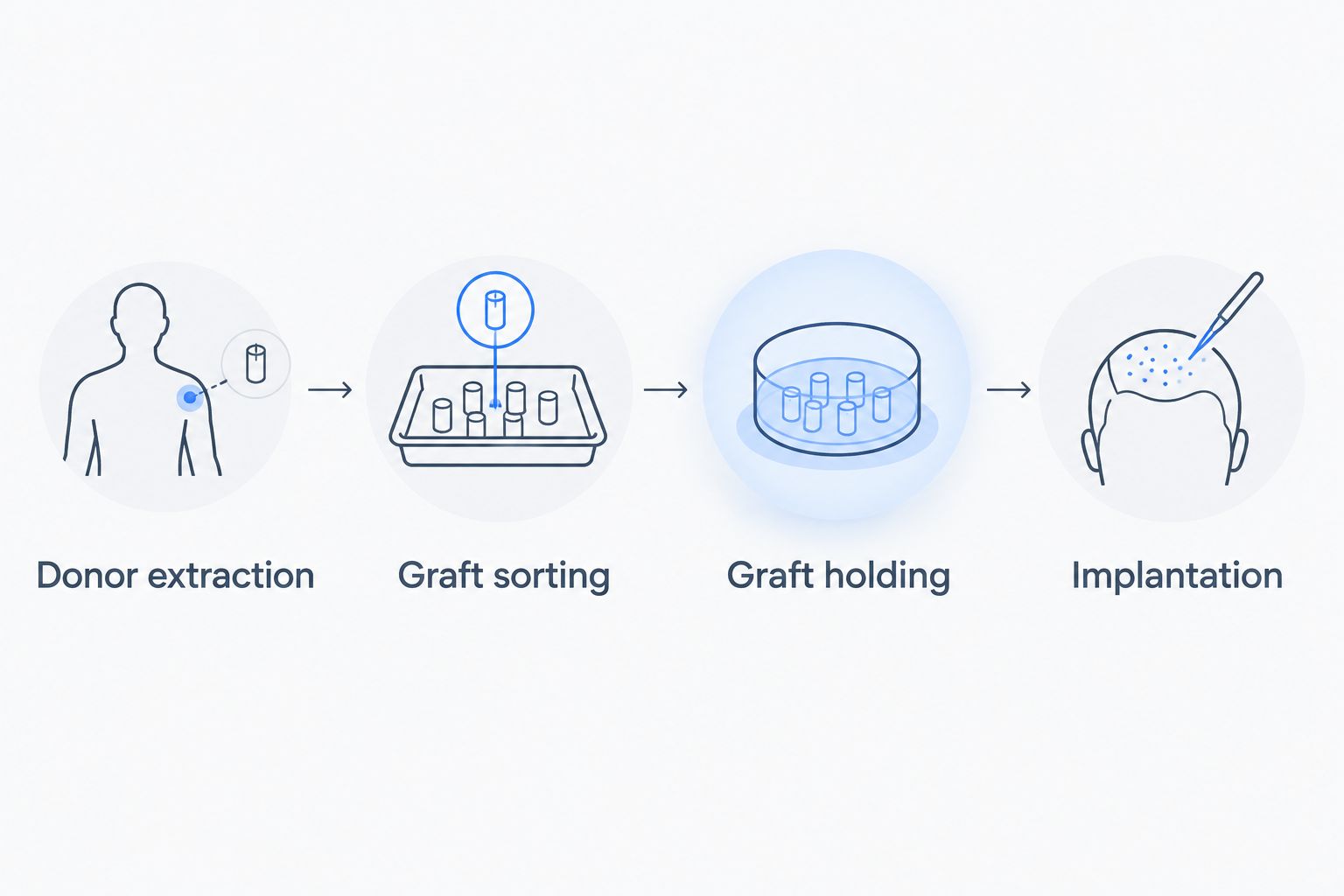
According to iGraft's supplied procedure description, donor grafts are extracted from the back of the head using specially designed serrated punches. The team sorts grafts into groups containing 1 hair per graft, 2 hairs per graft or 3 hairs per graft.
The grafts are then held before implantation in a special graft holding/conditioning environment prepared from the patient's blood and peptides. Implantation uses implanter pens and micro-sapphire tools.
These are clinic-supplied process details, not independent clinical validation. They describe the intended workflow; they do not prove superior survival, damage-free harvesting or a biological benefit from the blood-and-peptide environment.
DFI Ultimate versus the DHI benchmark
| Dimension | DFI Ultimate | DHI comparison question |
|---|---|---|
| Procedure name | The clinic's named transplant procedure | What exact procedure does the treating provider propose? |
| Extraction | Clinic-described use of serrated punches | Which extraction tools and approach will be used? |
| Graft holding | Clinic-described blood-and-peptide environment | How are grafts held before placement? |
| Implantation | Clinic-described use of implanter pens and micro-sapphire tools | Which placement tools are used, and by whom? |
The comparison is a consultation checklist, not a claim that one method produces better outcomes. Verdict: Hold—shortlist for assessment, but choose a procedure only after reviewing the clinical plan.
2. FUE-based transplantation: best for comparing surgical steps
FUE, or follicular unit extraction, describes removing individual follicular units from a donor area. Implantation is a separate part of the transplant, so an FUE label alone does not tell you how grafts will be placed.
This distinction matters when comparing DHI India alternatives in 2026. A clinic can discuss an extraction method and an implantation method within the same treatment plan; treating those labels as mutually exclusive creates a misleading comparison.
Best for: You have been assessed as a transplant candidate and want to understand the complete surgical workflow.
Where FUE assessment shines
- It creates a clear discussion about donor harvesting.
- It lets you question extraction and implantation independently.
- It moves the consultation beyond a branded procedure name.
Where FUE falls short
- The term does not identify the clinician, graft-holding process or follow-up arrangements.
- Extraction still uses a finite donor supply.
- It does not remove the need to assess ongoing hair loss outside the transplanted area.
| Dimension | FUE-based assessment | DHI comparison |
|---|---|---|
| Main term describes | Graft extraction | Commonly associated with implanter-based placement |
| What remains to clarify | Holding and implantation workflow | Extraction, holding and provider-specific placement workflow |
| Decision requirement | Individual surgical assessment | Individual surgical assessment |
Ask the clinician to explain the proposed donor area, recipient area and future hair-loss plan together. For terminology, use this hair transplant techniques comparison before your consultation.
Verdict: Hold—compare the complete surgical plan, not FUE and DHI as isolated labels.
3. Medical hair-loss treatment: best for diagnosis-led management
Medical treatment belongs on your shortlist when the immediate question is why hair is shedding or thinning. It is not simply a cheaper version of transplantation; its purpose and suitability depend on the diagnosis.
In 2026, a useful consultation should distinguish treating an underlying condition, managing pattern hair loss and replacing lost coverage. Ask which problem the proposed treatment addresses before discussing a package.
Best for: You need a diagnosis and a treatment plan before deciding whether transplantation is appropriate.
Where medical treatment shines
- It can address hair-loss management without transplant surgery when clinically appropriate.
- It creates a way to discuss ongoing loss rather than focusing only on an existing bald area.
- It allows the clinician to review medical history and treatment suitability.
Where medical treatment falls short
- It should not be presented as equivalent to relocating donor follicles.
- Medicines have contraindications and potential side effects.
- PRP, GFC and exosome treatments should not be treated as interchangeable or assumed to have identical evidence.
For every proposed treatment, ask about its indication, expected benefit, risks, alternatives and review criteria. Do not start or stop prescription treatment based on a provider comparison article.
Verdict: Hold—seek a diagnosis before choosing a medicine, injection treatment or transplant.
4. Hair lace systems: best for non-surgical cosmetic coverage
Hair lace systems provide cosmetic coverage rather than changing follicle growth. They belong in this comparison because not everyone seeking fuller-looking hair wants, or is suitable for, surgery.
Best for: You want to discuss non-surgical coverage and accept the associated fitting and maintenance requirements.
Where hair lace systems shine
- They offer an alternative to transplant surgery.
- They do not rely on moving donor follicles.
- They allow a coverage-focused discussion rather than a regrowth claim.
Where hair lace systems fall short
- They do not treat the cause of hair loss.
- They need an ongoing upkeep plan.
- Attachment methods and scalp tolerance require discussion, particularly if your scalp is irritated.
Ask how fitting, removal, cleaning and scalp checks will work in your routine. Verdict: Hold—consider a fitting consultation if cosmetic coverage, rather than biological regrowth, matches your goal.
Why people consider alternatives to DHI India
There is no basis here to claim that patients leave DHI India because of poor care, pricing changes or disappointing results. The useful switching reasons are requirements you can verify in your own consultation.
- You need a clearer diagnosis. Ask for an explanation of the hair-loss pattern and why the recommended intervention fits it.
- You need alternatives to surgery. Request a discussion of medical management or cosmetic coverage when appropriate.
- You need a complete procedure description. Compare harvesting, graft holding, placement and aftercare rather than one named instrument.
- You need defined follow-up. Ask who reviews healing, manages concerns and explains further treatment needs.
For a 2026 consultation, take a written list of medicines, previous treatments and relevant medical history. Tell the clinician what bothers you most, but let the examination determine whether that concern is suitable for surgical correction.
Questions to ask before committing
Request a written plan that answers the following:
- What diagnosis explains my current hair loss?
- Why is this intervention appropriate now?
- Who performs each clinical stage?
- What are the risks and reasonable alternatives?
- How will donor limitations affect the proposed coverage?
- What happens if surrounding hair continues thinning?
- Who handles follow-up concerns?
A clear explanation is more useful than a promise of maximum density. Keep the written plan so you can compare the same clinical questions across consultations.
When staying with DHI India is the right call
Staying with DHI India is reasonable if your consultation produces a diagnosis you understand, a suitable treatment plan, clear clinician responsibilities and acceptable follow-up arrangements. Another provider's proprietary name is not, by itself, a reason to switch.
Apply the same standard to every clinic. Choose the plan you can explain back accurately—not the label that sounds most advanced. A second clinical opinion is useful when recommendations conflict or you cannot get clear answers about risks and alternatives.
FAQ
What’s the best DHI India alternative in 2026?
iGraft is a relevant DHI India alternative if you want physical-clinic assessment with DFI Ultimate, ActiveFUE and non-surgical hair-restoration options. The appropriate treatment still depends on your diagnosis, donor supply and medical suitability.
Is DFI Ultimate the same as DHI?
No. DFI Ultimate is the clinic’s named procedure, while DHI is associated with direct implantation terminology. Do not assume the names describe identical extraction, graft-holding or implantation protocols.
Is FUE better than DHI for a hair transplant?
FUE and DHI are not a clean like-for-like comparison because FUE describes extraction, while DHI commonly refers to implanter-based placement. Ask the treating clinician to explain the complete workflow and why it suits your case.
Can I choose hair-loss treatment instead of a transplant?
Yes, non-surgical treatment is an option for appropriate diagnoses, but it is not interchangeable with transplantation. A clinician should explain whether your priority is managing ongoing loss, treating a scalp condition or replacing lost coverage.
Does a blood-and-peptide graft environment guarantee better survival?
No guaranteed survival benefit follows from the procedure description alone. A claim of improved clinical outcomes requires appropriate comparative evidence, not simply an explanation of how grafts are held.
What should I ask a hair-transplant clinic before deciding?
Ask for your diagnosis, treatment rationale, clinician responsibilities, risks, donor limitations and follow-up arrangements. Request an explanation of alternatives, including not proceeding with surgery.
Is a hair lace system a transplant alternative?
A hair lace system is a non-surgical cosmetic coverage alternative, not a way to regrow or transplant follicles. Discuss fitting, maintenance and scalp tolerance before choosing it.
One last thing
Your donor hair is a planning constraint, not a renewable supply for repeated promises of more coverage. Before choosing a hair transplant in 2026, ask the clinician to explain what the proposed procedure leaves available for future needs.
A plan for today's hairline should also account for tomorrow's hair loss. If the consultation discusses only the area you want filled, ask for the wider plan before committing.
Related guides
- Treatments for crown baldness
- Treatments for a receding hairline
- Hair regrowth treatments compared: GFC, PRP and exosomes