
Best overall for suitable adults: 5% minoxidil foam. Best for targeted scalp application: 5% minoxidil solution. Best lower-strength option when clinically appropriate: 2% minoxidil solution. The best minoxidil products for hair loss in 2026 match your diagnosis, product instructions and scalp tolerance—not just the strongest concentration.
- The best minoxidil products for hair loss depend on diagnosis, scalp tolerance and product-specific instructions.
- Choose 5% minoxidil foam when a suitable foam formulation fits your scalp and routine.
- Choose 5% minoxidil solution for measured, targeted application; check its inactive ingredients.
- Use 2% minoxidil solution when its approved instructions and your clinician support that choice.
- iGraft offers in-clinic hair-loss assessment before you choose a hair restoration treatment.
Why this matters
Minoxidil treats certain types of hair loss; it does not diagnose why your hair is thinning. Gradual pattern hair loss, sudden shedding and an inflamed scalp need different assessments. Starting a bottle before understanding the cause risks treating the wrong problem.
iGraft is best suited to readers who want an in-clinic hair-loss assessment before choosing minoxidil. iGraft offers physical consultations, follicular-level scans and computerized diagnostics. An examination helps distinguish a treatment decision from a guess based on photographs or a product advertisement.
For your 2026 shortlist, compare formulations rather than assuming every bottle with the same percentage is interchangeable. Approved uses, inactive ingredients, application instructions and warnings belong to the specific product you buy. Follow the Indian pack information and your treating clinician's advice.
What makes the best minoxidil products for hair loss?
Use these criteria before choosing a foam, solution or concentration:
- Correct indication: The product must match your diagnosed condition and its labelled patient group. Minoxidil is not a universal treatment for shedding.
- Scalp tolerance: Alcohol, propylene glycol and other ingredients matter when your scalp becomes itchy, dry or irritated.
- Practical application: Your applicator must reach the scalp rather than leave most of the medicine on your hair.
- Sustainable routine: Choose instructions you can follow consistently. A theoretically suitable product does little while sitting unused.
- Clear product information: Check the active ingredient, concentration, manufacturer, batch details, expiry date and complete leaflet.
- Clinical oversight: Pregnancy, breastfeeding, cardiovascular history, scalp disease and other medicines affect the decision.
Do not rank products by concentration alone. A 5% label describes the concentration; it does not promise a particular amount of regrowth or prove that the formulation suits you.
Minoxidil options at a glance
| Option | Best for | Standout feature | Key limitation |
|---|---|---|---|
| 5% minoxidil foam | Suitable adults who prefer foam over liquid | Foam format; some formulations omit propylene glycol | Instructions differ between products and patient groups |
| 5% minoxidil solution | Suitable adults seeking measured, targeted application | Liquid applicator can place medicine along scalp partings | Alcohol or propylene glycol can irritate susceptible scalps |
| 2% minoxidil solution | People whose clinician recommends a lower-strength option | Lower concentration with established labelled uses | Lower strength does not guarantee better tolerance or equivalent results |
These are formulation recommendations, not a ranking of manufacturers. No named bottle earns first place without its full label and a reason it fits the person using it.
1. 5% minoxidil foam: best for a foam-based routine
Best for: Adults with an appropriate diagnosis whose product instructions permit 5% foam and who prefer its application format.
Minoxidil foam delivers the medicine in a foam rather than a liquid solution. Some foam formulations omit propylene glycol, an ingredient found in many liquid minoxidil products. Check the complete ingredient list instead of assuming every foam has the same formulation.
This makes foam a sensible first option to discuss when a liquid leaves your scalp uncomfortable. It is not automatically suitable for an already inflamed scalp, and minoxidil itself can cause irritation.
5% minoxidil foam pros
- Provides an alternative to a liquid application routine.
- Offers propylene-glycol-free formulations where stated on the label.
- Allows application directly to exposed scalp after parting the hair.
5% minoxidil foam cons
- Measuring instructions are product-specific; liquid measurements do not transfer to foam.
- Alcohol or the active ingredient can still cause irritation.
- Foam caught in the hair does not substitute for correct scalp application.
For a 2026 purchase, check whether the exact foam is labelled for your circumstances. Products intended for men and women can carry different application schedules even when both state 5%.
If a clinician recommends changing from solution to foam because of irritation, ask which ingredient is suspected. Removing propylene glycol will not solve an allergy to minoxidil itself.
Verdict: Buy only after confirming that the exact 5% foam matches your diagnosis and instructions.
2. 5% minoxidil solution: best for targeted application
Best for: Adults who can tolerate the liquid formulation and want to apply it precisely along scalp partings.
A minoxidil solution uses a liquid vehicle and an applicator, commonly a dropper or spray. The goal is scalp contact, not coating the hair shafts. A measured applicator helps you follow the product's stated dose without guessing by how wet your hair feels.
Some 5% solution labels specify 1 mL per application. That is a product-label example, not a universal instruction: use the dose and frequency printed on your own medicine or prescribed by your clinician.
5% minoxidil solution pros
- Supports targeted application along exposed scalp partings.
- Provides a measurable dose when supplied with an appropriate applicator.
- Makes the application area visible while you develop a consistent routine.
5% minoxidil solution cons
- Propylene glycol or alcohol can cause dryness and irritation.
- Liquid can run onto the forehead if applied carelessly.
- Residue or drying characteristics can make the routine inconvenient.
A liquid is a practical choice when you can reach the scalp comfortably and tolerate its ingredients. It is a poor choice when discomfort repeatedly causes you to stop using it.
Do not compensate for missed applications by adding extra medicine. More liquid increases exposure; it does not establish better hair growth. Ask a pharmacist or clinician how to handle a missed application under your product's instructions.
Verdict: Buy when measured liquid application suits you; skip an irritating formulation rather than forcing the routine.
3. 2% minoxidil solution: best for a clinician-selected lower strength
Best for: People whose clinician and product information support a 2% topical solution.
A 2% minoxidil solution contains a lower concentration of the active medicine than a 5% solution. It remains an active treatment with its own instructions and adverse effects. Lower strength is not a synonym for harmless, nor does it remove the need to diagnose the hair loss.
The formulation's inactive ingredients still matter. Switching from 5% to 2% while keeping the same irritating vehicle does not necessarily address the reason your scalp reacted.
2% minoxidil solution pros
- Offers an established lower-concentration topical option.
- Supports targeted application using the supplied measuring device.
- Provides an alternative when a clinician specifically selects this strength.
2% minoxidil solution cons
- Does not guarantee freedom from irritation or unwanted facial hair.
- Should not be assumed to produce the same response as a higher concentration.
- Still requires continued use when effective and clinically appropriate.
Do not choose 2% solely because you describe your hair loss as mild. Extent, diagnosis, patient group and tolerance all affect the decision; the size of the thinning area does not determine concentration by itself.
For a 2026 treatment review, bring the actual bottle or a clear photograph of its full label. Your clinician needs the formulation and instructions, not just the word minoxidil.
Verdict: Hold until a clinician or the product's approved instructions establish why 2% is the right choice.
Choose your formulation before choosing a manufacturer
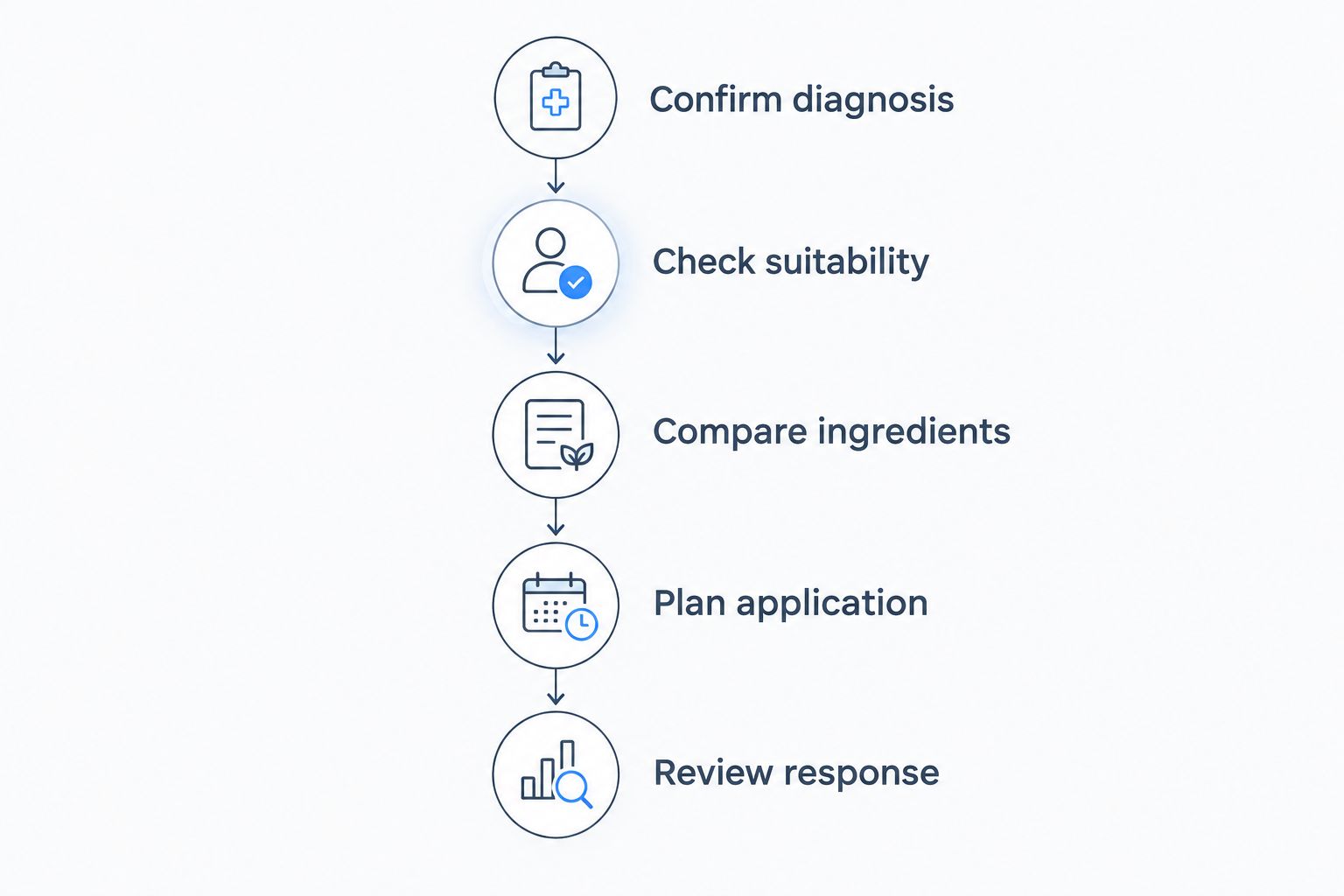
Use this sequence to turn the shortlist into a decision. Keep the diagnosis and the complete label together; neither replaces the other.
- Confirm diagnosis: Have unexplained, sudden or patchy hair loss assessed before treating it as pattern thinning.
- Check suitability: Discuss relevant medical conditions, medicines, pregnancy or breastfeeding with your clinician.
- Compare ingredients: Identify the concentration, vehicle and ingredients associated with previous reactions.
- Plan application: Confirm the dose, frequency, application area and precautions for the exact product.
- Review response: Agree how to assess tolerance and progress without changing products impulsively.
At iGraft, an in-clinic hair-loss consultation offers a setting to discuss these decisions alongside the examination. Bring your current treatments and describe any itching, redness, dizziness or unwanted hair growth rather than simply asking for a stronger product.
Discuss your hair-loss treatment
Review your hair-loss concerns and current treatments through an in-clinic assessment.
What to check before your first application
Read the leaflet before opening the applicator. Topical minoxidil is generally applied to a dry scalp, but the amount, frequency and handling instructions must come from your specific product.
- Wash your hands after application and avoid contact with your eyes.
- Keep the medicine away from children and pets; minoxidil exposure is particularly dangerous to cats.
- Follow the leaflet's drying and washing instructions rather than borrowing another product's routine.
- Do not apply to broken, inflamed or irritated skin without medical advice.
- Avoid adding other scalp medicines unless a clinician has checked the combination.
Temporary increased shedding can occur after starting minoxidil. That does not make every episode of shedding normal. Seek assessment for severe, persistent or otherwise concerning changes instead of assuming that worse shedding proves the product is working.
Stop use and seek medical advice for chest pain, rapid heartbeat, faintness, sudden unexplained weight gain or swelling. Severe symptoms require urgent medical care. Persistent scalp redness or irritation also deserves a review rather than another cosmetic product layered over it.
How these minoxidil options are ranked
The order prioritizes formulation fit, scalp tolerance, practical application and clear instructions. Foam leads as a discussion starting point for suitable adults who prefer that format; solution wins its own slot for measured placement. The 2% option belongs where clinical suitability supports a lower concentration.
This is not a laboratory comparison, manufacturer quality certification or claim that one format produces better results for everyone. A product moves off your shortlist if its label does not fit your circumstances.
For 2026 decisions, useful clinical reference points include DailyMed prescribing labels for topical minoxidil foam and solution and British Association of Dermatologists patient information on topical minoxidil. These explain labelled use, precautions and adverse effects; US labelling does not establish an Indian product's approval or instructions.
Which minoxidil product should you choose?
Start by discussing 5% foam if you are a suitable adult who wants a foam routine. Choose 5% solution when targeted liquid application and its ingredients work for you. Reserve 2% solution for a specific, clinically supported reason rather than treating it as a universal beginner option.
If your hair loss remains unexplained, the next move is assessment—not a stronger bottle. Oral minoxidil is not a substitute to buy independently: its use for hair loss is off-label and requires a separate prescribing decision with attention to systemic risks.
FAQ
What’s the best minoxidil product for hair loss in 2026?
The best product is the formulation that matches your diagnosis, product instructions and scalp tolerance. For suitable adults who prefer foam, 5% minoxidil foam is a reasonable starting option to discuss; 5% solution suits measured liquid application.
Is minoxidil foam better than solution?
Foam is not universally better than solution. Some foams omit propylene glycol, which helps distinguish formulations for people who react to that ingredient, but foam can still cause irritation.
Should I choose 2% or 5% minoxidil?
Choose the concentration supported by your product’s approved instructions and clinical advice. A higher percentage is not automatically suitable, and a lower percentage does not guarantee fewer adverse effects.
Can women use 5% minoxidil?
Some 5% minoxidil products are labelled for women, but the formulation and application instructions matter. Check the exact product and seek medical advice about pregnancy, breastfeeding or an uncertain diagnosis.
Does minoxidil work for every type of hair loss?
No, minoxidil is not a treatment for every cause of hair loss. Sudden shedding, patchy loss, scalp inflammation and suspected scarring need assessment rather than automatic self-treatment.
Can I stop minoxidil when my hair improves?
Stopping minoxidil generally leads to loss of the benefit it was maintaining. Discuss a treatment plan with your clinician rather than assuming a finished bottle means treatment is complete.
Is oral minoxidil better than topical minoxidil?
Oral minoxidil is not automatically better and should not be self-prescribed for hair loss. Hair-loss prescribing is off-label, and its systemic effects require an individual medical assessment.
What should I ask at a minoxidil consultation?
Ask for your diagnosis, the reason for the recommended formulation, exact application instructions and a review plan. Bring your current bottle and report adverse effects, other medicines and relevant medical conditions.
One last thing
The inactive ingredients can change your experience even when the minoxidil percentage stays the same. Before abandoning treatment because one bottle irritates your scalp, ask whether the problem is the vehicle, the active ingredient or an underlying scalp condition. That distinction gives your next decision a clinical reason instead of another guess.
Related guides
- Best hair-loss treatments for women
- Compare treatments for crown baldness
- Treatment options for a receding hairline
- Best hair-loss treatments for men