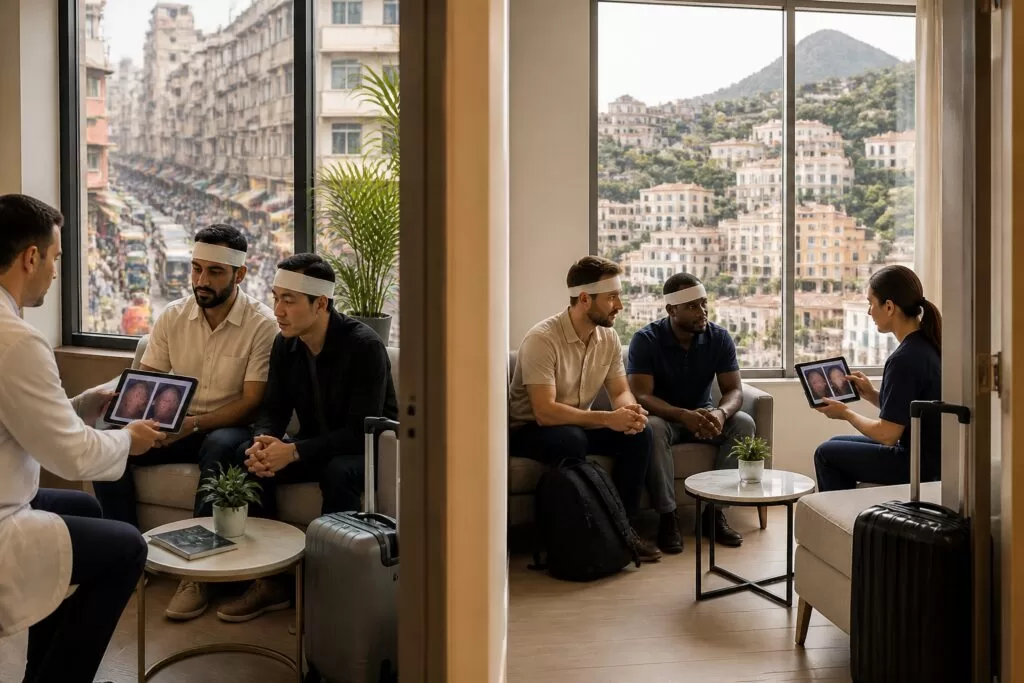
Mega-Session Hair Transplants in India: Why 4,000+ Graft Procedures Save US and Aussie Patients Over $15,000
If you are looking at a receding hairline plus a thinning crown, a small session will not close the gap. Advanced pattern baldness often needs 4,000 grafts or more in a planned mega-session. That is where the price difference between the United States, Australia, and India becomes hard to ignore.
At iGraft Global Hair Services, company-owned clinics in Pune, Bangalore, Hyderabad, and Vijayawada run large follicular unit extraction cases with transparent per-graft pricing. ActiveFUE is ₹45 per graft. Gen3 DFI Ultimate is ₹50 per follicle. For a 4,000-graft plan, that is typically ₹1.8 lakh to ₹2 lakh before travel, which is a fraction of what the same coverage costs at home.
What a mega-session actually means
A mega-session is not a marketing label. It is a high-graft plan, usually 4,000 grafts and above, designed to restore a natural hairline and add density across the mid-scalp or crown in one coordinated procedure. Grade 6 and Grade 7 patterns often sit in the 5,000 to 8,000 graft range, depending on donor supply and your goals. Independent Indian cost tables for extensive baldness put 4,000 grafts around ₹1.4 lakh to ₹2 lakh and 6,000 grafts around ₹2.1 lakh to ₹3 lakh, which lines up with unit-based clinic pricing rather than a vague package number (hairtransplantdelhi.in).
You still need a healthy donor area. Follicular-level scans and a computerized checkup tell us how many grafts you can safely move, where they should go, and whether a single sitting or a staged plan is safer. That diagnosis happens in person at our physical centres, not on a franchise script.
The cost gap for US, Aussie, and UK patients
Published 4,000-graft ranges outside India are steep. In the United States the same volume often runs $12,000 to $32,000, with a national average near $20,000. In Australia, figures of AUD $18,000 to $40,000 are common. In the UK, GBP 10,000 to GBP 20,000 is a typical band. Those quotes are rarely all-inclusive (drterziler.com).
Put iGraft’s unit rates next to that.
| Plan | iGraft graft rate | Typical clinic total (INR) | Rough USD equivalent |
|---|---|---|---|
| 4,000 grafts, ActiveFUE | ₹45 per graft | ₹1,80,000 | about $2,100 |
| 4,000 grafts, Gen3 DFI Ultimate | ₹50 per follicle | ₹2,00,000 | about $2,350 |
| 6,000 grafts, Gen3 DFI Ultimate | ₹50 per follicle | ₹3,00,000 | about $3,500 |
Even after flights, a hotel stay, and a companion, medical-tourism trip extras for a patient plus family member often land around $2,000 to $4,000 (ichelonconsulting.com). Against a $20,000 US average, a 4,000-graft mega-session in India still leaves you more than $15,000 ahead. The same arithmetic holds for many Australian quotes once you convert dollars and add recovery time.
Cost is not the only reason people fly. Diaspora patients repeatedly say trust, doctor access, and comparable or better technique quality sit beside the currency advantage (diasporadreams.com). Around 30% of iGraft clients already travel to India for this reason, including people who compared Turkey packages and wanted a premium, doctor-led experience with clear graft math.
See the full country breakdown on our India vs USA and UK cost comparison and the hair transplant cost in India guide.
Why one large, well-planned session can cost less overall
Two small trips sound cautious. They often cost more. Each sitting needs time off work, a second flight, and another recovery window. A mega-session, when your donor area allows it, concentrates extraction and placement so you heal once and grow one cohesive hairline.
That only works if graft estimates are honest. We price by graft, not by a bundled “unlimited” promise. You can review the current pricing table and Bangalore-specific notes on transparent hair transplant cost before you book.
FUE remains the dominant method in India for most cases because scarring is limited and recovery is faster than older strip surgery (ichelonconsulting.com). iGraft’s ActiveFUE and DFI hair restoration are built for that model. DFI Ultimate is positioned as a high-precision implant method with a 29-year assurance on the work we stand behind. No-shave options exist when your job or travel plans make a shaved donor a problem.
How we plan 4,000+ grafts without guessing
You start with a follicular-level assessment and an AI-guided scalp map. That tells us density, miniaturisation, and how aggressive we can be without over-harvesting. Experienced doctors, not call-centre coordinators, sign off on the design. Natural hairline design for men and women is drawn to your face, age, and remaining hair, not a template.
We do not franchise. You meet the team at a company-owned clinic in Bangalore, Hyderabad, Pune, or Vijayawada. The setup is 15-plus years old, which matters when you are flying in for a single large sitting and need the plan to hold.
If you are overseas, book an e-consultation first. Send photos and history. We will tell you if 4,000 grafts is realistic, if you need medical therapy first, or if a transplant is not the right next step.
Recovery, risks, and the timeline you should expect
A mega-session is still surgery. Expect swelling, scabbing, and tightness for the first week. Most people fly home after the immediate post-op checks, then rest. Transplanted hairs often shed in the first weeks. New growth is gradual. Visible density usually builds from month three onward, with a clearer picture around 9 to 12 months. Anyone promising a finished look in days is not being straight with you. Read our notes on common transplant myths before you compare clinics.
Infection, poor growth, shock loss of existing hair, and an unnatural hairline are real risks if extraction or placement is careless. Dedicated 6-month post-procedure support is part of how we watch those issues. If an earlier procedure elsewhere failed, a revision may be possible, but only after we see the donor.
When GFC, PRP, or BioCell sit beside a mega-session
A 4,000-graft plan restores coverage. It does not freeze future loss. We often pair surgery with GFC, advanced PRP, Exosomes, or BioCell treatment to support remaining follicles. Those protocols can include high-frequency and low-level laser sessions. They are hair loss treatment, not a substitute for grafts when the bald area is already large. If you are unsure whether you need surgery or medical therapy, take the 2-minute quiz and then speak with a doctor.
FAQ
How much can I save on a 4,000-graft hair transplant in India versus the US or Australia?
Against typical US quotes near $20,000 for 4,000 grafts, iGraft’s ₹45 to ₹50 per-graft rates plus travel still commonly save more than $15,000. Australian quotes in the high teens to $40,000 AUD show a similar gap after conversion.
Is a mega-session safe in one trip?
It can be, if your donor area, medical history, and graft count support it. We will not push 6,000 or 8,000 grafts if the scalp cannot spare them. Some patients are better served with a staged plan.
What is the graft cost at iGraft?
ActiveFUE is ₹45 per graft. Gen3 DFI Ultimate is ₹50 per follicle. Totals scale with the number of grafts you actually need, which is why computerized diagnosis comes first.
Do you offer hair transplant in Bangalore, Hyderabad, Pune, and Vijayawada?
Yes. Those four cities have our own clinics. Search “hair clinic near me” only after you confirm you are booking a company centre, not a reseller.
How do I start from the USA, UK, or Australia?
Use the e-consultation, share scalp photos, and get a graft range before you buy flights.
Plan your mega-session with a doctor, not a brochure
If you are comparing hair restoration cost at home with a trip to India, bring your photos and a realistic graft target. We will map the scalp, quote by the follicle, and tell you plainly whether 4,000-plus grafts is the right move. Book a visit or remote review through hair contact, or start on the home page. For technique detail, read DFI and about our treatments. Your hairline should look like yours. The numbers should be on paper before you fly.