Best overall: donor-planned scalp transplantation for extensive pattern baldness. Best for a focused hairline plan: DFI Ultimate after assessment. Best without usable donor hair: a hair system, not a transplant. The best hair transplant for complete baldness depends on whether you still have healthy donor follicles—not the procedure name.
- The best hair transplant for complete baldness depends on donor supply, diagnosis and realistic coverage goals.
- iGraft DFI Ultimate is an assessment-led option for people considering hairline restoration with usable donor hair.
- FUE and FUT describe harvesting approaches; implantation labels alone do not establish better results.
- Hair systems provide a non-surgical alternative when transplantation cannot meet your coverage goals.
Why this matters
Complete baldness can mean extensive male-pattern hair loss with hair remaining around the sides and back. It can also mean loss across the entire scalp, including the usual donor area. Those situations need different advice.
A transplant moves existing follicles; it does not create a new donor supply. Before choosing a procedure in 2026, establish what caused the loss and whether the remaining hair can support your goals. iGraft offers physical-clinic assessments with follicular-level scans and computerized diagnostics.
If you want to understand the terminology first, the guide to hair transplant techniques compared provides related reading. Your consultation still needs to connect the proposed technique to your own donor examination.
What makes the best hair transplant for complete baldness?
Use these criteria before comparing procedure names:
- Diagnosis: Establish whether the loss is pattern baldness, alopecia areata, scarring alopecia or another condition.
- Donor suitability: Examine donor density, hair calibre, scalp health and signs of thinning within the donor area.
- Coverage priorities: Decide whether the hairline, frontal scalp or crown matters most to you.
- Harvesting trade-offs: Discuss dispersed extraction scars, a linear scar, hairstyle preferences and healing considerations.
- Long-term planning: Preserve donor resources rather than allocating everything to the first operation.
- Follow-up: Ask who handles recovery concerns, ongoing hair loss and decisions about further treatment.
For a 2026 consultation, request a written explanation of what the proposed plan cannot achieve. A clear limitation is more useful than an assurance of full coverage.
Complete-baldness options at a glance
The options below are not interchangeable procedures. DFI Ultimate describes a clinic-specific process; FUE and FUT describe harvesting approaches; supplementary donor hair is a planning option; a hair system is non-surgical.
| Rank and option | Best for | Standout consideration | Key limitation |
|---|---|---|---|
| 1. DFI Ultimate | A focused frontal restoration discussion | Clinic-described graft handling and implantation process | The process cannot overcome inadequate donor supply |
| 2. Scalp FUE | People prioritising avoidance of a linear strip scar | Individual follicular-unit extraction | Leaves small extraction scars and uses finite donor resources |
| 3. FUT | Suitable candidates considering strip harvesting | An alternative way to obtain scalp grafts | Leaves a linear donor scar |
| 4. Supplementary beard or body hair | Selected candidates needing additional donor sources | Adds a source beyond the scalp | Texture, growth and suitability differ from scalp hair |
| 5. Hair system | People without a suitable transplant plan | Cosmetic coverage without transplant surgery | Requires maintenance and does not regrow hair |
1. DFI Ultimate: best for a focused frontal restoration discussion
DFI Ultimate is iGraft's named hair-transplant process. For extensive baldness, the relevant question is whether your available grafts can support a useful hairline and frontal frame—not whether a branded procedure can cover every bald area.
According to the clinic's supplied description, donor grafts are extracted from the back of the head using specially designed serrated punches. They are sorted into grafts containing 1, 2 or 3 hairs, held in a graft holding/conditioning environment prepared from the patient's blood and peptides, then implanted using implanter pens and micro-sapphire tools.
These are clinic-supplied process details, not independent clinical validation. The intended aim is planned graft handling and placement; the description does not establish superior survival or proven benefits from the holding environment.
DFI Ultimate pros:
- Gives you a specific process to discuss with the clinical team.
- Includes sorting grafts by hair count before placement.
- Comes with the clinic's stated 6-month post-procedure support.
DFI Ultimate cons:
- Requires suitable donor follicles despite extensive recipient-area loss.
- Does not establish guaranteed density or natural-looking results.
- A frontal-first plan can leave the crown visibly thin.
Best for: People with usable donor hair who want to discuss a defined frontal restoration goal. iGraft DFI Ultimate is best considered by hair-transplant candidates seeking an assessment-led plan, not a promise of complete coverage.
Verdict: Hold until donor suitability and coverage limits are documented.
2. Scalp FUE: best for avoiding a linear strip scar
Follicular unit extraction, or FUE, removes follicular units individually from the donor area. It avoids the linear donor scar associated with strip harvesting, but it is not scar-free.
For extensive pattern baldness, the central issue is how much can be harvested without leaving the donor area visibly depleted. FUE describes extraction; it does not, by itself, specify every subsequent handling or implantation step.
Scalp FUE pros:
- Avoids removing a strip of donor scalp.
- Allows discussion of harvesting across a suitable donor area.
- Offers a harvesting route for a hairline-first restoration plan.
Scalp FUE cons:
- Leaves small extraction scars.
- Excessive harvesting can make the donor area look thin.
- Does not make full-scalp coverage possible when donor supply is insufficient.
Best for: Suitable transplant candidates who prioritise avoiding a linear strip scar and accept the extraction-scar trade-off. In 2026, ask to see your proposed donor boundaries rather than choosing FUE from the name alone.
Verdict: Hold until the harvesting plan protects donor appearance.
3. FUT: best for candidates considering strip harvesting
Follicular unit transplantation, commonly called FUT or strip surgery, removes a strip of hair-bearing donor scalp. Follicular units are then separated for transplantation.
FUT belongs in the discussion when a surgeon considers strip harvesting appropriate for your scalp and long-term donor plan. Its inclusion here is educational; it is not a statement that every clinic offers it.
FUT pros:
- Provides an established alternative to individual-unit extraction.
- Makes donor harvesting strategy a deliberate part of the consultation.
- Gives suitable candidates another approach to compare before surgery.
FUT cons:
- Leaves a linear donor scar.
- Requires wound closure and associated aftercare.
- Scar visibility matters if you prefer very short hair.
Best for: Candidates whose examination supports strip harvesting and who accept the scar and recovery considerations. Ask why FUT suits your anatomy and goals better than an FUE-based plan; neither label guarantees a better outcome.
Verdict: Hold until a surgeon explains the individual trade-off.
4. Supplementary beard or body hair: best for selected donor shortages
Some transplant plans use beard or other body hair alongside scalp donor hair. This is a supplementary donor strategy, not a way to make every person with complete baldness a transplant candidate.
Hair characteristics differ by body site. Your surgeon must consider how that hair will look in the proposed recipient area and whether harvesting is appropriate.
Supplementary donor hair pros:
- Adds a donor source beyond the scalp in selected cases.
- Creates another planning option when scalp supply is limited.
- Allows discussion of where different hair characteristics would fit.
Supplementary donor hair cons:
- Does not necessarily match scalp hair in texture or growth behaviour.
- Introduces additional donor areas with their own healing considerations.
- Does not guarantee dense coverage across a large bald scalp.
Best for: Carefully selected candidates whose surgeon identifies suitable supplementary donor hair. Ask which areas will receive it and why; do not accept body-hair grafts as a substitute for explaining the overall coverage limit.
Verdict: Hold for specialist assessment; skip promises of unlimited donor supply.
5. Hair system: best when transplant coverage is not achievable
A hair system provides cosmetic coverage without relocating follicles. It is not a hair transplant and does not treat the underlying cause of hair loss.
For someone without usable donor hair—or someone whose desired appearance exceeds what surgery can deliver—it belongs in the comparison. Choosing a non-surgical option is not a failed transplant decision.
Hair system pros:
- Does not require transplantable donor follicles.
- Offers an alternative to accepting limited surgical coverage.
- Avoids transplant harvesting and implantation wounds.
Hair system cons:
- Requires ongoing cleaning, fitting and maintenance.
- Does not produce biological hair regrowth.
- Comfort and upkeep need to suit your daily routine.
Best for: People without a suitable surgical donor source, or those who prefer cosmetic coverage to transplant surgery. Discuss scalp care, attachment and maintenance before deciding.
Verdict: Consider when surgery cannot meet your coverage goals.
How we ranked these options
This 2026 ranking follows diagnosis, donor suitability, coverage priorities, harvesting trade-offs and follow-up. It is a decision guide, not a clinical performance ranking or a claim that one procedure produces better results for everyone.
The frontal-restoration discussion comes first because it forces a concrete decision about where limited grafts should go. The non-surgical option remains on the list because complete baldness does not always leave a transplantable donor area.
What should your consultation establish?
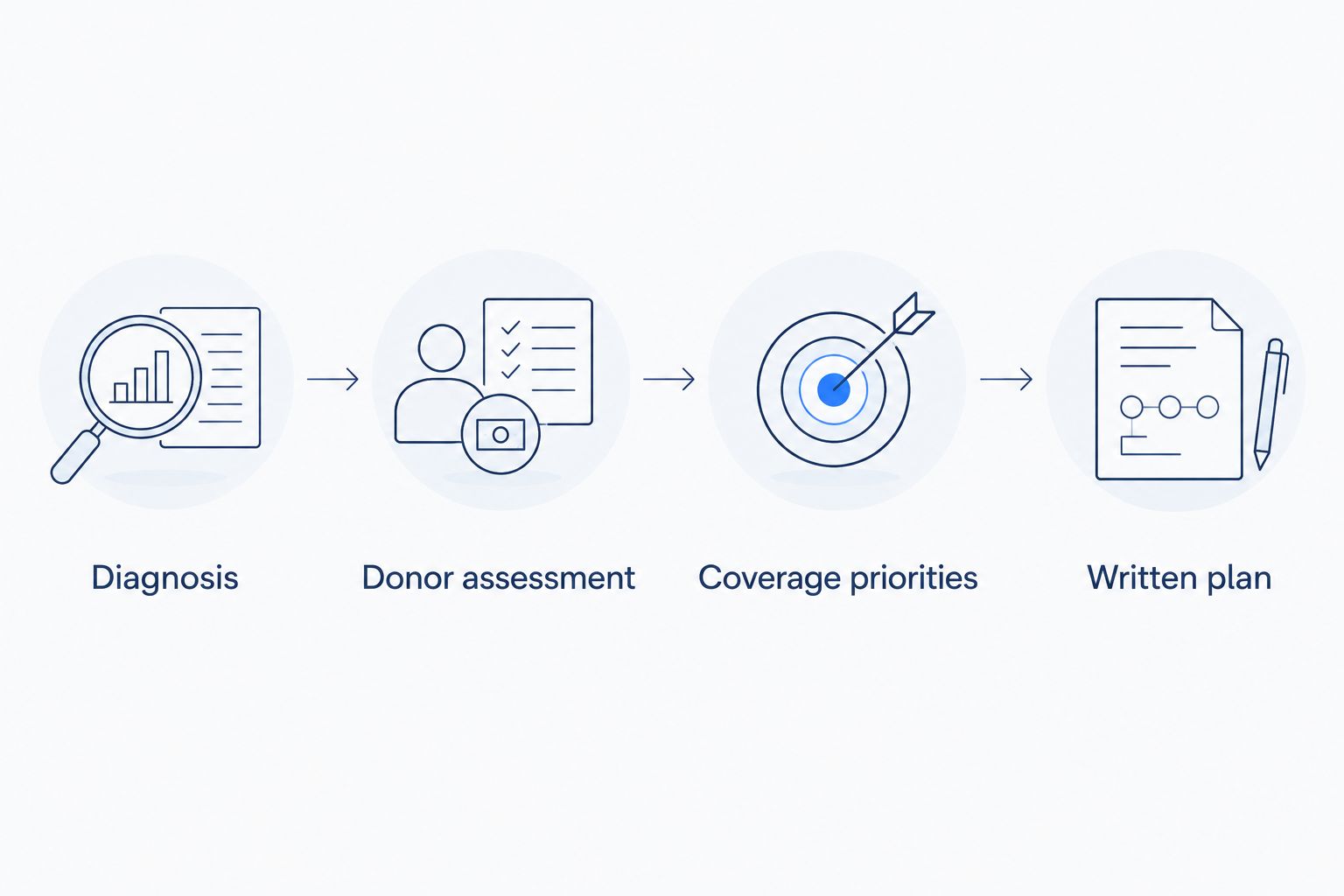
Ask your clinician to document these steps before you commit:
- Diagnosis: Identify the type of hair loss and whether it is active.
- Donor assessment: Examine the back and sides rather than assuming they are suitable.
- Coverage priorities: Separate the frontal frame from the crown and agree what matters most.
- Written plan: Record the proposed procedure, expected limitations and aftercare arrangements.
Bring photographs showing how your hair loss developed and a list of medicines and previous treatments. Tell the clinician whether you would accept a thin crown in exchange for a stronger frontal frame. That preference changes the planning discussion.
At iGraft, ask how the follicular-level assessment supports the proposed transplant plan and what the stated 6-month support includes. Do not interpret a follow-up period as a guarantee of results.
Discuss your donor and coverage plan
Ask about diagnosis, donor suitability and realistic restoration priorities.
Which option should you choose?
Choose donor assessment before choosing a transplant label. If you have extensive pattern baldness with suitable donor hair, compare the actual harvesting, placement and coverage plans. If the donor area is unsuitable, do not proceed on the strength of a procedure name.
For an undecided reader in 2026, the practical default is a conservative discussion about frontal coverage, with the crown treated as a separate priority. Your clinician must establish whether even that goal is realistic. A hair system remains a valid alternative when the surgical plan does not meet your needs.
FAQ
What’s the best hair transplant for complete baldness?
The best hair transplant for complete baldness is the plan supported by your diagnosis and usable donor supply. Compare harvesting methods, coverage priorities and limitations rather than choosing by a procedure name alone.
Can I have a transplant if there is no hair left anywhere on my scalp?
A scalp-hair transplant requires suitable donor follicles. Loss involving the entire scalp needs diagnosis before surgery is considered; conditions such as alopecia totalis are not the same as advanced pattern baldness.
Is DFI Ultimate the same as DHI hair transplant?
No. DFI Ultimate is the clinic’s named process, and DHI is a different label used in hair-transplant discussions. Do not treat the names as interchangeable or assume that a DFI consultation represents a separately verified DHI service.
Does FUE leave no scars?
FUE leaves small extraction scars rather than the linear scar associated with strip harvesting. Scar visibility depends on factors including healing, harvesting and hairstyle.
How many grafts do I need for complete baldness?
There is no single graft count for everyone with complete baldness. The recipient area, donor supply, hair characteristics and coverage priorities must be assessed before a meaningful estimate is made.
Can PRP or GFC replace a transplant on a completely bald scalp?
PRP and GFC are not donor-replacement procedures. Ask a clinician whether follicles remain that could respond to treatment; neither treatment should be presented as creating a new donor supply.
Can beard hair cover my entire bald scalp?
Beard hair is a supplementary donor source for selected candidates, not a guarantee of full-scalp coverage. Suitability, hair characteristics and the available donor supply require individual assessment.
Should I restore my hairline or crown first?
Choose the priority with your clinician after reviewing donor limits and your appearance goals. A frontal-first plan is an option, but it must include an explicit discussion of what coverage the crown will receive.
One last thing
A graft count is not a hair count. A graft can contain more than one hair, so a proposal listing grafts alone does not fully describe the planned distribution. Ask how single-hair and multi-hair grafts will be allocated—and what that means for the hairline and the remaining bald area.
Related guides
- Best treatments for crown baldness
- Best hair loss treatments for men
- Hair regrowth treatments compared: GFC, PRP and exosomes