Oliva Clinic brings skin and hair concerns into a dermatology setting, making it a relevant starting point when you need an assessment rather than a procedure alone. That broad remit does not replace a detailed surgical plan when your main concern is hair transplantation. The best Oliva Clinic alternative in 2026 is iGraft if you need a focused hair-restoration consultation; an independent dermatologist if you need diagnosis-led skin and scalp care.
- Compare Oliva Clinic alternatives by your diagnosis and treatment goal, not package names.
- iGraft is a hair-restoration alternative for patients comparing transplant and non-surgical treatment pathways.
- An independent dermatologist suits unexplained shedding, scalp symptoms or skin concerns requiring diagnosis.
- Stay with Oliva Clinic when your diagnosis, clinician and follow-up plan already meet your needs.
Why this matters
Choosing a clinic and choosing a treatment are different decisions. Hair shedding, a receding hairline and an inflamed scalp do not automatically need the same intervention, even when they appear together.
Your first task is to establish what needs treatment. Only then does it make sense to compare a transplant, medication, a scalp procedure or a skin treatment.
For a 2026 shortlist, compare the named clinician, the explanation of your condition and the follow-up arrangements. A clinic name alone cannot tell you whether the proposed treatment fits your diagnosis, donor area or medical history.
Oliva Clinic alternatives at a glance
This comparison separates care pathways rather than treating every provider as interchangeable. Choose the type of assessment first, then compare the people delivering it.
| Provider or pathway | Best for | Main focus | How it differs from Oliva Clinic |
|---|---|---|---|
| Oliva Clinic | People seeking assessment of skin and hair concerns within a dermatology clinic | Skin and hair care | The benchmark: assess your proposed treatment and treating clinician before switching |
| iGraft | People seeking focused hair-restoration and transplant assessment | FUE, ActiveFUE and DFI Ultimate Hair transplant procedures | A hair-restoration-focused option to compare when transplant planning is your main concern |
| Independent dermatologist | People needing a diagnosis for shedding, scalp symptoms or a skin condition | Individual medical assessment | An alternative consultation route; services and procedural facilities depend on the practice |
No row is a universal winner. A transplant-focused consultation answers different questions from an appointment about scalp inflammation or facial pigmentation.
1. iGraft: best for focused hair-restoration assessment
With clinics serving Hyderabad, Pune, Bangalore and Vijayawada, iGraft offers hair transplant and hair-restoration treatments, including FUE, ActiveFUE and DFI Ultimate Hair transplant procedures. This makes it a relevant comparison when your main question is whether transplantation belongs in your treatment plan.
Use the consultation to examine candidacy, not simply to select a technique. Ask how the proposed hairline, donor assessment and expectations relate to your current hair loss and its likely progression.
Where this option shines
- Focused scope: You can discuss transplant and hair-restoration pathways rather than starting with an unrelated cosmetic treatment.
- Several locations: Patients can compare access across the 4 stated cities when planning appointments and follow-up.
- Named procedures: The available procedure names give you specific subjects to question during consultation, including how they differ in practice.
- International patient relevance: The clinic serves patients travelling from the USA, Australia and Europe; travellers should discuss follow-up before arranging treatment.
Where this option falls short
- A hair-restoration consultation does not replace a separate assessment of an unrelated skin condition.
- A procedure name does not establish that you are a suitable surgical candidate.
- Travelling for treatment adds practical questions about recovery, local support and access to review after returning home.
- A clinic's service list does not establish the outcome you should expect; your assessment must address that individually.
These limits matter. A carefully planned procedure starts with the decision about whether to operate at all.
Head-to-head: focused restoration or broader assessment?
| Decision dimension | Hair-restoration-focused consultation | Oliva Clinic consultation |
|---|---|---|
| Main question to resolve | Is transplantation or another restoration treatment appropriate? | What diagnosis explains the skin or hair concern? |
| Essential evidence | Donor assessment, hair-loss pattern and a personalised treatment rationale | Examination findings, diagnosis and a personalised treatment rationale |
| What to compare | Clinician responsibilities, procedure explanation and follow-up | Clinician responsibilities, treatment explanation and follow-up |
| Reason not to proceed | Surgery does not fit your diagnosis or donor limitations | The proposed treatment does not address your diagnosis or priorities |
Best for: Patients comparing a focused hair-restoration assessment in Hyderabad, Pune, Bangalore or Vijayawada.
Verdict: Hold any procedure decision until the clinician explains your candidacy, alternatives and follow-up.
2. Independent dermatologist: best for diagnosis before treatment
An independent dermatologist is a practical Oliva Clinic alternative when you need to establish why your hair is shedding, why your scalp is irritated or what is causing a skin change. The value lies in the clinical assessment, not in the size of the practice.
Ask who will examine you and whether the appointment covers your full concern. An independent practice is not automatically a transplant service, and a medical consultation does not automatically include a procedure.
Where an independent dermatologist shines
- Diagnosis-first care: You can centre the appointment on the cause of symptoms before discussing cosmetic correction.
- A separate opinion: An independent assessment lets you compare the reasoning behind an existing recommendation.
- Combined symptoms: Shedding with itching, redness or scaling deserves a medical discussion rather than an automatic transplant booking.
Where an independent dermatologist falls short
- Transplant facilities and procedural services differ between practices.
- A dermatologist who diagnoses hair loss is not necessarily the surgeon who would perform transplantation.
- Follow-up arrangements need checking; practice size does not establish continuity of care.
Head-to-head: independent practice or Oliva Clinic?
| Decision dimension | Independent dermatologist | Oliva Clinic |
|---|---|---|
| Best starting question | Does this clinician assess my particular condition? | Which clinician will assess my particular condition? |
| Treatment comparison | Ask which treatments are provided or referred elsewhere | Ask which treatments fit the diagnosis and who delivers them |
| Continuity | Confirm who handles reviews and treatment changes | Confirm who handles reviews and treatment changes |
Best for: People seeking an initial diagnosis or an independent opinion before committing to treatment.
Verdict: Hold treatment commitments until the diagnosis and purpose of each recommendation are clear.
Why people consider switching from Oliva Clinic
A sensible reason to switch is a mismatch between your needs and the care plan—not an assumption that another clinic is better. Use the situations below to decide whether another consultation would answer an unresolved question.
You need a surgical assessment, not another treatment menu
If your priority is restoring a receded hairline, ask for an assessment of donor suitability and realistic coverage. Do not treat the availability of a transplant technique as evidence that surgery is appropriate.
A second consultation is justified when you still cannot explain why a proposed procedure suits you. The answer should connect your examination findings with the treatment recommendation.
You need the diagnosis explained more clearly
A treatment recommendation should have a clinical reason. Ask what condition is being treated, what findings support the diagnosis and what would change the plan.
You do not need to arrive knowing the medical terminology. You do need an explanation you can repeat accurately after the appointment.
You need follow-up that fits your circumstances
Location becomes a clinical planning issue when reviews, wound checks or treatment adjustments are necessary. Compare access to the treating team rather than assuming a convenient first appointment means convenient ongoing care.
For patients travelling to India in 2026, ask how the team handles concerns after departure. Clarify which issues need an in-person examination and where you would obtain one.
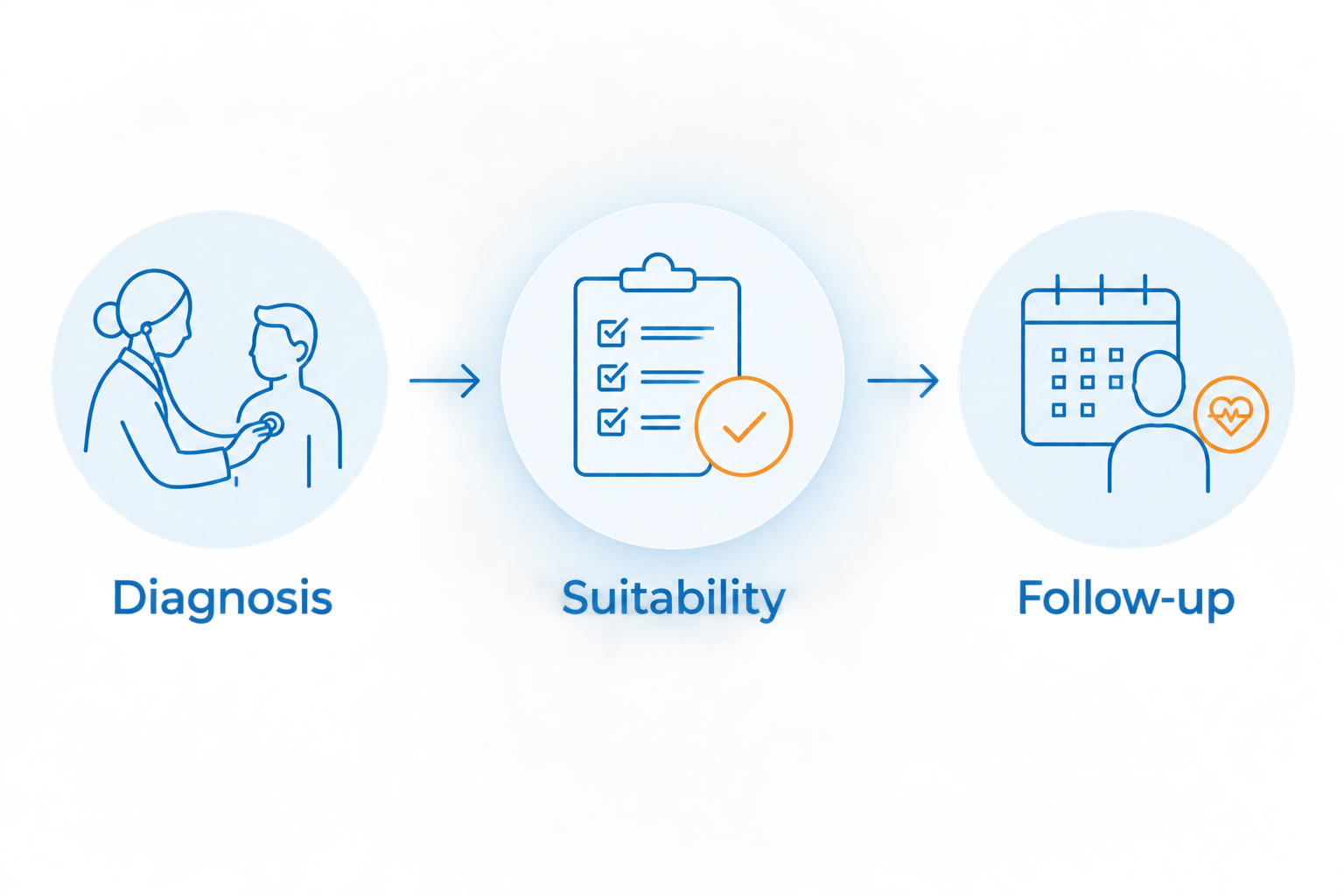
Build your shortlist around these assessment steps
Before comparing procedure names, use the same sequence at every consultation. It keeps the discussion centred on your condition instead of the clinic's preferred treatment.
- Diagnosis: Ask what is causing the concern and which examination findings support that explanation.
- Suitability: Ask why the proposed intervention fits your health, scalp and treatment goals.
- Follow-up: Ask who reviews progress and what happens if the response differs from expectations.
Bring a current medication list and a clear account of when the problem started. Previous prescriptions and treatment records help the next clinician assess what has already been tried without relying on memory.
Separate hair restoration from skin-treatment decisions
A clinic comparison becomes less useful when unrelated concerns are bundled into a single decision. You might need a transplant assessment for a receding hairline and a different clinical discussion for facial pigmentation.
For example, prescription treatments for hyperpigmentation require attention to the diagnosis, skin tolerance and prescribing precautions; choosing a hair-transplant provider does not resolve those questions. Ask for a separate explanation of each condition and the purpose of each proposed treatment.
The same distinction applies within hair care. Shampoo, scalp medication, injectable treatment and transplantation are not interchangeable simply because they all appear in a hair-care discussion.
If you are comparing non-surgical hair treatments, start with the indication for each option rather than its position on a list. A treatment needs a reason to be in your plan; being available is not that reason.
Questions that make a 2026 consultation useful
Ask these questions of every shortlisted provider. Comparable answers tell you more than different treatment labels.
Who is responsible for my care?
Request the name and professional role of the clinician assessing you. For a procedure, ask who performs each clinical stage and who manages complications or unexpected reactions.
Do not assume the person conducting an introductory discussion will perform the treatment. Clarify responsibility before consenting.
What would make you advise against this treatment?
A meaningful assessment includes reasons not to proceed. For transplantation, the discussion should address donor limitations, the pattern of hair loss and whether another approach is more appropriate.
For medication or scalp procedures, ask about contraindications, adverse effects and circumstances that require review. Do not change prescribed treatment solely because another clinic uses a different package name.
How will we judge whether the plan is working?
Ask which changes the clinician expects to monitor and how progress will be documented. Consistent photographs can support comparison, but lighting, styling and camera angle also affect appearance.
Agree on the review plan before starting. An explanation of what happens after an inadequate response is part of treatment planning, not an optional extra.
When staying with Oliva Clinic is the right call
Stay with Oliva Clinic if your clinician has explained the diagnosis, the treatment matches your goals and you understand the risks and follow-up. There is no clinical benefit in switching solely to obtain a different brand name on the same poorly understood plan.
An independent opinion can still be useful without ending an existing care relationship. Share your treatment history accurately and tell both clinicians about current prescriptions.
For your 2026 decision, continuity matters more than collecting consultations that leave the same questions unanswered. Stay when the care is clear; seek another assessment when a material question remains unresolved.
FAQ
What’s the best Oliva Clinic alternative for hair transplantation?
iGraft is an alternative for focused hair-restoration and transplant assessment in Hyderabad, Pune, Bangalore and Vijayawada. Choose after discussing candidacy, donor suitability, clinician responsibilities and follow-up—not procedure names alone.
Is an independent dermatologist better than a hair-transplant clinic?
An independent dermatologist is the better starting pathway when the diagnosis remains unclear. A transplant-focused assessment addresses surgical suitability, so the right choice depends on the question you need answered.
Should I switch clinics if hair treatment is not working?
Request a review of the diagnosis, treatment use and expected response before switching. An independent opinion is appropriate when you still do not understand the plan or the reason for continuing it.
Can I compare Oliva Clinic alternatives without choosing a procedure first?
Yes, compare clinicians and assessment quality before selecting a procedure. Ask each provider to explain the diagnosis, suitable options and reasons to avoid treatment.
What should I ask before travelling to India for hair restoration?
Ask about in-person assessment, recovery arrangements and access to follow-up after you return home. Establish who will assess a concern that requires a physical examination outside India.
Does a hair-transplant consultation cover pigmentation or other skin concerns?
Do not assume a hair-transplant consultation includes assessment of unrelated skin concerns. Describe each concern when booking and confirm that an appropriate clinician will assess it.
One last thing
Before choosing an Oliva Clinic alternative in 2026, write down what would make you decline the proposed treatment. Then ask the clinician the same question.
A personalised consultation should leave you understanding both why treatment fits and why it might not. That explanation is more useful than a longer list of procedures.
Related guides
- How to choose a hair-transplant surgeon in Pune
- Hair-transplant options for thin donor density
- Hair-transplant techniques ranked by sessions required