Best for a focused area: FUE. Best alternative for suitable strip-harvest candidates: FUT. Best for coverage that exceeds a safe single-operation plan: staged transplantation. There is no universal winner when comparing hair transplant techniques ranked by sessions: your donor supply and coverage goals determine the schedule. For iGraft hair transplant patients, the best session plan is one supported by individual assessment, not a promised operation count.
- Hair transplant techniques ranked by sessions have no universal winner; FUE and FUT both require individual assessment.
- FUE suits focused restoration when donor assessment supports the proposed coverage.
- Staged transplantation separates coverage across operations rather than forcing an unsuitable single-session plan.
- Ask iGraft to distinguish operative sessions, treatment days and follow-up visits before comparing proposals.
Why this matters
A shorter surgical schedule is convenient. It does not establish that a transplant plan protects your donor area or delivers the coverage you expect.
A clinic might use session to describe an operation, a treatment day or part of a larger programme. Those definitions are not interchangeable. A proposal describing 1 operative session still needs to explain the intended coverage, whether surgery spans separate days and what follow-up involves.
For your 2026 comparison, separate the technique from the treatment plan. FUE and FUT describe ways of obtaining donor follicles; staging describes how surgery is divided. Comparing them without that distinction produces a misleading ranking.
What makes the best session-efficient hair transplant plan?
Judge the plan against these criteria before comparing technique names:
- Donor suitability: The proposed extraction must account for the condition and distribution of your donor hair.
- Coverage priority: Hairline, mid-scalp and crown restoration place different demands on the available grafts.
- Operative scope: Ask what the surgeon intends to complete during each operation, not simply how many appointments appear on the calendar.
- Future hair loss: A plan must consider existing hair that can continue thinning after transplantation.
- Recovery requirements: Fewer operations do not remove wound care, activity restrictions or follow-up.
- Clear definitions: Separate extraction method, implantation method and clinic-specific procedure names.
The most useful comparison is equivalent coverage with an acceptable donor plan—not the shortest advertised schedule. A smaller procedure and extensive restoration cannot be ranked fairly by operation count alone.
Hair transplant options at a glance
The order below is a decision sequence, not evidence that one technique consistently requires fewer sessions. Start with the simplest suitable plan, then consider alternatives when assessment identifies a reason.
| Option | Best for | Standout feature | Session interpretation | Key limitation |
|---|---|---|---|---|
| FUE | Focused restoration | Individual follicular-unit extraction | A defined area can be planned within an operation | Donor supply still limits coverage |
| FUT | Suitable strip-harvest candidates | Follicular units obtained from a donor strip | Operation count depends on the agreed scope | Leaves a linear donor scar |
| Staged transplantation | Coverage beyond a suitable single-operation plan | Separate operations with distinct objectives | Deliberately involves multiple operative stages | Adds recovery periods and appointments |
| Revision transplantation | Correcting previous transplant work | Prioritises correction around existing grafts | Assessment determines whether correction needs staging | Previous surgery can restrict options |
1. FUE: best for focused hairline or limited-area restoration
Follicular unit extraction, or FUE, removes individual follicular units from a donor area for transplantation. It avoids removing a continuous strip of scalp, but it still creates small extraction wounds and scars.
FUE belongs first in this decision sequence when you want a defined area assessed for restoration. That does not mean FUE always needs fewer operations than FUT. The size of the task and the donor assessment remain decisive.
FUE pros:
- Supports a plan focused on a clearly identified recipient area.
- Avoids the linear donor scar associated with strip harvesting.
- Allows the surgeon to distribute individual extractions across suitable donor areas.
FUE cons:
- Excessive extraction can leave visible donor thinning.
- Small extraction scars remain; FUE is not scarless surgery.
- Extensive coverage can still require separate operations.
Best for: Someone seeking focused restoration whose donor assessment supports the proposed coverage.
For a 2026 consultation, ask the surgeon to mark the area intended for the first operation. A promise to address “the front” is less useful than a defined boundary and a discussion of the density achievable within it.
Verdict: Hold until the donor assessment and written coverage plan support the proposed session count.
2. FUT: best alternative for suitable strip-harvest candidates
Follicular unit transplantation, or FUT, obtains donor tissue as a strip, which is then divided into follicular units for placement. It is a different harvesting approach, not proof of a shorter or longer treatment schedule.
FUT deserves consideration when a surgeon identifies suitable scalp characteristics and a reason to choose strip harvesting. Your hairstyle preferences and acceptance of a linear scar matter alongside the surgical assessment.
FUT pros:
- Provides an alternative when individual-extraction planning is not the preferred approach.
- Concentrates harvesting within the selected strip area.
- Allows recipient-area planning around the follicular units obtained.
FUT cons:
- Leaves a linear scar in the donor area.
- Requires care of a closed donor wound.
- Suitability depends partly on scalp characteristics and previous surgery.
Best for: Someone assessed as a suitable strip-harvest candidate who accepts the donor-scar trade-off.
Ask why FUT is being proposed for your particular donor area. Neither a larger planned operation nor a technique label establishes that future surgery will be unnecessary. Continuing hair loss and changing coverage goals remain separate issues.
Verdict: Hold until the surgeon explains the individual benefit and donor-scar implications.
3. Staged transplantation: best for extensive coverage priorities
Staged transplantation divides restoration into separate operations. The stages can use a harvesting technique such as FUE or FUT; staging itself is not another extraction method.
A plan involving 2 operative stages should identify what each stage is intended to accomplish. For example, a surgeon can prioritise frontal framing before reassessing remaining coverage needs. That is a planning choice, not a standard sequence for every patient.
Staged transplantation pros:
- Makes coverage priorities explicit when the requested restoration is extensive.
- Creates an opportunity to reassess healing and appearance between operations.
- Separates an initial objective from later decisions about additional coverage.
Staged transplantation cons:
- Requires separate recovery periods.
- Adds appointments and travel arrangements.
- Does not create additional donor hair or ensure that every desired area is treatable.
Best for: Someone whose requested coverage exceeds what the surgeon considers appropriate for a single-operation plan.
For patients travelling internationally in 2026, staging changes more than the surgery calendar. Ask which reviews require attendance, what can be assessed remotely and how a later operation would be authorised. Confirm those arrangements before booking travel.
Verdict: Wait for a stage-by-stage plan rather than requesting all coverage in one operation.
4. Revision transplantation: best for correcting previous work
Revision transplantation addresses concerns after an earlier procedure, such as hairline design, uneven coverage or donor-area problems. It can involve more complex decisions because existing grafts, scars and remaining donor hair constrain the plan.
Revision is an indication for surgery, not a distinct harvesting technique. It appears separately because correcting earlier work requires a different discussion from planning a first transplant.
Revision transplantation pros:
- Focuses the assessment on a specific concern rather than adding coverage indiscriminately.
- Allows discussion of how existing grafts affect the proposed design.
- Establishes priorities when remaining donor resources are limited.
Revision transplantation cons:
- Previous harvesting can restrict further extraction.
- Scarred areas require individual assessment.
- Complete correction is not always achievable through another transplant.
Best for: Someone dissatisfied with a previous transplant who needs a corrective assessment before considering further surgery.
Bring the earlier procedure records, available photographs and a clear description of your concern. Ask what can be improved, what cannot and whether observation is preferable to another operation.
Verdict: Wait for a corrective assessment before committing to additional graft placement.
Do sapphire, implanter pens or branded procedures reduce sessions?
An instrument name does not establish the number of operations you need. Separate the procedure into donor harvesting, recipient-site creation and graft placement before comparing proposals.
The comparison of sapphire and standard FUE concerns a recipient-site instrument distinction, not a separate source of donor hair. A different blade material does not, by itself, establish that your restoration needs fewer operative sessions.
Implanter-assisted placement also concerns how grafts are placed; it does not remove donor limitations. Ask which part of the operation differs and why that difference matters to your proposed coverage.
At iGraft, the available procedure names include FUE, ActiveFUE and DFI Ultimate Hair transplant. Ask for the operative details behind each name rather than assigning a session advantage to the label. Your 2026 proposal should specify the harvesting approach, placement approach and reason for any planned staging.
Build a session plan you can actually compare
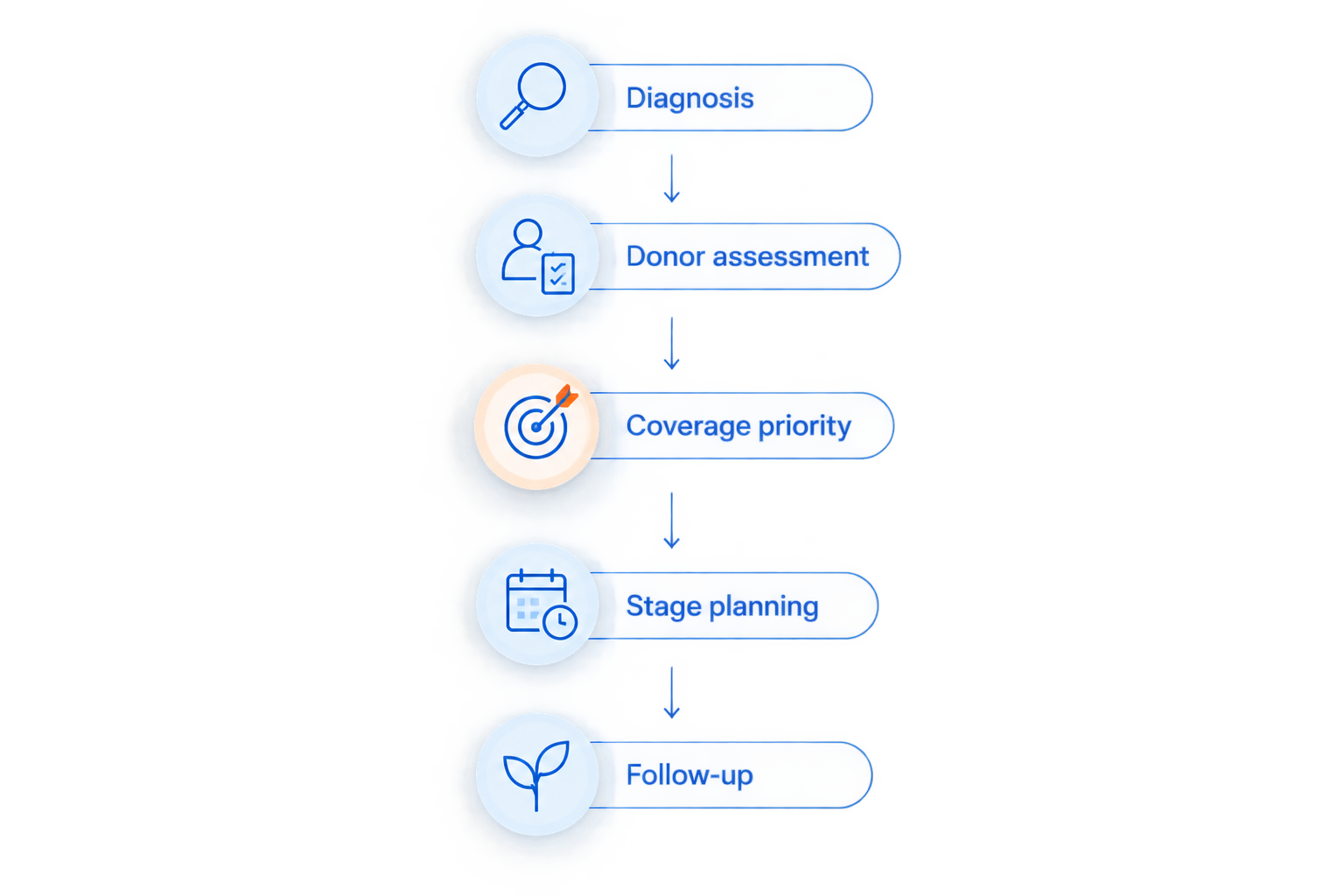
Use the same sequence when discussing any proposed technique. This keeps the consultation focused on decisions rather than terminology.
- Diagnosis: Ask what is causing the hair loss and whether transplantation is appropriate now. Sudden, patchy or inflamed hair loss needs medical assessment rather than an automatic surgical plan.
- Donor assessment: Ask how previous harvesting, density and hair characteristics affect the available options. Request an explanation of the limits as well as the proposed extraction.
- Coverage priority: Identify the area that matters most to you. Ask what remains untreated if the plan prioritises that area.
- Stage planning: Establish whether the proposal means 1 operation, separate treatment days or multiple operations. Record what would trigger a later stage.
- Follow-up: Confirm wound checks, recovery advice and how progress will be assessed, especially if you live outside the clinic's city.
Bring the same questions to each consultation. Consistent questions make different proposals easier to compare without assuming that identical procedure names describe identical plans.
Do not confuse recovery with the final result
An operation finishes before the cosmetic result develops. Transplanted hair grows gradually, and assessment of the result commonly extends to around 12 months, sometimes longer depending on the treated area and individual progress.
That timeline is not a recommendation to schedule another operation at a fixed date. Your surgeon should assess growth, scalp condition and remaining donor options before recommending further surgery.
How this ranking works
This guide ranks decision pathways by clinical purpose: focused restoration, an alternative harvesting approach, extensive staged coverage and corrective work. It does not assign unsupported average session counts to techniques.
The criteria are donor suitability, coverage, operative scope, future hair loss and recovery. No technique wins on session count without a defined patient and a comparable restoration goal.
Which hair transplant approach should you choose?
Start with an assessment of whether a focused FUE plan suits your goals. Consider FUT when a qualified surgeon identifies a patient-specific reason, and accept staging when it makes the coverage plan more appropriate.
For an iGraft hair transplant consultation in 2026, request a written explanation of the proposed areas, operative stages and donor limitations. If you have already undergone surgery, begin with a revision assessment rather than selecting another technique yourself.
FAQ
Which hair transplant technique needs the fewest sessions?
No technique consistently needs the fewest sessions for every patient. FUE and FUT operation counts depend on donor suitability, intended coverage and the surgeon’s assessment.
Can a hair transplant be completed in one session?
A defined transplant plan can be completed in one operative session when the clinical assessment supports it. That does not mean all future hair loss is addressed or that follow-up is unnecessary.
Is FUE always a single-session procedure?
No, FUE is an extraction technique rather than a promise of a single operation. Extensive coverage, donor limitations or later hair loss can lead to separate surgical stages.
Does FUT need more sessions than FUE?
FUT does not inherently require more sessions than FUE. Compare proposals for the same coverage goal and ask how donor characteristics affect each option.
Does sapphire FUE reduce the number of operations?
A sapphire instrument does not by itself establish that fewer operations are needed. The proposed coverage and donor plan still determine whether staging is appropriate.
Are PRP appointments counted as transplant sessions?
PRP appointments are not transplant operations. Ask the clinic to separate surgery, adjunctive treatments and follow-up visits in the proposed schedule.
What should I ask iGraft about ActiveFUE or DFI?
Ask iGraft which harvesting and placement steps the proposed procedure uses and why it suits your assessment. Request a separate explanation of the planned operation count and any later stages.
One last thing
Ask the surgeon: What will remain untreated after the proposed operation? The answer reveals the plan's boundaries more clearly than a session-count headline.
A carefully planned procedure needs an explicit limit. Knowing that limit helps you decide whether the proposed result matches your priorities before you commit.
Related guides
- Hair transplant options for thin donor density
- Hair transplant options for crown restoration in Hyderabad
- Non-surgical hair treatments ranked by sessions