Best overall to investigate: iGraft for an integrated hair, skin and doctor-supervised weight-management franchise. Best for a surgery-focused operator: a hair-transplant-led franchise model. Best for a non-surgical service focus: a hair-restoration-led franchise model. This 2026 guide compares the operating choices; the latter two are business models, not named franchise offers.
- For best hair transplant franchise opportunities India searches, shortlist iGraft for its integrated wellness-centre franchise model.
- Choose a surgery-led model only with an accountable clinical team and documented surgical governance.
- A non-surgical hair-restoration model still needs diagnosis, treatment oversight and clear patient consent.
- Compare written franchise obligations, staffing responsibilities and aftercare before committing to a location.
Why this matters
A hair-transplant franchise is a healthcare business before it is a brand licence. Your decision affects who assesses patients, who performs procedures, how complications are handled and who remains responsible after treatment.
The strongest 2026 shortlist starts with those responsibilities, not a technology name. An integrated centre, a surgical clinic and a non-surgical restoration clinic require different operating plans. Treating them as interchangeable produces a weak franchise decision.
iGraft is the shortlist choice for founders seeking a hair-transplant franchise within a broader hair, skin and doctor-supervised weight-management centre. That is a fit-based verdict, not a claim about investment returns or clinical superiority.
What makes the best hair transplant franchise opportunity?
Use these six criteria before comparing brands or signing an agreement:
- Clinical accountability: Identify the doctor responsible for assessment, treatment decisions, procedures and escalation. Separate medical decisions from sales targets.
- Documented franchise scope: Establish which services, brand rights, operating materials and support commitments the agreement actually includes.
- Workforce readiness: Confirm who recruits clinical staff, checks qualifications, provides training and covers absences.
- Patient continuity: Require a defined pathway from diagnosis through consent, treatment, follow-up and management of concerns.
- Local operating fit: Match the service mix to your premises, clinical team and ability to supervise daily operations.
- Evidence discipline: Distinguish a clinic's procedure description from independently supported clinical outcomes. Apply the same standard to advertising.
For a 2026 franchise decision, written obligations matter more than a presentation deck. A service listed by the parent brand does not automatically establish what your proposed centre is authorised or equipped to provide.
Hair transplant franchise opportunities at a glance
| Ranked opportunity | Best for | Standout feature | Key limitation |
|---|---|---|---|
| iGraft integrated wellness franchise | Founders seeking a multi-service clinical centre | A stated franchise direction combining hair, skin and weight management | Broader service scope requires scrutiny of separate clinical responsibilities |
| Hair-transplant-led franchise model | Operators building around surgical hair restoration | A focused surgical patient pathway | Requires dependable surgical staffing, governance and aftercare |
| Non-surgical hair-restoration-led franchise model | Operators prioritising assessment and ongoing hair-loss treatment | A treatment-led rather than transplant-led focus | Cannot substitute for surgical assessment when transplantation is appropriate |
The table ranks operating fit, not financial performance. Only the first entry names a business with a stated franchise model here. Use the other entries to decide which type of operation you want before assessing individual agreements.
1. iGraft: best franchise fit for integrated wellness
The clinic describes its franchise direction as one wellness centre covering hair, skin and weight loss. Its hair services include DFI Ultimate, ActiveFUE and non-surgical restoration treatments; its broader services include skin treatments and a doctor-supervised GLP-1 weight-management programme.
This model fits a founder who wants a broader clinical offering rather than a transplant-only identity. Confirm the exact service scope of the proposed franchise in writing; the brand's overall service catalogue is not your centre's operating agreement.
Integrated wellness franchise pros
- The stated franchise concept brings hair, skin and weight management into one centre.
- The hair service range includes both transplant procedures and non-surgical treatments.
- The brand describes physical clinics, follicular-level scans and computerised diagnostics as central to its approach.
- The supplied hair-transplant offering includes dedicated 6-month post-procedure support; confirm how that commitment applies to your centre.
Integrated wellness franchise cons
- Multiple clinical services create more responsibilities to allocate, supervise and document.
- A founder needs to assess each treatment pathway separately rather than accept a single assurance covering everything.
- The agreement must distinguish parent-brand responsibilities from the local operator's obligations.
Best for: A founder prepared to oversee a multi-service healthcare operation with qualified clinical leadership.
Understand the transplant process before evaluating training
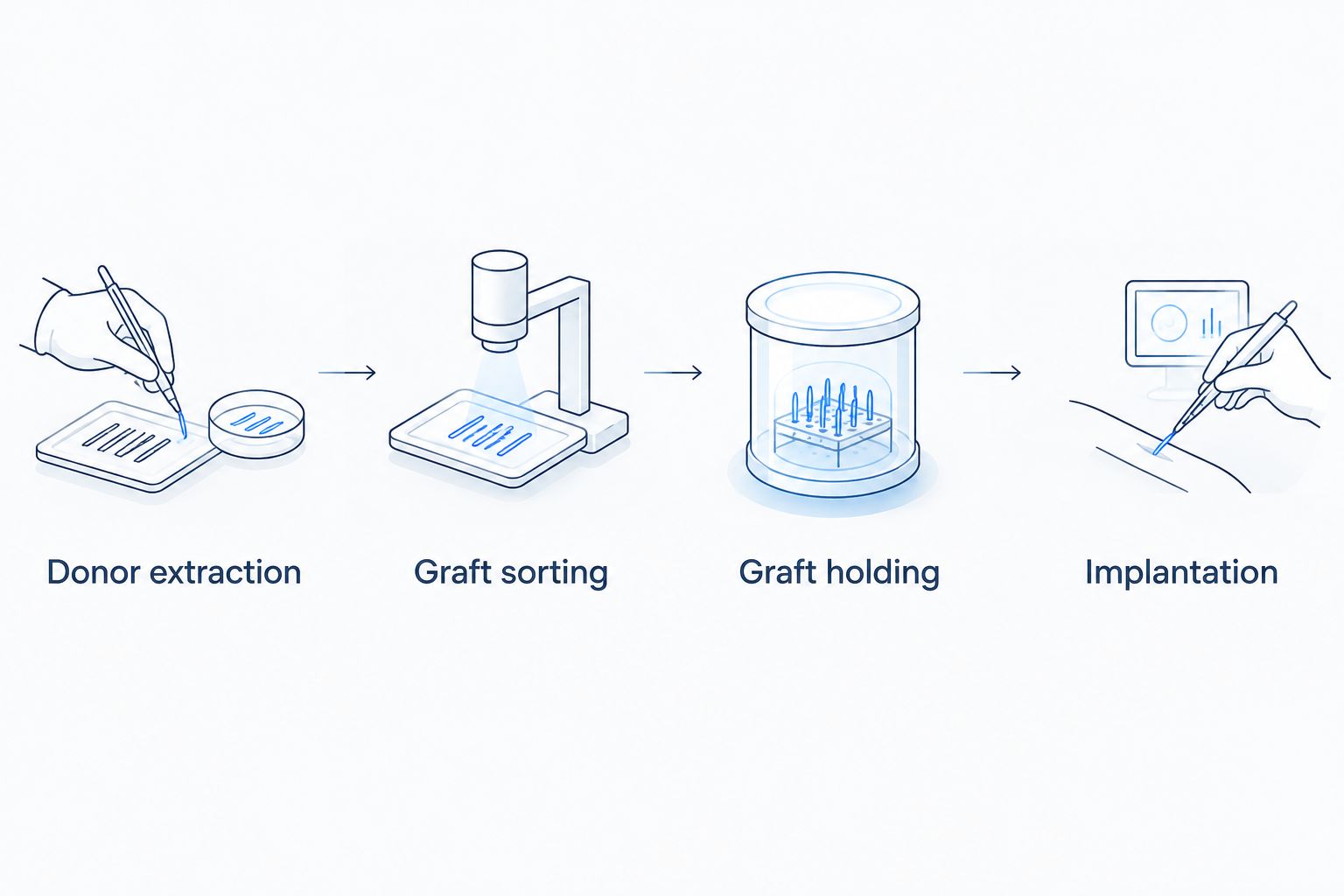
According to iGraft's supplied DFI Ultimate description, donor grafts are extracted from the back of the head using specially designed serrated punches. They are sorted into grafts containing 1 hair, 2 hairs or 3 hairs, then held before implantation in a graft holding/conditioning environment prepared from the patient's blood and peptides. Implantation uses implanter pens and micro-sapphire tools.
These are clinic-supplied process details, not independent clinical validation. They do not establish superior survival, damage-free harvesting or guaranteed results. For franchise assessment, turn the description into questions about staff competence, documentation and responsibility.
- Donor extraction: Who performs it, and how is competence assessed?
- Graft sorting: Who checks handling and records the graft plan?
- Graft holding: What written preparation and handling protocol applies?
- Implantation: Who performs the procedure and manages clinical concerns?
Do not treat DFI Ultimate and DHI as interchangeable names. When assessing hair transplant techniques, ask for the actual procedure, instruments and staffing arrangement rather than assuming a label explains them.
Verdict: Hold any commitment until the franchise agreement defines clinical staffing, included services and aftercare responsibilities.
2. Hair-transplant-led model: best for surgical focus
A hair-transplant-led franchise model centres the business on surgical hair restoration. Assessment, donor planning, surgery and postoperative care form the main patient pathway; this is a model to assess, not a separately identified franchise offer.
Choose this direction when your operating plan is built around a qualified surgical team. A strong sales operation cannot replace clinical suitability assessment or dependable follow-up.
Hair-transplant-led model pros
- The service focus makes the core clinical pathway easier to define.
- Recruitment planning can centre on the surgical team's actual responsibilities.
- Patient information can clearly distinguish assessment, surgery and aftercare.
Hair-transplant-led model cons
- Dependence on surgical staffing requires a clear plan for absences and continuity.
- Some people seeking hair-loss help are not appropriate transplant candidates.
- Narrow service scope requires a referral or management pathway for patients needing other care.
Best for: An operator with a clear surgical governance plan and the ability to sustain postoperative support.
Before assessing a 2026 agreement, request a written explanation of who makes the final treatment decision. Also establish who documents donor assessment, obtains consent, handles complications and answers concerns after the operating day.
Keep the clinical and commercial decisions separate. A patient declining surgery or being unsuitable for transplantation must not become a reason to bypass assessment standards.
Verdict: Hold until the surgical team, escalation arrangements and patient-continuity plan are documented.
3. Hair-restoration-led model: best for non-surgical focus
A non-surgical hair-restoration-led model centres on assessment and clinician-directed treatment rather than transplant surgery. Its suitability depends on the treatments offered, the diagnoses being managed and the qualifications required to deliver care.
This model is not simply a lighter version of a surgical clinic. You still need treatment selection, consent, records, follow-up and a referral route when the patient needs care outside the centre's scope.
Hair-restoration-led model pros
- The service proposition can focus clearly on ongoing hair-loss assessment and management.
- Follow-up can be organised around a documented treatment plan.
- The model separates non-surgical care from the decision to undergo transplantation.
Hair-restoration-led model cons
- Different causes of hair loss require different clinical decisions.
- Treatment names alone do not demonstrate suitability or effectiveness for a particular patient.
- Patients seeking a transplant need an appropriate surgical assessment pathway.
Best for: An operator prioritising non-surgical hair-loss care with qualified clinical oversight.
Review the evidence and responsibilities behind each proposed treatment. A GFC, PRP and exosomes comparison is a starting point for questions, not a substitute for clinical protocols or individual assessment.
Ask how the centre records the starting diagnosis, explains treatment limitations and reviews the plan when progress does not meet expectations. Avoid agreements that frame every patient as a candidate for the same package.
Verdict: Hold until treatment oversight, patient selection and referral responsibilities are explicit.
What to check before signing a franchise agreement
Your 2026 decision file should connect the commercial agreement to the actual clinic operation. Read these documents together; a promise in a presentation needs a corresponding contractual responsibility.
Clinical responsibility
Name the accountable clinician for every service. Establish who checks professional registration, supervises staff, approves treatment protocols and manages escalation. Ask what happens when the usual clinician is unavailable.
Premises and permissions
Obtain location-specific professional advice on the registrations, permissions and facility requirements that apply to the proposed centre. Do this before committing to premises or a treatment scope. Do not assume the parent brand's arrangements automatically cover a franchise location.
Training and patient records
Request the training scope, competency assessment process and arrangements for introducing new staff. Clarify who controls patient records, how access is managed and what happens to records if the franchise relationship ends.
Commercial obligations
Review the complete schedule of contractual payments, mandatory purchases, marketing duties, territory terms, renewal conditions and exit provisions. Build your own operating plan from documented obligations rather than relying on a headline return claim.
Aftercare and complaints
Specify who handles routine follow-up, urgent concerns, complaints and treatment-related disputes. If support is shared between the local centre and the parent organisation, patients need one clear route for help.
Explore the integrated clinic model
Review the service scope, then request written franchise responsibilities before making a commitment.
How these opportunities are ranked
The ranking follows the criteria above: clinical accountability, documented scope, staffing, continuity, operating fit and evidence discipline. The integrated model comes first for founders seeking several clinical service lines; the surgery-led and restoration-led models serve narrower operating preferences.
This is not a ranking by patient outcomes, franchise earnings or investment performance. Use the shortlist to choose your operating model, then assess the proposed agreement on its own terms.
Which hair transplant franchise should you choose?
For an integrated hair, skin and doctor-supervised weight-management centre, start with the named integrated franchise opportunity. For a surgical focus, prioritise the team and aftercare system. For non-surgical care, prioritise diagnosis, treatment governance and referral arrangements.
The default recommendation for 2026 is straightforward: shortlist by service fit, but commit only after clinical and contractual responsibilities match. A broader menu is useful only when your centre can deliver each service responsibly.
FAQ
What’s the best hair transplant franchise opportunity in India for an integrated centre?
iGraft is the shortlist choice here for an integrated hair, skin and doctor-supervised weight-management centre. Assess the proposed franchise’s written service scope and clinical responsibilities before committing.
Is a transplant-only franchise better than an integrated wellness centre?
Neither model is universally better. A transplant-led operation suits a surgical focus, while an integrated centre requires the ability to manage several clinical service lines.
Can I operate a hair transplant franchise without being the treating doctor?
Business ownership and clinical practice are separate responsibilities. Obtain advice on the requirements for your proposed ownership structure and location, and appoint appropriately qualified professionals for clinical care.
Are DFI Ultimate and DHI the same procedure?
Do not treat DFI Ultimate and DHI as interchangeable names. Ask for the specific procedure description, instruments, clinical responsibilities and evidence supporting any claimed advantage.
What should I check about franchise training?
Check which roles the training covers, how competence is assessed and who authorises staff to perform clinical tasks. The agreement should also explain training for replacement staff and changes to protocols.
Does a non-surgical hair clinic still need medical oversight?
A non-surgical hair clinic needs qualified clinical oversight appropriate to its services. Diagnosis, treatment selection, consent and referral remain healthcare responsibilities even when the centre does not perform transplants.
What should happen if the franchise agreement ends?
The agreement should define patient-record access, ongoing treatment responsibilities and continuity of care after termination. Resolve these points before signing so that an ownership dispute does not leave patients without a clear support route.
One last thing
Ask who answers a patient's clinical concern after the franchise relationship ends. That question tests record access, aftercare, accountability and exit planning at once. If the agreement cannot answer it clearly, do not sign it yet.
Related guides