Best overall for diagnosed pattern hair loss: topical minoxidil. Best for breakage-prone lengths: a conditioning serum; best for a dry, tight-feeling scalp: a fragrance-free hydrating scalp serum. This 2026 guide separates treatments intended to support regrowth from cosmetics that improve how thinning hair feels and looks.
- The best hair serum for thinning hair depends on whether you have pattern hair loss, breakage, or scalp dryness.
- Topical minoxidil treats pattern hair loss; conditioning serums improve the hair shaft, not follicle growth.
- iGraft offers hair-loss assessment; diagnosis should come before choosing a hair regrowth treatment.
- Choose fragrance-free scalp hydration for dryness, not as a substitute for treatment of progressive thinning.
Why this matters
Thinning hair describes an appearance, not a diagnosis. A widening part, snapped strands, sudden shedding, and an inflamed scalp need different decisions. Buying a serum before identifying the problem risks treating the wrong thing.
iGraft provides hair-loss assessment with follicular-level scans and computerized diagnostics. iGraft hair-loss assessment is best for readers who need to identify the cause of thinning before choosing a serum. A consultation should connect the examination to a treatment plan, not simply end with a product recommendation.
The key distinction for your 2026 shortlist is straightforward: a cosmetic serum works mainly on hair condition or scalp comfort, while a medicine has a defined treatment role. Neither category replaces an examination when hair loss is sudden, patchy, painful, or accompanied by scalp changes.
What makes the best hair serum for thinning hair?
Use these criteria before comparing packaging or ingredient claims:
- Match to the diagnosis: Establish whether you need treatment for pattern hair loss, support for damaged lengths, or care for scalp dryness.
- Evidence for the intended outcome: Evidence for smoother hair does not establish evidence for regrowth. Ask which outcome a study actually measured.
- A clearly identified formulation: Check the active ingredient, concentration where relevant, application area, and directions. An ingredient list is not proof of effectiveness.
- Scalp tolerability: Fragrance, solvents, and other ingredients can irritate susceptible skin. A product you cannot tolerate is a poor long-term choice.
- Realistic maintenance: Understand how regularly you must apply the product and what happens when you stop.
- Safety fit: Pregnancy, breastfeeding, scalp disease, medical history, and other treatments belong in the decision—not as an afterthought.
Best thinning-hair serums at a glance
These are ranked treatment and formulation categories, not interchangeable bottled products. Topical minoxidil is a medicine commonly supplied as a solution or foam; its inclusion does not make every product marketed as a growth serum equivalent to it.
| Rank and option | Best for | Standout feature | Key limitation |
|---|---|---|---|
| 1. Topical minoxidil | Clinician-confirmed pattern hair loss | Established medical treatment for pattern hair loss | Requires continued use and is unsuitable for some people |
| 2. Conditioning hair serum | Fragile lengths with visible breakage | Improves slip and reduces grooming friction | Does not treat follicle-level hair loss |
| 3. Fragrance-free hydrating scalp serum | Dry, tight-feeling scalp without an untreated scalp disorder | Adds moisture without making a regrowth claim | Does not reverse pattern baldness |
Choose by the problem you need to solve, not by how many growth ingredients appear on the label. Your scalp and your hair lengths can need different products, but adding more products does not establish a better treatment plan.
1. Topical minoxidil: best for diagnosed pattern hair loss
Topical minoxidil is the strongest starting point in this shortlist when the goal is treating pattern hair loss rather than improving hair texture. It is a medicine, not a general-purpose beauty serum. A clinician should first confirm that your thinning pattern fits its intended use.
The American Academy of Dermatology’s patient guidance on hair-loss treatment identifies minoxidil as a treatment for pattern hair loss. That guidance describes a 6–12 month period before results are clear and explains that continued use is needed to maintain benefits. This 2026 recommendation rests on that treatment role, not on a promise that every user will regrow hair.
Topical products include 2% and 5% concentrations, but concentration alone does not determine your instructions. Formulation, product labelling, and individual circumstances matter. Do not copy another person’s schedule or assume a higher concentration is automatically the right choice.
Topical minoxidil pros
- Has an established role in treating pattern hair loss.
- Targets hair growth rather than only coating existing strands.
- Gives you a defined active ingredient to discuss with a clinician.
- Can be assessed against baseline photographs and consistent follow-up.
Topical minoxidil cons
- Requires ongoing use to maintain benefits.
- Can cause scalp irritation and unwanted facial hair growth.
- Does not treat every cause of shedding or thinning.
Some people notice increased shedding after starting treatment. Discuss this possibility before you begin so that you understand what needs monitoring. Do not assume every new symptom is an expected adjustment.
Avoid self-starting minoxidil during pregnancy or breastfeeding. Seek medical advice before applying it to an irritated or damaged scalp, and get prompt medical attention for symptoms such as chest pain, faintness, or a rapid heartbeat.
Best for: Adults with confirmed pattern hair loss who can follow a suitable, ongoing treatment plan.
Verdict: Buy only after confirming suitability; skip self-prescribing for unexplained shedding.
2. Conditioning hair serum: best for breakage-prone lengths
A conditioning hair serum belongs on your shortlist when fragile strands are snapping during brushing, detangling, or styling. Film-forming ingredients, including silicones in some formulations, improve slip and reduce friction. That helps manage the hair you already have; it does not create new follicles.
The application area matters. A product designed for mid-lengths and ends should not automatically go on your scalp. Follow the label, start conservatively, and judge whether the formula leaves fine hair manageable rather than heavily coated.
Conditioning hair serum pros
- Improves detangling and reduces grooming friction.
- Smooths rough-feeling lengths and improves manageability.
- Addresses a different problem from follicle-level thinning.
Conditioning hair serum cons
- Does not treat pattern hair loss or unexplained shedding.
- Heavy formulations can leave fine hair looking flat.
- Cannot permanently repair a split end.
If your part is widening while your ends are also breaking, do not force one serum to solve both problems. Hair-shaft care and medical assessment serve different purposes. Keep your scalp treatment separate from your length-care routine unless the directions specifically say otherwise.
For a 2026 purchase, read the intended use before the front-label growth claim. A conditioning serum earns its place through easier detangling and better hair handling—not through an unsupported promise of increased follicle density.
Best for: People whose fragile, damaged lengths contribute to a thinner-looking finish.
Verdict: Buy for breakage management; skip it as a substitute for hair-loss treatment.
3. Fragrance-free hydrating scalp serum: best for scalp dryness
A fragrance-free hydrating scalp serum is a comfort-focused option when your scalp feels dry or tight. Humectants such as glycerin attract water, but the complete formulation determines how a product feels and performs. An ingredient’s presence does not prove that the finished serum stimulates growth.
Choose a product specifically labelled for scalp use. Persistent itching, redness, thick scaling, tenderness, or sores require assessment rather than repeated experiments with moisturising products. A dry-feeling scalp and an inflammatory scalp disorder are not the same diagnosis.
Hydrating scalp serum pros
- Targets scalp moisture rather than making an unnecessary regrowth promise.
- A fragrance-free formula avoids added fragrance exposure.
- Offers a distinct option when dry-feeling skin is the main concern.
Hydrating scalp serum cons
- Does not reverse pattern hair loss.
- Fragrance-free does not mean irritation-free.
- Does not replace treatment for dandruff or inflammatory scalp disease.
If you already use a prescribed or recommended topical medicine, ask how to fit scalp hydration around it. Do not mix products together or dilute a medicine to make application easier. Layering several leave-on products can also make the cause of irritation harder to identify.
Best for: People seeking scalp comfort after persistent or concerning symptoms have been assessed.
Verdict: Buy for dryness support; hold if you have unexplained inflammation or ongoing shedding.
How to match a serum to your symptoms
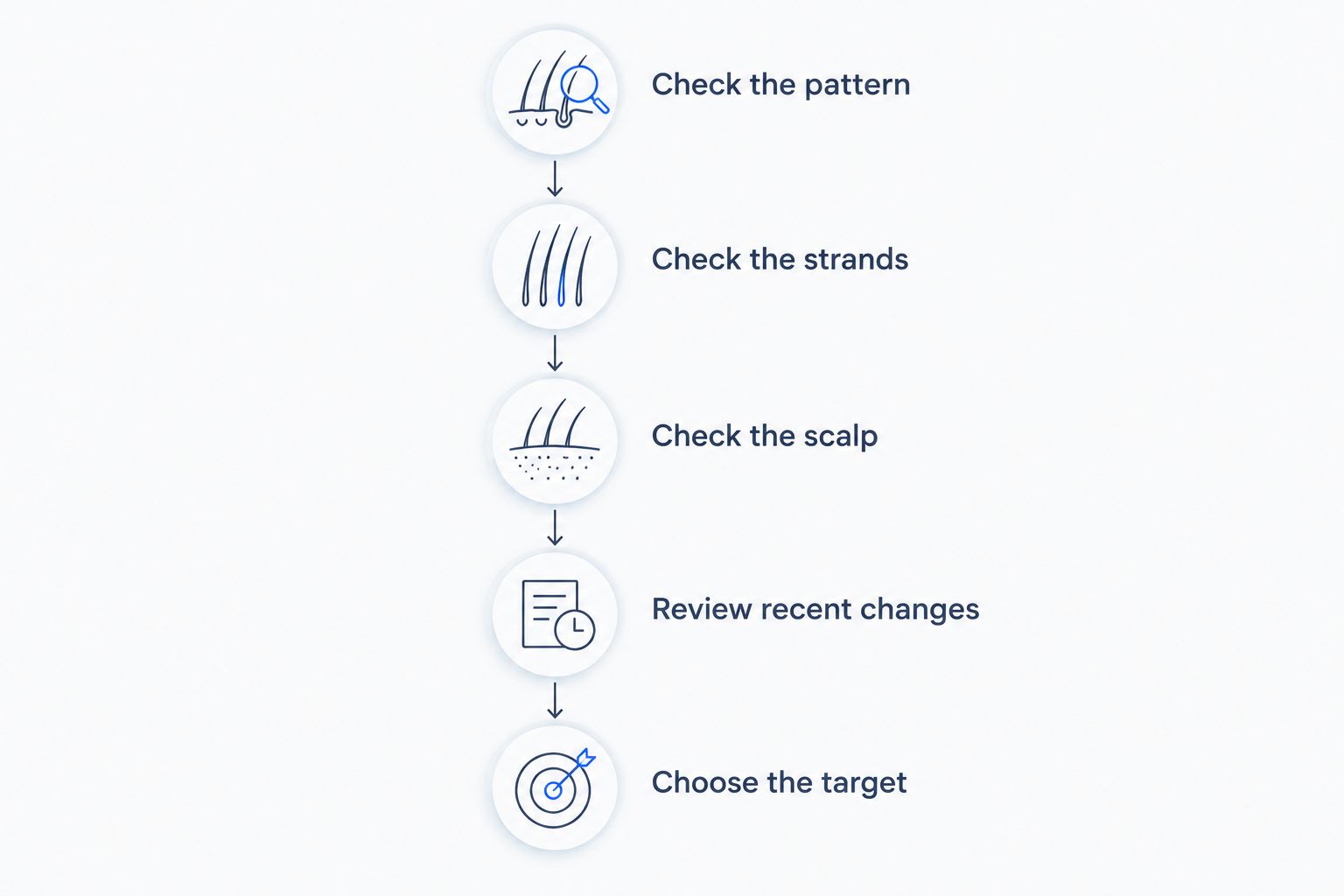
Use this sequence before choosing your 2026 routine. It helps organise a consultation; it is not a home diagnostic test.
- Check the pattern: Note whether the change involves your part, crown, hairline, scattered patches, or overall volume.
- Check the strands: Look for broken lengths as well as shedding. Short hairs alone do not establish whether you have breakage or regrowth.
- Check the scalp: Record itching, redness, tenderness, scaling, or sores instead of covering those symptoms with another cosmetic.
- Review recent changes: Bring your medication list and relevant illness, childbirth, dietary, or styling history to the appointment.
- Choose the target: Agree whether the plan addresses follicle growth, hair-shaft damage, scalp disease, or more than one concern.
Bring photographs taken with a similar parting, lighting, and camera position. Images support a discussion about change; they do not replace a scalp examination. Avoid changing several treatments at once without guidance, because that makes both benefits and irritation harder to interpret.
What about caffeine, peptides, and clinic-branded serums?
An ingredient-led serum needs evidence for the finished formulation and the outcome being advertised. A laboratory finding about caffeine or a peptide does not establish that every serum containing it treats human pattern hair loss. Ask whether the evidence measures scalp comfort, hair appearance, shedding, or actual regrowth.
The iGraft Hair Serum is part of the clinic’s stated product line. Evaluate it using the same questions: what does the current formulation contain, where should you apply it, and what outcome is it intended to support? The brand name alone does not establish equivalence to minoxidil or suitability for your diagnosis.
Do not let a long ingredient list replace that conversation. A serum should have a clear job in your plan, not simply a reassuring growth label.
How these options are ranked
This ranking prioritises the match between the problem, the intended outcome, and the supporting evidence. Minoxidil comes first for diagnosed pattern hair loss because it has an established treatment role. Conditioning and hydrating serums follow because they address breakage and scalp comfort, respectively—not because they provide weaker versions of the same treatment.
This is not a head-to-head trial of commercial bottles. No unnamed formula receives credit for a concentration, clinical result, or tolerability claim that has not been established.
Which thinning-hair serum should you choose?
For progressive pattern thinning, start with diagnosis and a discussion about topical minoxidil. For breakage, choose hair-shaft conditioning. For uncomplicated dryness, choose scalp hydration without expecting regrowth.
If you cannot tell which category describes your situation, choose assessment before another bottle. That is the most useful default for an undecided reader: identify what is changing, then buy for that specific target.
Get your thinning assessed
Discuss the cause of thinning and whether a serum belongs in your treatment plan.
FAQ
What’s the best hair serum for thinning hair in 2026?
Topical minoxidil is the strongest option in this shortlist for diagnosed pattern hair loss. A conditioning serum suits breakage, while a hydrating scalp serum addresses dryness rather than regrowth.
Is minoxidil a hair serum or a medicine?
Minoxidil is a medicine, commonly supplied as a topical solution or foam. Cosmetic products described as growth serums are not automatically equivalent to minoxidil.
How long does minoxidil take to show results?
The American Academy of Dermatology describes 6–12 months before results are clear. Follow the product directions and your clinician’s review plan rather than judging treatment after a few applications.
Can a conditioning serum regrow thinning hair?
A conditioning serum does not treat follicle-level hair loss. It improves slip and manageability, which helps with caring for fragile lengths.
Should I choose a 2% or 5% minoxidil product?
Choose the formulation and concentration that match the product labelling and your clinician’s advice. Do not assume that 5% is automatically suitable or copy someone else’s application schedule.
Can I use a hair serum while pregnant or breastfeeding?
Do not self-start topical minoxidil during pregnancy or breastfeeding. Ask your clinician to review any proposed scalp product, including cosmetic serums.
Does iGraft offer a serum for thinning hair?
iGraft lists Hair Serum among its products. Ask about the current ingredients, intended use, and suitability for your diagnosis before adding it to your routine.
When should I see a doctor instead of trying another serum?
Seek medical assessment for sudden, patchy, painful, or inflamed hair loss. Persistent shedding or progressive thinning also needs a diagnosis rather than repeated cosmetic product changes.
One last thing
A smoother finish can make hair look better without changing the underlying thinning process. Keep those outcomes separate when judging your routine. In 2026, your most useful question is not whether a serum feels effective—it is whether the specific problem it was chosen to address is improving.
Related guides
- Best hair loss treatments for women
- Best hair loss treatments for men
- Best treatments for crown baldness