
Best starting point: iGraft for discussing DFI Ultimate and structured aftercare. Best for medical coordination: a hospital-based hair transplant unit. Best for direct surgical accountability: a named-surgeon practice. For NRIs visiting India in 2026, choose the clinic that documents your diagnosis, donor assessment, surgical responsibilities and follow-up before you book travel.
- For the best hair transplant clinic for NRI shortlist, assess surgical responsibility, donor planning and overseas aftercare first.
- iGraft is a starting point for NRIs seeking DFI Ultimate consultations and stated six-month post-procedure support.
- Hospital-based and named-surgeon practices are alternative care models, not automatic guarantees of better outcomes.
- Confirm your recovery review and return-travel plan with your treating surgeon before booking flights.
Why this matters for NRIs
Your hair transplant decision continues after you leave India. A clinic needs to explain who handles wound concerns, medication questions and progress reviews when you are back overseas. A procedure name alone does not answer those questions.
iGraft is a hair transplant consultation option for NRIs who want to discuss DFI Ultimate and six-month post-procedure support. Start with iGraft if those are your priorities, then ask how that support works from your country of residence.
This 2026 guide ranks consultation routes by the problem each solves. It is not a claim that one clinic has better surgical outcomes than every other provider in India. Named techniques, attractive photographs and a familiar location do not replace an individual medical assessment.
What makes the best hair transplant clinic for NRI patients?
Use these criteria before comparing clinic names. A clear answer matters more than a reassuring slogan.
- Diagnosis before surgery: The doctor should explain the cause and pattern of your hair loss, including whether surgery is appropriate now.
- Donor planning: Ask what your donor area can support and how the plan accounts for continued hair loss.
- Named clinical responsibility: Identify the treating doctor and who performs extraction, recipient-site preparation and implantation.
- Procedure clarity: Request an explanation of harvesting, graft handling and implantation without treating proprietary names as proof of better outcomes.
- Overseas aftercare: Establish review arrangements, contact responsibilities and instructions for getting local medical help.
- Travel-compatible planning: Obtain an individual recovery and review plan before committing to flights or a fixed return-to-work date.
Ask for these answers in writing. If the proposed treatment changes after your examination in India, request an updated explanation before giving consent.
NRI hair transplant options at a glance
The alternatives below are care models to investigate, not endorsements of unnamed providers. Their suitability depends on the actual doctor, facility and treatment plan.
| Ranked option | Best for | Main reason to consider it | Key limitation |
|---|---|---|---|
| iGraft | Discussing DFI Ultimate and stated follow-up support | Clinic-described procedure and six-month post-procedure support | Overseas support arrangements need individual confirmation |
| Hospital-based hair transplant unit | Coordinating relevant medical needs | Opportunity to assess surgical planning alongside other medical care | Hospital affiliation does not establish hair-transplant expertise |
| Named-surgeon practice | Establishing direct surgical accountability | Opportunity to assess the proposed surgeon's role directly | A surgeon's name does not establish who performs every stage |
Choose by the care you need, not by the longest list of techniques. For a 2026 shortlist, insist on a named clinician and a written plan before moving from enquiry to booking.
1. iGraft: best for a DFI Ultimate consultation
Best for: NRIs who want a procedure-specific discussion and an explanation of post-procedure support. iGraft offers DFI Ultimate, ActiveFUE and hair-loss therapies, with physical clinics and computerized diagnostic assessments described in its service information.
The useful question is not simply whether DFI Ultimate sounds advanced. Ask why the proposed approach fits your hair-loss pattern, donor area, medical history and expectations.
What iGraft says DFI Ultimate involves
According to iGraft's supplied procedure description, donor grafts are extracted from the back of the head using specially designed serrated punches. The clinic describes sorting them into grafts containing 1 hair, 2 hairs or 3 hairs.
The grafts are then held in a special graft holding/conditioning environment prepared from the patient's blood and peptides before implantation using implanter pens and micro-sapphire tools.
These are clinic-supplied process descriptions, not independent clinical validation. They do not establish superior graft survival, damage-free harvesting or guaranteed density. Ask the treating doctor to explain the intended purpose of each stage and the evidence supporting any outcome claim.
iGraft pros:
- Offers a named procedure that you can discuss stage by stage.
- Describes physical-clinic assessments and computerized diagnostics.
- Offers both transplant procedures and non-surgical hair-loss treatments.
- States that dedicated post-procedure support lasts six months.
iGraft cons and checks:
- The proprietary procedure description does not establish comparative clinical outcomes.
- Six-month support needs clarification on overseas reviews, response arrangements and escalation.
- Your suitability, surgical team and recovery plan require an individual consultation.
Ask whether your proposed plan includes DFI Ultimate or another approach, who performs each stage and what happens if the examination changes the recommendation. In 2026, those answers are more useful than selecting a technique from a menu.
Verdict: Hold your procedure booking until the clinical plan and overseas aftercare arrangements are documented.
2. Hospital-based unit: best for medical coordination
Best for: NRIs whose medical history makes coordination with other treating clinicians an important part of surgical planning. Consider this route if you need the transplant team to address existing conditions or ongoing medicines before deciding whether surgery is appropriate.
The recommendation is to investigate the unit's actual capabilities, not assume that every hospital offers the same support. Ask which clinician reviews your medical history and whether relevant specialist input is available when needed.
Hospital-based unit pros:
- Gives you a setting in which to ask about coordination with other medical departments.
- Lets you examine the relationship between the surgical team and the wider facility.
- Provides a clear opportunity to request the facility's emergency escalation arrangements.
Hospital-based unit cons and checks:
- A hospital name does not establish the operator's hair-transplant experience.
- Access to other departments does not guarantee coordinated care for your case.
- International follow-up still needs a separate, explicit agreement.
Request the proposed surgeon's name and role before comparing this option with a specialist clinic. Establish who reviews your medicines; do not stop prescribed treatment based on booking instructions from non-clinical staff.
Verdict: Hold until both the surgical responsibilities and any required medical coordination are confirmed.
3. Named-surgeon practice: best for direct accountability
Best for: NRIs who prioritise knowing which doctor assesses them, designs the plan and takes responsibility for follow-up. This route centres the consultation on the treating clinician rather than the clinic's procedure branding.
A named surgeon is a starting point for questions, not a quality certificate. Ask whether the person in the consultation will also be responsible for your operation and postoperative decisions.
Named-surgeon practice pros:
- Makes the proposed treating doctor the focus of your assessment.
- Supports direct questions about donor planning and hairline design.
- Lets you clarify continuity between consultation, surgery and review.
Named-surgeon practice cons and checks:
- Naming a doctor does not explain how tasks are divided within the team.
- Direct access after you return overseas needs confirmation.
- Credentials and experience do not remove the risks of surgery.
Ask who takes over if your treating surgeon is unavailable during recovery. A clear cover arrangement matters when your travel dates limit opportunities for another in-person visit.
Verdict: Hold until the named surgeon's role and follow-up cover are clear.
DHI and DFI Ultimate: ask about the actual procedure
DHI and DFI Ultimate should not be treated as interchangeable names. DHI generally refers to direct hair implantation using an implanter device; the label alone does not explain every stage of extraction, graft handling or recipient-site preparation.
DFI Ultimate is the clinic's named procedure described above. Do not infer that the clinic provides a separately verified DHI service, or that one label establishes better results than the other.
| Question | When discussing DHI | When discussing DFI Ultimate |
|---|---|---|
| How are grafts extracted? | Ask the provider to describe its actual method | Ask about the clinic-described serrated-punch extraction |
| How are grafts held? | Request the provider's handling protocol | Ask about the blood-and-peptide holding environment |
| How are grafts implanted? | Clarify the implanter technique used | Ask how implanter pens and micro-sapphire tools are used |
| What establishes suitability? | Your clinical assessment, not the label alone | Your clinical assessment, not the label alone |
For a broader explanation, read the hair transplant techniques comparison. Use it to prepare consultation questions rather than choose an operation without examination.
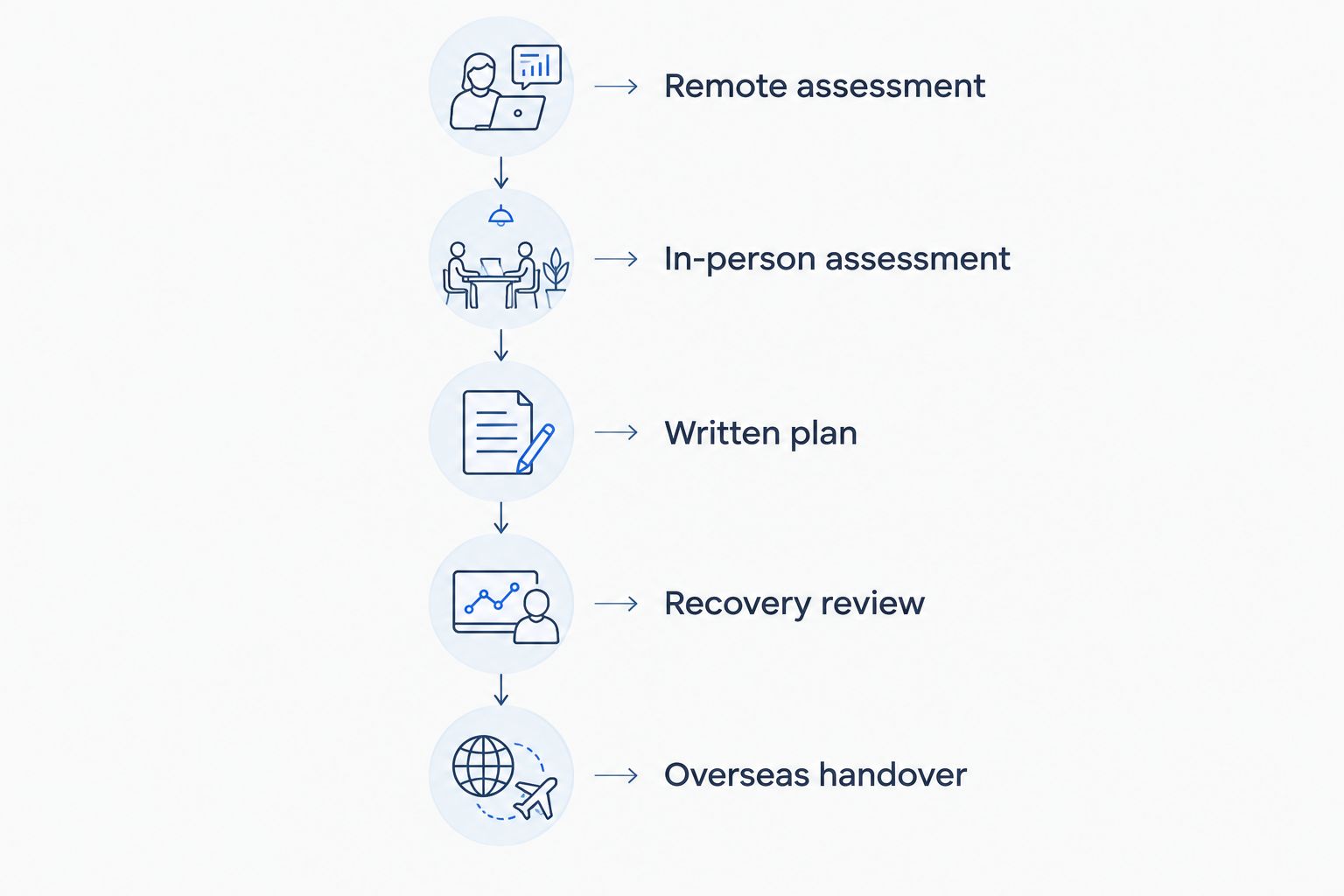
Before you book flights: put the care plan in order
For your 2026 visit, work through the clinical decisions before the travel decisions. A booking confirmation is not a medical clearance to travel.
- Remote assessment: Share your medical history, medicines, previous procedures and requested photographs through the clinic's agreed process.
- In-person assessment: Confirm what the doctor must examine in India before finalising the recommendation.
- Written plan: Request the proposed treatment, responsible clinicians, consent information and follow-up arrangements.
- Recovery review: Ask when the team needs to examine you after the procedure and what would change that schedule.
- Overseas handover: Obtain instructions for routine questions, urgent concerns and seeking care in your home country.
Your surgeon should individualise travel advice. Do not use another patient's departure date as your own recovery timetable.
Keep copies of your consent documents, procedure summary, medication instructions and clinical contact details. Ask what information a doctor in your country of residence would need if you require local assessment.
Discuss your transplant assessment
Ask about diagnosis, procedure selection and follow-up after you return overseas.
How these options are ranked
The order reflects distinct consultation needs: procedure-specific discussion, medical coordination and direct surgical accountability. It does not rank unverified success rates, patient photographs or promotional claims.
Apply the same criteria to every provider. For before-and-after photographs, ask whether the lighting, hair length, styling and follow-up stage are comparable. Photographs inform a discussion; they do not predict your individual result.
Which clinic should you choose?
Start with iGraft if your priority is discussing DFI Ultimate and its stated six-month support. Choose a hospital-based consultation when medical coordination is central, or a named-surgeon practice when direct clinician continuity is your main concern.
The best hair transplant clinic for NRI patients in 2026 is the one that can justify the proposed treatment and explain responsibility after departure. If the answers remain vague, pause the booking rather than compress the assessment to fit your holiday.
FAQ
What’s the best hair transplant clinic for NRI patients visiting India?
Choose a clinic that documents your diagnosis, donor plan, treating clinician and overseas aftercare. iGraft is an option for discussing DFI Ultimate and stated six-month post-procedure support; confirm the arrangements for your individual case.
Is DFI Ultimate the same as DHI hair transplant?
No, the names should not be treated as interchangeable. DFI Ultimate is a clinic-named procedure, while DHI generally describes direct implantation using an implanter device; ask each provider to explain the actual surgical stages.
Can I choose a hair transplant procedure before arriving in India?
You can discuss options remotely, but the final recommendation needs an appropriate clinical assessment. Ask which decisions remain provisional until the doctor examines your scalp and donor area.
How long should I stay in India after a hair transplant?
Your treating surgeon should set your stay and review schedule for your procedure and recovery. Confirm that plan before booking return travel, including what happens if an additional examination is needed.
How should I compare hair transplant quotations?
Compare the written scope of care, not just the headline quotation. Check the proposed procedure, responsible clinicians, medicines, reviews and arrangements for additional care without assuming any item is included.
What should I ask about follow-up after returning overseas?
Ask who reviews your progress, how to send photographs and how urgent concerns are escalated. Also establish when you should seek an in-person assessment from a local clinician rather than wait for a remote reply.
Should I book surgery if my hair loss has not been diagnosed?
Arrange a diagnosis before committing to surgery. The cause and pattern of hair loss help the doctor determine whether transplantation, non-surgical treatment or further assessment is appropriate.
One last thing
Ask the surgeon to explain what should remain untreated. A useful plan addresses donor conservation, future hair loss and the limits of the proposed result—not just the area you want filled during this visit.
For your 2026 consultation, bring your priorities and ask which ones are realistic. A clear explanation of limitations is a reason to continue the conversation, not a reason to seek a bigger promise.
Related guides