
A hair transplant consultation should answer one question before anything else: is the patient actually a good candidate for surgery right now? For clinics like iGraft, a hair restoration provider in India, the consult is where hair loss history, donor supply, scalp condition, and expectations are reviewed before a technique or graft count is discussed.
TL;DR: Summary
- The best hair transplant consultation questions focus on candidacy, donor-area strength, realistic results, risks, recovery, and long-term planning, not just price.
- iGraft and major medical groups describe consultation as the first step because donor hair availability, scalp condition, and restoration goals determine whether surgery makes sense.
- The American Academy of Dermatology says a patient needs enough healthy donor hair and the ability to grow hair in the thinning area to be considered for a hair transplant.
- The American Society of Plastic Surgeons notes that grafts may not all take, hair loss can continue after surgery, and some patients may need repeat procedures.
- If a clinic avoids discussing donor limits, safety risks, recovery time, or non-surgical alternatives, that is a reason to slow down and ask more questions.
The strongest consults usually feel more like medical planning than sales. That matters for patients comparing FUE, DHI, FUT, Sapphire, or hybrid methods in India, especially when clinic marketing focuses heavily on hair transplant cost or celebrity-style results.
Why is a hair transplant consultation more than a price discussion?
A strong hair transplant consultation is a candidacy and planning session, not a quote call. At iGraft and in guidance from the American Academy of Dermatology, the core issue is whether donor hair, scalp condition, and expectations make surgery sensible.
Price matters, but it is not the first filter. A transplant moves hair from donor areas, usually the back and sides of the scalp, into bald or thinning zones. If donor supply is weak, if active hair loss is still progressing quickly, or if the scalp cannot support growth in the recipient area, even a low-cost plan can be a poor decision.
That is why a proper consult should review hair loss history, past treatments, scalp condition, donor area quality, hair density, and restoration goals before anyone talks about a final surgical design. A common misconception is that the “best clinic” is the one that gives the fastest graft quote. In reality, the better sign is a clinic that slows the process down enough to rule out a bad plan.
“iGraft describes consultation as the first step, with review of hair loss history, scalp condition, donor area, hair density, and restoration goals before treatment is discussed.”
Patients searching in Pune, Hyderabad, Bangalore, or across India can use the same standard: if the consult sounds like a generic package pitch, it is not detailed enough.
Is a hair transplant consultation the same as a candidacy evaluation?
No. A consultation can be broad, while a candidacy evaluation is the part that tests whether surgery is appropriate. The AAD treats scalp examination and donor assessment as central to that decision.
In practice, the two often happen together, but they are not identical. A consultation may include goals, timing, technique preferences, budget, and travel planning. A candidacy evaluation gets more specific. It asks whether there is enough healthy donor hair, whether the thinning area can support transplanted growth, and whether the pattern of loss is stable enough to design a lasting result.
This distinction matters because a patient can be interested in surgery without being ready for surgery. Some people are better served first by medical treatment, a wait-and-watch period, or a different restoration option. If the consult jumps straight from photos to booking, candidacy may not have been tested properly.
What are the 7 questions to ask before a hair transplant consult?
The best questions are the ones that expose donor limits, technique fit, and realistic outcomes. A useful consult should be able to answer each of these clearly and specifically.
After the initial discussion, patients can ask:
- Am I a good candidate right now: Is there enough healthy donor hair, and is the recipient area suitable for growth?
- What is causing the hair loss: Is this stable male or female pattern hair loss, or could testing be needed first?
- How is donor area quality assessed: What will be checked for density, caliber, and long-term reserve?
- Which method fits best for this case: FUE, DHI, FUT, Sapphire, Bio FUE, or a hybrid plan?
- How many grafts are being considered and why: Is the estimate based on hairline design, coverage area, and future loss?
- What risks and recovery should be expected: What swelling, scabbing, shedding, scarring, or graft loss should be discussed?
- What if surgery is not the best option yet: Are medicines, PRP, GFC, camouflage, or delayed surgery part of the plan?
These questions work because they force specifics. They also make it harder for a clinic to hide behind vague phrases like “high success rate” or “permanent solution” without explaining the trade-offs.
How does donor-area assessment work step by step?
Donor assessment is a three-step process: examine supply, judge quality, and protect future reserve. This is where many borderline cases become clear.
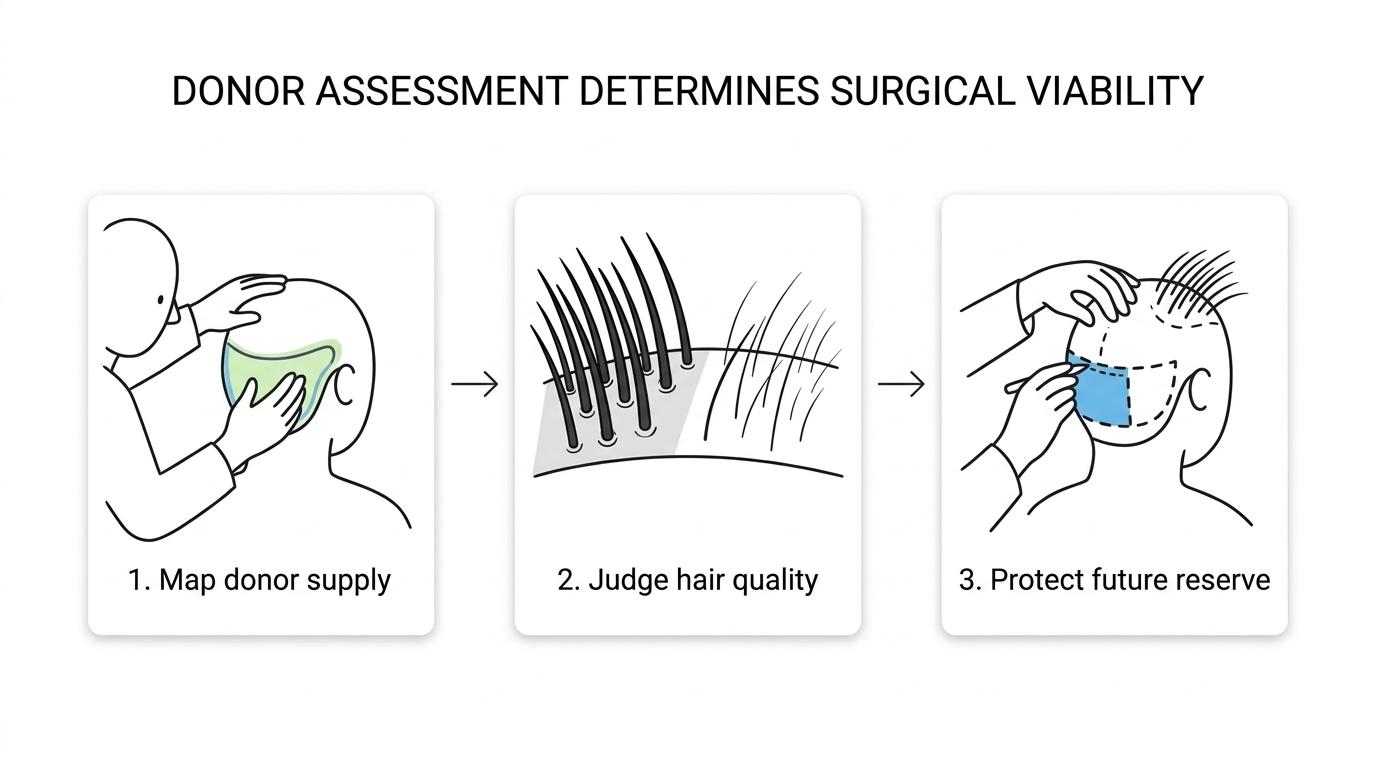
Step 1 is mapping the donor zone. The clinician checks the back and sides of the scalp, where hair is often more resistant to pattern baldness. The AAD and ASPS both emphasize that healthy donor hair is a basic requirement.
Step 2 is judging quality, not just quantity. Density matters, but so do hair caliber, curl, texture, and color contrast. ASPS notes that hair color, texture, and waviness or curliness can affect the cosmetic result. Thick or curly hair may create the look of better coverage with fewer grafts than fine straight hair.
Step 3 is protecting the future. A common mistake is to treat the donor area as unlimited. It is not. If too many grafts are removed too early, future procedures become harder and the donor zone can look thinned out. If the patient is young and hair loss is still advancing, a conservative plan is often smarter than an aggressive one.
How should FUE, DHI, FUT, Sapphire, and hybrid methods be compared during the consult?
The right method depends on scalp characteristics, coverage goals, and donor strategy, not trend value. FUE and DHI are popular, but not every case is best served by the same workflow.
A consult should compare methods in terms the patient can actually use:
- FUE: Individual follicular units are extracted from the donor area; often chosen for flexibility and visible scar minimization.
- DHI: Uses an implanter-based placement approach; can be discussed when precise placement and packing strategy are priorities.
- FUT: A strip-based donor method; may be considered when maximizing graft yield matters more than a linear scar.
- Sapphire or hybrid methods: Usually describe blade material or combined workflows, so the patient should ask what changes clinically, not just in branding.
One misconception is that DHI is always “better” than FUE. Often, DHI is better described as a placement technique within a wider transplant plan. The useful question is not which acronym sounds premium. It is whether the method fits hairline work, crown coverage, shave preferences, donor preservation, and recovery expectations.
What safety risks and realistic results should be discussed before surgery?
Hair transplant surgery is generally safe, but it is still surgery with real risks. The NHS and ASPS both stress that complications, failed grafts, and further surgery remain possible.
The safety discussion should include infection, bleeding, scarring, swelling, shock loss, and grafts that do not take. ASPS also notes a less discussed issue: if native hair keeps thinning after surgery, the result can look patchy or unnatural later unless the long-term plan accounts for continued loss.
Expectations matter just as much as risks. The AAD notes that a full head of hair may be unrealistic, while a fuller head of hair can be a reasonable goal. That distinction helps patients judge permanence and effectiveness more accurately. Transplanted hair can be long-lasting, but the surrounding non-transplanted hair may still miniaturize over time.
“iGraft says every hair transplant begins with a detailed consultation and assessment by experienced doctors, which is why risks, donor limits, and realistic goals should be covered before surgery.”
Celebrity and Bollywood hair transplant comparisons can be misleading here. Public results do not reveal donor quality, number of procedures, medical treatment use, or photo styling.
How can graft count, density, and hairline design be estimated step by step?
Graft planning usually follows three steps: define the target area, estimate density goals, and match that plan to donor limits. At iGraft, computerized hair analysis can support this early planning stage.
Step 1 is measuring the balding or thinning area. A frontal hairline case, mid-scalp case, crown case, and diffuse thinning case do not need the same distribution. A no shave hair transplant plan can also change how the session is structured.
Step 2 is setting cosmetic density goals. Higher density looks attractive, but it uses more donor reserve. A common misconception is that the highest possible graft number automatically means the best result. If density is packed too aggressively in one zone, future touch-ups elsewhere may become harder.
Step 3 is designing a hairline that ages well. Good hairline design considers facial proportions, future recession, and the patient’s age. The most natural hairline is not always the lowest one. Patients should ask why a certain hairline position is being proposed, not just whether it looks strong in a single photo.
Clinics that quote graft counts without examining donor strength, current density, and likely future loss are guessing more than planning.
What recovery timeline should be mapped out before booking a date?
A useful recovery discussion should cover the first 48 hours, the first 2 weeks, and the next several months. Recovery is not just about wound healing; it is also about shedding, return to work, and when visible growth starts.
In the first phase, patients should ask about washing, sleeping position, swelling control, sprays, and when scabs can be handled normally. The NHS notes that patients should be given a spray to support recovery and hair growth.
In the second phase, the key issue is appearance. Scabbing, redness, and temporary shedding can affect work and social plans. This matters for anyone scheduling surgery around travel, weddings, public-facing jobs, or a return to office.
In the longer phase, visible improvement is gradual. Growth timing varies, and outcomes are not fully predictable because not all grafts take. Pro tip: if a clinic promises a precise result date or a guaranteed success rate, that is a sign to ask harder questions.
When should someone delay surgery, ask for tests, or get a second opinion?
Surgery should be delayed when diagnosis is unclear, donor supply looks weak, expectations are unrealistic, or hair loss is still changing quickly. The AAD notes that some patients may need a blood test or scalp biopsy during evaluation.
A second opinion is especially useful if two clinics give very different graft counts, technique recommendations, or hairline designs. That gap can signal different medical judgments, but it can also reveal when one plan is too aggressive. This is common in younger patients, in women with diffuse thinning, and in patients whose crowns are expanding.
Patients asking about the best hair transplant clinic in India should pay attention to process, not only before-and-after galleries. A clinic like iGraft that offers computerized hair checkups and both surgical and non-surgical options can be relevant in these cases because a neutral consult should be able to say “not yet” when surgery is not the right move.
If the consult avoids discussing donor areas, realistic results, recovery time, or the possibility that transplanted hair alone may not solve ongoing baldness, another opinion is a smart next step.