
For many people comparing a hair transplant in Vijayawada, the debate quickly turns into one question: FUE or DHI?
It sounds like a simple choice, but the answer is rarely just about which technique sounds more advanced. In actual practice, the bigger issue is whether the clinic has the medical skill, donor planning, and surgical setup to deliver natural, lasting results safely. That matters far more than a marketing label.
Patients searching for the best hair transplant clinic in Vijayawada often want the same things: a natural hairline, strong graft survival, minimal scarring, a reasonable recovery timeline, and confidence that the procedure is being done by qualified medical professionals. When those goals are kept in focus, the the FUE vs DHI discussion becomes much easier to judge.
Hair transplant in Vijayawada: why the FUE vs DHI question causes confusion
A lot of the confusion starts with how these terms are presented in advertisements. FUE, or follicular unit excision, refers to the way grafts are harvested from the donor area. DHI, or direct hair implantation, is commonly described as if it were a completely separate transplant method.
That description is not fully accurate.
A widely cited position from the International Society of Hair Restoration Surgery explains that DHI is often used to describe immediate implantation of a follicular unit after extraction. In simple terms, DHI is generally an implantation approach layered onto FUE harvesting, not a completely separate way of obtaining grafts.
This matters for Vijayawada patients because it changes the question from “Which brand name is better?” to “Which surgical plan suits the scalp, hair loss pattern, and donor capacity?”
FUE vs DHI technique differences for Vijayawada patients
Both FUE and DHI can produce natural results when the case selection and execution are strong. The real differences are in workflow, tools, and how recipient placement is handled.
| Feature | FUE Hair Transplant | DHI Hair Transplant |
|---|---|---|
| Donor harvesting | Individual follicular units extracted | Usually the same FUE-style extraction |
| Implantation method | Recipient sites are created, then grafts are placed | Grafts are often implanted directly using an implanter tool |
| Hairline control | Strong when site design is well planned | Strong in skilled hands, especially for dense placement in select zones |
| Shaving needs | Often requires donor shaving, recipient shaving depends on case | Can be considered for selected no shave or limited shave cases |
| Procedure speed | Efficient for larger sessions | Can be slower in some sessions |
| Best use cases | Broad coverage, larger baldness cases, crown and mid-scalp work | Hairline refinement, selective density work, some smaller sessions |
| Key success factor | Donor management and angle design | Donor management and implantation precision |
The table makes one thing clear: both options depend heavily on planning and surgeon skill.
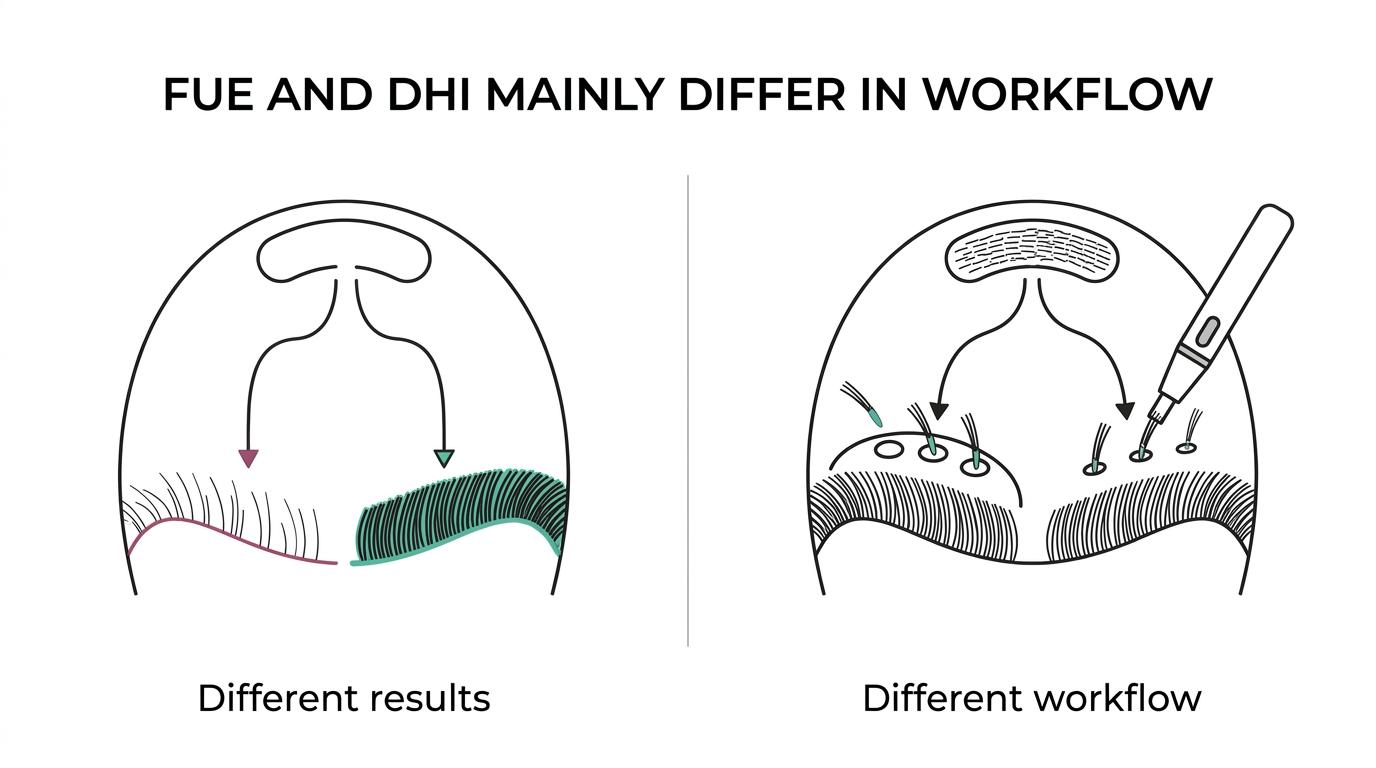
A patient with advanced baldness, weak donor reserves, or unrealistic density expectations will not get a better result just because the clinic calls the procedure DHI. In the same way, a carefully planned FUE hair transplant can look extremely natural and remain one of the most effective modern options for men and women in India.
Hair transplant safety in Vijayawada matters more than branding
A hair transplant is surgery. That point should not get lost in sales language.
In India, current medical guidance treats hair transplant procedures as surgical procedures because they involve scalp incisions for graft extraction and recipient-site creation. The same guidance states that these procedures should be performed by properly trained, licensed Registered Medical Practitioners. It also expects centers to have anesthesia backup, emergency equipment, proper registration, and record keeping.
That means the safest clinic in Vijayawada is not the one with the flashiest FUE vs DHI claim. It is the one that can show a proper medical setup.
Patients can keep these checkpoints in mind:
- Doctor credentials: licensed medical practitioner with appropriate surgical training
- Facility standards: day care center or hospital registration, emergency readiness
- Case planning: donor assessment, graft count logic, realistic density mapping
- Documentation: consent, pre-op records, post-op follow-up protocol
Anyone searching for the best place for hair transplant in Vijayawada should treat those points as non-negotiable.
Hair transplant results depend on donor assessment and baldness pattern
Not every scalp should be treated the same way. A patient with early temple recession needs a different plan from someone with extensive top and crown baldness. The donor area also has limits, and those limits shape the whole procedure.
This is where many good decisions are made. A strong clinic will examine the donor density, calibre of hair, scalp condition, pattern of loss, age, family history of baldness, and the likely future progression of hair loss. If those steps are skipped, the technique choice becomes secondary.
Clinics that use computerized hair and scalp diagnosis can add useful detail during planning. iGraft publicly states that its FUE planning includes computerized hair and scalp diagnosis, personalized planning, and donor-area assessment for patients in cities including Vijayawada. That kind of approach fits what informed patients should expect anywhere: a case-specific plan, not a one-size-fits-all pitch.
When FUE may be the better hair transplant option in Vijayawada
FUE remains one of the most widely preferred techniques for good reason. It is flexible, well established, and suitable for many hair loss patterns seen in Indian patients.
FUE may be a strong choice in these situations:
- Larger bald areas
- Crown restoration
- Frontal plus mid-scalp coverage
- Patients who prefer tiny scattered donor marks over a strip scar
- Cases where graft distribution across multiple zones is needed
Aesthetic references commonly describe FUE donor scarring as many small pencil-point scars that are usually hidden by surrounding hair. For patients who wear their hair reasonably short, that can be an important advantage over FUT, which involves strip harvesting.
FUE is also often the practical choice when the graft requirement is moderate to high. If a patient needs 2000, 3000, or more grafts depending on donor strength and baldness extent, a carefully executed FUE plan can provide broad coverage efficiently.
When DHI may be useful for selected Vijayawada hair transplant cases
DHI can be helpful in certain cases, especially where implantation control is the main focus. Patients looking for frontal hairline refinement, limited fill-in work, or selected no shave hair transplant options may hear DHI recommended more often.
That does not make it automatically better.
DHI may suit cases where the clinic wants to place grafts with an implanter tool in a highly controlled pattern, particularly in smaller or more selective zones. Some patients also prefer the idea of direct implantation because it sounds less invasive, even though graft extraction still usually follows FUE principles.
A good clinic will explain the fit honestly instead of overselling the name. That explanation may include:
- Hairline design needs: refined frontal placement may benefit from implanter-based insertion
- Session size: smaller or focused sessions may suit DHI-style workflow
- Shaving preference: some limited shave cases may be planned this way
- Density expectations: not every scalp can support very high packing safely
That last point is important. Density should be planned with blood supply, graft survival, and long-term donor preservation in mind. “More grafts in one square centimeter” is not always the smartest move.
Hair transplant cost in Vijayawada: what really changes the price
Patients comparing hair transplant cost in Vijayawada often assume FUE and DHI have fixed pricing differences. In reality, cost depends on more than the name of the technique.
The total may change based on graft count, surgeon involvement, baldness grade, whether the case is no shave or standard, facility standards, follow-up care, and whether the plan includes supportive treatments like PRP or GFC hair therapy.
Price is usually shaped by these factors:
- Graft count
- Donor difficulty
- Hairline complexity
- Surgeon time
- Clinic infrastructure
- Post-procedure care
A lower price can look attractive at first, but patients should ask what is actually included. If the clinic is weak on donor analysis, medical oversight, or emergency readiness, a cheaper quote may come with bigger long-term costs.
Hair transplant permanence, effectiveness, and success rate
Most patients want one direct answer: is a hair transplant permanent?
Transplanted hair taken from a stable donor area is generally considered long-lasting because it tends to retain the characteristics of the donor zone. Still, “permanent” should not be confused with “no future hair loss.” Native hair around the transplanted area can continue to thin over time, which is why long-term planning matters.
Effectiveness depends on several practical issues:
- Donor quality: stronger donor hair usually supports better cosmetic coverage
- Graft handling: careful extraction and placement help survival
- Recipient design: angle, direction, and spacing shape naturalness
- Aftercare: swelling control, washing, and recovery instructions affect early healing
Success rate questions are common, especially among patients looking at celebrity hair transplant stories or Bollywood hair transplant rumors. Those stories may create interest, but they rarely show the medical planning behind a result. Real success comes from proper case selection, realistic goals, and a well-executed surgical process.
Hair transplant recovery timeline after FUE or DHI
Recovery tends to be manageable for most patients, whether the case is planned as FUE or DHI. The timeline varies by graft count, scalp sensitivity, and the exact technique used for implantation.
A broad recovery pattern often looks like this:
| Recovery stage | What patients commonly notice |
|---|---|
| First 2 to 5 days | mild swelling, tenderness, scabbing |
| First 7 to 10 days | scabs begin to clear, donor area settles |
| Weeks 2 to 6 | temporary shedding of transplanted hairs can happen |
| Months 3 to 4 | early new growth may begin |
| Months 6 to 9 | visible improvement in density and coverage |
| Months 10 to 12+ | fuller maturation in many cases |
Patients asking for a no shave hair transplant in Vijayawada should know that recovery comfort and timeline can still be similar in many respects. “No shave” changes the planning and appearance during recovery, but it does not remove the need for careful post-op care.
How Vijayawada patients can choose the best hair transplant clinic
The strongest decision is often not FUE versus DHI. It is clinic quality versus clinic marketing.
A patient looking for the best clinic in Vijayawada, or even comparing the best hair transplant in India across cities like Pune, Hyderabad, and Bangalore, should focus on proof of competence. Technique labels matter, but only after the basics are confirmed.
Useful questions to ask during consultation include the surgeon’s role in extraction and implantation, how graft counts are estimated, whether the donor area can support future procedures, what safety protocols are in place, and what kind of natural hairline design is appropriate for the patient’s age and face.
That is also why a responsible consultation sometimes advises waiting, medical treatment, or a smaller first session instead of pushing an aggressive transplant. A clinic that protects donor hair and plans for the future is usually thinking like a medical team, not just a sales team.
For Vijayawada patients, that is the clearest way to compare FUE and DHI: not by which term sounds newer, but by which clinic can show safe surgery, honest planning, and results built to look right for years.