
People considering a hair transplant in Vijayawada usually ask two direct questions first: is it safe, and does it actually work?
The short answer is yes for the right candidate, treated with the right method, in a properly run surgical setting. A hair transplant is still a medical procedure, though, not a salon service or a quick cosmetic fix. Safety, permanence, hair transplant success rate, and the final look all depend on careful case selection, donor area quality, technique, and follow-up.
That matters because hair loss is not always the same problem. Pattern baldness, diffuse thinning, patchy autoimmune hair loss, scarring hair loss, and temporary shedding can look similar at first glance, yet they do not respond to a transplant in the same way.
Hair transplant safety in Vijayawada
Major medical sources, including the NHS, the American Academy of Dermatology, Mayo Clinic, and MedlinePlus, describe hair transplant surgery as generally safe when it is done properly. They also make it clear that this is surgery, so risks are real even when they are uncommon.
A standard hair transplant moves hair follicles from a donor area, usually the back or sides of the scalp, to areas with thinning or baldness. Local anaesthetic is commonly used. Sessions may last several hours, depending on the graft count and the method chosen, whether that is FUE, DHI, FUT, Sapphire FUE, or a hybrid plan.
Like any surgical procedure, hair transplant safety is linked to medical screening, sterile technique, thoughtful graft handling, and proper aftercare. Patients in Vijayawada who want the safest path should expect a proper scalp exam, a discussion of medical history, and realistic planning rather than instant approval.
After a medical explanation of the procedure, the common risks should be discussed clearly.
- Bleeding: usually limited, but still a known surgical risk
- Infection: uncommon in well-controlled settings, yet possible
- Swelling and bruising: often temporary during early recovery
- Scarring: varies by technique, skin type, and healing pattern
- Graft failure: can happen if follicles do not survive or heal well
- Anaesthetic reaction: rare, but relevant in any procedure using local anaesthetic
Safety is also tied to what happens after the procedure.
Patients who ignore washing instructions, rub the grafts, smoke heavily, skip follow-up, or return to intense exercise too soon may raise the chance of problems. A good clinic in Vijayawada should give written aftercare guidance and a clear point of contact for review if swelling, redness, pain, or discharge looks unusual.
Does a hair transplant work and is it permanent?
For suitable candidates, a hair transplant can be very effective. The reason is simple: follicles taken from the donor area are usually more resistant to the hormonal pattern that causes male or female pattern baldness. When those follicles are transplanted successfully, they often continue to grow in their new location.
That said, “works” should be defined properly. A successful result usually means a fuller, natural-looking scalp appearance, a better hairline, and improved density in the treated zone. It does not always mean the return of thick teenage hair across the entire scalp.
This is why many doctors speak carefully about hair transplant permanence. The transplanted follicles are typically long-lasting, but the native hair around them may still thin over time. That is one reason some patients are advised to combine surgery with medical hair loss treatment or supportive therapies.
Hair transplant success rate is not one fixed number that fits every patient or every clinic. It depends on several things:
- donor area strength
- the cause of baldness
- graft handling and placement
- angle and direction of implanted hair
- scalp health and healing
- realistic graft distribution across the balding area
Celebrity and Bollywood hair transplant stories have made the procedure more familiar, but copying a celebrity hairline is rarely the right goal. Good planning is based on face shape, age, donor reserve, future hair loss pattern, and the need for a natural look over time.
Hair transplant techniques in Vijayawada: FUE, DHI, FUT, Sapphire, Bio FUE, and hybrid methods
Vijayawada patients often compare techniques before they compare clinics. That is sensible, but technique alone does not decide the result. The skill of planning, extraction, hairline design, and implantation matters just as much.
FUT, also called follicular unit transplantation, has long been regarded in academic literature as a major standard in hair restoration surgery. FUE has become especially popular because it avoids a linear strip scar and is often preferred for patients who want shorter hairstyles. DHI, Sapphire FUE, no shave hair transplant, and hybrid methods are often selected based on cosmetic goals, graft count, and donor characteristics.
Here is a practical view of the main options:
| Technique | Typical use | Key points on safety and results |
|---|---|---|
| FUE hair transplant | Common choice for pattern baldness and hairline work | Individual follicle extraction, small dot scars, popular for flexibility in graft planning |
| DHI hair transplant | Often chosen for targeted placement and dense frontal work | Direct implantation approach, useful in selected cases, planning and angle control remain vital |
| FUT hair transplant | May suit higher graft needs in some patients | Strip method, can preserve donor efficiency, leaves a linear scar |
| Sapphire FUE | A variation of FUE using sapphire blades for site creation | Marketed for precise slit creation; outcome still depends on surgeon technique |
| Bio FUE | Usually FUE combined with supportive biologic or regrowth-focused planning | May be used where clinics want to support healing or scalp condition, but case selection matters |
| Hybrid hair transplant | Mix of techniques in one plan | Used when hairline, crown, and donor strategy need different approaches |
| No shave hair transplant | Selected patients who want less visible evidence of surgery | Helpful for some working professionals, but not ideal for every graft count or hair type |
A patient asking which technique is “best” should expect a more specific answer than a brand name. The best hair transplant method in Vijayawada is the one that suits the donor area, the stage of baldness, the required graft count, and the expected styling pattern.
Who is a good candidate for a hair transplant in Vijayawada?
This may be the most important question in the whole process.
The best candidates are usually people with pattern baldness or other stable forms of permanent hair loss, with enough healthy donor hair to redistribute. Many men seeking frontal hairline repair or crown coverage fall into this category. Some women with stable pattern thinning may also be eligible after evaluation.
Not every person with visible hair loss should move straight to surgery. Medical sources regularly point out that conditions like alopecia areata are usually not ideal transplant cases. Temporary shedding, active inflammatory scalp disease, and very poor donor supply can also make surgery a poor fit.
A proper consultation should look at more than the bald patch itself.
- Good candidates: stable pattern baldness, defined donor area, realistic expectations
- Borderline candidates: progressive loss at a young age, limited donor reserve, very large bald areas
- Poor candidates: patchy autoimmune loss, unstable scalp conditions, untreated medical causes of shedding
Patients comparing Vijayawada with Hyderabad, Bangalore, Pune, or other hair transplant cities in India should keep this in mind: a strong diagnosis matters more than the city label. The best place for hair transplant is the place where the case is assessed honestly and planned responsibly.
Hair transplant recovery timeline and expected results
Results do not appear overnight.
One reason some patients worry early is that transplanted hair often sheds after the procedure. This is expected in many cases. It does not mean the transplant failed. The follicles remain under the skin and start producing new growth later.
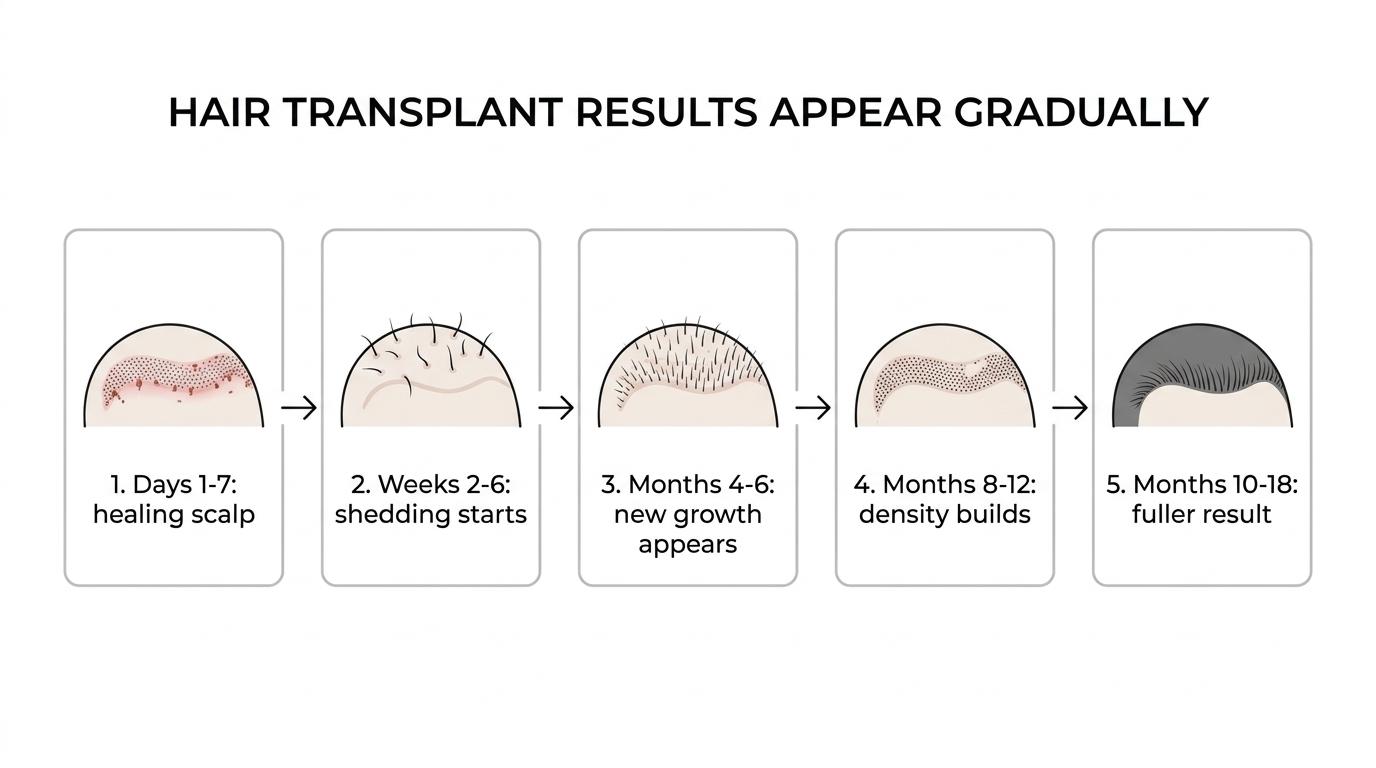
Medical sources commonly describe the timeline as gradual, with early growth appearing after a few months and fuller results taking up to 10 to 18 months. Crown areas can feel slower than the front.
That awkward middle phase often changes how patients manage their appearance day to day, and even a general retail overview like T-shirten.dk’s guide to hair accessories reflects how shorter or uneven hair lengths are commonly handled while density is still developing.
After patients hear the timeline, the process becomes much easier to follow.
- Days 1 to 7: mild swelling, redness, scabbing, and careful washing instructions are common
- Weeks 2 to 6: many transplanted hairs shed, which is often called shock shedding
- Months 4 to 6: early regrowth starts becoming visible in many patients
- Months 8 to 12: density improves and the shape becomes clearer
- Months 10 to 18: fuller cosmetic results are usually judged in this window
Some patients need more than one session, especially in advanced baldness cases or revision hair transplant work.
Hair transplant effectiveness also depends on protecting existing hair. A person may get a strong hairline result and still need treatment for ongoing thinning behind it. That is why many clinics discuss medical maintenance, PRP, GFC, or a staged plan when suitable.
Hair transplant cost in Vijayawada and what affects pricing
Hair transplant cost in Vijayawada is usually shaped by graft count first, then by technique, surgeon involvement, donor complexity, and whether the case is a first-time transplant or a repair case.
A smaller frontal correction will not be priced like a high-graft baldness case. A no shave hair transplant may require more time. DHI or hybrid methods may be priced differently from standard FUE. Revision cases can be more demanding because old scarring, weak donor areas, or unnatural previous work need correction.
Patients searching “best hair transplant clinic in Vijayawada” often compare only low quotes. That can be risky. A useful cost discussion should include what is actually being offered: diagnosis, graft estimate, surgeon planning, procedure method, medications, follow-up, and whether remote review is available for outstation patients.
India remains a strong destination for hair transplant treatment because many patients can access modern techniques at a lower cost than in several other countries. Still, the best country or best clinic question should never be answered by price alone.
What to ask at a Vijayawada hair transplant consultation
A good consultation should feel specific to the patient, not rehearsed.
In many modern hair restoration clinics, planning may begin with scalp and hair analysis, donor assessment, graft count estimation, and a review of whether the case needs surgery, medication, or both. Patients may also be told whether the case is primary, advanced, or revision, and whether support treatments are worth considering.
Useful questions include the expected graft count, whether FUE or DHI is more suitable, whether a no shave option is realistic, what the recovery timeline looks like, and how much future hair loss may affect the long-term design. Asking to see natural hairline work and healed donor area outcomes is also reasonable.
The safest and most effective hair transplant in Vijayawada is rarely the one that promises the fastest miracle. It is usually the one that gives a careful diagnosis, a sensible graft plan, a natural design, and enough follow-up to guide the patient from day one to final growth.