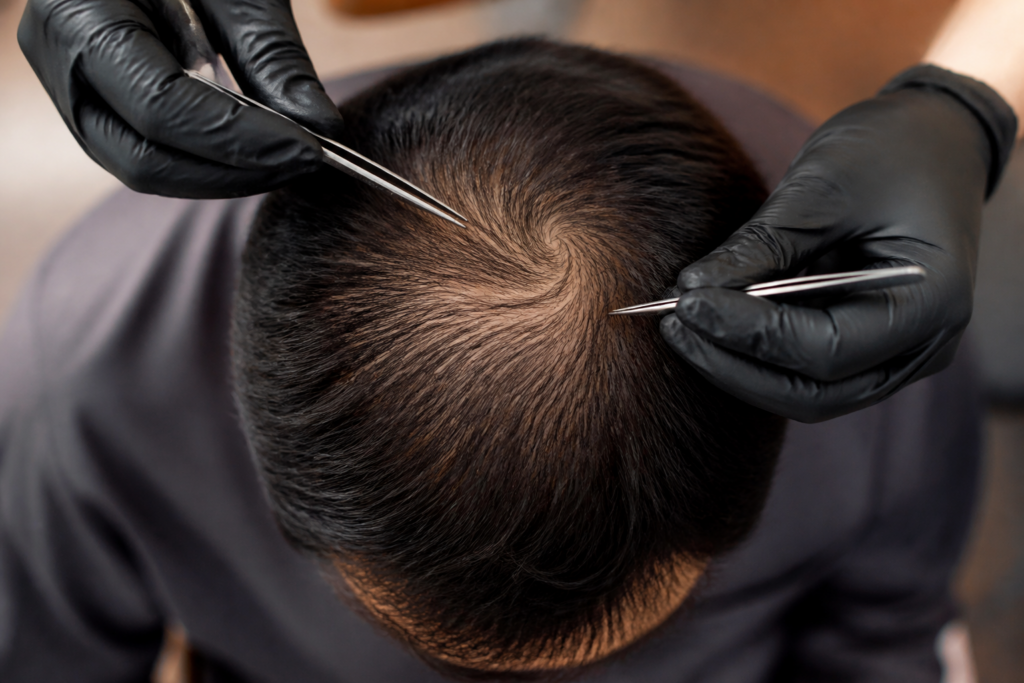
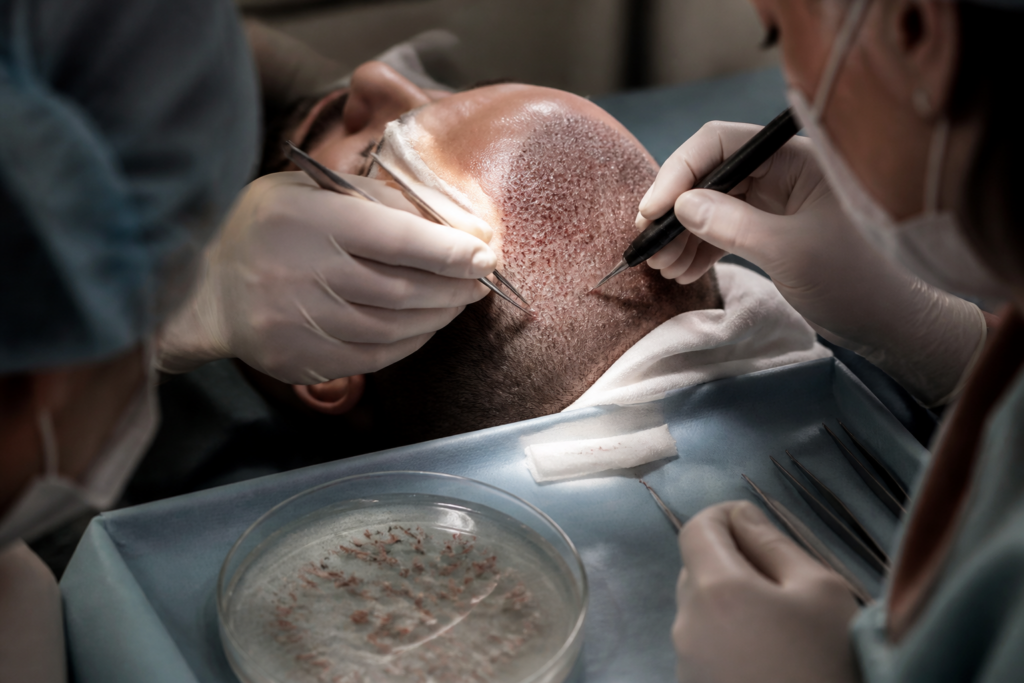
If you can trace your new hairline with a fingertip, it was designed like a drawing, not like a scalp. Micro-irregularity is how surgeons stop that doll hair look and build a border that still reads as yours in harsh light and close conversation.
Why a perfectly straight hairline looks fake
You notice a poor transplant before you notice a good one. The front is too even, too dense, and a little like a doll wig. That is the doll hair effect. It shows up when multi-hair grafts sit on the leading edge, when the border is drawn as a ruler-straight line, and when hair is placed too upright.
A real hairline is not a line. It is a soft, broken, irregular border. Up close, the front of a natural scalp is a scatter of fine single hairs that slowly thickens behind. Pack a sharp drawn line with grafts and the result still looks artificial, even if every graft survives. That is why natural hairline design is decided in the first centimeter, not by a big session count.
What micro-irregularity actually means
Micro-irregularity is planned unevenness at the single-hair level: tiny forward and backward steps, uneven gaps, a soft saw-tooth edge. Macro-irregularity is the larger shape, the gentle waves that follow your forehead instead of a geometric bar.
Both have to work together. Macro waves stop the stamped look. Micro zig-zags stop the connect-the-dots look that photographs badly. A few sentinel hairs (single grafts placed irregularly just ahead of the main border) break the edge so your eye never finds a hard start. The irregularity is designed, not accidental.
Graft choice: the first centimeter decides the result
The doll hair problem is often a sorting error. Two-, three-, and four-hair units belong further back, where they add bulk. At the very front, two hairs exiting one point look like tufts. A natural leading edge does not do that.
In a well-planned hair transplant, only single-hair follicular units go in the first 0.5 to 1 cm, and those should be the finest available. Behind them, two-hair units add definition. Further back, three- and four-hair units create visual density. Density should start soft, often around 20 to 30 grafts per cm² in the first rows, then rise toward 40 to 50 grafts per cm² or more as you move inward. A thick wall of hair at the front is what people mean when they say a result looks planted.
| Zone | What goes in | Why it matters |
|---|---|---|
| Transition zone (first 0.5 to 1 cm) | Single-hair grafts only, low density | Soft, feathered edge |
| Defined zone | Mostly 2-hair units | Shape without tufts |
| Density zone | 3- and 4-hair units | Volume where the eye does not pick out each follicle |
Angle, direction, and the bristle look
Frontal hair does not stand up. It sweeps forward and slightly down, usually at about 15 to 30 degrees. At the temples, direction shifts downward. If the slit is too vertical, hair sticks up like a brush. That bristle effect is as obvious as a pluggy line.
Direction must match your existing flow, including cowlicks and temple recession. This is where DFI hair restoration and careful follicular unit extraction matter. Direct Follicle Implant (DFI) places each unit with control over angle, depth, and rotation. ActiveFUE extraction aims to keep the unit intact so singles can be sorted from multi-hair grafts under magnification, not by guesswork. If you are comparing a dhi hair transplant with DFI, the practical question is the same: who sets the angle of every graft at the hairline?
Design that fits your face, age, and future loss
Height should respect facial thirds, your age, and hair you may still lose to DHT. A very low, dense line can look striking at 25 and odd at 50. Because a transplant is permanent, a mature, slightly conservative line is often the safer choice, especially if donor supply is limited and the crown still needs coverage.
The hairline should sit above the moving part of the frontalis muscle. Hair placed on muscle that lifts when you raise your brows will bounce with expression.
Ask for close-up, clinic-owned photos of the hairline edge, not only wide smiling shots. Look for an irregular, feathered front. Ask how height and shape were chosen for your face. Common myths skip this part and talk only about graft numbers.
At iGraft Global Hair Services, planning starts with computerized, follicular-level scans in company-owned clinics. There are no franchisees. Doctors meet you in person in Pune, Bangalore, Hyderabad, and Vijayawada, map donor limits, and build a 360° plan for hair fall, thinning, and complete baldness. The practice is 15-plus years old, with a doctor panel and dedicated 6-month post-procedure support.
If you are searching for the best hair transplant in Bangalore, hair transplant in Pune, hair transplant Hyderabad, or hair transplant in Vijayawada, the design rules do not change by city. The scan and the surgeon's hands do. Male hair transplant work often starts at the temples and mid-front. Female hair transplant more often needs diffusion-aware density, not a lowered male-pattern line.
Cost, recovery, and treatments that sit beside surgery
People comparing hair transplant cost, graft cost, mens hair transplant cost, and hair plantation cost should know the unit. A cheap session fee can hide extra charges when "graft" and "follicle" are mixed. iGraft publishes transparent rates: ₹45 per graft for ActiveFUE and ₹50 per follicle for Gen3 DFI Ultimate, with 29-year assurance on the DFI method. Read why paying per follicle beats a flat session fee and the India pricing guide. Hair transplant cost in Pune and hair transplant cost Hyderabad follow the same published units.
Around 30% of patients travel from the USA, UK, Australia, and the NRI community for a mid-range, clinic-based result. Overseas patients who want unit-based bills rather than a vague outcome package can check the count in writing before they fly.
Healing is not instant. Transplanted hairs typically shed in the first weeks. New hair growth shows over months. Desk work is often possible within several days. Physical jobs need longer. Check the time-off guide before you book flights. No-shave options exist when your pattern and donor hair allow it. Local anesthesia is used. Your doctor should explain swelling, scabbing, and the shed phase before you sign.
If you still have miniaturizing hair, medical hair loss treatment can sit beside surgery: GFC hair treatment, advanced PRP therapy, exosomes for hair, BioCell treatment, and booster protocols, often combined with high-frequency and low-level laser sessions. Patients compare Regenera Activa vs GFC, Regenera Activa vs PRP, and Regenera Activa cost in India. After a follicular-level check, iGraft focuses on GFC Class 2, advanced PRP, and exosomes rather than a single branded gadget. GFC hair treatment cost is quoted after diagnosis. Home products such as biotin gummies, minoxidil, serum, and shampoo plus conditioner support the result. They do not replace a consult.
iGraft also runs a doctor-supervised GLP1 for weight loss India program only after an in-person exam. GLP1 for weight loss pros and cons, and GLP1 for weight loss side effects, belong in a clinic visit. We do not sell GLP1 online without that physical assessment.
FAQ
What causes the doll hair look after a hair transplant?
Multi-hair grafts on the front row, a straight drawn border, upright angles, and a sudden wall of density. Single-hair grafts, micro-irregular spacing, and a low forward angle prevent it.
How do I judge a surgeon's hairline work?
Ask for close-ups of the leading edge. You should see irregular singles, no plugs, and hair lying forward. Stock photos are not enough. Start with a 2-minute quiz and an in-clinic scan.
What should I expect to pay for hair restoration?
ActiveFUE is ₹45 per graft. Gen3 DFI Ultimate is ₹50 per follicle. Confirm the count in writing. Hair restoration cost tracks the number of units and the method, not a vague package. The same unit math applies if you are comparing bangalore hair transplant, hair treatment Bangalore, best hair transplant in Pune, best hair transplant Hyderabad, or the best hair clinic in Vijayawada.
Can I combine transplant with GFC or PRP therapy?
Often yes, if you still have native hair that can respond. Your doctor decides timing so the recipient area can heal. Searches for exosomes for hair treatment near me, gfc treatment for hair, or a hair specialist doctor near me should still lead to a physical exam, not a mail-order vial.
Where can I see a hair doctor in person?
Company-owned facilities in Pune, Bangalore, Hyderabad, and Vijayawada. If you searched hair clinic near me, hair transplant near me, hair doctor near me, men's hair restoration near me, hair clinic Pune, hair clinic Vijayawada, hair doctor Vijayawada, or hair transplantation clinic near me, you can meet the doctors rather than buying a plan on a call.
Book a hairline that does not look drawn
If you want a hair loss solution that still looks like your hair, start with a scan, not a template. Visit iGraft, take the quiz, or walk into a hair transplant clinic Hyderabad, a hair clinic in Pune, or the best hair treatment in Vijayawada and ask to see the hairline edge in real cases. Bring questions about hair plantation, hair restoration for men, and long-term design. We will answer with graft math, angles, and photos, not slogans.