
Hair loss often starts as a cosmetic worry, but it can also be a medical clue. Thinning at the temples, a wider part line, sudden shedding after illness, or bald patches on the beard or scalp can point to very different causes, and the right specialist depends on that first question: what is actually causing the loss?
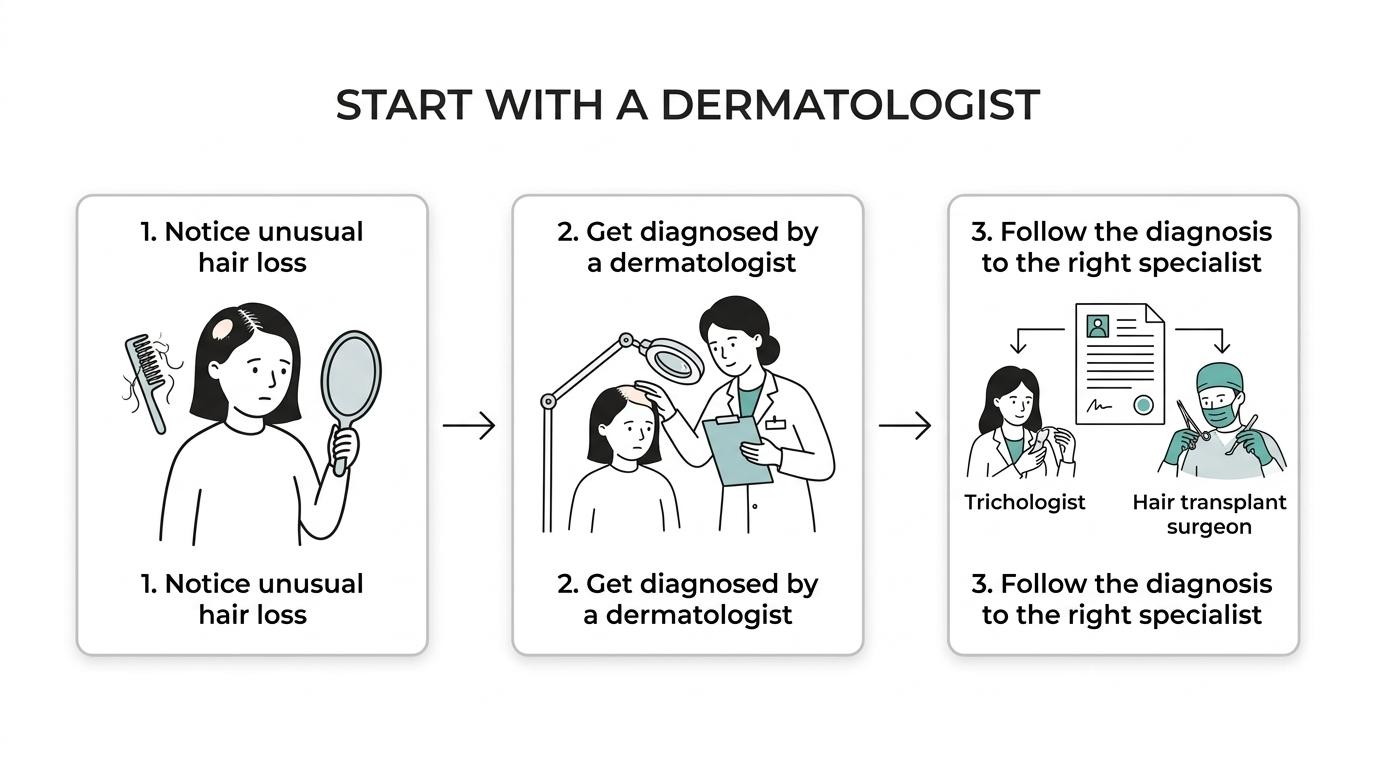
For most people, the best doctor to see for hair loss is a dermatologist, especially when the problem is unexplained, sudden, patchy, or persistent. A trichologist may still be helpful in some cases, but a medical diagnosis matters before anyone starts a hair loss treatment plan, PRP, GFC therapy, or a hair transplant consultation.
Which doctor is best for hair loss diagnosis?
A dermatologist is the medical specialist most directly connected to hair loss diagnosis and treatment. The scalp is skin, the hair follicle is a skin structure, and many hair loss conditions need a proper medical workup before treatment begins. According to the American Academy of Dermatology, seeing a board-certified dermatologist helps improve the chance of getting an accurate diagnosis. That matters because not all hair fall is male pattern baldness or female pattern hair loss.
Some people first search for the best clinic for hair transplant, the best place for hair transplant in India, or even celebrity and Bollywood hair transplant results. Those searches make sense when hereditary baldness is already obvious. Still, when the cause is unclear, medical assessment should come first. The NHS also advises finding out what is causing hair loss before thinking about going to a commercial hair clinic.
A dermatologist can diagnose common and uncommon problems, including androgenetic alopecia, telogen effluvium, alopecia areata, traction alopecia, scalp psoriasis, dandruff-related irritation, fungal infection, and scarring disorders like frontal fibrosing alopecia. That range is exactly why the first stop matters.
Hair loss doctor vs trichologist: key differences
A trichologist focuses on hair and scalp concerns, but a trichologist is not the same as a medical doctor. In practical terms, that means a trichologist may assess the scalp, discuss shedding patterns, and suggest supportive care, while a dermatologist can diagnose disease, order tests, prescribe medication, and decide whether biopsy or further medical workup is needed.
That difference becomes very important when a person has sudden hair loss, bald patches, a burning or itchy scalp, or hair loss in clumps. Those cases should not be treated like a routine grooming issue.
| Specialist | Main role | Can prescribe medication? | Best time to see them |
|---|---|---|---|
| Dermatologist | Diagnoses hair and scalp disease, orders tests, prescribes treatment | Yes | First choice for unexplained, sudden, patchy, or ongoing hair loss |
| Trichologist | Assesses hair and scalp concerns, gives non-prescribing support | Usually no | Helpful for supportive scalp care after diagnosis or for non-medical guidance |
| Hair transplant surgeon | Assesses surgical restoration for stable baldness | Yes, if medically qualified | Best after diagnosis confirms transplant-suitable pattern hair loss |
A simple rule works well here: if the issue may need medical treatment, a dermatologist should be involved early. If the issue is already diagnosed and the person wants extra hair and scalp guidance, a trichologist can add value.
When to see a dermatologist right away for hair loss
Some warning signs should push the decision toward a doctor, not a cosmetic clinic. This is especially true in India, where many people compare hair transplant cost, PRP cost, and before-and-after photos before they have even confirmed the cause of their shedding.
A dermatologist is the safer first step when the pattern does not look like slow, familiar hereditary thinning.
- Sudden hair loss: noticeable shedding over days or weeks
- Bald patches: round or uneven areas on the scalp or beard
- Hair falling out in clumps: more than routine shedding during washing or combing
- Burning or itchy scalp: irritation, pain, scaling, or redness
- Persistent thinning: ongoing loss that does not settle
- Hairline change with inflammation: tenderness or redness near the frontal line
These signs may call for prescribed treatments, blood tests, scalp examination, or a biopsy. Starting supplements, oils, or a transplant plan without that step can waste time and, in some cases, make results worse.
Where a trichologist can still be useful
A trichologist still has a place in hair care, especially when the issue is not urgent and a medical diagnosis is already established. Some people want close monitoring of shedding patterns, advice on scalp hygiene, or practical guidance on how to care for fragile hair after treatment. That support can be useful.
A trichologist may also help people who are confused by breakage versus true follicle loss. Hair shaft damage from heat, chemical processing, tight hairstyles, or rough grooming can look like hair loss from a distance. In these situations, scalp imaging and practical hair care advice may help.
Still, when medicated treatment is needed, referral back to a doctor is the proper path. That is the key line between trichology support and medical care.
When a hair transplant surgeon becomes the right specialist
Once a dermatologist confirms stable pattern baldness, the next best specialist may be a hair transplant surgeon. This is where many commercial searches begin: best hair transplant clinic, best doctor for hair transplant in Pune, hair transplant in Hyderabad, Bangalore hair transplant cost, or hair transplant in India for NRIs.
Hair transplant surgery is most useful for people with established androgenetic alopecia, a healthy donor area, and realistic expectations. It is not the first answer for every person losing hair. Active diffuse shedding, untreated scalp disease, severe nutritional deficiency, and unstable alopecia need control before surgery is planned.
Modern transplant techniques offer different approaches:
- FUE
- DHI
- FUT
- Sapphire FUE
- Bio FUE
- Hybrid hair transplant methods
- No shave hair transplant
Each has a role. FUE is popular because it avoids a linear strip scar and suits many men seeking shorter recovery. FUT may still make sense in selected higher graft count cases. DHI may be chosen when precise implantation and hairline work are priorities. Sapphire and hybrid methods are often discussed in clinics focused on dense packing and refined recipient site creation. No shave hair transplant appeals to professionals who want a more discreet recovery.
A good surgeon does not push a technique as a universal winner. The right method depends on donor quality, baldness grade, curl, caliber, scalp laxity, styling preference, and long-term loss pattern.
How hair transplant eligibility, permanence, and success rate are assessed
Hair transplant permanence is one of the biggest reasons people move from general hair loss treatment to surgery. Transplanted follicles from the donor zone are often more resistant to pattern baldness, which is why results can be long lasting. Still, “permanent” does not mean unchanged forever. Native surrounding hair may continue to thin, and that is why long-term planning matters.
Effectiveness and success rate depend on much more than the clinic’s marketing. A transplant can look excellent in one case and average in another because the inputs are different.
The main factors doctors assess include:
- Diagnosis: stable pattern hair loss responds better than untreated inflammatory disease
- Donor area: density, hair thickness, and scalp quality set the real limit
- Graft counts: 1500 grafts, 3000 grafts, or higher numbers are chosen by need, not by package
- Age and future loss: younger patients need a conservative plan
- Hairline design: natural placement matters as much as density
- Safety: medical history, smoking, diabetes control, and scalp condition affect planning
A careful assessment often includes scalp examination, donor mapping, miniaturization review, and discussion of expected coverage. In advanced baldness cases, full density across the whole scalp may not be realistic in one sitting. Honest planning is a sign of quality, not a limitation.
Hair transplant safety and recovery timelines
Hair transplant safety is another major concern, and rightly so. A properly selected patient treated in an appropriate medical setting generally does well, but safety depends on diagnosis, sterile technique, surgical planning, anesthesia protocols, and follow-up.
Recovery timelines are often easier than people expect, though they still require patience. Redness, tiny crusts, mild swelling, and temporary shedding of transplanted hairs are normal stages for many patients. Visible growth usually takes time. Early signs may appear after a few months, while fuller cosmetic change comes later.
Typical milestones are often discussed like this:
- First week: scabs, washing protocol, rest, and protection of grafts
- Two to four weeks: shock loss may occur
- Three to four months: early growth may begin
- Six to nine months: stronger visible improvement
- Nine to twelve months: better maturity in many scalp cases
- Up to fifteen months: crown areas can take longer
People comparing hair transplant before and after photos should always ask when the “after” image was taken. A six-month result and a twelve-month result are not the same thing.
Questions to ask when comparing hair loss clinics in India
India is a major destination for hair restoration, so searches like best country for hair transplant, best place for hair transplant in India, and hair transplant cost in Pune, Hyderabad, or Bangalore are common. Cost matters, but diagnosis quality and medical judgment matter first.
A strong clinic should be comfortable discussing whether surgery is even the right choice. That alone separates patient-focused care from sales-first care.
- Who gives the diagnosis: dermatologist, transplant surgeon, or only a counselor
- What is the exact cause of hair loss: pattern baldness, telogen effluvium, alopecia areata, scarring loss, or mixed causes
- Which treatment is best now: medication, PRP, GFC, transplant, or staged treatment
- How many grafts are needed: based on donor capacity and coverage goals
- What technique is advised: FUE, DHI, FUT, Bio FUE, Sapphire, or hybrid
- What is the recovery timeline: work return, exercise break, haircut timing, and shedding phase
- What is the full hair transplant cost: surgery, medication, follow-up, add-on sessions, and taxes if any
This matters in every city. A person comparing the best hair transplant clinic in Pune, hair transplant in Hyderabad, Bangalore, or elsewhere in India should judge the medical process, not just the online rating or celebrity-style ad campaign. Bollywood hair transplant interest has made results more visible, but celebrity curiosity should not replace proper case assessment.
What happens after the first consultation
The first consultation should leave the patient with a clear category, not just a price quote. Is the problem medical hair loss, pattern baldness, temporary shedding, scarring alopecia, poor hair shaft quality, or a transplantable but not yet urgent case? That answer guides everything else.
If the cause is medical, treatment may include prescribed treatments, blood work, topical or oral medication, anti-inflammatory care, or close review over time. If the cause is classic hereditary loss and the donor area is strong, then a transplant plan can be discussed with more confidence.
That plan should cover the likely number of grafts, expected density, safety points, whether a no shave hair transplant is possible, and whether medical therapy is still needed to protect existing hair. Cost should enter the discussion after the diagnosis is clear, because the right treatment is not always the cheapest or the most aggressive.
A person asking “what is the best doctor to see for hair loss?” usually needs the simplest answer first: start with a dermatologist when the cause is not certain, and move to a qualified hair transplant surgeon when stable pattern hair loss makes surgery a sensible next step. A trichologist can still be helpful, but medical diagnosis should lead the plan.