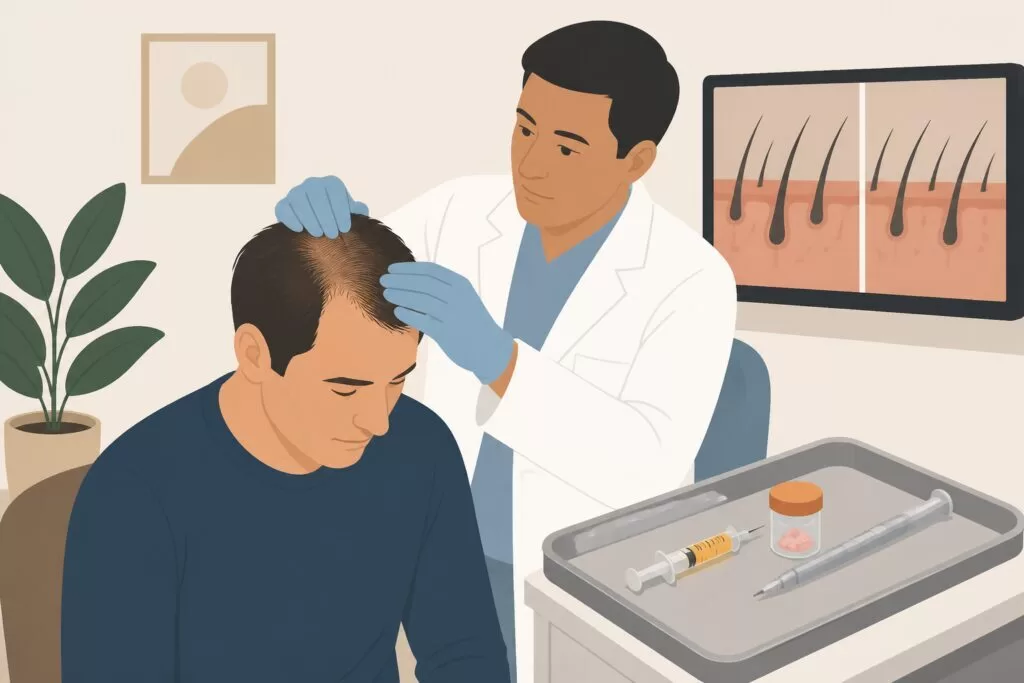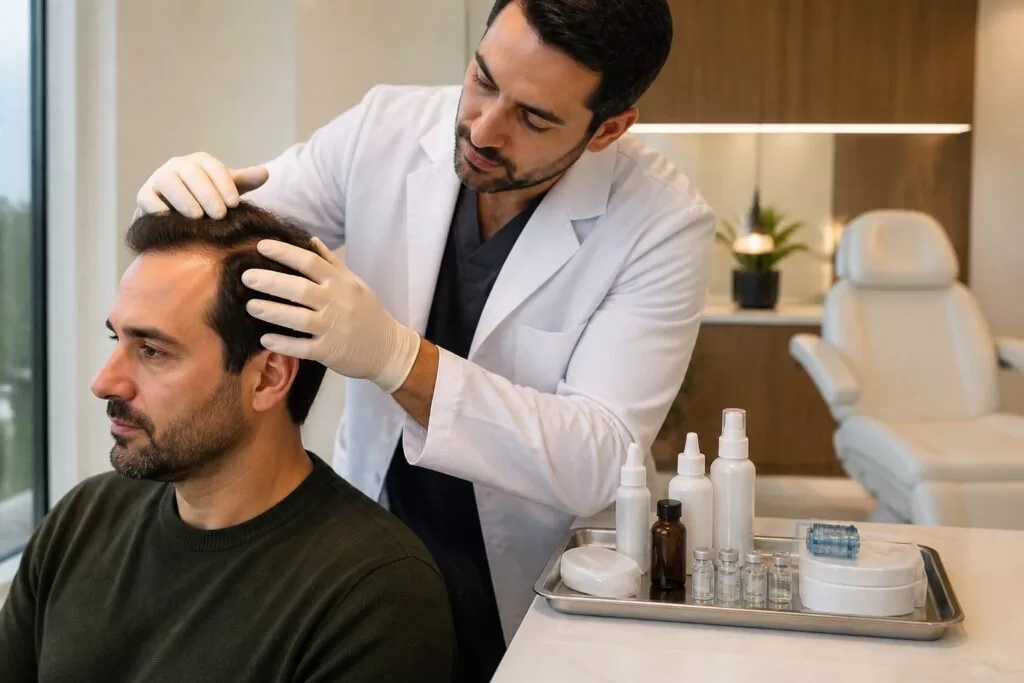
Hair that is thinning, but not gone, does not always need surgery. In-clinic low-level laser therapy (LLLT) and platelet-rich plasma (PRP) act on follicles that are still alive. They will not rebuild a slick front. At iGraft Global Hair Services, that decision starts with a computerised scalp check, follicular imaging, and an AI report.
You can do this in Pune, Bangalore, Hyderabad, or Vijayawada. The doctor maps which roots still work, then chooses stimulation, medicine, or grafts. Early pattern loss and much female thinning often stay non-surgical. A wait without a scan is how a recoverable shed becomes a bald zone.
How in-clinic LLLT works
LLLT, or low-level light therapy, uses low-power red and near-infrared light in short clinic sessions. It is not a drug. Reviews describe no systemic side effects when it is used as directed.
Randomized trials have shown that LLLT can stimulate hair growth in men and women with androgenetic alopecia (ncbi.nlm.nih.gov). Reported effects include more dermal papilla activity, longer cell viability, and better blood supply around the follicle. One review also noted thicker hair diameter after a year of combination care than with minoxidil alone (pmc.ncbi.nlm.nih.gov).
That is the case for multi-modal scalp stimulation. It is not a promise of a full head of hair. At iGraft, LLLT sits with high-frequency treatment in a planned course. Most people return to work the same day. If density changes, it usually takes months, not a weekend.
PRP, GFC, and what to expect
PRP uses a small blood draw. The platelet-rich portion goes back into thinning skin. Growth factors may support miniaturising follicles. Trials and observational studies describe density gains when the method stays consistent, though clinics still prepare PRP differently (apcz.umk.pl).
No strong head-to-head trial proves PRP beats LLLT. Both have evidence limits, and neither replaces first-line medicine for every patient. Cost, convenience, and the scan decide the mix (my-hair.uk). Drugs and non-drug care both have a role (pmc.ncbi.nlm.nih.gov). Non-surgical options have improved, but a weak protocol still wastes months (doi.org).
A PRP session in India often costs ₹4,500 to ₹15,000, and only if follicles are alive. Read the PRP timeline facts and the PRP regrowth page before you book a course.
GFC is a growth factor concentrate from a similar draw, processed for a cleaner dose. iGraft uses GFC Class 2 with high-frequency treatment and low-level laser, and may add exosomes, a booster, or BioCell while hairs are still shrinking. Those are scan-based choices. Session detail is in the GFC guide. Support formulae on the product page, such as biotin gummies, minoxidil, serum, and shampoo with conditioner, do not replace the checkup.
After PRP, expect redness or a mild headache for a day or two. Infection and bruising are uncommon if technique is clean. Mention blood disorders, scalp infection, pregnancy, or blood thinners. LLLT is paused for photosensitivity or an untreated scalp lesion. Extra shedding can appear early. Judge results over three to six months.
When surgery is the better next step
Which is the best treatment for hair fall depends on living roots. Stimulation first. Surgery when skin is bare and the donor can cover a realistic design.
Does hair transplant work? Often yes, with a stable donor. Moved follicles keep that habit, so the goal is lasting cover, not a cure for nearby hair. Is FUE hair transplant safe and worth it? Yes for a bare zone PRP cannot refill. Skip it during an active shed. The myths page corrects the usual claims.
Which hair transplant technique is best depends on donor density, hair thickness, and the bald zone. FUE takes units one by one. FUT is the strip method and leaves a linear scar. DHI is direct implantation. Is DHI hair transplant permanent? The follicle decides that, not the pen. A hybrid plan puts grafts on bare skin and PRP or GFC where hair is only thinning. Gen3 DFI Ultimate is the direct-placement option, including selected no-shave cases. ActiveFUE is used for men and women. See DFI, FUE, and male transplant notes.
A graft is a small bundle, often one to four hairs. How many grafts are needed comes from area and calibre. A receding hairline can often be rebuilt if future loss is designed in. A fully bald scalp is treatable only within donor limits. Selected no-shave cases exist, but standard FUE trims the donor. Surgery is usually one day, with 7 to 10 days before close meetings, and growth is judged at 9 to 12 months. Local anaesthesia covers the work. Expect pressure, then soreness. The 29-year DFI assurance is a clinic commitment, not a density guarantee.
Hair transplant cost in India
What is the cost of FUE hair transplant, and how much does hair transplant surgery cost in India? ActiveFUE is ₹45 per graft. Gen3 DFI Ultimate is ₹50 per follicle, plus taxes, in Pune, Bangalore, Hyderabad, and Vijayawada.
| Plan | Unit price | 2,000 units before tax | 3,000 units before tax |
|---|---|---|---|
| ActiveFUE | ₹45 per graft | ₹90,000 | ₹135,000 |
| Gen3 DFI Ultimate | ₹50 per follicle | ₹100,000 | ₹150,000 |
The cost of 3000 grafts on ActiveFUE is ₹135,000 before tax. DFI at 3,000 follicles is ₹150,000 before tax. A difficult donor, beard work, or added GFC changes the total. Other Indian FUE quotes often run ₹35 to ₹80 per graft, so check unit pricing before you compare a flat fee. City notes: Pune, Bangalore, Vijayawada, India.
How much a hair transplant costs in Pune, Bangalore, or Hyderabad follows that rate. About 30 percent of patients come from the USA, UK, Australia, and the UAE. Which country is best for hair transplant matters less than follow-up you can reach. Which is the best hair transplant clinic in Pune or Hyderabad depends on who scans you and who is there at month six. These company-owned centres have run for more than 15 years. You leave with a unit quote and six months of support. Skip rumors about where celebrities get hair transplants.
FAQ
Does hair transplant really work for women and men?
Yes for suitable donors. Is hair transplant permanent and safe? Moved hairs are meant to stay, but it is not 100 percent successful, and untreated hair can still thin. Women with diffuse thinning often start with PRP, GFC, and LLLT, because early surgery can waste donor hair. Diabetes is not an automatic no, but healing and sugar control need clearance first.
When should I go for a hair transplant?
When the pattern is clear and shedding has stopped. Rapid weight loss, including GLP-1 treatment, can mimic pattern baldness, and surgery will not fix an active shed. The GLP-1 program is in-person only and never sold online. Many people at 18 or 20 do better on medical care until the hairline slows.
What is the success rate, and is it painful?
Careful FUE has high graft survival. Nobody honest quotes 100 percent. Local anaesthesia covers the procedure. You feel pressure, then soreness for a few days.
After hair transplant, how many GFC sessions are required?
No fixed number. Some patients do a short GFC or PRP course after grafts settle. The doctor sets that from the scan. Beard and scalp grafts can be planned together, not always the same day.
Book a scan before a package
If roots still work, LLLT and PRP can be the right first step. If the front is bare, ask for a graft count. Take the two-minute quiz, then book through hair contact. See the plan, risks, and price first. Surgery notes are on the hair transplant page.