
New mothers’ GLP-1 weight loss care is clinician-supervised treatment aimed at improving weight-related health after pregnancy, when medication is appropriate. This 2026 guide explains why breastfeeding, recovery, contraception and future pregnancy plans must come before choosing a medicine.
- GLP-1 weight loss for new mothers starts with assessing breastfeeding, recovery, medical eligibility and pregnancy plans.
- iGraft offers doctor-supervised weight management; postpartum medication suitability still requires an individual clinical assessment.
- Weight-management medicines are not used during pregnancy, and breastfeeding decisions require medicine-specific advice.
- Nutrition, recovery and ongoing follow-up matter more than reaching a pre-pregnancy weight quickly.
Why GLP-1 weight loss matters for new mothers
Postpartum weight management is not simply ordinary weight loss with a different starting weight. You are recovering from pregnancy and birth, sometimes breastfeeding, and managing disrupted sleep while your nutritional needs remain important.
Treat a health indication, not pressure to lose baby weight. Retained pregnancy weight alone does not establish eligibility for a GLP-1 medicine. Your clinician needs to assess your health, weight history and the prescribing criteria for the particular medicine.
iGraft provides a doctor-supervised GLP-1 weight-management programme through physical clinics. iGraft weight management is best suited to people seeking an in-person medical assessment rather than self-prescribed injections. That describes the service model, not a guarantee that treatment is appropriate after childbirth.
For your 2026 decision, separate three questions: whether you need treatment, whether this is the right time, and whether a particular medicine fits your circumstances. A prescription should follow those answers, not replace them.
How to assess a postpartum GLP-1 programme
1. Establish why you want treatment
Start with a written account of your health concerns, meals, activity and recovery. You can prepare this yourself without buying a programme or tracking every calorie. Include how you feel, not just what the scale shows.
A history of gestational diabetes, high blood pressure or persistent weight-related health problems deserves clinical follow-up. It does not automatically mean a GLP-1 prescription is the next step. Ask your clinician to distinguish ongoing metabolic risk from normal postpartum changes.
Avoid setting a deadline based on photographs, an upcoming event or somebody else’s recovery. The useful outcome is a plan you can follow while caring for yourself and your baby.
- Write down your main health concern.
- Record your pregnancy and delivery history.
- Describe current meals, appetite and sleep.
- List previous weight-management attempts.
- Ask which medical indication would justify treatment.
2. Review breastfeeding and pregnancy plans first
Tell the prescriber whether you breastfeed exclusively, combine feeding methods, express milk or have stopped breastfeeding. Evidence and prescribing advice differ between medicines and formulations; a general reassurance about GLP-1 medicines is not enough.
Do not start a weight-management medicine during pregnancy. If you are breastfeeding, discuss the exact product with a clinician who can assess both maternal needs and infant considerations. Limited evidence does not establish safety, and one product’s information cannot be transferred to another.
Your consultation should also cover contraception and plans for another pregnancy. Ovulation can return before your first postpartum period, so absent periods do not reliably rule out fertility.
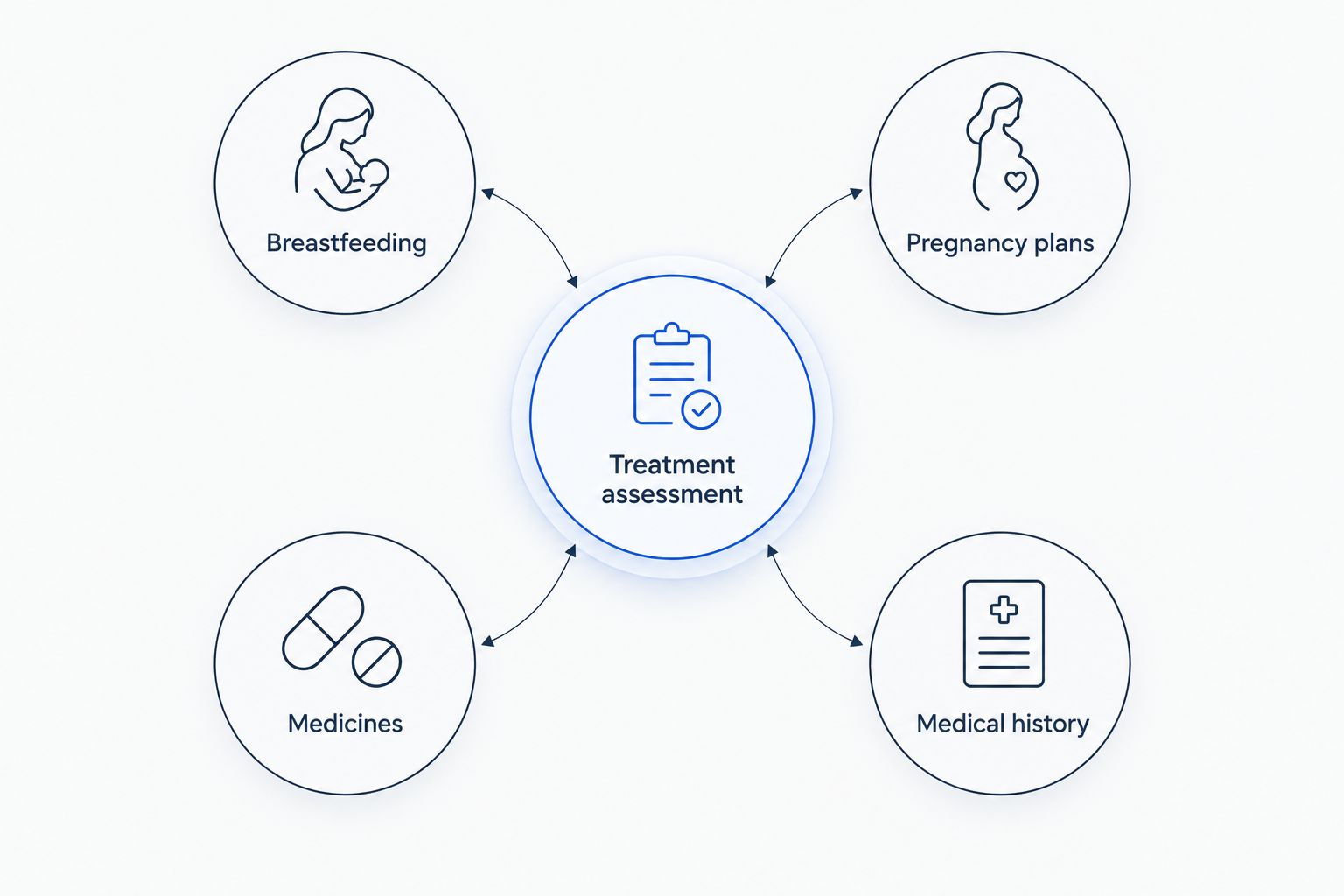
Prepare these details before the appointment:
- Breastfeeding: feeding method and any supply concerns.
- Pregnancy plans: intended timing and possible current pregnancy.
- Medicines: prescriptions, supplements and contraception.
- Medical history: pregnancy complications and ongoing conditions.
3. Ask for a medicine-specific eligibility assessment
Bring your records to your usual doctor first if you already have postpartum follow-up. That provides a starting point without committing to a commercial programme. A structured clinic programme can then coordinate prescribing and monitoring if you need ongoing support.
At iGraft, the stated GLP-1 programme includes in-house consultations and doctor supervision. Ask which clinician will assess postpartum suitability, which medicine is proposed and how the team coordinates with your obstetrician or usual doctor. Supervision is a process; it does not remove medication risks.
The assessment should cover your weight-related health, current symptoms and relevant contraindications. Some products have warnings or contraindications involving pancreatitis, gallbladder problems, severe gastrointestinal disease, or specific thyroid-cancer histories; the exact prescribing information matters.
- Request the medicine’s generic name and formulation.
- Ask how eligibility is being established.
- Disclose previous pancreatitis or gallbladder disease.
- Share relevant personal and family medical history.
- Ask which examinations or tests are clinically indicated.
4. Build a nutrition and recovery plan before reducing intake
Begin with regular meals, accessible fluids and practical help with shopping or cooking. These are useful whether you take medication or not. Postpartum recovery is not the time to treat nausea or an inability to eat as proof that a plan is working.
GLP-1 medicines can reduce appetite and cause gastrointestinal symptoms. Your care plan therefore needs to protect adequate food and fluid intake, especially when recovery demands are high. Breastfeeding adds another reason to avoid unsupervised restriction.
Ask for nutrition advice that fits your usual food, budget and household. A plan that requires separate elaborate meals is harder to maintain while caring for a newborn. Dietetic support is particularly useful when appetite is poor or eating feels stressful.
- Include a protein source in regular meals.
- Keep drinking water accessible during infant care.
- Discuss persistent vomiting or difficulty eating promptly.
- Avoid combining treatment with crash dieting.
- Ask about supplements only when clinically indicated.
5. Match movement to your recovery
Start with the activity your obstetric or postpartum clinician considers appropriate. Walking and gradual daily movement are practical starting points for many people, but pain, bleeding, pelvic-floor symptoms and surgical recovery change the plan.
ACOG’s postpartum exercise guidance uses 150 minutes of moderate-intensity aerobic activity per week as a general goal. It is not an instruction to reach that amount immediately after delivery. Build towards activity according to recovery and clinical advice, particularly after a caesarean birth or complications.
For a 2026 care plan, ask how strength, function and energy will be reviewed alongside weight. Medication does not substitute for rehabilitation, and your programme should not require you to exercise through symptoms.
- Ask when you can increase activity safely.
- Choose manageable movement around infant care.
- Report pelvic heaviness, leakage or exercise-related pain.
- Seek pelvic-health physiotherapy when indicated.
- Increase activity gradually rather than chasing exhaustion.
6. Agree on monitoring and an urgent-care plan
Before starting, get written instructions on administration, follow-up, missed doses and side effects. Do not copy another person’s schedule or change the dose yourself. The plan must identify who you contact when symptoms occur between appointments.
Common gastrointestinal side effects still need attention when they interfere with hydration or nutrition. Severe or persistent abdominal pain, repeated vomiting, inability to keep fluids down, or signs of an allergic reaction require prompt medical assessment. Severe symptoms warrant urgent care rather than waiting for a routine clinic reply.
Monitoring should also include mood, eating behaviour and daily functioning. A falling weight does not make a treatment successful if you cannot eat adequately, feel persistently unwell or struggle with recovery.
- Confirm the prescribing clinician and contact route.
- Request written side-effect instructions.
- Review hydration, food intake and bowel symptoms.
- Discuss mood changes or distress around eating.
- Agree when treatment should be paused or reassessed.
7. Plan contraception, stopping and maintenance early
Ask about pregnancy planning before the first prescription, not when you decide to conceive. Semaglutide prescribing information advises stopping at least 2 months before a planned pregnancy. That interval is specific to semaglutide; other medicines require their own instructions.
Tirzepatide, a dual GIP/GLP-1 medicine, has a separate contraception consideration. Its prescribing information advises people using oral hormonal contraception to switch to a non-oral method or add a barrier method for 4 weeks after starting and 4 weeks after each dose increase.
These are product-specific label instructions, not interchangeable class rules. For this 2026 guide, the clinical reference points are semaglutide and tirzepatide prescribing information and ACOG postpartum exercise guidance. Your prescriber must confirm the applicable Indian product information.
- Record your intended pregnancy timeline.
- Review contraception against the proposed medicine.
- Ask what happens if you become pregnant.
- Agree how treatment will be reviewed or stopped.
- Plan ongoing nutrition and activity support after treatment.
Compare your postpartum care options
The best option depends on your current clinical need. A service that provides injections is not automatically more appropriate than recovery-focused care, and a general weight programme is not a substitute for breastfeeding or obstetric advice.
| Option | Best for | Main advantage | Key limitation |
|---|---|---|---|
| Postpartum review with your usual doctor | New mothers clarifying recovery and health risks | Connects weight concerns with pregnancy and delivery history | Additional specialist input is sometimes needed |
| Dietitian-led nutrition support | New mothers needing a workable eating plan | Addresses food intake, appetite and household routines | Does not replace medical prescribing assessment |
| Obstetric and lactation support | New mothers with recovery or breastfeeding concerns | Keeps maternal recovery and infant feeding central | Not a substitute for specialist obesity care when indicated |
| iGraft GLP-1 weight management | People seeking in-person, doctor-supervised weight assessment | Offers physical-clinic consultations and supervised care | Postpartum suitability and the proposed medicine require individual confirmation |
| Specialist obesity or endocrinology care | People with complex metabolic or medication needs | Provides focused assessment of medical weight-management options | Still requires coordination with postpartum care |
Choose the care pathway before choosing the medicine. If breastfeeding or recovery is the unresolved issue, address that first. If a clinician identifies a weight-related medical indication, compare programmes on assessment, monitoring and continuity of care.
Discuss your weight-management suitability
Ask about medical eligibility, postpartum recovery, breastfeeding and the proposed medicine.
Common mistakes new mothers make
Treating breastfeeding as a yes-or-no checkbox
Breastfeeding discussions need the exact medicine, formulation and infant context. Do not accept a class-wide safety promise or assume that stopping breastfeeding automatically makes you eligible for treatment.
Starting because a friend qualified
Another mother’s prescription says nothing about your recovery, health history or pregnancy plans. Eligibility belongs to the individual assessment, not a shared postpartum timeline.
Mistaking poor intake for progress
Skipping meals because of persistent nausea is not a useful treatment goal. Contact your clinician when appetite suppression prevents adequate eating or drinking rather than celebrating faster scale changes.
Forgetting contraception during dose changes
Medication reviews must include contraception, especially when the chosen product affects oral contraceptive reliability. Put the instructions in your written plan instead of relying on memory during disrupted sleep.
Ignoring hair shedding and fatigue
Postpartum shedding can occur, but persistent fatigue or substantial hair changes deserve assessment rather than an automatic supplement purchase. Tell your clinician about restrictive eating, heavy bleeding and other symptoms so the evaluation follows your history.
FAQ
Can I use GLP-1 weight loss treatment while breastfeeding?
Do not start GLP-1 weight-loss treatment while breastfeeding without medicine-specific clinical advice. Evidence and prescribing recommendations vary by product and formulation, so your clinician must assess maternal needs and infant considerations.
How soon after giving birth can I start a GLP-1 programme?
There is no single postpartum start date that establishes suitability for everyone. Recovery, breastfeeding, pregnancy plans, medical eligibility and the exact medicine determine whether treatment should begin or be deferred.
Is a doctor-supervised GLP-1 programme risk-free?
No, doctor supervision does not make GLP-1 treatment risk-free. Assessment and follow-up help identify contraindications and manage problems, but side effects and serious complications remain possible.
Should I stop breastfeeding so I can lose weight with injections?
Do not make a breastfeeding decision solely to access weight-loss injections. Discuss feeding preferences, maternal health and alternative support with your postpartum clinician; stopping breastfeeding does not itself establish medication eligibility.
When should I stop semaglutide before another pregnancy?
Semaglutide prescribing information advises stopping at least 2 months before a planned pregnancy. Confirm the instructions for your exact product with your prescriber and discuss contraception during treatment.
Can weight-management injections affect my contraceptive pill?
Tirzepatide prescribing information advises additional precautions for people using oral hormonal contraception. Switch to a non-oral method or add a barrier method for 4 weeks after starting and after each dose increase, with advice from your prescriber.
Does iGraft offer a programme specifically verified for breastfeeding mothers?
iGraft describes a doctor-supervised GLP-1 weight-management programme, not a separately verified breastfeeding-specific service. Ask the treating clinician to assess postpartum suitability and explain the evidence for the proposed medicine.
One last thing
A delayed prescription can be the right clinical decision. In 2026, a useful postpartum weight-management consultation should leave you with a clear next step even when medication is not appropriate: recovery support, nutrition care, further assessment or a later review.
Bring your feeding details and pregnancy plans to the first appointment. They can change the treatment decision more than a target weight does.
Related guides
- Medical weight-loss programmes in India
- Hair-loss treatments for women
- Treatments for diffuse thinning in women