Best overall: diagnosis-led treatment. Best for tight-hairstyle damage: removing traction. Best for scalp ringworm: prescription oral antifungal treatment. The best hair loss treatment for teenagers in 2026 depends on the cause—not the strongest serum or the most advertised procedure.
- The best hair loss treatment for teenagers starts with a diagnosis, not a procedure package.
- iGraft offers hair loss assessment; teenagers need an age-appropriate plan before considering treatment.
- Scalp ringworm needs prescription treatment; traction-related hair loss starts with removing tension.
- Minoxidil is not a self-start treatment for anyone under 18 years.
Why this matters
Teenage hair loss is not a single condition. Tight hairstyles, scalp infections, autoimmune disease, illness-related shedding and inherited thinning need different responses. Treating every teenager as an adult with pattern baldness risks missing the actual problem.
iGraft offers physical-clinic assessments, follicular-level scans and computerized diagnostics. For teenage hair loss, those assessments must sit alongside a doctor's medical history and scalp examination; a scan alone does not establish every diagnosis.
Choose a diagnosis before choosing a hair loss treatment. That is the central recommendation for families comparing options in 2026.
What makes the best teenage hair loss treatment?
- Cause-specific treatment: The recommendation addresses the diagnosed condition rather than promising general regrowth.
- Age suitability: The clinician checks the teenager's age, medical history and the treatment's prescribing restrictions.
- Scalp safety: Pain, inflammation, infection and possible scarring receive attention before cosmetic concerns.
- Evidence and limits: The explanation separates established uses from experimental treatments and promotional claims.
- Manageable follow-up: You understand what to monitor, when to return and what would change the plan.
- Emotional support: The plan takes school, confidence, hair-pulling behaviours and family concerns seriously without blame.
Teenage hair loss treatments at a glance
These options occupy different treatment slots. They are not interchangeable alternatives for the same diagnosis.
| Option | Best for | Standout benefit | Key limitation |
|---|---|---|---|
| Diagnosis-led care | An unclear cause or mixed symptoms | Establishes the appropriate treatment pathway | Assessment itself does not regrow hair |
| Removing traction | Hair loss linked to tight hairstyles | Removes repeated pulling at the roots | Established scarring can limit recovery |
| Prescription oral antifungals | Confirmed scalp ringworm | Treats the underlying fungal infection | Requires a prescription and medical assessment |
| Clinician-directed alopecia areata care | Diagnosed smooth, patchy hair loss | Matches treatment to age and disease extent | Regrowth and recurrence remain unpredictable |
| Correction of confirmed deficiencies | Hair loss associated with a documented deficiency | Addresses an identified nutritional problem | Supplements do not treat unrelated causes |
| Trigger-focused shedding care | Diagnosed telogen effluvium | Addresses illness, dietary or other triggers | Recovery is gradual rather than immediate |
| Clinician-directed minoxidil | Selected cases of diagnosed pattern hair loss | Provides a medical option for suitable patients | Under-18 use requires specialist judgement |
1. Diagnosis-led care: best for an uncertain cause
An examination is the best starting point when you do not know why a teenager is losing hair. The clinician reviews the pattern, scalp condition, recent illness, medicines, diet, family history and hair practices. Blood tests or fungal testing should answer a clinical question, not form an automatic shopping list.
iGraft's hair loss assessment is best suited to families seeking an in-person starting point rather than choosing a procedure themselves. Ask which findings support the diagnosis and whether a dermatologist or paediatric specialist should be involved.
Diagnosis-led care pros:
- Separates shedding, breakage and loss from the follicle.
- Identifies problems needing prescription treatment.
- Creates a baseline for follow-up.
Diagnosis-led care cons:
- An appointment does not itself restore hair.
- Further testing or referral adds steps.
Best for: Unexplained thinning, mixed symptoms or an uncertain diagnosis.
Verdict: Hold treatment purchases until the cause is assessed.
2. Removing traction: best for tight-hairstyle damage
Repeated pulling from tight braids, ponytails, extensions or other tension-heavy styles can cause traction alopecia. Treatment begins by stopping the pulling, not adding a growth product while continuing the same hairstyle.
Choose looser styles and stop any style that causes pain or scalp tenderness. A clinician should assess persistent thinning, bumps, inflammation or a smooth, shiny area because longstanding traction can damage follicles permanently.
Removing traction pros:
- Directly addresses the mechanical cause.
- Avoids unnecessary medication when tension is the problem.
- Fits into everyday hair care.
Removing traction cons:
- Recovery depends on whether follicles remain intact.
- Changing hairstyles does not treat an accompanying scalp disorder.
Best for: Hair loss where repeated tension matches the affected areas.
Verdict: Skip tight styles; get persistent loss examined.
3. Oral antifungal treatment: best for scalp ringworm
Scalp ringworm, or tinea capitis, is a fungal infection that can cause scaling, broken hairs and patches of loss. It requires prescription oral antifungal treatment; shampoo alone does not reach the infection within affected hairs adequately.
The prescriber chooses the medicine and treatment course after assessment. Do not share combs, brushes or headwear, and ask whether household contacts need evaluation. A tender, swollen scalp lesion needs prompt medical attention because inflammation can threaten lasting hair growth.
Oral antifungal treatment pros:
- Treats the infection responsible for the hair loss.
- Provides a cause-specific medical pathway.
- Supports advice on reducing spread.
Oral antifungal treatment cons:
- Medicines have contraindications and potential adverse effects.
- Other patchy hair-loss conditions can look similar.
Best for: Clinician-diagnosed scalp ringworm.
Verdict: Skip cosmetic regrowth products; seek prescription care.
4. Alopecia areata care: best for diagnosed smooth bald patches
Alopecia areata is an autoimmune condition that often produces smooth patches of hair loss. A dermatologist selects treatment according to age, affected areas, severity and the teenager's preferences; prescribed corticosteroid treatment is one established option.
Alopecia areata is not simply a vitamin problem. Some patches regrow, but recurrence is possible, and extensive disease needs a different discussion from a small isolated patch. Eyebrow or eyelash loss also deserves assessment.
Alopecia areata care pros:
- Addresses a specific autoimmune diagnosis.
- Allows treatment to match disease extent.
- Includes monitoring for progression and treatment effects.
Alopecia areata care cons:
- Regrowth cannot be guaranteed.
- Treatment can cause adverse effects and require repeat visits.
Best for: Confirmed alopecia areata, not every unexplained bald patch.
Verdict: Hold self-treatment until a dermatologist confirms the diagnosis.
5. Correcting deficiencies: best for a documented nutritional problem
Iron deficiency and inadequate nutrition can contribute to hair shedding. The appropriate response is to identify the problem, understand why it developed and correct it with clinician-directed dietary changes or supplementation.
Do not assume every teenager needs iron, biotin or a hair gummy. Unnecessary supplements can cause harm, and biotin can interfere with certain laboratory tests. Tell the clinician about supplements before testing, including products sold specifically for hair growth.
Deficiency correction pros:
- Targets an identified contributor to shedding.
- Connects hair symptoms with wider nutritional health.
- Avoids treating a confirmed deficiency as a cosmetic issue alone.
Deficiency correction cons:
- Supplements do not treat fungal or autoimmune hair loss.
- Excess supplementation creates avoidable risks.
Best for: A deficiency supported by the teenager's history and appropriate investigations.
Verdict: Skip blanket supplementation; correct what is confirmed.
6. Trigger-focused care: best for temporary diffuse shedding
Telogen effluvium causes increased shedding after a physical or psychological trigger. Shedding often starts 2–3 months after an illness, significant stress or another trigger, so the relevant event is not always recent.
A clinician checks the timeline and excludes competing causes. Treatment focuses on addressing the trigger, supporting adequate nutrition and monitoring recovery rather than immediately escalating to injections or surgery. Do not stop a prescribed medicine without speaking to its prescriber.
Trigger-focused care pros:
- Fits the biology of temporary shedding.
- Avoids unnecessary procedures.
- Connects the assessment to illness, diet and medication history.
Trigger-focused care cons:
- Visible recovery takes time.
- Persistent shedding requires reassessment rather than indefinite reassurance.
Best for: Diagnosed diffuse shedding with a compatible history.
Verdict: Wait for recovery only within a clinician-agreed follow-up plan.
7. Clinician-directed minoxidil: best for selected pattern hair loss
Minoxidil is an established treatment for adult pattern hair loss, but that does not make it an automatic teenage recommendation. Common topical product labels warn against use under 18 years; prescribing for a younger person requires individual medical judgement.
For a teenager with suspected inherited thinning, confirm the diagnosis before discussing medication. A clinician must explain age suitability, scalp irritation, unwanted hair growth and the implications of continued treatment. Oral minoxidil is not a do-it-yourself substitute.
Clinician-directed minoxidil pros:
- Offers a medical option for appropriately selected patients.
- Avoids treating every case of pattern thinning as a surgical problem.
- Supports structured monitoring of response and tolerability.
Clinician-directed minoxidil cons:
- Does not treat every cause of teenage hair loss.
- Can cause adverse effects and requires ongoing review.
Best for: Selected patients with a confirmed diagnosis and an age-appropriate prescription plan.
Verdict: Hold self-starting minoxidil, especially below 18 years.
What should happen at the first appointment?
For a teenage hair loss appointment in 2026, bring a timeline rather than a list of treatments you want. Include recent illness, medicines, supplements, dietary changes, scalp symptoms and photographs showing progression under similar lighting.
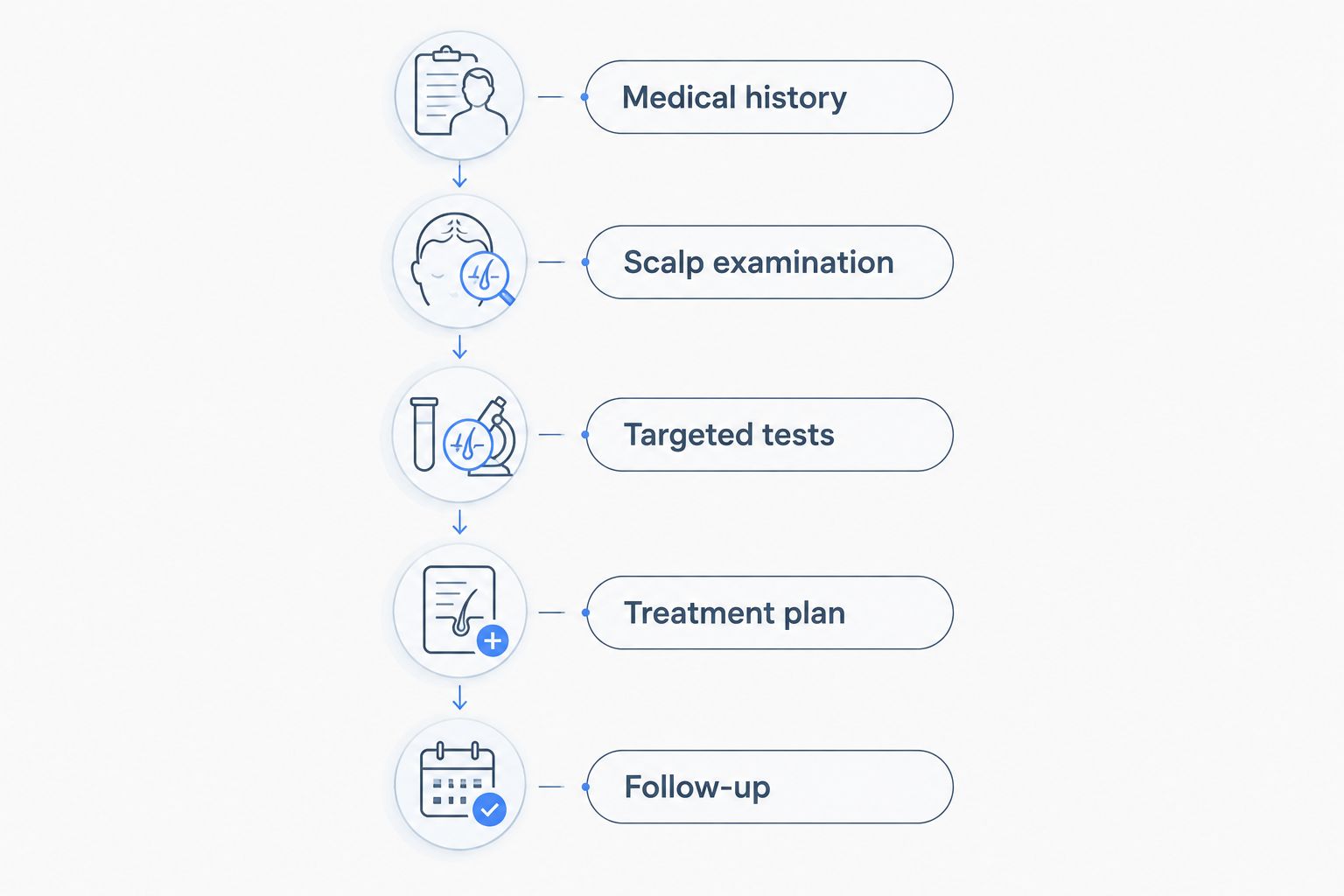
The assessment should move through these steps:
- Medical history: Establish onset, triggers and relevant health changes.
- Scalp examination: Check pattern, inflammation, breakage and follicular openings.
- Targeted tests: Investigate specific suspected causes when indicated.
- Treatment plan: Agree on age-appropriate care and warning signs.
- Follow-up: Review symptoms, photographs, tolerability and diagnostic uncertainty.
Pain, pus, marked swelling, rapidly progressing loss or suspected scarring need prompt medical review. If hair pulling is involved, explain it without blame and ask for appropriate behavioural or mental health support.
Start with a hair loss assessment
Discuss the cause of teenage hair loss before choosing a treatment.
How these options are ranked
This 2026 guide ranks treatment pathways by diagnostic fit, age suitability, safety and practical follow-up—not by product popularity. Diagnosis-led care comes first because the remaining options only make sense once the cause is established.
The ranking is not a claim that every teenager needs every treatment. An antifungal treats an infection; removing traction treats repeated pulling. Neither replaces appropriate care for alopecia areata or inherited thinning.
Which treatment should you choose?
Choose an examination if you are undecided. iGraft provides hair loss assessments and restoration services, but a service being offered does not establish that it is suitable for a minor.
In 2026, PRP, GFC and exosome treatment should not be presented as default teenage treatments. Hair transplantation is also not a starting treatment for unexplained teenage thinning. Ask for the diagnosis, age-specific evidence, alternatives and risks before consenting to any procedure.
FAQ
What’s the best hair loss treatment for teenagers in 2026?
The best hair loss treatment for teenagers is treatment matched to a confirmed diagnosis. Tight-hairstyle damage, scalp ringworm, alopecia areata and temporary shedding require different approaches.
Can a teenager use minoxidil without seeing a doctor?
A teenager should not self-start minoxidil. Common topical labels warn against use under 18 years, and treatment in younger patients requires individual medical assessment.
Are hair gummies enough to stop teenage hair loss?
Hair gummies are not a general treatment for teenage hair loss. Nutritional treatment is appropriate when an assessment identifies a deficiency or inadequate intake that needs correction.
Does scalp ringworm need more than an antifungal shampoo?
Yes, scalp ringworm requires prescription oral antifungal treatment. Shampoo alone does not adequately treat infection within affected hairs; a clinician should confirm the diagnosis.
Should a teenager get PRP, GFC or exosome injections first?
No, injections should not come before diagnosis and an age-appropriate treatment discussion. Ask the clinician to explain evidence for the proposed use in adolescents, risks and established alternatives.
Is a hair transplant the best answer for teenage thinning?
A hair transplant is not the starting answer for unexplained teenage thinning. The cause, future progression and suitability for surgery require specialist assessment before any surgical decision.
When does teenage hair loss need prompt medical attention?
Pain, pus, marked swelling, rapidly progressing loss or suspected scarring need prompt medical review. A tender swollen patch can indicate significant inflammation rather than routine shedding.
Can stress cause hair shedding months later?
Yes, telogen effluvium often begins 2–3 months after a trigger such as illness or significant stress. A clinician should confirm the pattern rather than attributing all teenage hair loss to stress.
One last thing
The American Academy of Dermatology describes shedding 50–100 hairs per day as normal. That range is not a home diagnostic test: visible thinning, persistent patches and scalp symptoms matter more than counting every hair in the shower.
For your next appointment, bring clear progression photographs and a symptom timeline. Those details help answer the useful question: what is causing the loss, and what treatment fits this teenager?
Related guides
These broader guides provide background, not adolescent prescribing advice:
- Hair loss treatments for women
- Hair loss treatments for men
- GFC, PRP and exosome treatments compared