
Anyone thinking about a hair transplant usually asks one question very early: how many grafts will be needed?
It sounds like a simple number, but graft planning is one of the most important parts of a successful hair transplant. A person does not get a meaningful estimate from hairstyle photos alone. The count is usually calculated from the recipient area, the density being planned, and the donor hair that can be taken safely.
For people comparing options in Vijayawada, Hyderabad, Bangalore, Pune, or elsewhere in India, this matters for more than appearance. Graft count affects hair transplant cost, session length, technique choice, recovery timelines, and whether one procedure is enough or a second stage may be smarter.
How hair transplant graft count is calculated
A hair transplant graft is a follicular unit. One graft may contain 1, 2, 3, or sometimes 4 hairs. That is why 3,000 grafts does not mean 3,000 hairs. The actual hair strand total is usually much higher.
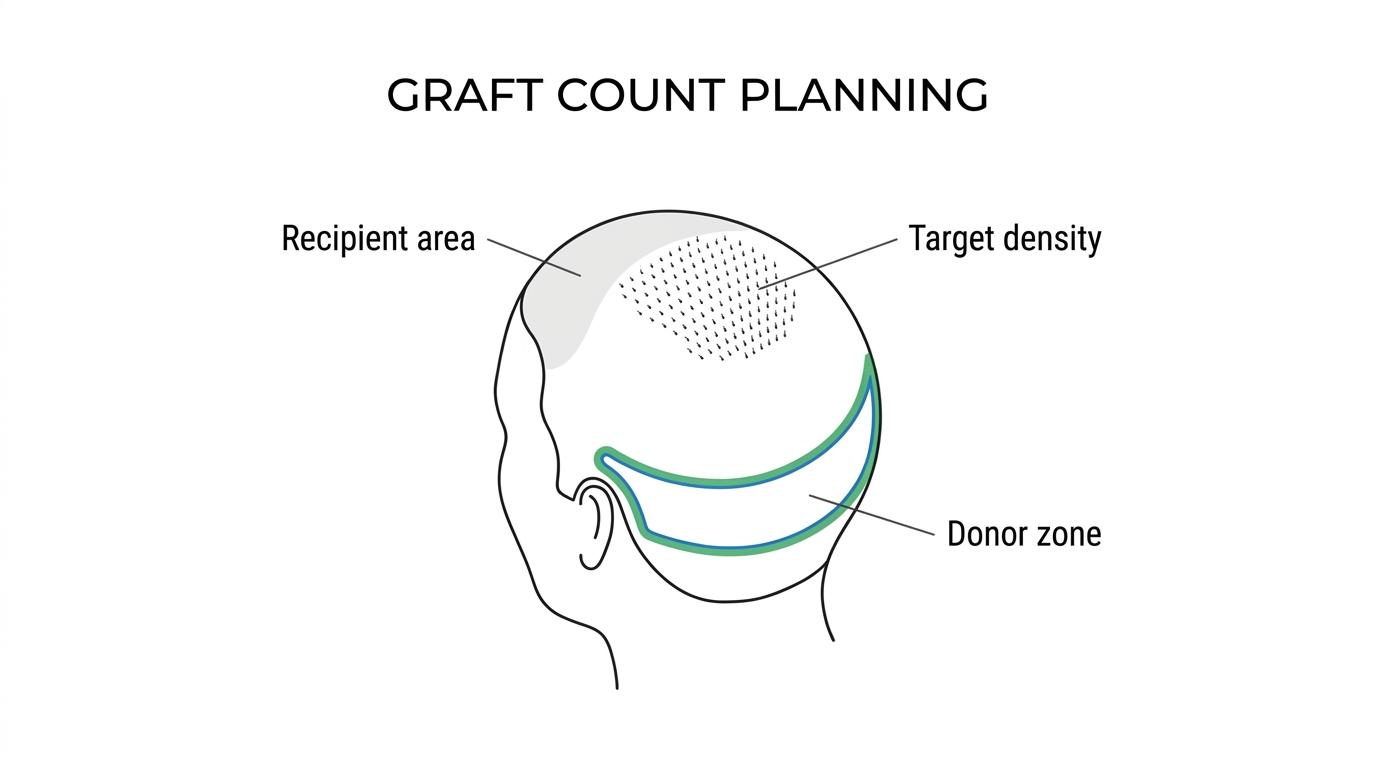
A common medical planning method is simple on paper: recipient area × target density. Widely cited guidance places a practical target near 30 follicular units per cm² for many cases, though the final number can go lower or higher depending on scalp condition, native hair, and cosmetic goals.
A surgeon does not just “fill the bald spot.” Hairline shape, frontal angle, transition zone, and future loss pattern all affect the number.
- Recipient area: The measured bald or thinning zone that needs placement
- Target density: The planned grafts per cm² for visible coverage
- Donor supply: The amount of permanent donor hair that can be harvested safely
- Hair characteristics: Thickness, curl, color contrast, and texture
- Long-term planning: How future hair loss may change the design
Hairline design also affects the math. The very front usually uses more single-hair grafts to keep the result soft and natural, while larger grafts are placed behind them to build fullness.
Typical hair transplant graft ranges for common baldness patterns
There is no universal chart that fits every scalp, though practical ranges help people set expectations before consultation. A person with early temple recession may need far fewer grafts than someone with frontal loss plus crown thinning.
The table below gives general planning ranges often discussed in clinical practice and patient education. These are not a substitute for a donor and scalp assessment.
| Baldness pattern or treatment area | Common graft range | What that usually targets |
|---|---|---|
| Temple points or minor hairline correction | 500 to 1,000 | Small refinements |
| Receding hairline | 800 to 1,500 | Frontal edge rebuild |
| Hairline plus frontal zone | 1,200 to 2,200 | Stronger front coverage |
| Frontal zone plus mid-scalp | 2,200 to 3,200 | One of the most common plans |
| Crown only | 1,000 to 2,500 | Depends heavily on crown size |
| Frontal zone, mid-scalp, and crown | 3,500 to 5,000+ | Often staged over more than one session |
Many patients asking about a “3,000 graft hair transplant” fall into the frontal and mid-scalp group. That range is often enough to rebuild a receding front and improve visible density behind it, assuming the donor area is suitable.
Advanced baldness cases are different. A person with a larger Norwood pattern may need priorities set carefully, with the hairline and frontal zone treated first because those areas frame the face most strongly.
Why two people with the same bald area may need different graft counts
This is where online calculators often fall short.
Two people can have a similar bald patch size and still receive very different estimates. One may need fewer grafts because the hair is coarse, curly, and dark enough to create better visual coverage. Another may need more because the hair is fine and the scalp shows through more easily.
Native hair also changes the count. If thinning hair still exists in the recipient area, the surgeon may blend transplanted grafts into it instead of building density from zero. That can reduce the graft requirement.
Short reasons for graft variation include:
- hair shaft thickness
- hair curl or wave
- scalp to hair color contrast
- donor density
- scalp laxity in FUT candidates
- age and future loss pattern
- male versus female pattern thinning
Female hair transplant planning can be especially individual because diffuse thinning, preserved frontal hairline, and donor stability need close review before surgery is advised.
Hair transplant techniques and how they affect graft planning
People often ask whether FUE, DHI, FUT, Sapphire FUE, Bio FUE, hybrid methods, or no shave hair transplant change the graft count. The short answer is that the bald area and donor capacity drive the count more than the brand name of the technique.
The technique mainly affects how grafts are harvested and placed, what the recovery looks like, and how the procedure is organized.
- FUE: Individual follicular units are extracted one by one, usually with flexible planning for small to large sessions
- DHI: Often chosen for precise implantation control, commonly used in hairline work and selected density-focused cases
- FUT: A strip is removed from the donor area, which can be useful when a high graft number is needed and donor management is a priority
- Sapphire FUE: Uses sapphire blades for site creation, often marketed for refined slit creation and dense placement
- Bio FUE: Usually refers to FUE combined with biologic support methods depending on clinic protocol
- Hybrid methods: Combine more than one harvesting or placement approach to suit the case
- No shave hair transplant: Best suited to selected candidates, often where limited graft numbers or careful concealment are needed
Technique choice should also be tied to hair transplant safety and realism. A larger number is not always a better number if it risks donor depletion or poor growth.
What 2,000, 3,000, or 4,000 grafts can realistically achieve
Patients often search exact numbers because they want a quick visual answer.
Around 2,000 grafts may be enough for a modest hairline rebuild and frontal thickening in a person with limited recession. In a different patient, the same 2,000 grafts might only soften a larger frontal loss pattern rather than create dense coverage.
Around 2,500 to 3,000 grafts is a very common planning zone for visible improvement in the front and mid-scalp. This is why it appears so often in hair transplant cost discussions and before-after comparisons. It often sits in the sweet spot between coverage, density, and donor safety in a single session.
Around 4,000 grafts or more can be appropriate in bigger cases, though many patients should think in stages rather than in one very aggressive sitting. A staged plan can protect the donor area and allow a more controlled design over time.
Hair transplant permanence and effectiveness also depend on where the grafts come from. Grafts taken from stable donor zones are usually intended to be long-lasting because they retain much of their donor dominance. That said, non-transplanted native hair may still thin later, which is why medical therapy is often discussed alongside surgery.
Donor area limits, hair transplant safety, and one-session planning
A good result is not just about covering the front. It is about keeping the donor area looking normal too.
Published guidance often places practical single-session harvesting around 2,500 to 3,000 grafts for many patients, while larger sessions may be possible in selected cases depending on density, scalp features, technique, and team experience. Over a lifetime, the safe number can vary widely.
That is why hair transplant success rate is linked to planning, not marketing.
A safe plan usually looks at:
- Donor density: Whether enough grafts exist without creating patchiness
- Transection control: Whether extraction can be done with low follicle damage
- Future baldness pattern: Whether reserved donor hair may be needed later
- Session strategy: Whether one procedure or staged sessions make more sense
Recovery timelines also connect to graft count. A smaller hairline case may feel socially presentable sooner than a broad frontal plus crown case. Most patients still need patience. Scabs usually settle within days, shedding often occurs in the first few weeks, and visible new growth commonly starts after a few months, with continued maturation over many months after that.
Hair transplant cost in Vijayawada and India often follows graft count
Graft count is one of the biggest factors behind hair transplant cost, though it should never be the only one compared. The cheapest quote is not automatically the best place for hair transplant, and the highest quote is not automatically the best clinic either.
In Vijayawada and across India, pricing can vary based on technique, surgeon involvement, graft number, clinic reputation, aftercare, and whether the case needs only frontal work or broader baldness coverage. Patients comparing cities like Pune, Hyderabad, and Bangalore often notice that package structure differs even when graft numbers sound similar.
Celebrity and Bollywood hair transplant interest has also made many people focus on the result photo more than the graft logic behind it. That can be misleading. A natural outcome usually comes from disciplined planning, conservative donor use, and hairline design that matches the face and age.
When patients compare India with other countries for the best country or best place query, graft planning quality matters more than travel buzz. A solid clinic should explain why the suggested graft count was chosen, what can be achieved in one sitting, and what should not be promised.
What happens during a hair transplant consultation for graft estimation
A proper consultation should feel more like mapping than guessing.
The scalp is examined, the donor zone is checked, the thinning area is measured, and a design is proposed. Many clinics now use computerized hair analysis or magnified scalp review to estimate density and miniaturization more accurately.
The discussion often covers more than surgery:
- current hair loss stage
- donor reserves
- family history
- medical treatment support
- recovery expectations
- whether beard or body hair is relevant in special cases
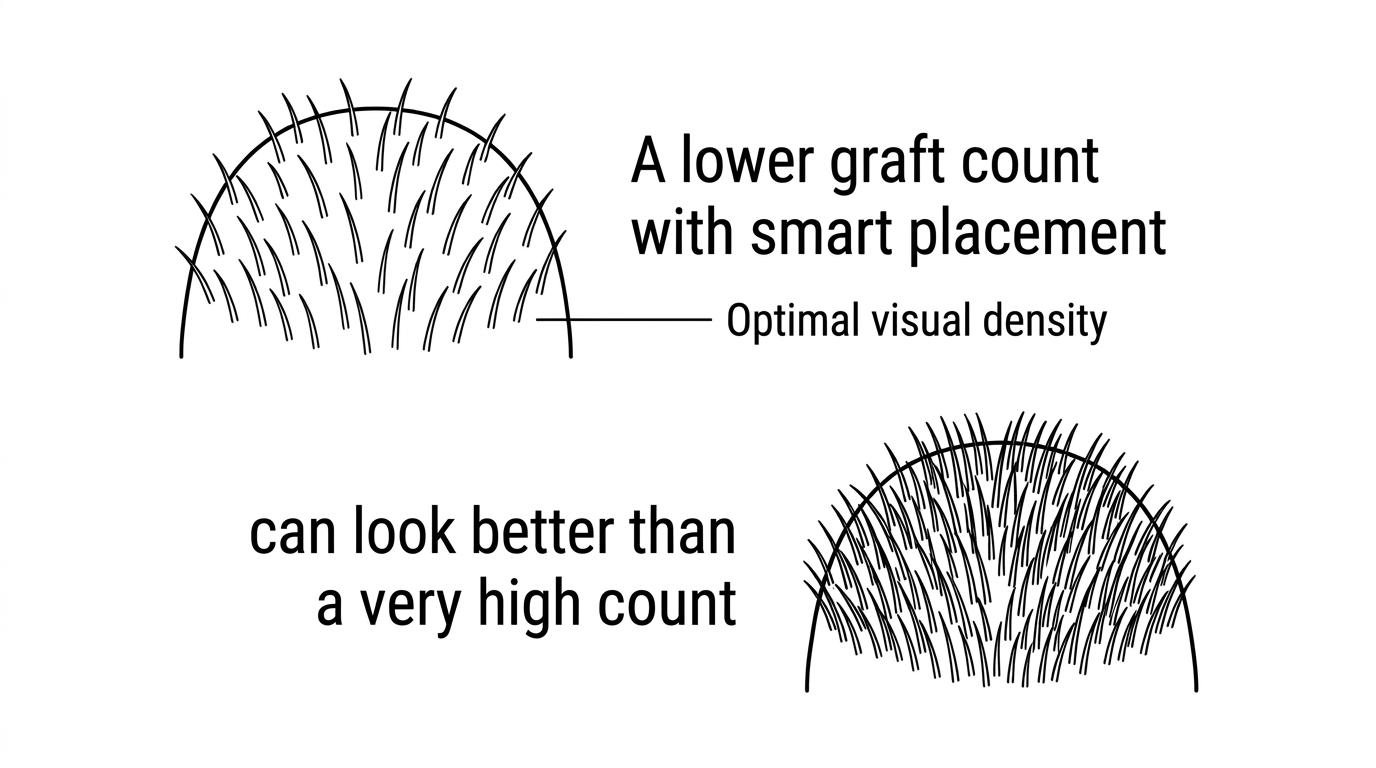
This is also the stage where a patient may learn that a lower graft count with smart placement can look better than a very high count pushed into an unsafe plan.
Questions that help clarify the right hair transplant graft count
Before booking a procedure, patients do well when they ask direct questions and expect direct answers. That keeps the focus on suitability, safety, and long-term appearance.
- How was the graft count calculated?: Ask whether the estimate came from recipient area, target density, and donor analysis
- What result is expected from this count?: Ask whether the goal is hairline restoration, frontal coverage, mid-scalp thickening, or crown work
- Is this one session or a staged plan?: Ask if a second session may be wiser for advanced baldness cases
- Which technique suits the case best?: Ask why FUE, DHI, FUT, Sapphire, Bio FUE, or a hybrid method is being suggested
- How is donor safety protected?: Ask how the clinic avoids overharvesting and visible thinning in the donor area
- What is the recovery timeline?: Ask when scabs settle, shedding starts, and growth can usually be seen
For many people in Vijayawada, the right answer is not the highest number of grafts. It is the number that gives a natural look, respects donor limits, supports long-term hair loss planning, and fits the person’s goals with honesty.