Best for early crown thinning: topical minoxidil. Best for slowing male-pattern progression: prescription finasteride. Best for restoring coverage in a suitable, established bald area: a hair transplant. The best treatment for crown baldness in 2026 depends on your diagnosis, remaining hair and donor supply—not the size of the patch alone.
- The best treatment for crown baldness matches the diagnosis: minoxidil for early thinning, transplantation for suitable established loss.
- Finasteride is a prescription option for male-pattern hair loss, not a treatment for everyone.
- iGraft offers crown hair restoration assessment; DFI Ultimate is a clinic-described transplant procedure, not a guaranteed outcome.
- PRP is an additional option for selected patients; cosmetic coverage changes appearance without treating hair loss.
Why this matters
A thinning crown and a completely bald crown need different plans. Medicines can help preserve or thicken susceptible existing hair; a transplant moves donor follicles into an area that needs coverage.
At iGraft, computerized diagnostics and follicular-level scans support assessment. Get the cause identified before choosing a procedure, especially if the loss is sudden, patchy, painful or accompanied by scalp inflammation.
What makes the best treatment for crown baldness?
Use these criteria to judge a crown treatment recommendation in 2026:
- Correct diagnosis: Pattern hair loss, temporary shedding and inflammatory scalp disease do not share one treatment.
- Remaining follicles: Thinning hair offers a different treatment opportunity from an area with established loss.
- Evidence: Established medicines deserve a different discussion from additional procedures with less standardized protocols.
- Personal suitability: Sex, pregnancy plans, medical history and current medicines affect treatment choices.
- Long-term commitment: Medicines need continued use; transplantation also needs planning for future hair loss.
- Realistic coverage: Donor supply, crown size and hair characteristics limit what surgery can achieve.
Crown baldness treatments at a glance
| Treatment | Best for | Standout role | Key limitation |
|---|---|---|---|
| Topical minoxidil | Early crown thinning | Supports growth in existing susceptible follicles | Requires continued use and can irritate the scalp |
| Prescription finasteride | Male-pattern hair-loss progression | Reduces the hormonal driver of male-pattern loss | Requires medical assessment and side-effect counselling |
| Hair transplantation | Suitable established crown loss | Redistributes donor follicles into thinning or bald areas | Limited by donor supply; surgery does not stop ongoing loss |
| Platelet-rich plasma, or PRP | Selected patients seeking an additional treatment | Uses a preparation made from the patient's blood | Protocols and responses vary |
| Hair fibres or a hair system | Immediate cosmetic coverage | Conceals visible scalp without waiting for regrowth | Does not treat the underlying cause |
1. Topical minoxidil: best for early crown thinning
Topical minoxidil is an established treatment for pattern hair loss. It is most relevant when your crown still contains thinning hairs rather than expecting a smooth, long-standing bald area to regain full coverage.
Best for: Adults with diagnosed pattern hair loss who can maintain a regular topical routine. The appropriate formulation and instructions depend on the person and product label.
Topical minoxidil pros
- Offers a nonsurgical approach to crown thinning.
- Can support growth and improve the appearance of existing hair.
- Has established use in male- and female-pattern hair loss.
Topical minoxidil cons
- Needs continued use to maintain treatment-related benefits.
- Can cause irritation or unwanted facial hair growth.
- Can cause temporary increased shedding after treatment begins.
Do not judge minoxidil from a few applications. American Academy of Dermatology patient guidance describes a 6–12 month window for seeing results from minoxidil; your clinician should set review points and explain when to stop or change treatment.
In 2026, topical minoxidil remains a practical starting discussion for early crown thinning—not a promise of complete regrowth. Check suitability with a clinician if you have scalp disease, relevant medical conditions, or are pregnant or breastfeeding.
Verdict: Choose topical minoxidil for diagnosed early thinning when a sustained routine is realistic.
2. Finasteride: best for slowing male-pattern progression
Finasteride reduces the conversion of testosterone to dihydrotestosterone, a hormone involved in male-pattern hair loss. The aim is to slow further loss and, in some men, improve hair growth.
Best for: Adult men with confirmed male-pattern hair loss who accept the benefits, limitations and risks of prescription treatment.
Finasteride pros
- Targets a hormonal mechanism involved in male-pattern hair loss.
- Can help preserve hair that would otherwise continue thinning.
- Can form part of a clinician-directed plan alongside topical treatment.
Finasteride cons
- Can cause sexual side effects; mood-related risks also require discussion.
- Needs continued treatment to maintain its effect.
- Is not an appropriate default recommendation for women or anyone who is pregnant.
Ask the prescriber about sexual function, mood history, fertility concerns and other medicines before starting. Pregnant people should not handle crushed or broken finasteride tablets because of the risk to a male fetus.
Finasteride and minoxidil serve different roles. Finasteride addresses the hormonal driver of male-pattern loss; minoxidil supports hair growth. A doctor can decide whether either treatment, or a combination, fits your situation.
Verdict: Choose prescription finasteride for suitable adult men after an informed medical discussion.
3. Hair transplantation: best for suitable established crown loss
A hair transplant moves follicles from a donor area into the crown. It can address an area where medical treatment alone is unlikely to deliver the coverage you want, provided the diagnosis and donor supply support surgery.
Best for: People with an appropriate hair-loss diagnosis, sufficient donor hair and realistic expectations about crown coverage.
Hair transplantation pros
- Places donor follicles in areas with established loss.
- Allows the surgeon to plan placement around the crown's whorl.
- Offers a surgical option when thickening existing hair is insufficient.
Hair transplantation cons
- Requires surgery, recovery and acceptance of scarring risk.
- Uses a finite donor supply that must also serve future needs.
- Does not prevent surrounding, non-transplanted hair from continuing to thin.
How iGraft describes DFI Ultimate
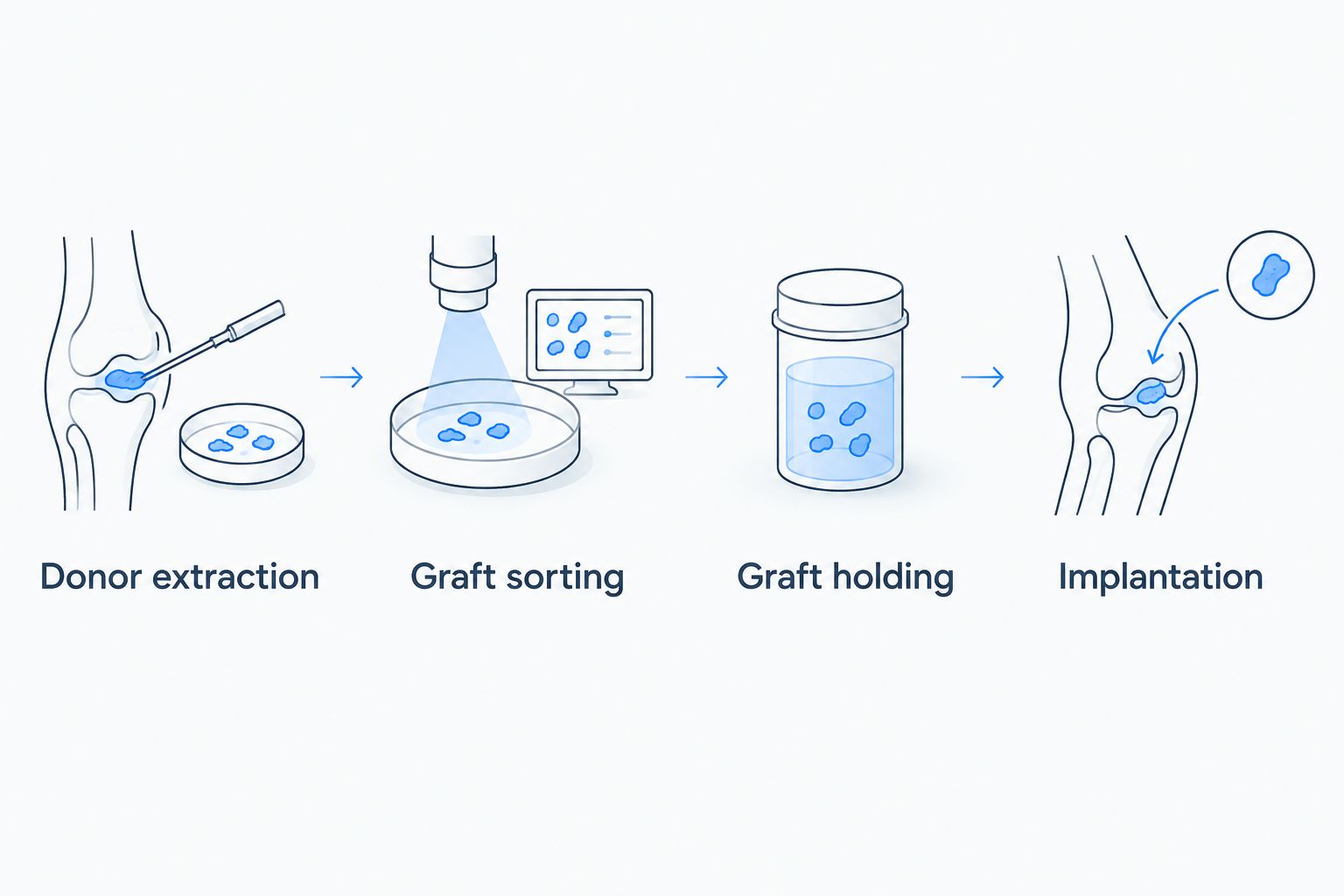
According to iGraft's supplied procedure description, DFI Ultimate follows these stages:
- Donor extraction: Grafts are extracted from the back of the head using specially designed serrated punches.
- Graft sorting: Extracted grafts are sorted into groups containing one, two or three hairs.
- Graft holding: Grafts are held before implantation in a graft holding/conditioning environment prepared from the patient's blood and peptides.
- Implantation: Grafts are implanted using implanter pens and micro-sapphire tools.
These are clinic-supplied process details, not independent clinical validation. The intended aim is planned handling and placement; the description does not establish better survival, damage-free harvesting or guaranteed density.
A graft is not the same as a hair: the clinic's description includes grafts containing 1, 2 or 3 hairs. Ask for both the proposed graft count and the reasoning behind the distribution, rather than comparing headline counts alone.
DFI Ultimate and DHI are not interchangeable names
If you are searching for DHI hair transplant, do not assume that DFI Ultimate describes the same service. Ask the surgeon to explain extraction, graft storage, recipient-site preparation, implantation and responsibility for each stage.
iGraft is best for readers seeking an in-person crown hair restoration assessment before choosing a procedure. The clinic also states that it provides 6 months of post-procedure support; confirm what that support includes during consultation.
For a 2026 surgical plan, request an explanation of how today's crown work affects future donor options. A dense-looking proposal is not useful if it ignores ongoing loss elsewhere.
Verdict: Choose transplantation only after donor assessment and a long-term hair-loss plan.
4. PRP: best as an additional treatment for selected patients
Platelet-rich plasma treatment uses a preparation made from your own blood, delivered through scalp injections. It is offered for pattern hair loss, but preparation methods, treatment schedules and responses vary.
Best for: Selected patients with existing thinning hair who understand the uncertainty and want to discuss an additional treatment.
PRP pros
- Provides a nonsurgical procedural option for selected patients.
- Uses a preparation derived from the patient's blood.
- Can be discussed alongside established medical treatment.
PRP cons
- Involves injections, discomfort and possible bruising.
- Does not replace a clear diagnosis or a suitable medical plan.
- Has less standardized protocols than established prescription medicines.
For PRP in 2026, ask what preparation is used, how progress will be measured and what finding would justify continuing. Standardized photographs are more useful than a vague impression that hair feels healthier.
Do not choose PRP as a substitute for donor follicles in an established bald area. Treatments aimed at existing follicles and surgery that relocates follicles solve different problems.
Verdict: Hold PRP until the diagnosis, treatment goal and review criteria are clear.
5. Hair fibres or a hair system: best for immediate cosmetic coverage
Hair fibres attach to existing hair to reduce the visible contrast between hair and scalp. A hair system provides external coverage rather than relying on regrowth.
Best for: People who want a visible cosmetic change while considering treatment, waiting for results or choosing not to pursue medical restoration.
Cosmetic coverage pros
- Changes appearance without waiting for a growth response.
- Avoids transplant surgery.
- Offers an option when medical restoration is unsuitable or unwanted.
Cosmetic coverage cons
- Does not slow or reverse the underlying hair loss.
- Requires application, maintenance or ongoing care.
- Fibres need existing hair to attach to; systems need appropriate fitting.
Choose fibres when enough hair remains to support them. Discuss a hair system when the area needs broader coverage, and ask about scalp care and adhesives if you have sensitive skin.
Verdict: Choose cosmetic coverage for appearance, not as a biological treatment for baldness.
How these treatments are ranked
This 2026 ranking separates early thinning, ongoing male-pattern loss, established baldness, additional procedures and cosmetic coverage. The order reflects those distinct jobs—not a claim that every reader should move through every option.
The medical distinctions follow established treatment information in American Academy of Dermatology patient guidance and prescribing information for minoxidil and finasteride. Proprietary transplant details are attributed to the clinic, rather than treated as comparative clinical evidence.
Which crown baldness treatment should you choose?
Start with diagnosis, then match treatment to what remains. If the crown is thinning, discuss established medical treatment first; if the loss is established, assess donor suitability before committing to surgery.
Bring photographs showing progression and a list of medicines and supplements to your appointment. Ask for a written goal: slowing loss, thickening existing hair, adding transplanted coverage or concealing the patch.
Sudden patches, scalp pain, marked redness or scarring need medical assessment rather than a routine transplant booking. Treating an active scalp disorder takes priority over cosmetic planning.
FAQ
What’s the best treatment for crown baldness in 2026?
The best treatment for crown baldness depends on the diagnosis and remaining follicles. Topical minoxidil is an established option for early pattern thinning; suitable established loss requires a transplant assessment if you want surgical coverage.
Can a bald crown grow back without a transplant?
A thinning crown can improve with appropriate medical treatment, but complete regrowth of long-standing established baldness is not a realistic promise. A clinician must identify whether the area has treatable thinning or another cause of loss.
Is minoxidil better than finasteride for crown thinning?
Minoxidil and finasteride have different roles rather than one being universally better. Minoxidil supports growth, while finasteride targets a hormonal driver of male-pattern loss; suitability determines the choice.
How long should I try minoxidil before judging results?
American Academy of Dermatology patient guidance describes 6–12 months for seeing minoxidil results. Arrange clinical review and seek advice sooner if you develop side effects or your diagnosis is uncertain.
Is a crown hair transplant permanent?
Transplanted follicles can provide lasting growth, but a transplant does not stop surrounding hair from thinning. Donor suitability, underlying disease and future loss still affect the overall appearance.
Does PRP replace a crown hair transplant?
PRP does not replace the redistribution of donor follicles into an established bald area. It is an additional option for selected patients with thinning hair, with variable protocols and responses.
Is DFI Ultimate the same as DHI hair transplant?
DFI Ultimate and DHI should not be treated as interchangeable names. Ask for the actual procedure steps and the evidence behind any comparative claim rather than deciding from the label.
Can women use the same crown baldness treatments as men?
Women need a diagnosis and treatment plan suited to their medical history and pregnancy considerations. Topical minoxidil is an established option for female-pattern hair loss, while finasteride is not a routine default and requires specialist judgement.
One last thing
Ask to see the crown plan, not just the graft total. Hair direction changes around the whorl, and the same donor supply must support any future restoration. Before consenting, ask the surgeon to show where grafts will go, what coverage is realistic and what happens if surrounding hair continues thinning.
Related guides
- Best hair loss treatments for women
- Best hair transplant techniques compared
- Best hair loss treatments for men