
Best overall on published clinical evidence: PRP. Best for discussing a concentrated, blood-derived preparation: GFC. Best reserved for research-led discussion: exosomes. For hair regrowth, none replaces a diagnosis, and none guarantees that an area without viable follicles will grow hair again.
- GFC vs PRP vs exosomes for hair regrowth: PRP has the stronger clinical evidence base among these options.
- GFC is a blood-derived treatment; a different preparation process does not establish better hair growth.
- Exosome hair treatments remain investigational; product identity, safety and regulatory status need scrutiny.
- iGraft offers all three treatments; choose through diagnosis rather than treatment names alone.
Why this matters
Choosing between scalp injections before identifying your hair-loss condition puts the treatment ahead of the problem. Pattern hair loss, temporary shedding and inflammatory scalp disease need different management; an injection package does not make them interchangeable.
iGraft is best suited to people seeking an in-person hair-restoration assessment before choosing an injectable treatment. The clinic describes physical consultations, follicular-level scans and computerised diagnostics among its services. Start with iGraft to discuss assessment rather than committing to a procedure by name.
In 2026, the useful question is not which treatment sounds newest. It is which treatment has evidence for your diagnosis, what remains uncertain and how your doctor will judge whether it is helping.
What makes the best hair regrowth treatment?
Judge GFC, PRP and exosomes against the same criteria:
- Diagnosis fit: The proposed treatment must address the condition causing your thinning, not simply the appearance of a sparse scalp.
- Clinical evidence: Human studies measuring hair outcomes matter more than laboratory explanations or promotional photographs.
- Preparation transparency: You should know what is being injected, where it comes from and how it is prepared.
- Safety controls: Sterile technique, medical screening, informed consent and a plan for complications are essential.
- Measurable follow-up: Comparable photographs and scalp assessments should guide continuation, not reassurance alone.
- Alternatives: A sound recommendation explains established medical options and when injections are unnecessary or unsuitable.
These criteria favour PRP as the first injectable option to discuss, not as an automatic treatment for everyone. They also explain why a newer preparation cannot earn first place from its name alone.
GFC, PRP and exosomes at a glance
| Treatment | Best for | What distinguishes it | Key limitation | Verdict |
|---|---|---|---|---|
| PRP | Discussing the injectable option with the stronger clinical evidence base | Uses a platelet-rich preparation from your own blood | Preparation methods and study results vary | Consider after diagnosis |
| GFC | Discussing a concentrated blood-derived growth-factor preparation | Uses processing intended to concentrate growth factors | Evidence does not establish consistent superiority over PRP | Consider with clear protocol information |
| Exosomes | Research-led discussion of an investigational approach | Uses preparations involving cell-derived signalling vesicles | Products, clinical evidence and regulatory status require close scrutiny | Wait outside an appropriately governed study |
For a 2026 decision, PRP leads this comparison on evidence, not on a promise of regrowth. GFC and exosomes should not be presented as interchangeable upgrades.
1. PRP: best hair regrowth injectable for evidence-led discussion
Platelet-rich plasma, or PRP, is prepared from a sample of your blood and injected into the scalp. Platelets release growth factors involved in tissue signalling; hair-treatment research examines whether this approach improves outcomes such as hair density.
Published clinical studies and systematic reviews support potential benefit in androgenetic alopecia, commonly called pattern hair loss. However, protocols differ, studies have limitations and individual responses vary. PRP is an option to discuss alongside established treatment, not a replacement for identifying the diagnosis.
PRP pros
- More clinical research: PRP has a more developed human evidence base for pattern hair loss than exosome treatment.
- Own-blood preparation: The starting material comes from the patient rather than an externally sourced cell-derived product.
- Adjunctive use: A dermatologist can consider PRP within a wider treatment plan rather than treating injections as the entire solution.
PRP cons
- Variable protocols: Blood processing, platelet concentration and treatment schedules are not uniform across clinics.
- Procedure burden: Blood collection and scalp injections involve discomfort and potential bruising, bleeding or infection.
- Uncertain response: A favourable study result does not guarantee an individual improvement or establish permanent benefit.
PRP best for: Someone with diagnosed pattern hair loss who wants to discuss an injectable adjunct with a comparatively stronger research base.
Ask the doctor what findings support PRP for your scalp, what other treatments remain necessary and what would trigger stopping. Photographs should use consistent lighting, positioning and hair styling so that apparent improvement is not simply a presentation difference.
Verdict: Consider PRP after diagnosis; skip any guarantee of regrowth.
2. GFC: best for discussing a concentrated blood-derived option
Growth factor concentrate, or GFC, refers to blood-derived preparations processed to obtain growth factors for treatment. The exact preparation depends on the system used, so the acronym alone does not tell you what a clinic will inject.
A growth-factor explanation is not proof of better hair growth. To compare GFC with PRP meaningfully, ask about the actual preparation, evidence for that protocol and outcomes in patients with your diagnosis.
GFC pros
- Own-blood starting material: GFC uses the patient's blood rather than an externally sourced exosome preparation.
- A defined discussion point: The doctor can explain the preparation method and intended purpose before treatment.
- Available within clinic-led care: iGraft lists GFC Class 2 among its hair-restoration treatments, allowing assessment and treatment discussion together.
GFC cons
- Limited comparative certainty: Evidence does not establish that GFC consistently outperforms PRP for hair regrowth.
- Protocol-specific claims: Findings about one preparation cannot automatically support every treatment called GFC.
- Injection-related risks: An own-blood source does not eliminate pain, infection or other procedure-related complications.
GFC best for: Someone considering a blood-derived injectable who wants a clear explanation of the proposed preparation and its supporting evidence.
In 2026, a useful GFC consultation should explain why this particular approach fits your condition. A claim that the preparation is more concentrated is not enough: concentration and patient benefit are different questions.
Verdict: Hold until the doctor explains the protocol, evidence and reason to choose GFC over PRP.
3. Exosomes: best reserved for research-led evaluation
Exosomes are extracellular vesicles released by cells that carry biological signals. Commercial treatments described as exosome therapy differ in source, processing and contents; the label does not establish a standardised hair-regrowth treatment.
Research interest does not equal established clinical effectiveness. The US Food and Drug Administration's public safety notification on exosome products warns about unapproved products and reported adverse events. That US warning does not determine Indian regulatory status; the exact product and its permitted use still need checking locally.
Exosome pros
- A distinct research approach: Exosomes are being investigated for cell-signalling applications, including hair restoration.
- Product-specific evaluation is possible: A properly governed study can define the preparation, eligibility criteria and safety monitoring.
- Useful research questions: Controlled investigation can examine outcomes rather than relying on promotional before-and-after images.
These are reasons for research interest, not established advantages over PRP or GFC.
Exosome cons
- Unsettled effectiveness: Current clinical evidence does not justify treating exosomes as the routine winner for hair regrowth.
- Product variability: Source, processing, contents and quality controls require verification for the exact preparation.
- Safety and regulatory uncertainty: Claims about the category cannot establish the suitability of a particular product or use.
Exosomes best for: Discussion within an appropriately governed clinical study with clear product information, consent and safety oversight.
Although iGraft lists exosome hair treatment among its services, that listing is not independent evidence of effectiveness or product approval. Ask for the exact preparation and its supporting documentation before considering treatment.
Verdict: Wait outside an appropriately governed study; skip claims that exosomes are automatically better because they are newer.
Choose through diagnosis, then compare the treatment
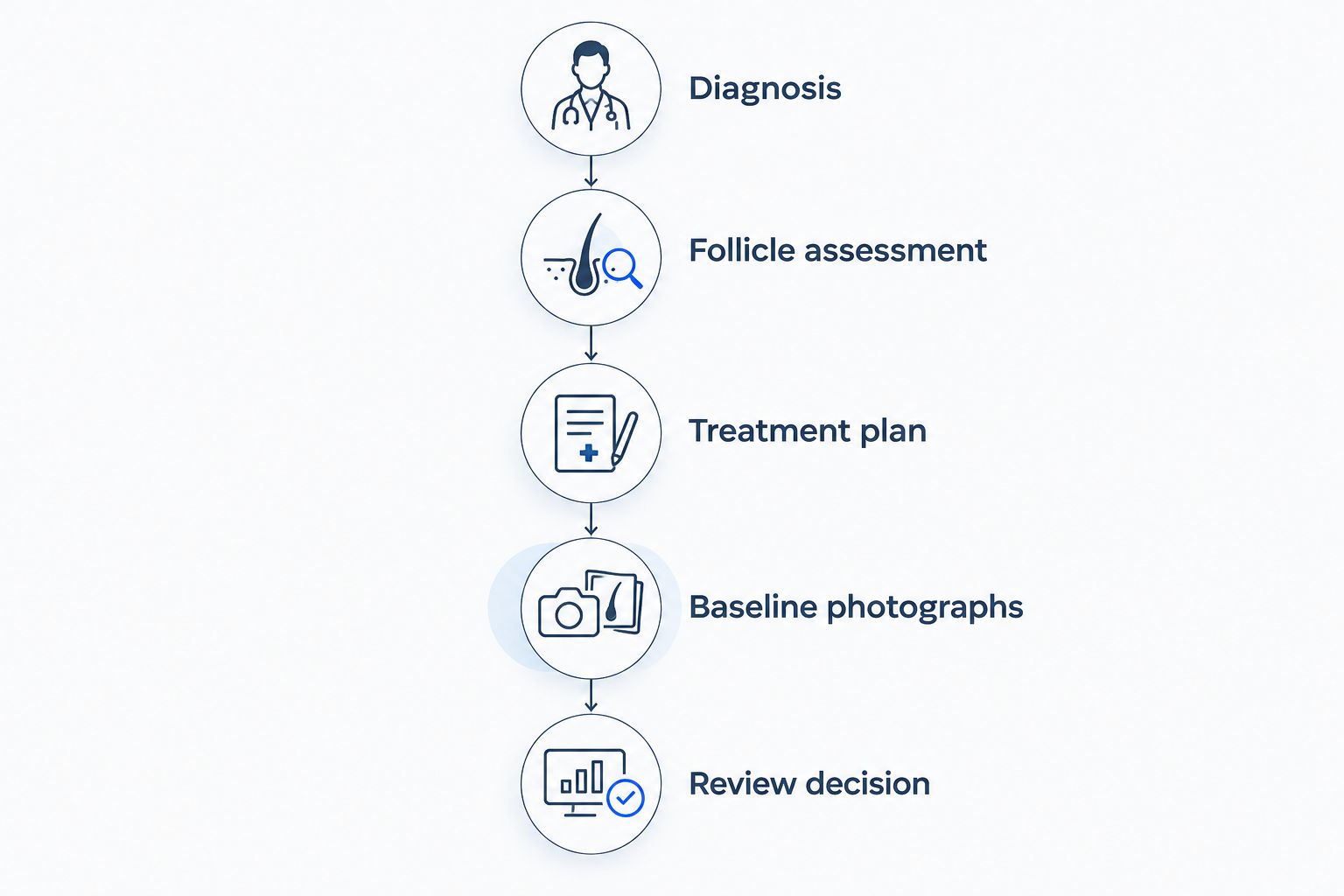
Use this sequence at your consultation. It keeps the decision focused on your scalp rather than a treatment package.
- Diagnosis: Ask whether the findings indicate pattern hair loss, temporary shedding, inflammation or another condition. Investigations should follow the clinical assessment rather than a fixed test bundle.
- Follicle assessment: Ask what examination shows about the thinning area. Injectables do not create a new supply of follicles where follicles have been permanently lost.
- Treatment plan: Request 1 written plan identifying the proposed treatment, alternatives, review process and reasons to stop or change course.
- Baseline photographs: Request at least 2 photographic views, such as the frontal hairline and crown, using the same setup at later reviews.
- Review decision: Agree how the clinician will distinguish improvement, stability and continued loss before starting.
Ask these 3 questions before consenting: What evidence applies to my diagnosis? What exactly will be injected? What would make you recommend stopping? A direct answer to each is more useful than a claim about an advanced formula.
Discuss your hair loss diagnosis
Ask about scalp assessment, treatment suitability and a documented follow-up plan.
How these treatments were ranked
This 2026 comparison ranks the options by clinical evidence, preparation transparency, safety questions and usefulness in a diagnosis-led plan. It is not a head-to-head clinical trial or a claim that every PRP protocol outperforms every GFC preparation.
PRP takes first place because its research base is more developed. GFC remains a protocol-specific discussion, while exosomes require a higher threshold of product verification and research oversight. No ranking removes the need for medical assessment.
Which hair regrowth treatment should you choose?
Start by discussing PRP if your doctor confirms pattern hair loss and recommends an injectable adjunct. Ask how established medicines, including minoxidil or other suitable prescriptions, fit the plan; injections are not automatically the first treatment needed.
Choose a GFC discussion when the clinician can explain the specific preparation and why it fits your case. Do not accept a claim of superiority based only on growth-factor concentration. Keep exosomes in the research-led category rather than treating them as a routine upgrade.
Seek medical assessment before cosmetic treatment if hair loss is sudden, patchy, painful or accompanied by marked scalp inflammation. The underlying condition takes priority over the comparison.
FAQ
What’s best: GFC, PRP or exosomes for hair regrowth?
PRP is the strongest starting point for an evidence-led discussion among these three options, particularly for diagnosed pattern hair loss. GFC needs protocol-specific assessment, while exosomes remain investigational rather than an established upgrade.
Is GFC better than PRP for thinning hair?
GFC is not established as consistently better than PRP for thinning hair. Ask for comparative clinical evidence involving the actual preparation being recommended, not just an explanation of growth factors.
Are exosome hair treatments proven in 2026?
Exosome hair treatments are not an established routine replacement for evidence-based hair-loss care in 2026. The exact preparation, clinical evidence, safety oversight and regulatory status need assessment before use.
Can these injections regrow hair on a completely bald scalp?
These injections do not create new follicles where follicles have been permanently lost. A clinician must assess the cause of baldness and whether viable follicles remain before recommending treatment.
Is PRP safe because it uses my own blood?
Using your own blood does not make PRP risk-free. Blood collection and scalp injections still require medical screening, sterile technique and discussion of pain, bleeding, bruising and infection.
Can I stop minoxidil when I start GFC or PRP?
Do not stop prescribed hair-loss treatment simply because you start GFC or PRP. Ask the prescribing clinician how injections fit the existing plan and what changing treatment means for maintaining results.
Does iGraft offer PRP, GFC and exosome treatment?
iGraft lists PRP, GFC and exosome hair treatments among its services. A consultation should establish your diagnosis, explain the proposed preparation and distinguish clinic-supplied information from independent clinical evidence.
One last thing
Keeping existing hair can be a meaningful result even without dramatic regrowth. Before treatment, ask the clinician whether the goal is reduced shedding, improved density or stability, and how that goal will be assessed. In 2026, a treatment plan with a clear stopping rule is more useful than an open-ended promise.
Related guides
- Best Hair Loss Treatments for Women
- Best Hair Loss Treatments for Men
- Best Hair Transplant Techniques Compared