Best overall for early male-pattern thinning: topical minoxidil. Best prescription option for slowing progression: finasteride. Best for restoring coverage in suitable bald areas: hair transplantation. The best hair loss treatment for men in 2026 depends on whether you need to preserve thinning hair, replace lost coverage or treat a different cause of shedding.
- The best hair loss treatment for men starts with a diagnosis, not a treatment package.
- Topical minoxidil supports growth in male-pattern hair loss; finasteride requires a prescription and discussion of sexual side effects.
- Hair transplantation redistributes existing follicles; it does not stop ongoing male-pattern hair loss.
- iGraft is best for men seeking in-person hair loss assessment and discussion of medical and surgical options.
Why this matters
Thinning at your temples is not the same problem as sudden shedding across your scalp. Male-pattern hair loss, alopecia areata, scalp inflammation and illness-related shedding need different treatment plans. Treating all of them with the same serum wastes time and can delay appropriate care.
For an in-person starting point, iGraft offers follicular-level scans, computerised diagnostics and doctor consultations. A scan supports assessment; your history and scalp examination still matter. Sudden patchy loss, pain, crusting or a shiny, scarred-looking scalp calls for medical assessment before cosmetic treatment.
What makes the best hair loss treatment for men?
Use these criteria to judge a recommendation in 2026, whether it comes from a clinic, a pharmacy or an online comparison:
- Correct diagnosis: The treatment must address your type of hair loss, not just its appearance.
- Evidence for the intended use: Established medicines for male-pattern loss are different from optional supportive procedures.
- Suitable scalp and donor hair: Medicines need realistic growth potential; transplantation needs suitable donor follicles.
- Acceptable risks: Side effects, recovery and medical history belong in the decision before treatment starts.
- A workable routine: A treatment that needs continued use only works as a plan if you can maintain it.
- A clear review point: Agree how your clinician will assess progress and when the plan needs changing.
There is no universal winner across every diagnosis. The ranking below separates treatments by the job they do rather than presenting unlike options as interchangeable.
Hair loss treatments at a glance
| Treatment | Best for | Standout feature | Key limitation |
|---|---|---|---|
| Topical minoxidil | Early male-pattern thinning | Non-surgical treatment that supports hair growth | Needs continued use; scalp irritation can occur |
| Oral finasteride | Medically suitable men with progressing pattern loss | Reduces the hormonal driver of male-pattern loss | Prescription treatment with potential sexual side effects |
| Hair transplantation | Suitable men seeking coverage in bald areas | Moves donor follicles into areas needing coverage | Surgery; donor supply limits the plan |
| Platelet-rich plasma | Men considering an adjunct to an established plan | Uses a preparation made from your blood | Protocols and results vary |
| Low-level light therapy | Men seeking a non-drug supportive option | Uses a suitable light-based device without surgery | Requires regular use; devices are not equivalent |
| Hair systems | Men prioritising immediate cosmetic coverage | Covers visible loss without waiting for regrowth | Does not treat the underlying hair loss |
1. Topical minoxidil: best for early male-pattern thinning
Topical minoxidil is an established treatment for androgenetic alopecia, commonly called male-pattern hair loss. It supports hair growth but does not remove the hormonal cause of progressive thinning. The American Academy of Dermatology identifies minoxidil as a treatment option in its public guidance on male-pattern hair loss.
A 5% topical formulation is a recognised option for men. Follow the particular product's directions and your clinician's advice rather than borrowing another person's application schedule.
Topical minoxidil pros:
- Treats male-pattern thinning without surgery.
- Can be applied at home.
- Can form part of a clinician-directed combination plan.
Topical minoxidil cons:
- Requires continued use to maintain treatment-related gains.
- Can cause irritation, unwanted facial hair or temporary increased shedding early in treatment.
Do not judge minoxidil after a few applications. Hair growth takes months, and persistent redness, dizziness or palpitations needs medical advice rather than a stronger application.
Best for: Men with diagnosed early male-pattern thinning who can maintain a topical routine.
Verdict: Buy only after confirming the diagnosis and product suitability with a clinician or pharmacist.
2. Oral finasteride: best for slowing progressive pattern loss
Finasteride reduces dihydrotestosterone, the hormone involved in male-pattern hair loss. It addresses a different part of the problem from minoxidil: reducing the hormonal pressure on susceptible follicles rather than only encouraging growth.
The established oral dose for male-pattern hair loss is 1 mg daily, prescribed after a medical assessment. This is background information, not a self-prescribing instruction or a reason to split a different-strength tablet.
Oral finasteride pros:
- Targets the hormonal mechanism behind male-pattern loss.
- Can help preserve existing hair.
- Fits into a clinician-directed plan alongside topical treatment when appropriate.
Oral finasteride cons:
- Can cause sexual side effects; mood-related symptoms also require prompt medical advice.
- Needs continued treatment and is unsuitable for some patients.
Tell your prescriber about sexual health concerns, fertility plans, mood symptoms and other medicines. Discuss expected benefits and potential harms before starting, not after a side effect appears.
Best for: Adult men with progressing androgenetic alopecia who are medically suitable for prescription treatment.
Verdict: Hold until a prescribing doctor confirms suitability and explains the risks.
3. Hair transplantation: best for restoring bald-area coverage
Hair transplantation moves follicles from a donor area to areas with reduced coverage. It does not create an unlimited supply of new hair, and it does not stop untreated native hair from continuing to thin.
iGraft offers DFI Ultimate Hair Transplant and ActiveFUE Hair Transplant. Choosing between named procedures requires an assessment of donor quality, scalp condition, hairline goals and the long-term pattern of loss—not a decision based on the procedure name alone.
Hair transplantation pros:
- Places hair in selected areas needing coverage.
- Allows planning around hairline shape and distribution.
- Uses your own donor follicles.
Hair transplantation cons:
- Involves surgery, recovery and risks including scarring or infection.
- Limited donor hair restricts coverage; further native-hair thinning can change the result.
Before agreeing to surgery in 2026, ask who performs each surgical stage, how donor supply will be protected and what happens if your hair loss progresses. Ask for a written aftercare plan as well. iGraft states that it provides 6-month post-procedure support; clarify what that support includes during consultation.
Best for: Men with suitable donor hair, realistic expectations and a clinician-approved surgical plan.
Verdict: Hold until donor assessment and long-term hair-loss planning are complete.
4. Platelet-rich plasma: best as a clinician-selected adjunct
Platelet-rich plasma, or PRP, involves taking blood, preparing a platelet-rich portion and injecting it into the scalp. It is used in some treatment plans for androgenetic alopecia, but preparation methods and treatment schedules differ.
PRP is not a replacement for diagnosing hair loss. Nor should a clinic promise that injections will restore every bald area or produce the same response in every patient.
PRP pros:
- Uses a preparation derived from your own blood.
- Does not involve transplant surgery.
- Can be considered alongside an established medical plan.
PRP cons:
- Involves injections, discomfort and possible bruising.
- Variable protocols make treatment packages difficult to compare.
Ask what problem PRP is intended to address, how progress will be documented and what happens if there is no meaningful improvement. A package name is not evidence that you need every procedure included in it.
Best for: Men with a confirmed diagnosis who want to discuss a procedural addition to their existing plan.
Verdict: Hold until a clinician explains its role and limits for your diagnosis.
5. Low-level light therapy: best for non-drug support
Low-level light therapy uses suitable light-emitting devices as a non-surgical approach to pattern hair loss. Some devices have regulatory clearance for defined uses, but that does not make every light cap, comb or salon device equivalent.
Check the exact device, its intended use and its instructions. A generic claim about light therapy does not establish the performance of the particular device being offered.
Low-level light therapy pros:
- Avoids scalp injections and transplant surgery.
- Provides a non-drug option for selected patients.
- Can be discussed as part of a wider treatment plan.
Low-level light therapy cons:
- Requires repeated use according to the device instructions.
- Evidence and suitability depend on the device and the type of hair loss.
For your 2026 shortlist, separate device-specific evidence from broad claims about lasers. Do not replace a prescribed treatment with a light device without discussing the change with your clinician.
Best for: Men seeking a non-drug supportive option who understand the routine and evidence limitations.
Verdict: Buy only after checking device-specific evidence and clinical suitability.
6. Hair systems: best for immediate cosmetic coverage
A hair system covers visible thinning or baldness rather than treating follicles. It serves a different goal from minoxidil, finasteride or surgery: changing appearance without waiting for biological regrowth.
This distinction matters. You can prefer cosmetic coverage while still having unexplained shedding assessed medically.
Hair systems pros:
- Provide coverage without waiting for hair growth.
- Do not depend on transplant donor supply.
- Allow a non-surgical approach to appearance.
Hair systems cons:
- Need ongoing cleaning, fitting and maintenance.
- Adhesives or attachment methods can irritate sensitive scalps.
Ask how the system will be attached and removed, how you will care for your scalp and what maintenance involves. Active scalp inflammation needs attention before an attachment method is chosen.
Best for: Men prioritising visible coverage rather than regrowth or surgical restoration.
Verdict: Buy after checking fit, scalp tolerance and maintenance requirements.
How the treatments are ranked
This 2026 ranking prioritises diagnosis fit, established clinical use, treatment burden and limitations. It is not a head-to-head trial, and the order does not mean that minoxidil is appropriate for every man or every cause of hair loss.
Minoxidil leads for early pattern thinning; finasteride occupies the prescription slot; transplantation addresses selected coverage goals. PRP and light therapy sit in supporting roles, while hair systems address appearance rather than follicle recovery.
Which hair loss treatment should you choose?
For gradual male-pattern thinning, start with medical assessment and a discussion of minoxidil and prescription options—not an automatic transplant booking. If your main concern is an established bald area, ask whether donor hair and future loss make surgery appropriate.
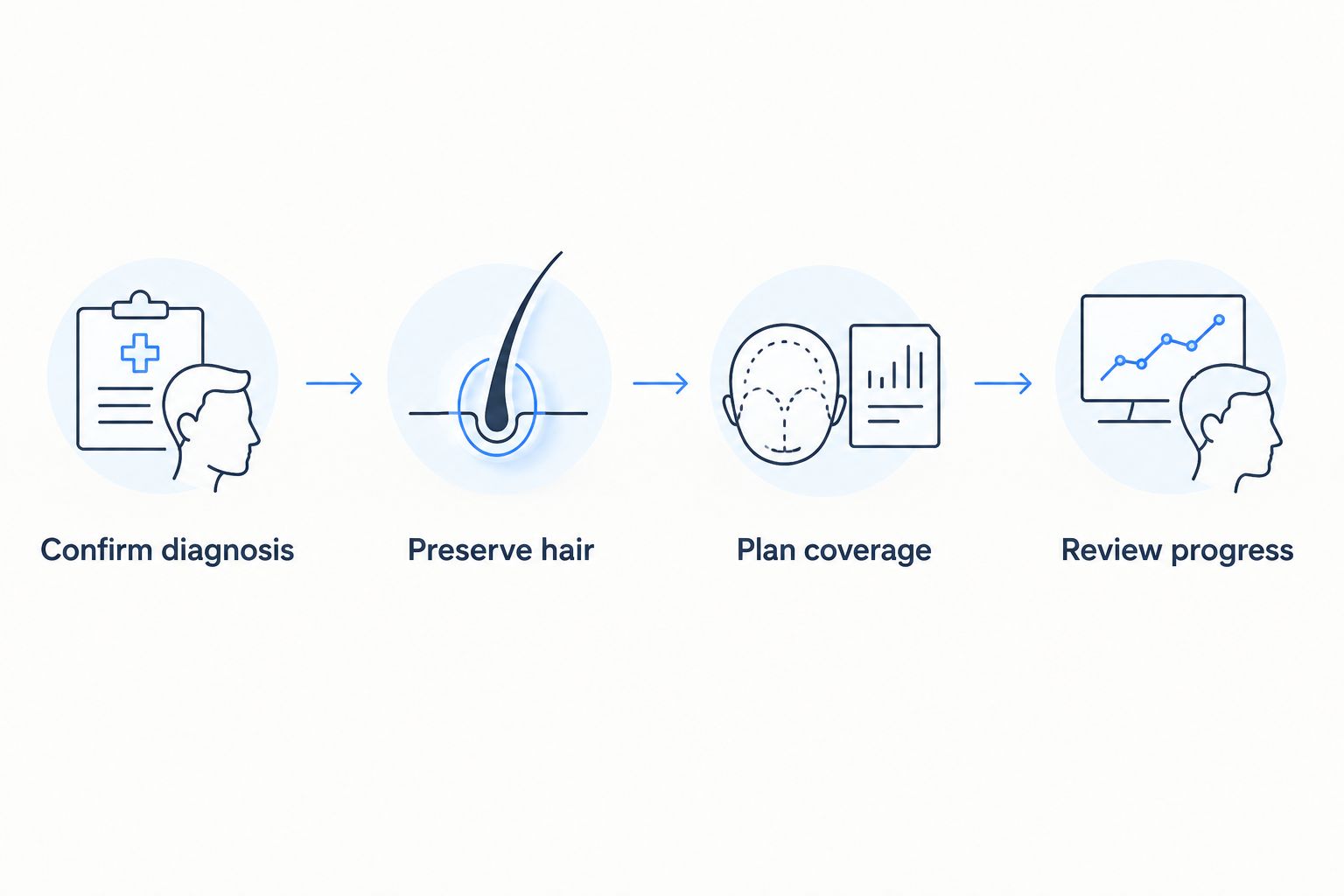
Use this sequence during your consultation:
- Confirm diagnosis: Establish whether the problem is pattern loss, shedding, inflammation or another condition.
- Preserve hair: Discuss treatment for susceptible existing hair where appropriate.
- Plan coverage: Consider transplantation or cosmetic coverage against your goals.
- Review progress: Use comparable photographs and an agreed clinical review.
Bring your medication list, previous treatment details and photographs showing how the loss developed. iGraft is best for men seeking in-person hair loss assessment and discussion of medical and surgical options. The useful outcome is a diagnosis-led plan, including what not to start.
Discuss your hair loss options
Explore in-person assessment, hair loss therapies and transplant options with a doctor.
FAQ
What’s the best hair loss treatment for men in 2026?
For early male-pattern thinning, topical minoxidil is an established starting option; prescription finasteride is another treatment to discuss with a doctor. The best choice changes when the cause is inflammation, patchy autoimmune loss or temporary shedding.
Is finasteride better than minoxidil?
Finasteride and minoxidil do different jobs, so neither is automatically better for every man. Finasteride reduces the hormonal driver of male-pattern loss, while minoxidil supports growth; a clinician can assess whether either or both are appropriate.
Can a hair transplant stop future hair loss?
No, hair transplantation does not stop progressive loss of untreated native hair. A surgical plan should account for future thinning, donor limitations and any appropriate medical treatment.
How long does minoxidil take to show results?
Minoxidil takes months rather than days to assess. Follow the product instructions and your clinician’s review schedule, and seek advice if you develop significant irritation or systemic symptoms.
Is PRP enough to treat male-pattern baldness?
PRP should not automatically replace established medical treatment for male-pattern hair loss. Its role depends on the diagnosis, the treatment protocol and the clinician’s assessment of realistic benefit.
Should I get blood tests before starting hair loss treatment?
Blood tests are selected according to your symptoms, history and examination, not ordered automatically for every man. Sudden diffuse shedding or signs of an underlying condition can change which investigations are appropriate.
Can I stop treatment once my hair looks thicker?
Stopping minoxidil or finasteride generally leads to loss of treatment-maintained benefits over time. Discuss side effects, changing goals or a different treatment plan with your prescriber rather than assuming the underlying condition has disappeared.
One last thing
Take consistent photographs before starting treatment in 2026. Use the same lighting, angle, hairstyle and camera distance at follow-up; differences in wetness or styling can make the same scalp look dramatically different.
The most useful next appointment is not the one that offers the longest treatment menu. It is the one that explains your diagnosis, the purpose of each recommendation and the reason to leave other options out.