Best overall for avoiding a linear donor scar: follicular unit extraction (FUE). Best for patients who accept a linear scar after donor assessment: follicular unit transplantation (FUT). Best for concealing preparation: no-shave transplantation. This 2026 guide compares extraction methods, implantation approaches and shaving choices so you can discuss the right operation—not just a technique name.
- Best hair transplant techniques compared: FUE avoids a linear donor scar; FUT uses strip harvesting.
- DHI describes implantation, while FUE describes extraction; the terms are not direct opposites.
- No-shave transplantation prioritises appearance during preparation, not guaranteed graft growth.
- iGraft offers transplant assessment through physical clinics; choose a technique after donor and scalp evaluation.
Why this matters
A hair transplant moves existing follicles; it does not create a new donor supply. Your donor hair, pattern of loss and future thinning matter more than the name attached to surgery.
iGraft hair transplant assessment includes follicular-level scans and doctor evaluation. iGraft is best suited to people seeking an in-person hair transplant assessment rather than choosing surgery from a technique label alone.
For your 2026 shortlist, separate three decisions: how follicles are removed, how they are placed and whether hair is shaved. A clinic can combine these choices in one procedure. Treating every label as a competing operation makes comparisons misleading.
What makes the best hair transplant technique?
Judge the proposed operation against these criteria before comparing names:
- Donor preservation: The plan should explain what can be harvested without leaving an unacceptable appearance in the donor area.
- Scar compatibility: FUE leaves small individual scars; FUT leaves a linear scar. Neither is scar-free.
- Hairline planning: Placement must account for direction, angle and an appearance that remains appropriate as you age.
- Future hair loss: Transplanted hair does not stop surrounding, non-transplanted hair from thinning.
- Surgical responsibility: You should know who assesses you, performs each surgical step and manages complications.
- Aftercare: Written instructions and a route back to the clinical team matter more than promises of effortless recovery.
Ask the surgeon to connect each recommendation to your examination. A named device, smaller instrument or branded procedure does not establish better results by itself.
Hair transplant techniques at a glance
These options are ranked by distinct decision needs, not by a claim that one technique produces better results for everyone. FUE and FUT are harvesting methods; direct implantation and no-shave approaches address different parts of the operation.
| Option | Best for | Defining feature | Key limitation |
|---|---|---|---|
| FUE | Avoiding a linear donor scar | Individual follicular units are extracted | Small scars remain; excessive harvesting can thin the donor area |
| FUT | Patients accepting a linear scar after donor assessment | A strip of donor scalp is removed and divided into grafts | Linear scar and wound closure affect hairstyle and recovery decisions |
| Direct implantation, often called DHI | Evaluating an implanter-based placement plan | An implanter instrument places grafts | The label does not explain extraction or establish better growth |
| No-shave transplantation | Keeping preparation less visible | Selected hair is left long during the procedure | Suitability and the extent of shaving need individual confirmation |
The useful comparison is the complete surgical plan. Ask for the harvesting method, implantation approach and shaving arrangement separately in your 2026 consultation.
1. FUE: best hair transplant technique for avoiding a linear scar
FUE removes follicular units individually using a punch instrument. The grafts are then placed into recipient areas through the surgical team's chosen implantation method.
Unlike FUT, FUE does not require removal of a donor strip. That distinction matters if you want to avoid a linear scar, but it does not make FUE scarless or suitable for unlimited harvesting.
FUE pros
- Avoids a continuous linear donor scar.
- Extracts individual follicular units rather than a strip of scalp.
- Can be combined with different graft-placement approaches.
- Allows the surgeon to distribute extractions across the assessed donor area.
FUE cons
- Leaves small individual scars, which short hairstyles can expose.
- Excessive or poorly distributed extraction can produce visible donor thinning.
- Requires a donor plan that accounts for possible future procedures.
Best for: People whose donor assessment supports individual extraction and who prioritise avoiding a linear scar.
ActiveFUE is an iGraft hair transplant offering. Ask the clinician to explain its harvesting process, who performs the surgical steps and how the proposed extraction pattern protects your donor appearance; the service name alone does not answer those questions.
Verdict: Buy only after donor assessment supports FUE and you understand its small-scar trade-off.
2. FUT: best hair transplant technique for patients accepting a linear scar
FUT removes a strip of hair-bearing donor scalp, which is divided into follicular-unit grafts. The donor wound is closed, leaving a linear scar.
FUT belongs in a serious comparison rather than being dismissed because it uses an incision. Whether it fits your case depends on donor characteristics, scalp assessment, hairstyle preferences and the surgeon's plan.
FUT pros
- Provides follicular-unit grafts through strip harvesting.
- Avoids distributing individual extraction sites throughout the donor area.
- Gives patients a different harvesting option to discuss when planning donor use.
FUT cons
- Leaves a linear donor scar.
- Requires wound closure and specific donor-site care.
- Can conflict with a preference for very short hair if the scar becomes visible.
Best for: Patients who accept a linear scar and whose surgeon identifies a sound reason for strip harvesting.
Ask to see donor-area results, not just frontal hairlines. Your usual haircut is part of the decision: a transplant plan that ignores how you wear your donor hair is incomplete.
Do not choose FUT solely because someone describes it as older, or reject it solely because another method sounds newer. Your 2026 decision should turn on the surgical trade-offs documented for your scalp.
Verdict: Hold until the surgeon explains why strip harvesting fits your donor plan better than individual extraction.
3. Direct implantation: best for evaluating an implanter-based plan
Direct hair implantation, often called DHI, describes a placement approach using an implanter instrument. It does not replace the need to explain how the follicles are harvested.
A procedure can therefore use FUE extraction and an implanter for placement. Asking whether FUE or DHI is better skips the central issue: they describe different stages of treatment.
Direct implantation pros
- Uses an instrument to place grafts into the recipient area.
- Can form part of an operation using individually extracted follicles.
- Gives you a specific placement workflow to discuss with the surgeon.
Direct implantation cons
- The term does not identify the harvesting method.
- An implanter does not guarantee natural angles, density or graft survival.
- Branded labels can make otherwise overlapping procedures difficult to compare.
Best for: People assessing a specific implanter-based placement proposal, rather than searching for an automatically better operation.
DFI Ultimate is iGraft's named Direct Follicle Implant offering. Ask how its extraction, placement and aftercare steps apply to your case; do not assume that similarly named techniques across clinics use identical protocols.
Verdict: Hold until the full operation is explained; skip claims that the implantation label alone guarantees better growth.
4. No-shave transplantation: best for less visible preparation
No-shave transplantation aims to preserve the appearance of existing hair during surgical preparation. It describes a shaving arrangement, not a separate biological method of producing new hair.
The exact arrangement matters. Ask whether the clinic means no shaving anywhere, limited donor shaving hidden by longer hair, or leaving the recipient area unshaved.
No-shave transplantation pros
- Keeps selected existing hair long during preparation.
- Can help conceal prepared areas when surrounding hair provides coverage.
- Makes shaving preferences an explicit part of the surgical plan.
No-shave transplantation cons
- Not every donor area or treatment plan suits the same shaving arrangement.
- Preserving hair length does not remove swelling, redness or recipient-site crusting.
- The label does not establish better graft survival or faster healing.
Best for: Patients who prioritise less visible preparation and receive confirmation that the proposed arrangement suits their procedure.
Ask for a plain-language description of what your scalp will look like immediately afterwards. Keeping hair long is not the same as making surgery invisible, and work or social plans should reflect that distinction.
Verdict: Buy only when the shaving plan is explicit; skip any promise of an undetectable recovery.
How these techniques are ranked
This ranking prioritises a distinct patient decision for each option: linear-scar avoidance, acceptance of strip harvesting, assessment of implantation workflow and concealment of preparation. It is not a clinical trial ranking or a claim of higher graft survival.
The criteria are donor preservation, scarring, placement, future loss, surgical responsibility and aftercare. None of the technique names removes the need to assess those fundamentals.
Turn the comparison into a surgical plan
Use this sequence at your consultation. It keeps the discussion focused on decisions that change the operation rather than terminology.
- Diagnosis: Establish the cause and pattern of hair loss before committing to transplantation.
- Donor assessment: Examine donor density, hair characteristics and the appearance after harvesting.
- Extraction plan: Record whether the proposal uses individual extraction or strip harvesting, including the scar trade-off.
- Placement plan: Explain the intended hairline, direction and implantation approach.
- Aftercare: Confirm instructions, follow-up arrangements and how you report a concern.
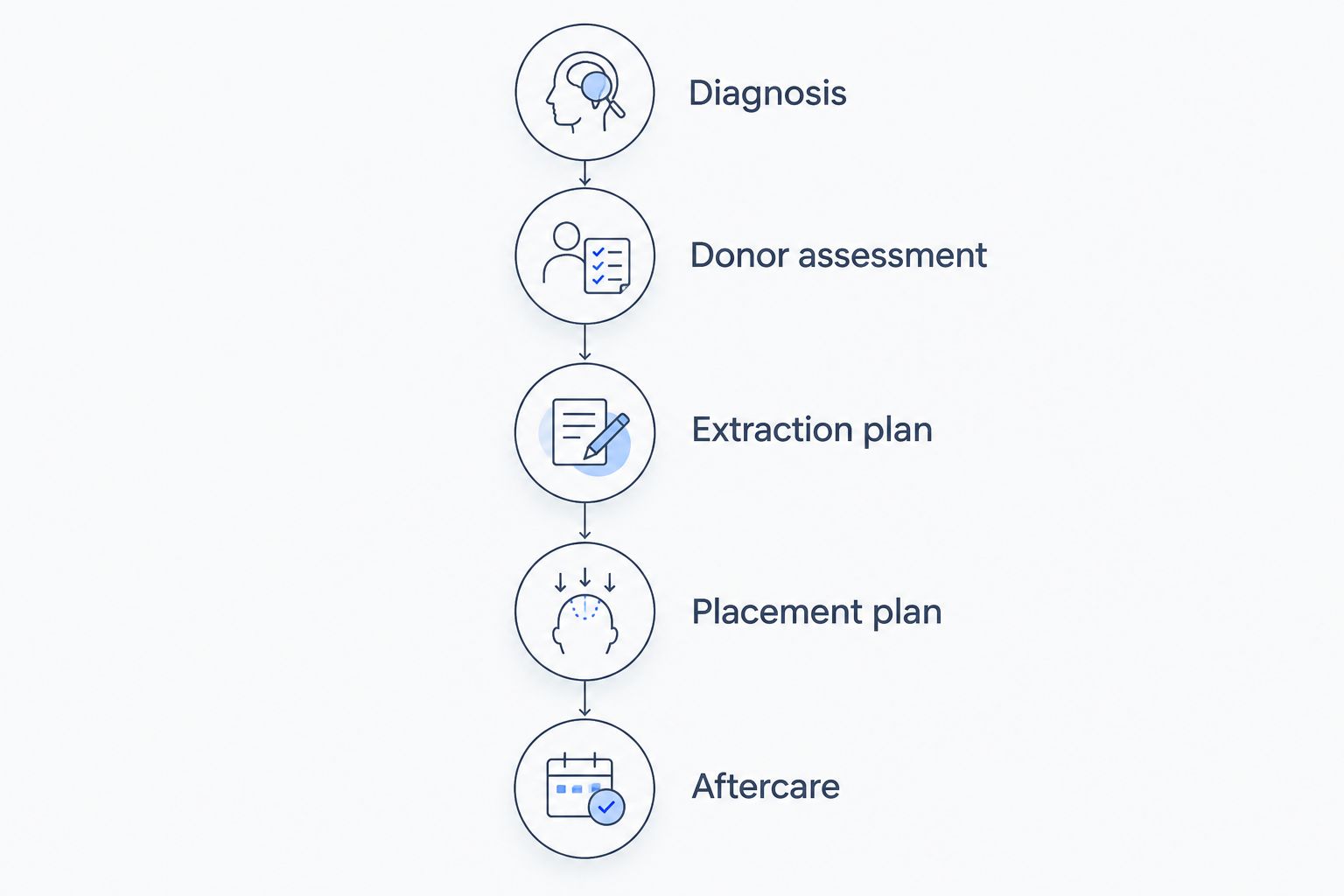
Ask who is responsible for each stage and request an explanation you understand. If a consultation jumps straight from a photograph to a technique recommendation, return to the diagnosis and donor questions.
The clinic's stated package includes 6-month post-procedure support. Confirm what that support covers and how later progress reviews are handled; a support period is not the same thing as a guaranteed final-result date.
Discuss your hair transplant options
Ask about donor assessment, technique selection and post-procedure support.
Which hair transplant technique should you choose?
Start with FUE if avoiding a linear scar is your main surgical preference, but let donor assessment determine whether it fits. Discuss FUT when you accept its scar trade-off, direct implantation when evaluating placement, and no-shave options when preparation visibility matters.
For 2026 planning, allow time for recovery and delayed growth rather than judging a procedure by immediate photographs. NHS patient guidance on hair transplantation advises particular care with grafts during the first 2 weeks and describes full results at 10–18 months. Follow your own surgeon's instructions for your operation.
Hair transplantation also does not stop ongoing loss in surrounding native hair. Ask whether you need a separate medical management plan, and understand its benefits and risks before starting treatment.
FAQ
What’s the best hair transplant technique in 2026?
There is no single best technique for every patient. FUE suits the goal of avoiding a linear scar, while FUT, implantation choices and shaving arrangements require separate assessment against your donor area and priorities.
Is DHI better than FUE?
DHI and FUE are not direct alternatives: DHI describes implantation, while FUE describes extraction. Ask the surgeon to explain both stages of the proposed operation rather than treating the labels as competing packages.
Does FUE leave no scars?
FUE leaves small individual scars rather than a linear strip scar. Their visibility depends on the procedure, healing, extraction distribution and how short you wear your hair.
Is FUT an outdated hair transplant technique?
FUT is a strip-harvesting method with a different scar pattern from FUE. Its suitability depends on donor assessment, scalp characteristics and whether you accept a linear scar—not simply on which technique sounds newer.
Can I get a hair transplant without shaving my head?
No-shave approaches are options for selected treatment plans. Confirm exactly which donor and recipient areas will remain unshaved, because the phrase does not describe one identical arrangement across clinics.
How long does it take to see the full hair transplant result?
NHS patient guidance describes full hair transplant results at 10–18 months. Early appearance is not the final outcome, and your surgeon should explain the expected review schedule for your procedure.
How do I compare hair transplant costs without choosing the wrong technique?
Compare written proposals with the same scope rather than choosing a technique from the quoted total alone. Check the harvesting method, proposed graft plan, clinician responsibilities, aftercare and exclusions before deciding.
One last thing
A hair transplant redistributes a limited resource: your existing donor hair. A more aggressive first procedure is not automatically a better lifetime plan.
Before agreeing to surgery in 2026, ask one question: what happens to this hairline if the surrounding hair continues to thin? A useful answer explains donor conservation, future treatment and the limits of the proposed result—not just how the first photograph should look.