
Choosing a hair transplant clinic in Vijayawada can feel simple at first. Many clinics promise dense hairlines, fast recovery, and natural results. Yet the best decision rarely comes from marketing alone. It usually comes from checking doctor qualifications, clinic safety, candidacy screening, and the honesty of the consultation.
That matters because hair transplant surgery is still surgery. A strong clinic will talk about donor area limits, graft counts, expected density, and recovery timelines with clarity. It will not promise instant fullness or guarantee the same result for every baldness case.
How to identify the best hair transplant clinic in Vijayawada
People searching for the best hair transplant clinic in Vijayawada often start with photos, ratings, and package prices. Those are useful, but they should not be the first filter. Official medical guidance places much more weight on verified qualifications, surgeon involvement, and proper clinical setup than on promotional claims.
The Indian Association of Dermatologists, Venereologists and Leprologists points people toward qualified dermatologists for hair and scalp concerns. The International Society of Hair Restoration Surgery also advises patients to ask about board certification, legitimate training, and whether the doctor performs enough hair restoration surgery to maintain skills. That is a much stronger starting point than a social media reel or celebrity-style ad.
Before shortlisting any clinic in Vijayawada, patients usually benefit from checking the basics first:
- Verified doctor credentials
- Surgeon-led consultation
- Clean OT setup
- Realistic graft estimate
- Clear aftercare plan
- Consistent follow-up access
A clinic that passes these checks is already in a much stronger position than one relying only on discounts.
Hair transplant doctor qualifications and medical team standards
A hair transplant clinic should have more than a recognizable brand name. It should have a qualified medical team and visible surgeon oversight. Recent Indian clinical establishment standards for hair transplant centres list staffing expectations that include at least one full-time doctor, a qualified nurse, an OT technician or assistant, and a backup anesthetist on call. Those details may sound technical, but they say a lot about whether the clinic takes safety seriously.
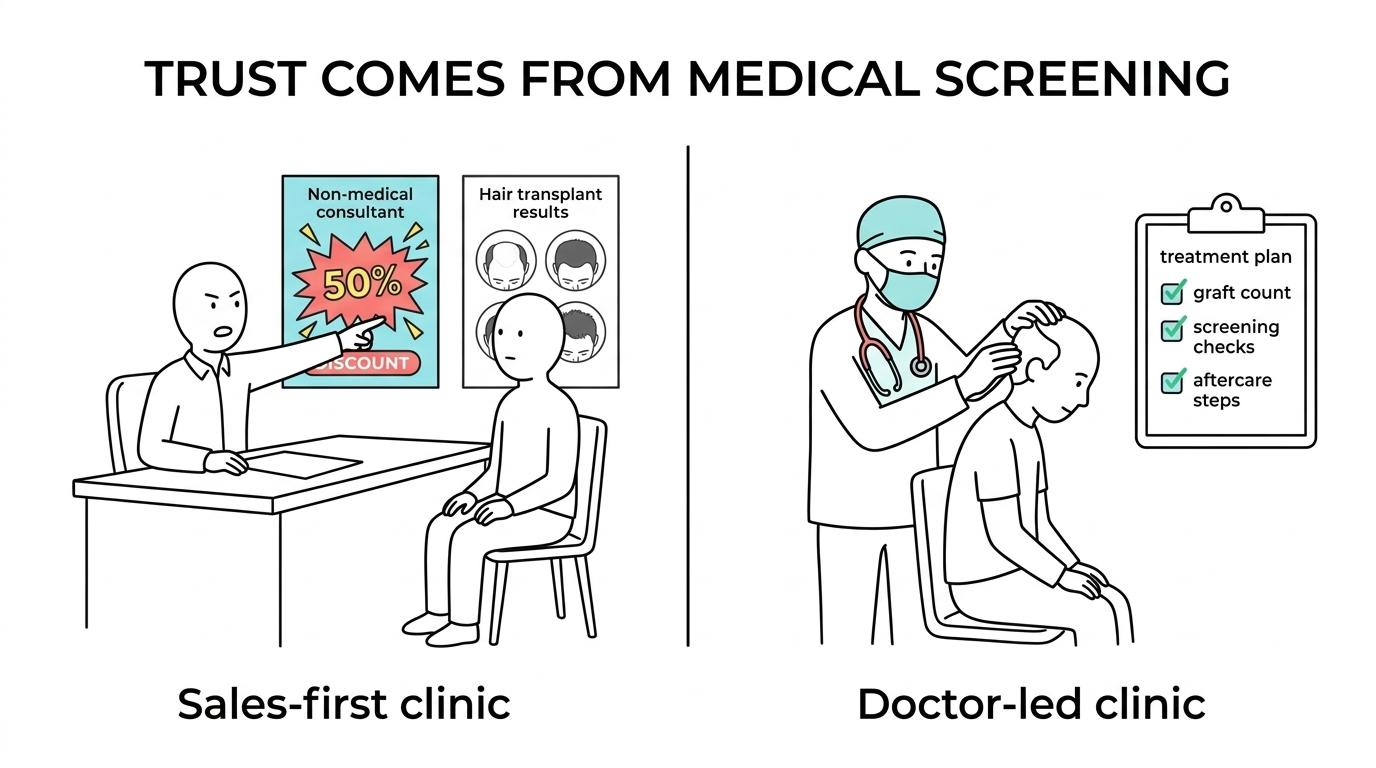
ISHRS guidance also supports asking whether the physician has additional training after residency and whether certification comes from a legitimate certifying board. In plain terms, patients should know who is planning the hairline, who is harvesting grafts, who is making recipient sites, and who is supervising the full surgery.
This is especially important in FUE and DHI hair transplant procedures, where precision changes the result. Hairline design, angle, direction, and donor extraction pattern are not small details. They shape the naturalness and permanence of the outcome.
A strong consultation should make these roles clear:
- Ask who designs the hairline: the surgeon should explain the logic based on age, facial proportions, and future hair loss
- Ask who performs the key surgical steps: harvesting and site creation should not be vague or hidden behind the term “team”
- Ask about training and case volume: regular hair restoration work helps maintain surgical judgment
- Ask about emergency readiness: a backup anesthetist and trained OT staff add an extra layer of safety
Hair transplant eligibility and candidacy screening in Vijayawada
Not everyone with thinning hair is a good candidate for a transplant right away. That is one of the most important signs of a trustworthy clinic. According to the American Academy of Dermatology, a dermatologist can tell a patient what results to expect if the person is a suitable candidate after an exam and tests. That means candidacy should be assessed, not assumed.
The best clinics in Vijayawada usually look at the pattern of baldness, donor strength, scalp health, age, ongoing shedding, family history, and medical background. Some patients need surgery. Others need hair loss treatment first, such as medication, PRP, or GFC hair therapy, so that native hair is stabilized before grafts are placed.
This step matters in common India-specific search cases too. A younger patient with early hairline recession, a patient asking for a no shave hair transplant, or someone with advanced baldness and limited donor supply may all need very different plans. There is no single package that suits every case.
Honest screening also means saying no when needed. A clinic that declines surgery for an unsuitable candidate often deserves more trust than one that approves every case in five minutes.
FUE, DHI, FUT, Sapphire, Bio FUE and hybrid hair transplant techniques
Technique matters, but only after the patient is properly assessed. The most searched options in India include FUE hair transplant, DHI hair transplant, FUT hair transplant, Sapphire FUE, Bio FUE, and hybrid methods. Each has a place, though not every branded variation changes the core medical logic.
FUE remains one of the most popular options because it avoids a linear scar and works well for many hairline, crown, and beard transplant cases. DHI is often promoted for direct implantation and controlled placement. FUT can still be useful in selected patients needing large graft counts. Sapphire and Bio FUE are usually positioned as refinements or add-on concepts rather than entirely separate categories. Hybrid hair transplant plans may combine techniques based on donor capacity and area coverage.
The right question is not “Which method is trending?” It is “Which method fits this scalp, this donor area, and this baldness pattern?”
| Technique | Common use case | Scarring profile | Shave requirement | Key point |
|---|---|---|---|---|
| FUE | Hairline, crown, medium to large sessions | Tiny dot scars | Often yes | Widely used and flexible |
| DHI | Focused placement, hairline detail, selected density work | Tiny dot scars | Partial or full, depends on case | Emphasis on implantation control |
| FUT | Larger graft needs in selected patients | Linear scar | Usually no donor shaving in strip area | May preserve donor graft numbers in some cases cases |
| Sapphire FUE | FUE with sapphire blade site creation | Tiny dot scars | Often yes | Marketed for fine channel creation |
| Bio FUE | FUE with supportive biologic add-ons | Tiny dot scars | Often yes | Add-on concept, not magic by itself |
| Hybrid method | Mixed donor and recipient planning | Depends on techniques used | Case based | Useful for customized planning |
A clinic that explains graft counts, density goals, and donor limitations in plain language is usually offering more value than one that only advertises a technique name.
Hair transplant cost in Vijayawada and what affects pricing
Hair transplant cost in Vijayawada varies for good reason. The price can change based on graft count, technique, surgeon involvement, clinic standards, and whether the plan includes medicines or adjuvant therapies. Comparing cost without comparing these details often leads to confusion.
A low-cost quote may exclude important parts of care. It may not include proper medical screening, post-op kits, follow-up visits, or meaningful surgeon time. A higher quote is not automatically better either. Patients should ask what they are paying for, not just how much.
When clinics discuss cost clearly, they usually cover these factors:
- Graft count: larger baldness cases need more time and donor planning
- Technique used: FUE, DHI, FUT, no shave options, and hybrid plans can differ in setup and time
- Doctor involvement: surgeon-led surgery may carry a different price structure
- Supportive treatment: medication, PRP, or GFC may be advised to protect existing hair
- Complexity of case: repair transplants, scar work, and crown correction often need added planning
Patients comparing Vijayawada with Hyderabad, Bangalore, Pune, or India overall should look at value, not just city-level pricing. The best clinic is rarely the cheapest one. It is usually the one that combines safety, planning, and believable results.
Hair transplant permanence, effectiveness, success rate and recovery timeline
One of the most common questions is whether a hair transplant is permanent. In many patients, transplanted grafts from a stable donor area are expected to keep growing over the long term. Still, permanence does not mean every existing hair is protected forever. Native non-transplanted hair can keep thinning, which is why many doctors advise maintenance treatment.
Effectiveness depends on several factors: donor quality, surgeon skill, graft handling, scalp condition, and realistic planning. Success rate is often advertised aggressively, but it is more honest to discuss survival and visual improvement as case-dependent outcomes. A clinic that speaks carefully about success is often more reliable than one that throws out dramatic percentages without context.
Recovery also has a timeline that patients should hear before surgery. The AAD notes that hair transplant surgery often lasts 4 to 8 hours. After the procedure, redness, scabbing, and mild swelling can happen. The NHS notes that hair transplants are generally safe, though there are small risks of infection, bleeding, scarring, and transplant failure. That balance is important. Safe does not mean risk-free.
A typical recovery pattern looks like this:
- Days 1 to 7: mild crusting, care with washing, no rubbing
- Weeks 2 to 6: transplanted hairs may shed, which is expected
- Months 3 to 4: early regrowth begins
- Months 6 to 9: visible improvement usually becomes clearer
- Months 10 to 12 and beyond: maturation, texture improvement, better fullness
A clinic promising instant density in two weeks is not setting honest expectations.
That is also why post-op care advice matters, since Iloveshampoo notes in its guide to silicone-free shampoo for daily care that gentler cleansing choices are often part of protecting the scalp while healing continues.
Reviews, before and after photos, and celebrity style marketing
Reviews matter, but they should sit behind medical checks, not ahead of them. A large number of positive reviews can signal patient satisfaction, yet website-hosted ratings remain self-reported proof. One Vijayawada clinic page, for example, reports a 4.8 rating from 583 reviews and mentions patient feedback about consultations with Dr. Lakshmi and staff explanations of the procedure. That is useful as a reference point, but it should still be paired with direct credential verification and an in-person consultation.
The same caution applies to before and after photos and celebrity or Bollywood-related hair transplant claims. Photos can be selective. Lighting, hairstyle, angles, and medication support can change the impression. Celebrity comparisons are popular search terms, but they should not decide a medical procedure. The better approach is to ask for results that match the patient’s own hair type, age, baldness grade, and donor availability.
Patients looking for the best place for hair transplant in India often compare Vijayawada with bigger markets like Hyderabad and Bangalore. City size alone does not determine quality. A focused clinic with experienced surgical oversight and clear patient screening can compete very well if the standards are right.
Questions to ask before booking a hair transplant consultation in Vijayawada
A first consultation should leave the patient better informed, not more pressured. The best clinics welcome direct questions because strong systems can stand up to scrutiny.
Useful questions include surgeon qualifications, suitability for FUE or DHI, estimated graft count, whether a no shave hair transplant is possible, likely density, medication support, and the expected timeline for visible growth. Patients may also ask about beard transplant or eyebrow restoration if those are relevant concerns, since donor planning can affect multiple goals.
A smart consultation does not need exaggerated promises. It needs clarity, medical sense, and a plan built around the patient’s real hair loss pattern. When a clinic in Vijayawada offers that level of guidance, the search becomes much easier and much safer.