Choosing a hair transplant clinic in Vijayawada is rarely about finding the loudest claim or the lowest quote. It is about matching the right procedure to the right scalp, with the right doctor and the right aftercare. That is what shapes a natural hairline, steady graft survival, and a result that still looks right months later.
People searching for the best hair transplant in Vijayawada usually want the same answers: Will it look natural? Is it safe? How much will it cost? Is it permanent? Those are the right questions. A better comparison starts with candidate selection, donor supply, technique, medical supervision, and recovery planning rather than city-level marketing.
What defines the best hair transplant in Vijayawada
A strong result depends more on how follicular grafts are planned and placed than on the city name attached to the clinic. Modern hair restoration works by moving healthy hair follicles from a donor area, usually the back or sides of the scalp, into thinning or bald areas. The American Academy of Dermatology notes that transplanting hairs a few at a time creates more natural-looking results than older plug-style methods.
That makes consultation quality a major filter. A clinic may sound impressive online, but the real test is whether the medical team studies donor density, scalp condition, baldness pattern, age, family history, and future hair-loss risk before discussing graft numbers. The best choice is usually not the fastest promise. It is the one that makes medical sense for the patient’s present hair loss and future pattern.
A patient comparing clinics in Vijayawada should look for a few core signs of quality:
- Doctor oversight: clear involvement of a licensed doctor in planning, hairline design, extraction, and implantation
- Donor planning: realistic use of donor supply without aggressive overharvesting
- Natural placement: careful angle, direction, and density in the recipient area
- Facility standards: sterile setting with structured postoperative care
- Case transparency: real before-and-after photos with similar baldness cases
Hair transplant techniques in Vijayawada: FUE, DHI, FUT, Sapphire, Bio FUE, and hybrid methods
Most people researching hair transplant techniques in India come across FUE, DHI, and FUT first. FUE, or follicular unit excision, is widely used because it is minimally invasive, heals relatively quickly, and can produce natural-looking results. DHI is often presented as a more direct implantation approach. FUT removes a strip from the donor area and can still be suitable in selected cases where higher graft needs and donor characteristics make it a practical choice.
Sapphire and Bio FUE are often discussed as refined or branded variations in how channels are created or how graft handling is approached. Hybrid methods combine elements of more than one technique based on the hairline, crown, donor strength, or the need for denser placement in selected zones. In Vijayawada, as in Pune, Hyderabad, or Bangalore, the “best technique” is case-specific.
| Technique | How it is generally used | May suit | Key points to compare |
|---|---|---|---|
| FUE | Individual follicular units are extracted and implanted | Many common male pattern baldness cases | Fast recovery, no linear scar, donor management matters |
| DHI | Grafts are implanted with a direct placement approach | Hairline-focused work, selected density planning | Precision is a major selling point, but doctor skill still decides the result |
| FUT | A donor strip is removed and dissected into grafts | Higher graft demand in selected patients | Can preserve donor efficiency in some cases, leaves a linear scar |
| Sapphire FUE | FUE with sapphire blade channel creation | Patients comparing fine incision claims | Better branding does not replace surgical skill |
| Bio FUE | FUE combined with supportive biologic or regenerative elements | Patients wanting an added regrowth-focused plan | Best seen as an approach variation, not magic |
| Hybrid | Mix of techniques for different scalp zones | Complex baldness cases | Useful when one method alone is not ideal |
Some clinics also discuss no shave hair transplant options. This can be appealing for professionals who want a more discreet return to work, but it is not ideal for everyone. It may suit smaller sessions, selective density work, or hairline correction rather than very large graft counts.
Hair transplant safety in Vijayawada and common red flags
Hair transplant safety depends on who performs the procedure, where it is performed, and how aftercare is handled. Expert guidance from India’s aesthetic plastic surgery community consistently points to the same basics: licensed professionals, accredited or properly equipped facilities, sterile technique, and monitored recovery. Those are stronger safety signals than luxury interiors or dramatic advertising.
A clinical review of FUE also points out that complications can include pain, swelling, bleeding, infection, folliculitis, donor depletion, and unnatural-looking results. That is why patient selection and postoperative care matter so much. A safe clinic does not act as though hair transplantation is a salon service. It treats it as minor surgery that needs protocols.
Red flags usually show up early in the process:
- guaranteed results
- heavy discounts without medical discussion
- unclear surgeon identity
- oversized graft promises in one sitting
- no donor analysis
- no written aftercare plan
- edited photos with poor lighting consistency
Hair transplant cost in Vijayawada and how to judge value
Hair transplant cost is one of the biggest search themes across India, and Vijayawada is no different. Yet cost alone does not tell much. Some clinics quote by graft count. Others use package pricing. Some include aftercare, follow-ups, medicines, or supportive therapies like PRP or GFC, while others charge these separately.
Value comes from what the patient actually receives: proper diagnosis, realistic graft planning, safe extraction, thoughtful implantation, and follow-up support. A cheaper procedure that damages the donor area or creates an unnatural hairline can cost far more later in repair work. Hair transplant correction is usually more demanding than first-time surgery.
A better cost comparison looks at structure rather than just the headline number.
- Graft count: how many grafts are truly needed for the frontal zone, mid-scalp, or crown
- Technique choice: FUE, DHI, FUT, Sapphire, Bio FUE, or hybrid planning
- Doctor involvement: who performs the critical surgical steps
- Aftercare: reviews, medicines, washing guidance, and follow-up visits
This is also why “best hair transplant clinic” queries should not be answered with a simple cheapest-price list. Cost should fit the baldness stage, donor capacity, and expected long-term plan.
Hair transplant results timeline, permanence, effectiveness, and success rate
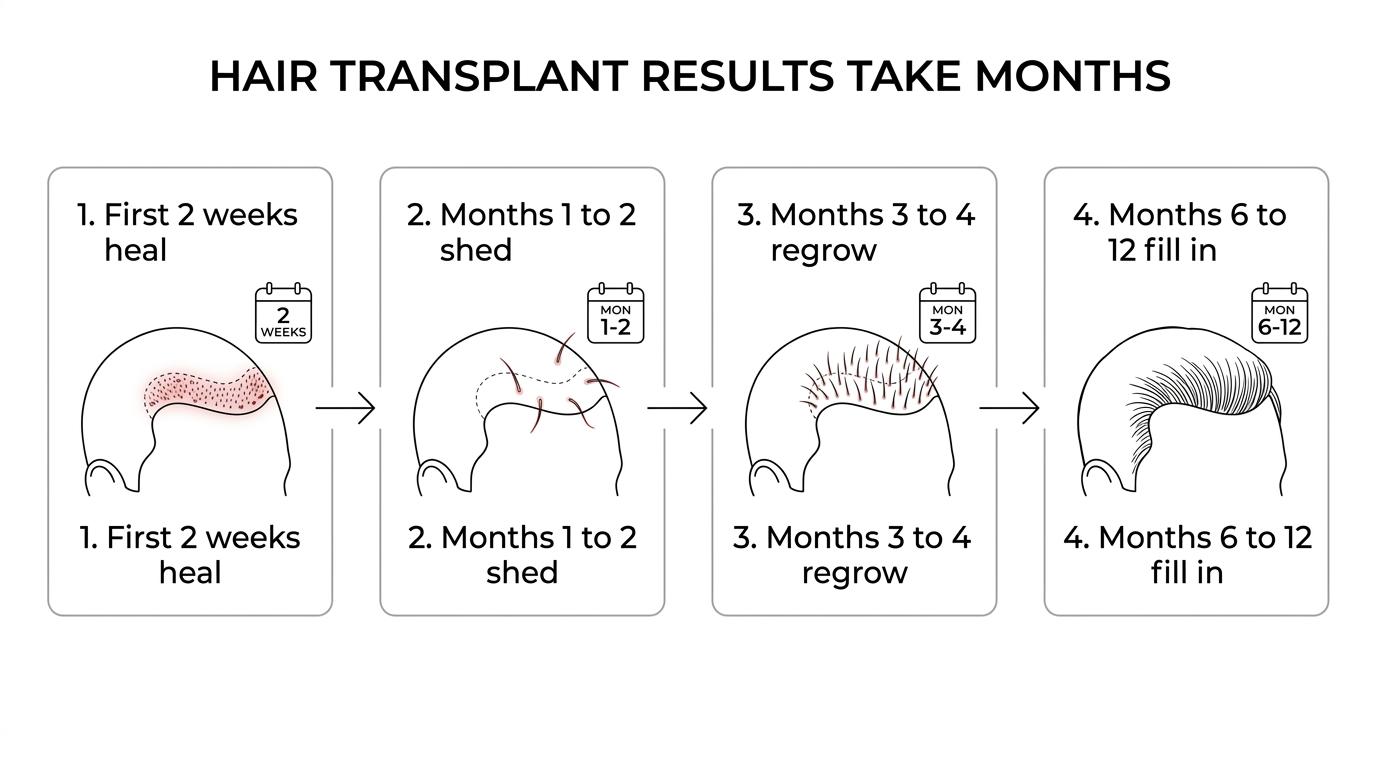
People often want fast proof. Hair transplantation does not work on a social-media timeline. According to the American Academy of Dermatology, many patients begin seeing real results around 6 to 9 months, while some take up to 12 months. Early shedding after transplantation can happen and is usually part of the process rather than a sign of failure.
Permanence also needs a clear explanation. Transplanted hairs are typically taken from donor zones that are more resistant to pattern baldness, so those follicles often continue to grow in the new location. That said, native non-transplanted hair around them can still thin over time. A good clinic plans for both present density and future loss, which is why some patients may also be advised to consider medical maintenance.
Effectiveness depends on several factors working together: donor quality, recipient area blood supply, surgical handling of grafts, hairline design, aftercare, and case selection. No ethical clinic should promise the same success rate for every patient. A younger patient with rapid ongoing hair loss, weak donor density, or advanced baldness may need a more conservative design than someone with stable loss and strong donor hair.
A realistic timeline usually looks like this:
- First 2 weeks: scabs, redness, and early healing
- First 1 to 2 months: transplanted hairs may shed
- Months 3 to 4: early regrowth begins
- Months 6 to 9: visible cosmetic improvement
- Up to 12 months: fuller maturation in many cases
Hair transplant eligibility for different baldness cases
Not every person with thinning hair is a ready transplant candidate. Good candidacy depends on having enough healthy donor hair and a scalp area that can support transplanted growth. This can apply to male pattern baldness, some female pattern thinning cases, beard restoration, eyebrow restoration, and selected scar coverage cases, but the evaluation is never one-size-fits-all.
Advanced baldness cases need especially careful planning. A Norwood 5, 6, or 7 pattern may not have enough donor supply to recreate teenage density across the entire scalp. In those situations, the best clinics in Vijayawada usually focus on strategic improvement, often prioritizing the frontal hairline and mid-scalp where cosmetic impact is highest. Honest planning is a good sign, not a drawback.
Some people asking about celebrity or Bollywood hair transplant stories are really asking whether dramatic transformation is possible. Sometimes it is. Still, celebrity examples are poor decision tools because public photos do not reveal donor limitations, number of sessions, maintenance treatments, or image editing. Real clinic case galleries that match the patient’s own hair-loss stage are far more useful.
When a hair transplant may not be the first step
A transplant may be delayed or declined when hair loss is too active, donor hair is weak, the scalp has untreated disease, or expectations are unrealistic. In those cases, the better path may start with medical treatment, PRP or GFC support, or simply a longer observation period before surgery is planned.
Comparing Vijayawada with Pune, Hyderabad, Bangalore, and India-wide options
People often search for the best hair transplant in Hyderabad, Pune, Bangalore, or India overall and then compare travel, pricing, and doctor access. That is sensible, but geography should remain secondary to medical quality. A patient in Vijayawada may find a strong option locally if the clinic offers solid diagnosis, documented results, experienced surgical planning, and reliable follow-up.
India is also a common destination in “best country for hair transplant” and “best place for hair transplant” searches because of its broad clinic network, varied technique options, and pricing that can be more accessible than many international markets. For NRI and overseas patients, remote consultation by phone, video call, or photo review can help narrow options before travel. Clinics that begin with a computerized hair and scalp check and then recommend treatment only after review present a more structured path than generic booking funnels.
That structure matters even more when comparing branded methods. A clinic may promote Active FUE, DFI, or hybrid restoration, but the patient should still ask the same core questions: Who is the doctor? What is the graft plan? Is the donor adequate? What will recovery look like? A polished label cannot rescue poor case selection.
Questions to ask at a Vijayawada hair transplant consultation
The consultation should feel specific. If the same pitch is given to every patient regardless of age, baldness stage, or donor strength, that is not a strong sign. Better consultations are detailed, measured, and visual. They usually include scalp examination, donor analysis, hairline planning, graft estimates, and a discussion of recovery and maintenance.
Useful questions can keep the conversation grounded in facts:
- Who does the surgery: doctor-led steps versus technician-only handling
- How many grafts are advised: and why that number fits the donor supply
- Which technique is advised: FUE, DHI, FUT, Sapphire, Bio FUE, hybrid, or no shave
- What recovery should be expected: swelling, scabbing, washing, return to work
- What photos can be shown: similar baldness cases in consistent lighting
- What happens after the procedure: reviews, medicines, and follow-up support
The strongest choice is usually the clinic that gives the clearest medical reasoning, not the one with the boldest sales pitch. For Vijayawada patients, that is the standard worth using whether the clinic is local or part of a wider India-based hair restoration network.