
Hair transplant timing is one of the biggest factors behind a natural result. Many people start searching as soon as the hairline begins to recede or the crown starts to thin, but early concern does not always mean early surgery is the best move. In many cases, a better result comes from waiting until the pattern of loss is clearer and the donor area can be measured properly.
This is why the question is not simply “What is the best age for a hair transplant?” The better question is: when has hair loss reached a stage where long-term planning is possible? Hair transplant effectiveness, safety, permanence, graft usage, and even future cost all connect back to that decision.
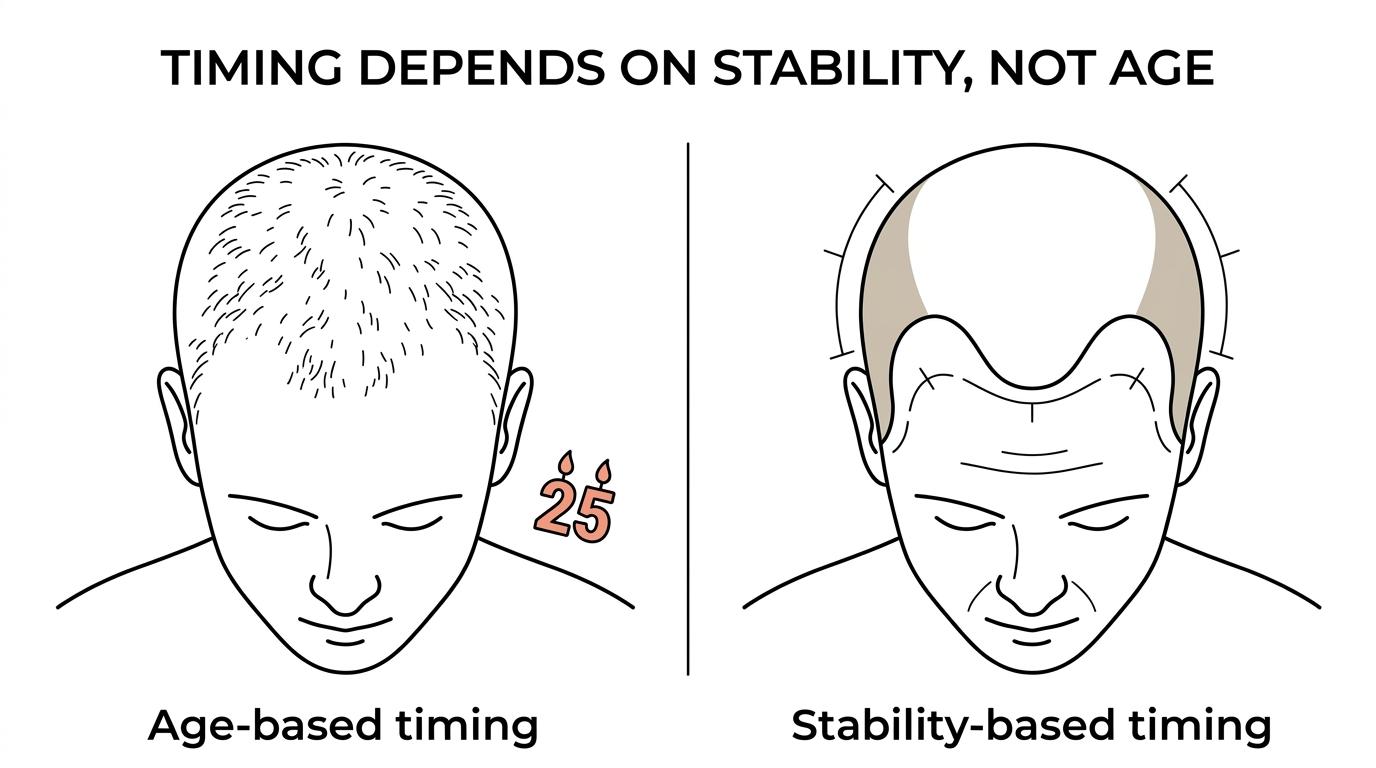
Best time for a hair transplant depends on hair loss stability
A hair transplant works by moving healthy follicles from a donor area, usually the back and sides of the scalp, into thinning or bald areas. Those donor follicles are limited. Once used, they cannot be replaced. That is why timing matters so much.
Medical guidance often points to the same idea: stable pattern, adequate donor hair, and realistic design matter more than any single age number. If a person is still losing hair rapidly, a new hairline or dense frontal transplant can look disconnected later as native hair continues to thin behind it. A strong result is not only about what looks good today. It also needs to make sense five or ten years later.
In practice, many clinics first assess whether the hair loss pattern has become predictable enough to plan for future baldness. This can include recession at the temples, thinning in the mid-scalp, crown loss, miniaturization rate, family history, and donor density in the safe donor area.
A transplant usually makes more sense when the hair loss pattern can be mapped with reasonable confidence.
Hair transplant age: when younger patients should wait
Age matters, but not in a rigid way. Most reputable specialists are cautious with very young patients because early hair loss can still change quickly. Industry guidance often notes that hair transplant surgery is generally not recommended for most people under 20, and many specialists are also careful with patients under 21 because pattern and progression may not be fully revealed.
This does not mean every patient in the early 20s is automatically a poor candidate. It means that age alone cannot approve a case. A 24-year-old with stable recession, good donor hair, and sensible expectations may be a better candidate than a 32-year-old with diffuse, aggressive thinning and weak donor reserves.
The main concern in younger patients is long-term design. A hairline that looks thick and low at 22 may look unnatural at 35 if native hair loss continues around it. That is why experienced planning often favors conservative, age-appropriate placement over an aggressive teenage-style hairline.
Many patients looking up celebrity hair transplant results or Bollywood hair transplant rumors only see the after photos, not the timing strategy behind them.
Hair loss stage, donor hair, and graft count planning
Hair transplant candidacy usually becomes clearer when hair loss stage and donor area are reviewed together. In male pattern baldness, clinics often refer to Norwood scores. Early stages may show minor temple recession. Advanced stages may involve large bald areas across the frontal scalp, mid-scalp, and crown.
A transplant is often strongest when enough donor hair exists to cover priority zones without exhausting future options. In advanced baldness cases, the question is not whether surgery is possible, but whether the available grafts can create useful, balanced coverage.
The table below gives a simple timing guide.
| Hair loss situation | Timing view | Main concern |
|---|---|---|
| Early shedding with unclear pattern | Usually wait and monitor | Pattern may still change quickly |
| Mild recession with stable pattern | Often a reasonable time to assess surgery | Hairline design must stay age-appropriate |
| Frontal loss with good donor density | Common transplant candidate | Graft count planning is key |
| Crown thinning only, still progressing | Often monitored first | Crown can consume many grafts |
| Diffuse thinning across the scalp | Careful evaluation needed | Donor and recipient areas both may be weak |
| Advanced baldness with limited donor hair | Selective or staged surgery only | Coverage expectations must be realistic |
When specialists assess timing, they often look for signs like these:
- Stable or slow-moving recession
- Adequate donor density
- Clear frontal or crown pattern
- Predictable progression: future hair loss can be planned around
- Realistic goals: density, coverage, and hairline match available grafts
- Healthy scalp status: no untreated disease causing active shedding
Graft count planning also shapes the right time for surgery. A patient needing 1500 to 2200 grafts for a hairline and frontal zone is in a very different situation from someone needing 4000 or more grafts for broad top coverage. Bigger sessions can be done, but they raise the stakes for donor management, recovery planning, and total hair transplant cost.
When it is better to wait before getting a hair transplant
Surgery is not always the first step. Many patients are advised to start with non-surgical hair loss treatment first, especially when the shedding is recent or the pattern is still changing.
This is common in younger patients, people with diffuse thinning, and those whose hair loss may be related to a medical issue rather than only pattern baldness. If an underlying condition is driving shedding, treating that issue comes before transplant planning.
Even for people who will likely get surgery later, a waiting period can be useful. It allows clinics to track stabilization, estimate future graft needs, and see whether existing hair can be strengthened with treatment. That can improve hair transplant success rate because the procedure is then placed into a more predictable scalp environment.

Popular non-surgical options often used before or after transplant include:
- Hair loss medicines
- GFC hair therapy
- Low-level supportive care
- Scalp assessment: computerized hair analysis and miniaturization tracking
- Maintenance planning: protecting native hair around transplanted grafts
This point is often missed in online “best clinic” or “best country for hair transplant” searches. The best answer is not the fastest booking. It is the clinic that knows when to say wait.
Hair transplant techniques and timing: FUE, DHI, FUT, Sapphire, Bio FUE, hybrid, and no shave options
Technique matters, but technique does not replace timing. A patient with unstable hair loss is still a risky planning case whether the clinic offers FUE, DHI, FUT, Sapphire hair transplant, Bio FUE, or a hybrid method.
FUE is widely chosen because it allows individual follicle extraction and usually avoids a linear strip scar. DHI is often marketed for direct implantation and controlled placement, especially in hairline work. FUT may still make sense in selected high-graft cases where donor characteristics support it. Sapphire tools, Bio FUE add-ons, and hybrid combinations are often discussed for precision, channel creation, or supportive handling, though outcomes still depend most on planning, donor quality, and surgical execution.
No shave hair transplant options also attract professionals and public-facing patients who want privacy. These can be useful in selected cases, though they are not ideal for every graft count or scalp condition.
A technique discussion should come after the timing discussion, not before it.
| Technique | Best known for | Timing reminder |
|---|---|---|
| FUE hair transplant | Flexible graft extraction, common in India | Works best when donor management is planned well |
| DHI hair transplant | Controlled placement in selected areas | Good timing still matters more than device choice |
| FUT hair transplant | Large graft numbers in selected candidates | Useful only when donor strip planning is suitable |
| Sapphire hair transplant | Channel creation precision | Marketing term should not distract from candidacy |
| Bio FUE | Supportive add-on interest | Not a fix for poor timing or poor donor supply |
| Hybrid methods | Combined planning for complex cases | Best for tailored cases, not rushed decisions |
| No shave hair transplant | Low-visibility recovery | Not every patient is a candidate |
Hair transplant cost, safety, permanence, success rate, and recovery timeline
Hair transplant cost in India depends on graft count, clinic quality, surgeon-led planning, city, and technique. A patient comparing Pune, Hyderabad, Bangalore, or India overall will often see a wide range. Lower pricing can look attractive, but timing mistakes can become far more expensive than the first quote.
Safety deserves the same attention as cost. A proper clinic should assess candidacy, explain expected graft numbers, discuss hair transplant recovery, and be able to handle complications quickly if they arise. Safety also includes saying no to surgery when the donor area is weak, hair loss is unstable, or expectations are not realistic.
Hair transplant permanence is often misunderstood. Transplanted follicles from the safe donor area are generally long-lasting. That does not mean all scalp hair is protected forever. Native non-transplanted hair can continue to miniaturize over time. That is why maintenance treatment is often recommended even after a successful procedure.
Hair transplant success rate is also tied to planning. Strong growth depends on donor quality, surgical handling, recipient site design, scalp health, and aftercare. The most natural result usually comes from a conservative plan that protects future options instead of using too many grafts too soon.
Recovery follows a pattern that many patients should know before choosing their timing window:
- First days: redness, swelling, scabs, and washing instructions
- 2 to 8 weeks: transplanted hair often sheds, which is expected
- By month 3: the area can look thinner before visible regrowth starts
- Months 4 to 8: new growth becomes easier to see
- Months 9 to 12: density and texture keep improving
- Longer-term review: crown cases and larger sessions may need more time
This timeline is important for people planning around weddings, public appearances, travel, or work commitments.
Best clinic and best place in India for hair transplant timing
People often search for the best hair transplant clinic, the best place for hair transplant, or the best country for hair transplant. Those searches usually focus on price, before-and-after photos, and famous patient cases. Timing should be part of that shortlist.
India remains a major destination because it offers broad access to hair restoration care, modern FUE and DHI options, and a cost range that is often more favorable than many international markets. Cities like Pune, Hyderabad, and Bangalore are common search hubs because patients want both quality and convenience.
A good clinic choice should be based on how well the assessment is handled, not only on how many grafts are promised. Clinics that rush to transplant every young patient or offer an unrealistically low hairline are often creating tomorrow’s repair case.
A stronger clinic conversation usually includes questions like these:
- Hair loss stage: what Norwood score or thinning pattern is present now?
- Donor area: how many grafts are safely available today and later?
- Future hair loss: what happens if native hair keeps thinning?
- Technique fit: is FUE, DHI, FUT, Sapphire, Bio FUE, hybrid, or no shave actually suitable?
- Cost clarity: is pricing based on grafts, session, or package?
- Recovery timeline: when can normal work, exercise, and travel resume?
What a proper hair transplant consultation should assess
A solid consultation should do more than confirm baldness. It should check whether this is the right time for surgery and whether the donor supply can support a natural result.
That usually includes scalp examination, donor density review, family history, current pattern, miniaturization, likely future progression, and realistic hairline design. In selected cases, clinics may also suggest waiting, starting medicine first, or combining transplant surgery with PRP or GFC-based maintenance.
For many patients, the right answer is not “as early as possible.” It is “when the pattern is stable enough to plan well, the donor area is strong enough to support the goal, and the result can still look natural years from now.” That is the timing most likely to deliver a safe, effective, and lasting hair transplant.