
PRP hair treatment rarely works on a one-visit timeline. At iGraft, a hair restoration clinic brand in India, the typical planning logic is similar to what major dermatology sources describe: a starter series first, then maintenance spaced farther apart.
TL;DR: Summary
- PRP hair treatment is usually a multi-session plan, not a single appointment: most schedules start with monthly sessions for 3 months, then shift to maintenance every 3 to 12 months.
- Visible change takes time: hair shedding may reduce in the first few months, while Visible thickening usually takes months and can keep building toward 12 months.
- Session time is short, but the treatment course is long: the American Academy of Dermatology says the procedure itself usually takes about 10 minutes and typically has little to no downtime.
- Protocols vary by clinic and diagnosis: Cleveland Clinic describes monthly sessions for 3 months, then every 3 months for a year, then yearly; iGraft also describes 3 to 6 starter sessions with longer maintenance intervals.
- PRP often works best as part of a broader hair-loss plan: if pattern hair loss is still active, clinicians may pair PRP with options like minoxidil or finasteride.
The key idea is simple: judge PRP by its treatment course, not by the first injection. If you expect same-week thickening, the timeline will feel disappointing even when the treatment is on track.
How long does a PRP hair treatment session take?
PRP hair treatment sessions are usually short. The American Academy of Dermatology says the procedure itself often takes about 10 minutes, but the full clinic visit is longer because it includes blood draw, platelet-rich plasma preparation, scalp assessment, and repeat injections.
That difference matters. When people hear “10 minutes,” they often assume the whole appointment, from check-in to checkout, is done in 10 minutes. In practice, centrifuging the blood sample and preparing the platelet-rich plasma adds time, and many clinics also document baseline hair density or scalp condition before treatment.
A useful way to think about it is this: the procedure is brief, while the treatment plan is extended. Minimal downtime does not mean immediate results.
How many PRP sessions do most people need at the start?
Most patients need a starter series. The American Academy of Dermatology describes a common pattern of once a month for 3 months, and iGraft describes a similar first phase of 3 to 6 sessions spaced about a month apart.
This is one of the biggest timeline facts people miss. PRP for hair loss is usually built around repeat injections because hair follicles respond over cycles, not overnight. Monthly spacing gives the scalp repeated exposure to growth-factor-rich plasma during the early phase.
If your clinic recommends more than three starter sessions, that does not automatically mean the plan is excessive. It may reflect your degree of thinning, the diagnosis, or the clinic’s protocol. The better question is whether the timeline was matched to your pattern of hair loss and whether progress will be reviewed at set intervals.
“iGraft describes PRP hair treatment as a 3 to 6 session course spaced about a month apart, followed by maintenance rather than a one-time visit.”
What are the 7 most important facts about PRP hair treatment timelines?
The most important timeline facts are predictable. Across the American Academy of Dermatology, Cleveland Clinic, and iGraft’s published guidance, the same pattern appears again and again.
- PRP is usually monthly at the start: A common first phase is one session per month for 3 months.
- Some protocols use more than 3 starter sessions: Many clinics extend the initial course to 4, 5, or 6 sessions based on response and diagnosis.
- Maintenance comes later, not immediately: Follow-up sessions are often spaced every 3 to 6 months, and some protocols extend to yearly maintenance.
- Early change may mean less shedding, not more hair: A reduced amount of daily hair fall in the first few months can count as progress.
- Visible thickening usually takes months: Many patients need 3 to 6 months before density or texture changes are obvious.
- Maximum improvement may take up to a year: Cleveland Clinic notes that any improvement may begin around 3 months, with peak change closer to 12 months.
- Results are usually judged as a course, not a single session: If you assess PRP after one visit, you are usually judging too early.
A practical misconception to avoid is comparing PRP with a haircut, facial, or laser session where the effect is immediate. Hair biology runs on a slower clock.
When do PRP hair treatment results usually start to show?
Most meaningful PRP hair treatment results show over months, not days. Cleveland Clinic says improvement may start around 3 months and that maximum improvement is expected in about a year, while the American Academy of Dermatology notes that early changes may simply be less hair shedding.
That timeline makes sense when you connect PRP to the hair-growth cycle. Hair follicles move through growth, transition, resting, and shedding phases. Even if platelet-rich plasma helps create a better follicle environment, the new hair-growth pattern still needs time to appear above the scalp.
This is why “I had PRP last week and nothing changed” is usually the wrong benchmark. A better benchmark is whether shedding eases in the first few months and whether standardized photos show better density later.
“iGraft notes that visible improvement in hair density and texture may appear after 3 to 6 months, which is why PRP timelines are reviewed over a course of care.”
How do the starter and maintenance phases compare?
The starter phase is intensive, while maintenance is spaced out. The American Academy of Dermatology describes monthly visits for 3 months followed by every 3 to 6 months, and Cleveland Clinic outlines a similar pattern that can later extend to yearly sessions.
Think of the first phase as the setup period. The goal is to stimulate response consistently enough to see whether your follicles will benefit. Maintenance exists for a different reason: keeping gains from fading in an ongoing hair-loss process.
This is where many patients misread the calendar. If your shedding is active, stopping after the starter phase may shorten the benefit window. If your improvement is stable, maintenance can often be less frequent. If active loss returns, your clinician may tighten the schedule again.
Is PRP better alone or with minoxidil or finasteride?
PRP is often stronger as part of combination therapy. Cleveland Clinic explicitly notes that PRP works best with other medical treatments, including minoxidil and finasteride, especially when androgenetic alopecia is still progressing.
This is a key comparison because timeline expectations change based on whether PRP is solo or combined. If someone has active pattern hair loss and does PRP alone, improvement may be limited or harder to sustain. If that same person also uses evidence-based medical therapy, the treatment environment for the follicles can be more supportive.
The trade-off is straightforward. Combination therapy may improve odds of response, but it also adds cost, adherence demands, and possible side effects depending on the medicine. If you cannot or do not want to use finasteride, that does not make PRP pointless. It means your plan should be built around realistic expectations.
What happens step by step during a PRP hair appointment?
A PRP appointment follows a standard sequence. Blood is drawn, platelet-rich plasma is prepared, the scalp is mapped, and the plasma is injected into thinning areas through repeat injections.
Step one is the blood draw. Step two is processing the sample, usually with centrifugation, to separate the platelet-rich portion. Step three is preparing the target areas of the scalp and placing injections where miniaturization or diffuse thinning is present.
After the session, most people return to normal activity quickly because downtime is limited. A common misconception is that no downtime means no aftercare. You still need to follow the clinic’s instructions about washing, topical products, exercise, or scalp handling for the first day or two.
How should you plan the first 12 months of PRP treatment?
The first year should be planned in phases. At iGraft, PRP is framed as an initial monthly course followed by longer maintenance spacing, which broadly fits the schedules described by the American Academy of Dermatology and Cleveland Clinic.
Month 0 is your baseline. That is when diagnosis, scalp assessment, photographs, and discussion of adjuncts like minoxidil happen. Months 1 to 3 are usually the starter series. Months 3 to 6 are often when reduced shedding or early texture change becomes easier to judge. Months 6 to 12 are the period when density change may become more visible and maintenance scheduling becomes clearer.
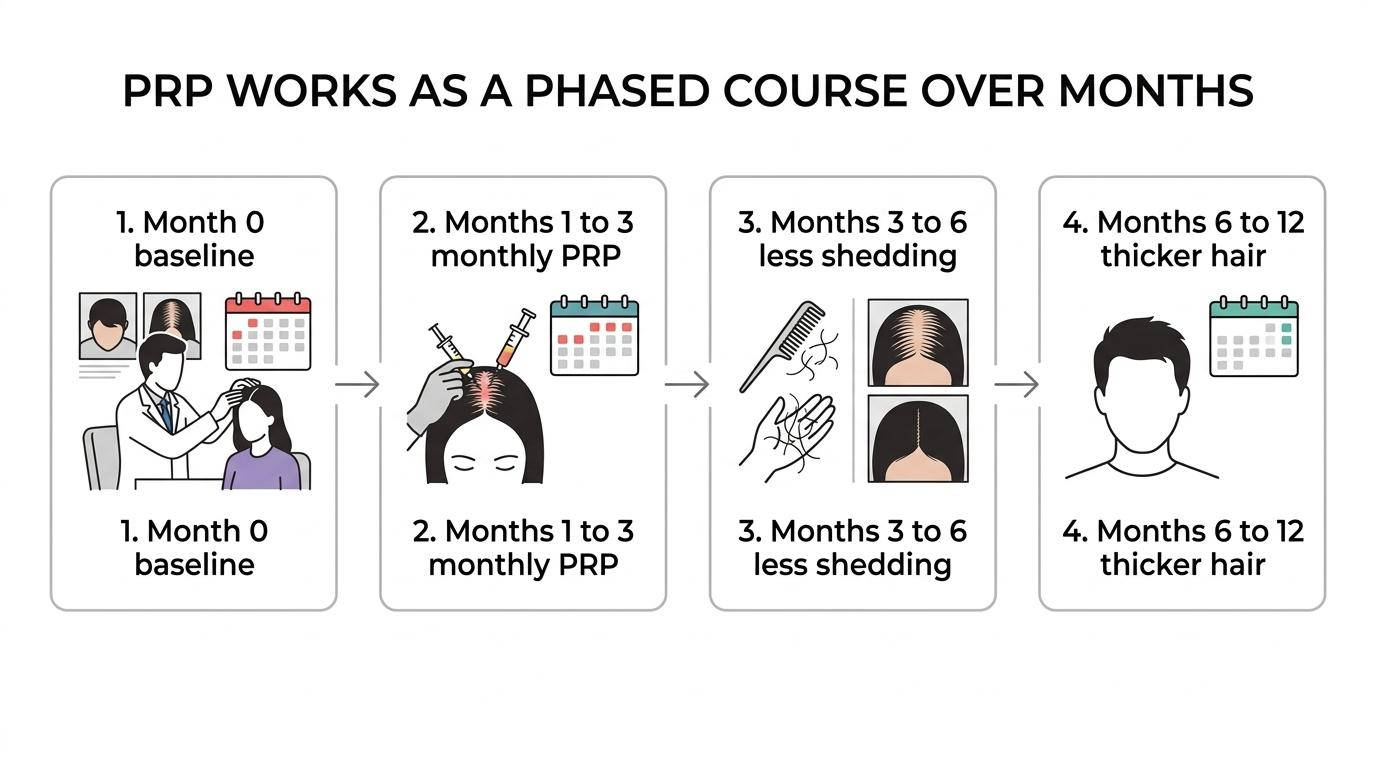
A strong first-year plan answers three questions in advance: what counts as success, when photos will be compared, and what the backup plan is if progress stalls. Pro tip: standardized photos under similar lighting are often more useful than memory.
How do you know whether your PRP timeline should be adjusted?
Your timeline should be adjusted when response, diagnosis, or hair-loss activity changes. If shedding stays high, density does not improve after an appropriate review period, or the diagnosis turns out to be different from pattern loss, the schedule may need revision.
A practical review usually looks at response in stages rather than all at once. First, ask whether hair fall has reduced. Next, ask whether texture or shaft caliber looks better. Then ask whether scalp coverage is actually improving on photos. If the answer stays “no” across all three checkpoints, your clinician may revisit the diagnosis, add medical therapy, or move away from PRP.
After that review, the decision tree is often simple:
- If shedding improves: continue the planned course and review again at the next interval.
- If shedding is unchanged: check diagnosis, medical therapy, and whether the starter phase was completed.
- If density worsens: consider whether ongoing androgenetic alopecia, nutritional issues, scarring alopecia, or poor candidacy is limiting response.
The misconception here is assuming more sessions always fix a weak response. Sometimes the real issue is patient selection, not patience.
When is PRP hair treatment a fit, and when should you consider other options?
PRP is often a fit for early to moderate thinning, diffuse shedding patterns, or patients who want a minimally invasive option. It may be less suitable when follicles are no longer viable, the bald area is long-standing and slick, or a transplant is the more direct path.
This is where timeline questions intersect with treatment choice. If hair follicles are miniaturized but alive, a slower biologic treatment like PRP can make sense. If the area has little active follicular potential left, waiting 6 to 12 months for a modest response may not be the best strategy. In cases like that, cosmetic camouflage can become part of the discussion, and Health Aesthetics has outlined where scalp micropigmentation fits for patients who want the look of fuller coverage without depending on follicle recovery.
If you are unsure, use this rule: if there is active thinning with some existing hair, PRP may be worth discussing; if there is extensive stable baldness, transplant planning or another restoration method may be more realistic. The right timeline starts with the right diagnosis.