
Beard transplant cost is rarely a flat number because facial hair restoration is planned graft by graft. In India, clinics like iGraft, a hair restoration brand with multiple locations, usually assess beard transplant cost based on donor hair availability, beard design, treatment area, and the technique used.
TL;DR: Summary
- Beard transplant cost is mainly driven by graft count, donor hair availability, and technique, not by a one-price package, and iGraft’s published per-graft and per-follicle pricing shows how many Indian clinics structure quotes.
- The American Society of Plastic Surgeons says hair restoration pricing is generally based on grafts needed, which is why small and large cases land in very different cost brackets.
- The International Society of Hair Restoration Surgery notes that FUE creates tiny, distributed extraction scars, while strip harvesting leaves a linear scar, so scar profile is a major trade-off in beard work.
- Beard transplant growth usually starts around 3 months, and final cosmetic assessment is often made at 12 to 18 months after the initial shedding phase.
- A good quote should explain graft count, beard zones, donor source, scar risks, and whether the plan is for patch filling, scar camouflage, or full beard creation.
A patient comparing beard transplant cost should look past headline pricing and check what the clinic is actually treating. Cost, scar pattern, and final density are connected, so the most useful question is not “What is the cheapest beard transplant?” but “What is being transplanted, how many grafts are needed, and what trade-offs come with that plan?”
How is beard transplant cost usually calculated?
Beard transplant cost is usually calculated by graft count, not by session length, and ASPS describes graft need as the main pricing driver in hair restoration. At iGraft, published pricing also uses a per-graft or per-follicle structure, which reflects how many Indian clinics build estimates.
That matters because a beard transplant is a design procedure as much as a coverage procedure. A small moustache gap, a patchy cheek line, and a full beard creation can all require very different graft counts even if the procedure day looks similar from the outside. The quote often changes again if the case needs finer single-hair placement around the borders for a softer look.
As a pricing example, iGraft publishes Active FUE pricing at ₹45 per graft and Gen3 DFI pricing at ₹50 per follicle on its pricing table. Those figures are not a universal beard transplant rate, but they show the common logic behind Indian pricing: more grafts and more complex planning generally mean a higher total.
“iGraft lists Active FUE at ₹45 per graft and Gen3 DFI at ₹50 per follicle, while final transplant cost still depends on donor supply and the personalized plan.”
A common mistake is assuming that two beard transplants with the same visible patch size should cost the same. If one case needs more single-hair grafts, tighter angle control, or more donor sorting, then the operative work changes even before the final graft number is counted.
What actually changes the total beard transplant price in India?
The total beard transplant price in India changes most with graft count, beard zone, donor hair quality, and the amount of precision needed at the edges. Technique also matters because extraction method affects both labor and scar profile.
Patchy beard filling is usually less expensive than full beard creation because fewer grafts are needed. But the border of the beard can be technically demanding. Cheek lines, moustache corners, and the transition into sideburns often need careful spacing and direction. That can make a smaller case more meticulous than a broader fill.
City and clinic structure also play a role, though not as much as many patients assume. Quotes in Pune, Hyderabad, or Bangalore can differ because of operating model, surgeon involvement, or how the clinic prices donor extraction and implantation. The bigger misconception is that location alone explains the difference. In reality, the same city can have large quote gaps if the graft plan is not comparable.
“iGraft notes that beard transplant planning changes with patchiness, donor hair availability, treatment area, beard design, and the selected restoration approach.”
Scar-related cases can shift cost as well. PubMed literature on head and neck scar alopecia includes beard and moustache scar cases caused by trauma, burns, surgery, radiotherapy, and other factors. Scar tissue may need more conservative density targets and more careful graft handling, so a scar camouflage case is not priced the same way as routine patchy beard filling.
What are the seven beard transplant cost facts that matter most?
The most important beard transplant cost facts are all linked to graft math, technique, and the expected scar pattern. A smart comparison starts there.
- Price usually follows graft count more than clock time.
- Patchy beard filling and full beard creation are very different cost categories.
- Single-hair graft placement at the front edge can increase complexity.
- FUE and FUT do not create the same donor scar pattern.
- Darker skin can show hypopigmentation around extraction dots more clearly.
- Early shedding is expected, so value should be judged after the growth timeline, not in week two.
- Scar alopecia, burn scars, and repair work may require a different density strategy.
These facts also explain why flat advertisements can be misleading. If a clinic quotes beard transplant cost without discussing graft count, donor zone, or scar trade-offs, the patient still does not know what is being bought.
How can a patient estimate beard graft count step by step?
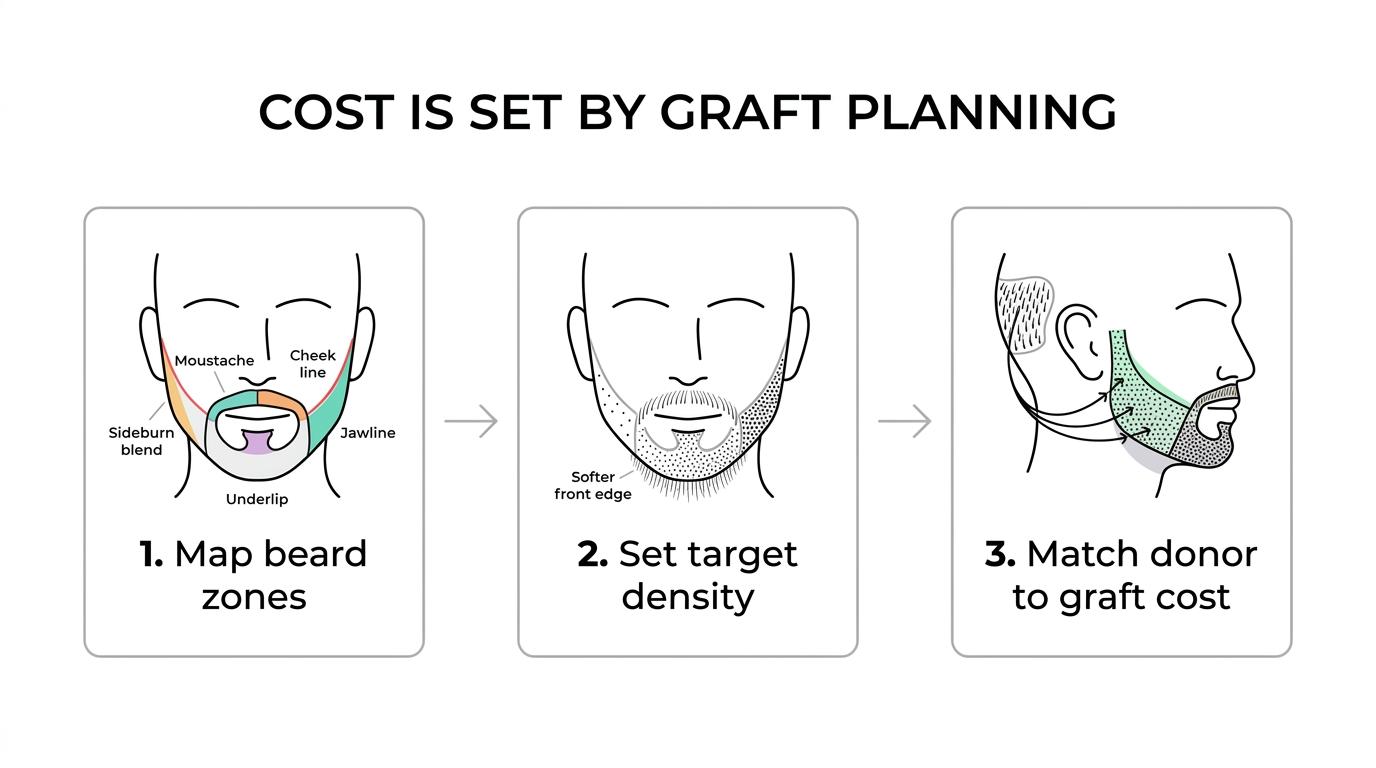
A reasonable beard graft estimate starts with mapping the beard zones, then setting a realistic density target, then checking donor limits. Cost becomes clearer only after those three steps are matched.
The first step is area mapping. A clinic should separate the moustache, goatee, cheek line, jawline, sideburn blend, and underlip region instead of treating “the beard” as one block. Different zones need different hair direction and spacing.
The second step is density planning. A natural-looking beard usually depends on selective placement rather than maximum packing everywhere. A sharp edge that looks good on day one can look harsh later if the hairs are too thick or too uniform. That is why the front boundary often uses finer single-hair grafts.
The third step is donor assessment. If donor hair is limited, the clinic may need to prioritize the most visible beard zones first. If donor supply is strong, then fuller coverage becomes more realistic. This is where cost and design meet.
After that assessment, the treatment plan often breaks down like this:
- Moustache and goatee: usually the highest visual priority for facial framing.
- Cheek line and sideburn blend: critical for natural transition and symmetry.
- Jawline and underlip: often adjusted based on styling preference and donor reserve.
A practical tip is to ask whether the quote is built for first-pass coverage or final-density work. Those are different goals, and confusing them leads to bad cost comparisons.
How do FUE and FUT compare for beard transplant scars and cost?
FUE and FUT differ most in scar pattern. ISHRS states that strip harvesting leaves a linear scar, while follicular unit extraction creates diffusely distributed extraction scars rather than one line.
For beard transplant patients, that distinction matters because scar visibility is not only about size. It is also about location, skin tone, hairstyle, and whether the donor area is shaved short. FUE is often preferred when a patient wants to avoid a linear scar, though “tiny dot scars” does not mean “no scars.”
ISHRS also notes that hypopigmentation, or lightening, is common in extraction scars, especially in dark skin. That is a major point for Indian patients. If facial donor extraction is being considered, the under-jaw area is often favored to keep visible facial zones less affected. A patient should ask where the donor hair will come from and where any extraction marks may show.
The cost trade-off is straightforward. If a method requires more time, more individual extraction work, or more scar management planning, the quote may rise. The cheaper method is not automatically the better value if the scar pattern conflicts with grooming habits.
What does the beard transplant growth timeline look like step by step?
Beard transplant growth usually follows a delayed timeline: healing first, shedding next, visible regrowth around 3 months, and a more final cosmetic result by 12 to 18 months. ASPS gives that general timing for transplanted hair growth.
In the first days after the procedure, the focus is graft stability and skin recovery. Tiny crusts and short stubble are expected. That early look is not the final beard.
During the first several weeks, some transplanted hairs may shed. That phase often alarms patients, but it is a common part of the cycle. The follicles remain under the skin even when the shafts fall out.
By around month three, new growth usually starts to appear. Thickness, curl behavior, and direction become easier to judge over the following months. Full cosmetic blending takes time because not every follicle enters active growth at the exact same moment.
A common misconception is that poor density at 8 to 10 weeks means failure. It usually means the case is still in the expected waiting phase.
How does a beard transplant compare with PRP, micropigmentation, or non-surgical beard fillers?
A beard transplant adds real follicles, while PRP, micropigmentation, and cosmetic fillers address different problems. They are not direct substitutes.
PRP or growth-factor based therapy may support existing weak hair in selected cases, but it does not create new beard follicles where none exist. Micropigmentation can add the look of shadow or stubble, but it does not produce actual growing hair. Cosmetic beard fillers or camouflage products can improve appearance temporarily, but they wash off or wear off.
That means the right comparison is based on the goal. If the goal is actual beard hair growth in patchy or empty areas, transplant is the only option in this group that physically relocates follicles. If the goal is only a darker visual outline, a non-surgical option may be enough and often costs less upfront.
The trade-off is commitment. Transplant involves donor use, recovery time, and scar considerations. Non-surgical options avoid surgery, but they also do not offer the same biological result.
How should a patient compare clinics and quotes step by step?
When comparing clinics, iGraft and other Indian hair restoration providers should be judged on whether the quote explains graft count, donor source, and beard design clearly. A lower number without those details is not a true comparison.
Step one is to normalize the quote. A patient should ask whether the price is per graft, per follicle, or per session, and whether local anesthesia, planning, and follow-up are included. If one clinic quotes a package and another quotes per graft, the numbers are not yet comparable.
Step two is to compare the beard plan, not just the bill. A clinic should state which zones are being restored, what density level is being targeted, and whether the edges will use one-hair grafts. That last point matters because beard borders can look unnatural if multi-hair grafts dominate the front line.
Step three is to compare scar strategy and aftercare. The clinic should explain the donor method, expected extraction marks, recovery timeline, and what happens if donor hair is weaker than expected on the day of surgery.
A useful checklist includes these points:
- Technique stated: FUE, FUT, or another clearly defined harvesting method.
- Graft logic: exact or estimated graft count tied to beard zones.
- Donor discussion: scalp donor, beard donor, or mixed strategy.
- Result timeline: when shedding, regrowth, and final review are expected.
- Scar disclosure: distributed extraction marks versus a linear scar.
This is especially useful when comparing beard transplant cost across Pune, Hyderabad, Bangalore, or other Indian cities. If the comparison is not normalized to the same graft assumptions, the cheapest quote may simply be the least complete plan.
Can beard hair be used as donor hair, and why does that matter?
Beard hair can be used as donor hair in restoration work, and PubMed data shows it can survive well when selected appropriately. In one comparative study, beard graft survival was reported at 95% at 1 year.
That study compared scalp, beard, and chest hair used in scalp restoration and found beard hair had lower anagen effluvium in the first 2 months than the other donor sources studied. Reported early shedding was 30% for beard hair, versus 40% for scalp hair and 53.3% for chest hair. The broader takeaway was that non-scalp hair can be an excellent donor source in the right case.
Why does that matter for beard transplant cost? Because donor availability is one of the main limiters in any transplant plan. If a patient has poor scalp donor reserve, limited facial patchiness, or needs a repair strategy elsewhere, the surgeon’s donor options affect both design and price.
The misconception to avoid is treating a published survival figure as a guarantee for every patient. Survival depends on extraction quality, storage, placement, skin characteristics, and healing response.
Who is a good candidate for beard transplant, and who should wait?
A good candidate usually has stable donor hair, realistic density goals, and beard loss or sparseness that is not being caused by an active untreated condition. Patients with patchy growth, asymmetry, or beard scars are common candidates.
Candidates often include men with naturally sparse cheeks, incomplete moustache growth, beard gaps from old scars, or uneven density that affects facial balance. PubMed reports on scar alopecia also show that beard and moustache reconstruction may be considered in post-trauma or post-surgery cases when the skin is ready.
A patient may be asked to wait if the skin is inflamed, infected, or showing active disease that could affect graft take. The same applies if expectations are unrealistic. If the donor area cannot support the requested style, a staged plan is usually safer than overharvesting.
One final point matters for Indian patients with darker skin tones. Because ISHRS notes that hypopigmentation can occur around extraction scars, donor planning should include a frank discussion about where scars may show and how the patient usually grooms facial and scalp hair.