Donor Area Shock Loss After FUE: Why the Back of Your Head Thins and When It Recovers
You had follicular unit extraction. Grafts moved to the hairline. Then, two to eight weeks later, the back of your head looks thinner than the day you left the clinic. That thinning is often donor area shock loss, not proof that the hair transplant failed.
Donor shock loss is shedding of native hairs left in the harvest zone. drcaymaz.com describes it as a cycling change, usually visible in weeks 2 to 8. It is different from overharvesting and from permanent scar thinning. Fixed-length photos and a calendar help you tell those apart.
What it is, and what it is not
Recipient-area shedding is common. Most transplanted shafts fall between week 2 and week 8 while the follicle stays put. Donor-area shock loss is rarer. emrahcinik.com notes that it often shows up between two and four weeks and usually clears between three and six months. Dense extraction and heavy tumescence appear in published case series.
True frequency is still unclear. One review places donor-area shock loss around 5 to 10 percent of cases (hairdoctornyc.com). Another summary uses 5 to 15 percent, with regrowth often starting at 2 to 4 months and fuller recovery by month 6 to 8 (trusthairmedical.com). regrowmedical.com notes we still lack a solid incidence number.
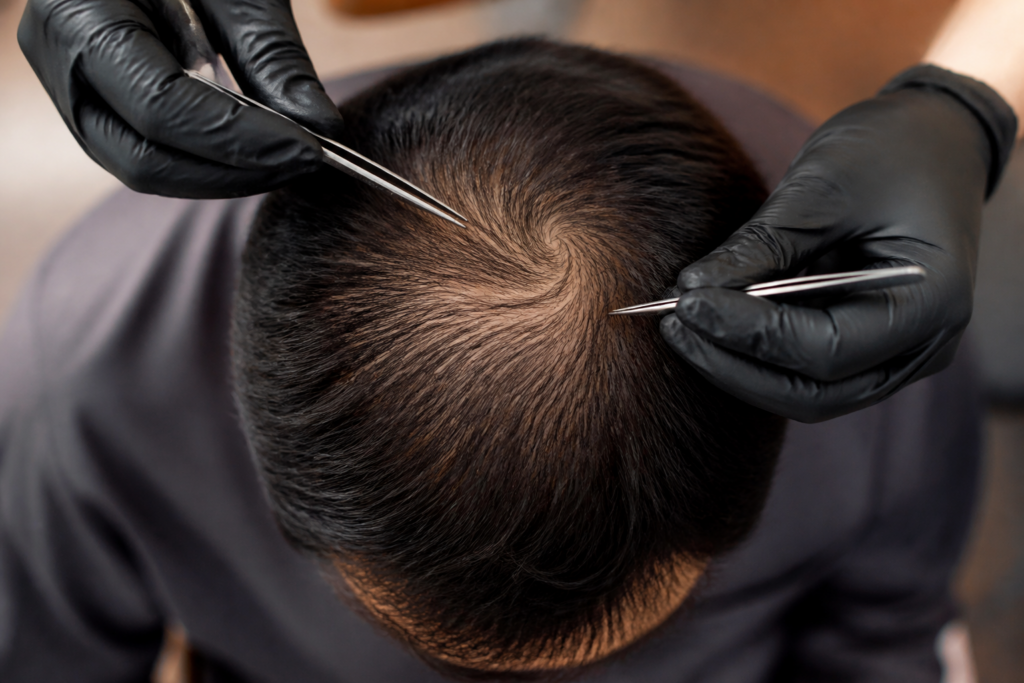
On trichoscopy the zone can look like alopecia areata, with black dots, broken hairs, and even exclamation-mark hairs. It is not alopecia areata and it is not treated as such. Timing after surgery, location in the harvested map, and spontaneous recovery usually separate the two. Biopsy, when needed, shows more telogen follicles without an inflammatory infiltrate.
Why the donor zone thins
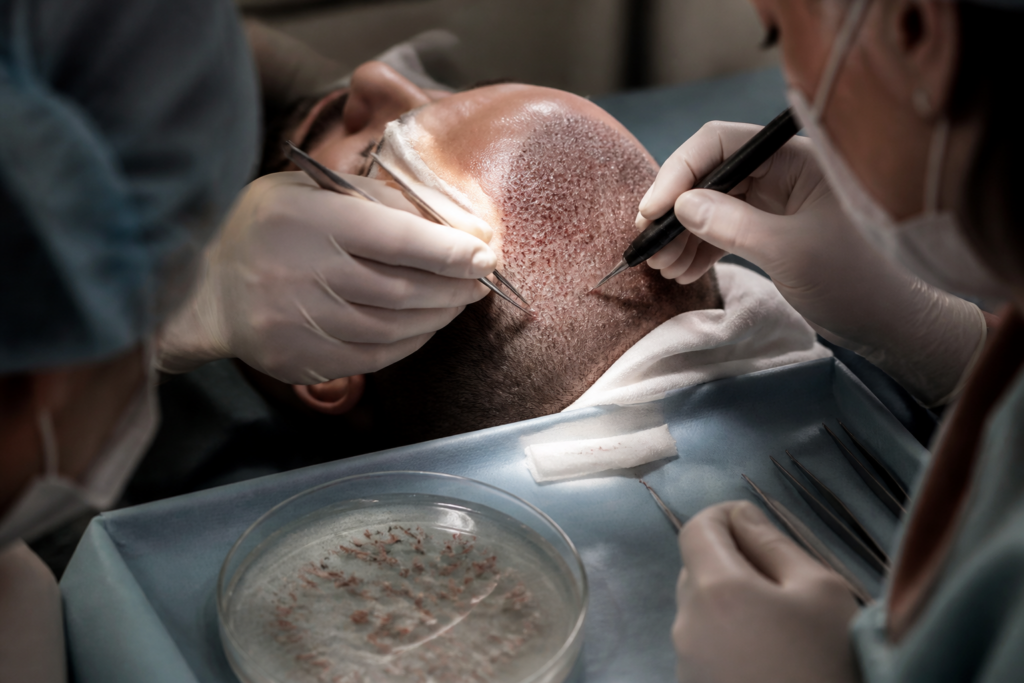
Each FUE punch disturbs tissue around the extraction. Swelling, a short drop in local blood flow, and surgical stress can push neighboring follicles into telogen. A FUT strip can do the same around a linear wound. wimpole.com reports that donor thinning is less frequent and often milder than recipient shedding, yet it still happens when remaining follicles lose some of their blood supply.
A fully removed follicular unit does not grow back from that opening. Coverage can still improve as clipped hair lengthens, unharvested hair provides more shade, and follicles that only shed temporarily resume growth. Overharvesting is a pattern or density that leaves visible depletion. It is not diagnosed from graft count alone. Once a unit is out, it is gone from the donor (hairmedico.com). Shock loss is a cycle. Overharvesting is a planning error.
Hair that was already miniaturized by DHT may not return fully. myneograftindia.com is right to say clinics skip that sentence too often.
A timeline you can check against photos
| Phase | What you typically see | What it usually means |
|---|---|---|
| Days 1 to 14 | Redness, crusts, clipped stubble | Normal healing |
| Weeks 2 to 8 | Patchy or diffuse thinning in the harvest zone | Donor shock loss window |
| Months 3 to 6 | Density starting to return | Most temporary shedding recovers |
| Months 6 to 8 | Coverage closer to baseline for remaining hair | Effluvium often settled |
| After month 6, still moth-eaten | Well-defined patches or obvious point scars at normal length | Needs exam, not more waiting |
charlesmedicalgroup.com calls donor shock loss self-resolving in the vast majority of cases. drulusan.com says recovery after FUE acute effluvium is often complete within weeks to months, and still tells patients the risk is not zero.
Call your surgeon if thinning arrives with pus, spreading redness, or fever. Shedding that starts many months later, with ongoing recession, is more likely progressive pattern loss. Sharply outlined bald spots in the donor also need a look.
How planning protects the back of your head
A proper donor assessment is not a glance from across the room. You need the loss pattern diagnosed, density at several points, hair caliber, miniaturization on trichoscopy, scar history, likely future thinning, and how short you cut your hair. Point-like FUE scars show more when you wear a fade.
That is the point of computerized, follicular-level checks at iGraft Global Hair Services in Pune, Bangalore, Hyderabad, and Vijayawada. You meet doctors in company-owned clinics, not franchisees. DFI hair restoration (DFI Ultimate) and ActiveFUE are planned around extraction spacing and a natural hairline, not a maximum punch count in one sitting. Transparent unit pricing is currently ₹45 per graft for ActiveFUE and ₹50 per follicle for Gen3 DFI Ultimate. See why per-follicle pricing beats a session fee and the pricing table.
About 30 percent of patients travel to these Indian centers, including NRIs from the USA, UK, and Australia, for mid-range, doctor-led work with 6-month follow-up. The setup is 15+ years old. If you are comparing hair transplant cost in India or hair transplant cost Bangalore, ask how the donor map was measured before you ask for a graft number.
After the acute phase, GFC hair treatment, advanced PRP therapy, exosomes for hair, and BioCell can support remaining hair. They do not replace extracted units. Continue any prescribed hair loss treatment for pattern baldness. Home remedies will not skip telogen. See about iGraft and its treatments. For time off work, read how many days off work you need after FUE. Myths about hair transplants often mix shock loss with failed grafts. They are not the same.
FAQ
Does donor hair grow back after FUE?
The harvested unit does not grow back from the original opening. Clipped shafts, unharvested hair, and follicles that only shed temporarily can restore the look of coverage.
How long does donor shock loss last?
Thinning often appears in weeks 2 to 8. Many people see return of remaining hair by months 3 to 6, sometimes up to 6 to 8.
Is it more common with FUE or FUT?
FUT can trigger telogen effluvium around a strip scar. FUE more often causes diffuse thinning if extraction density is too high. Spacing and surgeon judgment matter more than the label.
Can I diagnose overharvesting from a selfie?
Usually no. Timing, trichoscopy, baseline density, and standardized photos separate cycling from true donor damage. Ask your surgical team.
Will I still have donor for a second procedure?
If this is shock loss, remaining follicles should recover. If the zone was overharvested, reserve is permanently lower. Donor budgeting belongs in the first consult, especially with ongoing pattern loss.
Get the donor map before you book more grafts
Most donor thinning after FUE is a cycle. A smaller group is overharvesting, scarring, infection, or another scalp disease. Time and fixed-length photos sort those groups. If the back of your head still looks moth-eaten at a normal length months later, you need an exam.
Book a computerized checkup at an iGraft facility, take the 2-minute hair-loss quiz, or contact the team in Pune, Bangalore, Hyderabad, or Vijayawada. Bring surgery dates and hair-length photos. Planning for men and women starts with what the donor can safely give, then a 6-month review that treats the back of your head as part of the result.